
Time to First Token · Agnes 2.5 Pro Alpha
1879ms
Time to First Token · GPT-5 mini (high)
0ms
Deep dive into reasoning, benchmarks, and latency insights.
The current catalog does not contain complete performance evidence for both models, so this page does not declare an overall winner. Use the available fields as comparison signals and validate the models on your own workload.
Key decision metrics at a glance.
| Model | Metric | Value | Unit | Source / snapshot |
|---|---|---|---|---|
| Agnes 2.5 Pro Alpha | Reasoning | 6.0 | benchmark or capability score | Artificial Analysis · current catalog |
| GPT-5 mini (high) | Reasoning | 9.0 | benchmark or capability score | Artificial Analysis · current catalog |
| Agnes 2.5 Pro Alpha | Coding | 6.0 | benchmark or capability score | Artificial Analysis · current catalog |
| GPT-5 mini (high) | Coding | 2.0 | benchmark or capability score | Artificial Analysis · current catalog |
| Agnes 2.5 Pro Alpha | Multimodal | 3.0 | benchmark or capability score | Artificial Analysis · current catalog |
| GPT-5 mini (high) | Multimodal | 2.0 | benchmark or capability score | Artificial Analysis · current catalog |
| Agnes 2.5 Pro Alpha | Long Context | 5.0 | benchmark or capability score | Artificial Analysis · current catalog |
| GPT-5 mini (high) | Long Context | 3.0 | benchmark or capability score | Artificial Analysis · current catalog |
| Agnes 2.5 Pro Alpha | Blended Price / 1M tokens | $0.563 | USD per 1M tokens | Artificial Analysis · current catalog |
| GPT-5 mini (high) | Blended Price / 1M tokens | $0.688 | USD per 1M tokens | Artificial Analysis · current catalog |
| Agnes 2.5 Pro Alpha | P95 Latency | — | milliseconds | Artificial Analysis · current catalog |
| GPT-5 mini (high) | P95 Latency | — | milliseconds | Artificial Analysis · current catalog |
| Agnes 2.5 Pro Alpha | Tokens per second | 132.436 | tokens per second | Artificial Analysis · current catalog |
| GPT-5 mini (high) | Tokens per second | 0 | tokens per second | Artificial Analysis · current catalog |
Data provided by Artificial Analysis; live values use the current catalog.
This radar chart visually maps the core capabilities (reasoning, coding, math proxy, multimodal, long context) of `Agnes 2.5 Pro Alpha` vs `GPT-5 mini (high)`.
This grouped bar chart provides a side-by-side comparison for each benchmark metric.
Lower time to first token is better; higher tokens per second is better.
Compare input and output pricing in USD per 1M tokens.
Agnes 2.5 Pro Alpha$0.675
GPT-5 mini (high)$0.75
Agnes 2.5 Pro Alpha costs $0.075 less per run
This article is a dated snapshot published on 2026-08-07. Live cards above use the current catalog; missing live fields are not inferred.
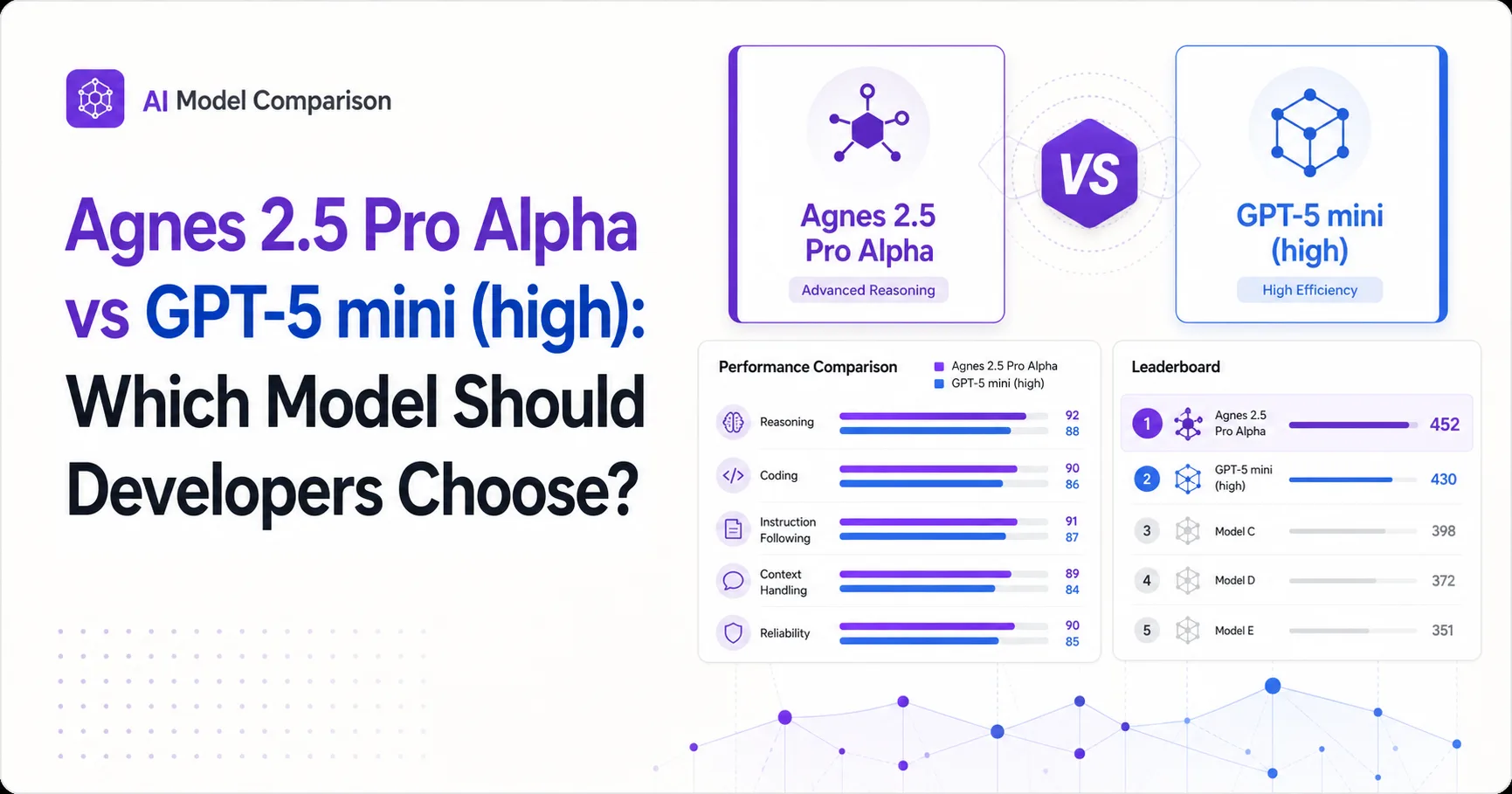
Agnes 2.5 Pro Alpha is the stronger measured developer choice, while GPT-5 mini (high) remains the safer mathematical specialist only if its identity and availability are confirmed. The comparison data gives Agnes 2.5 Pro Alpha a coding index of 58.8 versus 15.6 for GPT-5 mini (high), plus an intelligence index of 38.8 versus 25.3. GPT-5 mini (high) leads the available mathematics measurement with 90.7, while Agnes 2.5 Pro Alpha has no reported mathematics value. Agnes also has the lower blended price and a reported median output speed of 115.763 tokens per second. These results come from Artificial Analysis. Data provided by https://artificialanalysis.ai/
Agnes 2.5 Pro Alpha is the better default for coding workloads because its measured coding index is 58.8, compared with 15.6 for GPT-5 mini (high). The same dataset gives Agnes a 38.8 intelligence index, ahead of GPT-5 mini (high) at 25.3. Artificial Analysis supplies these benchmark values, but the figures do not establish how either model behaves on a developer's exact repository, language, or tool chain.
GPT-5 mini (high) has one clear measured advantage: a mathematics index of 90.7, while Agnes has no reported value. That makes GPT-5 mini (high) worth testing for symbolic reasoning, quantitative validation, and math-heavy evaluation sets. It does not prove superiority across general reasoning, because the two models are not represented on every index.
The operational comparison is less settled than the score comparison. Agnes has a reported release date of 2026-07-24, while GPT-5 mini (high) is dated 2025-08-07 in the data snapshot. However, the current OpenAI model directory does not list an independent gpt-5-mini or GPT-5 mini (high) entry. The research therefore cannot confirm whether the displayed name maps to a stable API identifier, a reasoning setting, or an older model label.
Agnes 2.5 Pro Alpha is the stronger measured coding model, but the evidence does not prove that it is the better production API for every engineering workflow. The coding-index gap is large enough to change the first test choice: Agnes scores 58.8, while GPT-5 mini (high) scores 15.6 in the supplied dataset. For code generation, refactoring, debugging, and repository navigation, that result makes Agnes the more credible starting candidate. Artificial Analysis is the source for those measurements.
The practical meaning of a benchmark gap depends on task composition. A coding score can improve the odds of useful patches, yet it cannot reveal whether a model follows local conventions, preserves tests, handles long files, or uses tools correctly. The research found no verified community testing for either model, so there is insufficient evidence about real-world failure modes, coding consistency, or user-perceived quality. Developers should treat the benchmark as a screening signal, not a deployment guarantee.
The speed result is also asymmetric. Agnes reports 115.763 median output tokens per second, while GPT-5 mini (high) has no output-speed value in the snapshot. Both models show 0.3-second latency. That means Agnes is the only model with evidence for sustained generation speed, but it does not establish a fair apples-to-apples throughput comparison. Streaming behavior, prompt length, provider routing, and rate limits remain unverified.
GPT-5 mini (high) deserves a separate mathematics test because its math index is 90.7. Agnes has no mathematics measurement, so the data cannot determine whether Agnes is competitive on quantitative tasks. The best conclusion is workload-specific: Agnes leads the measured coding evidence, while GPT-5 mini (high) has the stronger measured mathematics signal.
Agnes 2.5 Pro Alpha is cheaper on the supplied blended-token basis, but GPT-5 mini (high) can be cheaper for input-heavy workloads. The blended price is $0.5625 per 1M tokens for Agnes and $0.6875 for GPT-5 mini (high), according to Artificial Analysis. That supports Agnes for mixed workloads where input and output follow the dataset's 3-to-1 blend.
The token mix changes the decision. GPT-5 mini (high) costs $0.25 per 1M input tokens, compared with Agnes at $0.45. Agnes costs $0.9 per 1M output tokens, compared with GPT-5 mini (high) at $2. If an application repeatedly sends large prompts and receives short answers, GPT-5 mini (high) may be cheaper despite its higher blended figure. If the application generates substantial code, explanations, or structured output, Agnes's lower output price becomes more important.
The data does not provide usage forecasts, batch pricing, flex pricing, fast-mode pricing, or provider-specific fees. It also does not establish whether either displayed model is currently callable under a stable commercial contract. The OpenAI pricing page does not list gpt-5-mini in the supplied research, so GPT-5 mini (high)'s current official price cannot be independently confirmed. Agnes has no verified pricing page either.
Cost should therefore be evaluated in two stages. First, use the supplied blended numbers to prioritize Agnes for general development experiments. Then measure your actual input-to-output ratio and verify live billing before committing. A low token price does not compensate for retries, failed patches, manual review, or unavailable endpoints.
Agnes 2.5 Pro Alpha leads on 2 of 3 metrics
Agnes 2.5 Pro Alpha is the recommended first candidate for general coding, while GPT-5 mini (high) should remain a targeted mathematics experiment until its API identity is verified. Agnes leads the supplied coding index at 58.8 versus 15.6 and leads the intelligence index at 38.8 versus 25.3. It also has the lower blended price at $0.5625 per 1M tokens and the only reported output-speed measurement, 115.763 median output tokens per second. These figures are from Artificial Analysis.
Choose Agnes first when the product is an engineering assistant, code review tool, patch generator, documentation helper, or repository automation service. The recommendation is strongest when output volume matters, because Agnes's output price is $0.9 per 1M tokens versus $2 for GPT-5 mini (high). Developers still need a small task-based evaluation before production adoption because the research contains no verified community reports or failure examples.
Choose GPT-5 mini (high) when mathematics is central to the product and the endpoint is available under a confirmed model identifier. Its mathematics index is 90.7, and Agnes has no corresponding measurement. GPT-5 mini (high) may also fit input-heavy workflows because its input price is $0.25 per 1M tokens versus Agnes at $0.45. Those advantages do not establish overall coding quality or current availability.
The largest selection risk is not a score. The current OpenAI model directory does not independently list gpt-5-mini or GPT-5 mini (high), and the research found no official Agnes product page, documentation, or pricing page. Confirm endpoint names, access rights, retention terms, limits, and billing before building a dependency. The evidence supports a ranked experiment, not a final procurement decision.
Agnes 2.5 Pro Alpha is the better starting point for most coding evaluations, but unresolved availability evidence makes endpoint verification part of the selection process. The supplied research found no verified official documentation, product page, or community testing for Agnes. It also found no current official directory entry for GPT-5 mini (high). OpenAI Models and OpenAI Pricing are the relevant official pages cited in the research. The benchmark data remains useful for prioritization, yet developers should validate the exact API model, workload behavior, and billing before relying on either model in production.
Agnes 2.5 Pro Alpha is the better measured coding choice because its coding index is 58.8 versus 15.6 for GPT-5 mini (high), although repository-specific testing remains necessary before production use.
Agnes 2.5 Pro Alpha is cheaper on the supplied blended basis at $0.5625 per 1M tokens, but GPT-5 mini (high) has cheaper input tokens at $0.25 per 1M tokens.
GPT-5 mini (high) is the only model with a reported mathematics index, scoring 90.7, while Agnes 2.5 Pro Alpha has no mathematics value, so the comparison is incomplete.
The supplied research cannot confirm current availability because the OpenAI model directory does not list gpt-5-mini or GPT-5 mini (high) as an independent entry.
Developers should treat the speed comparison cautiously because Agnes reports 115.763 median output tokens per second, GPT-5 mini (high) has no speed value, and both show 0.3-second latency.