
Time to First Token · Claude 4.1 Opus (Reasoning)
0ms
Time to First Token · GPT-5 (medium)
0ms
Deep dive into reasoning, benchmarks, and latency insights.
The current catalog does not contain complete performance evidence for both models, so this page does not declare an overall winner. Use the available fields as comparison signals and validate the models on your own workload.
Key decision metrics at a glance.
| Model | Metric | Value | Unit | Source / snapshot |
|---|---|---|---|---|
| Claude 4.1 Opus (Reasoning) | Reasoning | 8.0 | benchmark or capability score | Artificial Analysis · current catalog |
| GPT-5 (medium) | Reasoning | 9.0 | benchmark or capability score | Artificial Analysis · current catalog |
| Claude 4.1 Opus (Reasoning) | Coding | 6.0 | benchmark or capability score | Artificial Analysis · current catalog |
| GPT-5 (medium) | Coding | 6.0 | benchmark or capability score | Artificial Analysis · current catalog |
| Claude 4.1 Opus (Reasoning) | Multimodal | 3.0 | benchmark or capability score | Artificial Analysis · current catalog |
| GPT-5 (medium) | Multimodal | 3.0 | benchmark or capability score | Artificial Analysis · current catalog |
| Claude 4.1 Opus (Reasoning) | Long Context | 4.0 | benchmark or capability score | Artificial Analysis · current catalog |
| GPT-5 (medium) | Long Context | 4.0 | benchmark or capability score | Artificial Analysis · current catalog |
| Claude 4.1 Opus (Reasoning) | Blended Price / 1M tokens | $30 | USD per 1M tokens | Artificial Analysis · current catalog |
| GPT-5 (medium) | Blended Price / 1M tokens | $3.438 | USD per 1M tokens | Artificial Analysis · current catalog |
| Claude 4.1 Opus (Reasoning) | P95 Latency | — | milliseconds | Artificial Analysis · current catalog |
| GPT-5 (medium) | P95 Latency | — | milliseconds | Artificial Analysis · current catalog |
| Claude 4.1 Opus (Reasoning) | Tokens per second | 0 | tokens per second | Artificial Analysis · current catalog |
| GPT-5 (medium) | Tokens per second | 0 | tokens per second | Artificial Analysis · current catalog |
Data provided by Artificial Analysis; live values use the current catalog.
This radar chart visually maps the core capabilities (reasoning, coding, math proxy, multimodal, long context) of `Claude 4.1 Opus (Reasoning)` vs `GPT-5 (medium)`.
This grouped bar chart provides a side-by-side comparison for each benchmark metric.
Lower time to first token is better; higher tokens per second is better.
Compare input and output pricing in USD per 1M tokens.
Claude 4.1 Opus (Reasoning)$33.75
GPT-5 (medium)$3.75
GPT-5 (medium) costs $30 less per run
This article is a dated snapshot published on 2026-08-07. Live cards above use the current catalog; missing live fields are not inferred.
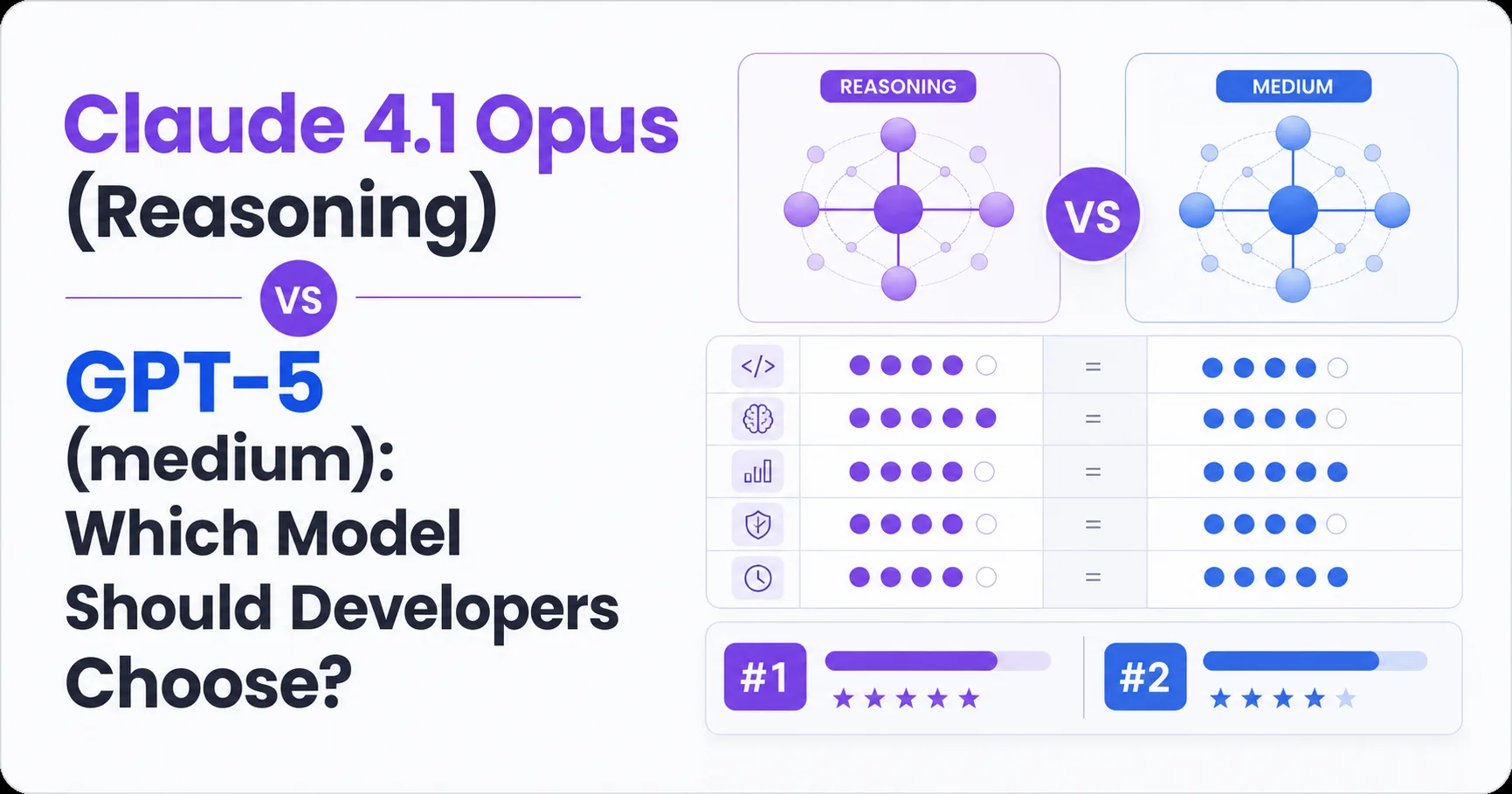
GPT-5 (medium) is the stronger default for developers because the available benchmark data gives it the same 33.7 Intelligence Index, a higher 91.7 Math Index, and a much lower blended price of $3.4375 per 1M tokens. Claude 4.1 Opus (Reasoning) remains relevant for teams that already have an approved Bedrock or Google Cloud deployment path, but its official availability is narrower than the comparison dataset suggests. The dataset identifies Claude 4.1 Opus (Reasoning) with a 2025-08-05 release date and GPT-5 (medium) with a 2025-08-07 release date. Those dates describe the supplied comparison snapshot, not necessarily current production availability. Data provided by https://artificialanalysis.ai/ Anthropic’s current documentation lists Claude Opus 4.1 as retired, with Bedrock and Google Cloud exceptions. Claude pricing OpenAI’s current model catalog does not list gpt-5-medium, so the dataset’s performance and pricing values should be treated as comparison evidence rather than a complete deployment guarantee. OpenAI Models
GPT-5 (medium) offers the better measured trade-off, while Claude 4.1 Opus (Reasoning) offers a narrower but potentially useful provider-specific option. The supplied data shows an Intelligence Index tie at 33.7, so the comparison does not support claiming a general reasoning winner. The Math Index separates the models more clearly: GPT-5 (medium) scores 91.7, while Claude 4.1 Opus (Reasoning) scores 80.3. That gap makes GPT-5 (medium) the more defensible choice for workloads containing mathematical verification, quantitative transformation, or structured numerical reasoning. Data provided by https://artificialanalysis.ai/
GPT-5 (medium) also has the lower listed cost across the supplied price dimensions. Its input price is $1.25 per 1M tokens and its output price is $10, compared with Claude’s $15 input and $75 output prices. The blended comparison favors GPT-5 (medium) at $3.4375 versus Claude at $30. These values do not establish total application cost because actual spend depends on prompt shape, output length, retries, caching, and provider fees.
Availability changes the practical result. Anthropic explicitly marks Claude Opus 4.1 as retired, except for Bedrock and Google Cloud. Claude pricing OpenAI’s supplied documentation does not list GPT-5 (medium), and the pricing page does not provide a current price for it. OpenAI API Pricing The evidence therefore supports GPT-5 (medium) on measured value, but not a fully verified production integration decision.
GPT-5 (medium) is the measured performance choice for math-heavy developer workflows, while neither model has enough public evidence here to support claims about coding style, tool use, or long-context behavior. The supplied benchmark gives GPT-5 (medium) a Math Index of 91.7 against Claude 4.1 Opus (Reasoning) at 80.3. That difference matters when an application must preserve numerical relationships across several steps, validate formulas, classify quantitative errors, or produce answers that can be checked mechanically. It does not prove that GPT-5 (medium) is better at every programming task.
The Intelligence Index is tied at 33.7 for both models. Developers should read that tie as a limit on the conclusion. The data does not justify a broad statement that one model is generally more intelligent, more capable, or more reliable. Data provided by https://artificialanalysis.ai/ A benchmark index also cannot answer whether either model follows repository conventions, edits files safely, selects tools correctly, or recovers from failed commands.
Latency is tied at 0.3 seconds in the supplied snapshot. Neither model has a reported median output speed, so the data cannot establish which model streams tokens faster after the initial response. The practical winner can therefore change if your application is dominated by output generation, provider queueing, regional routing, or tool-call duration.
The official evidence is incomplete for both entries. Anthropic’s model overview does not separately document Claude 4.1 Opus (Reasoning), its slug, context window, output limit, or model-specific benchmarks. Claude models overview OpenAI’s model page likewise does not document gpt-5-medium specifically. OpenAI Models Evidence is insufficient for a confident claim about context capacity, maximum output, reasoning controls, or failure modes.
GPT-5 (medium) leads on 2 of 2 metrics
GPT-5 (medium) is the lower-cost option on every supplied token price, but Claude 4.1 Opus (Reasoning) can still be rational when migration or platform constraints dominate the bill. Claude is listed at $15 per 1M input tokens and $75 per 1M output tokens. GPT-5 (medium) is listed at $1.25 input and $10 output. The blended figures are $30 for Claude and $3.4375 for GPT-5 (medium). Data provided by https://artificialanalysis.ai/
The most important practical implication is output sensitivity. An application that generates long code patches, extensive explanations, or repeated structured responses pays more for Claude’s output tokens. An application that sends large shared instructions pays more for Claude’s input tokens as well. The exact cost advantage depends on the traffic mix, and the supplied data does not provide request volume, output distribution, cache hit rate, or retry frequency.
Claude’s pricing page also lists prompt caching at $18.75 per 1M tokens for a five-minute cache write, $30 per 1M tokens for a one-hour cache write, and $1.50 per 1M tokens for cache hits and refreshes. Claude pricing Caching can change the economics for stable, repeated context, but the available material does not state whether the comparison’s blended figure includes caching. It also does not give an equivalent GPT-5 (medium) caching configuration.
A cheaper token price can become a more expensive system if the model needs more retries, produces unusable patches, or requires extra validation calls. The research brief contains no reliable community tests for either model, so evidence is insufficient to quantify those operational costs. Teams should measure successful task completion cost, not token price alone.
GPT-5 (medium) leads on 3 of 3 metrics
GPT-5 (medium) is the recommended first candidate for new developer workloads, provided an accessible endpoint and current contract can be verified before implementation. Its supplied benchmark profile combines a 33.7 Intelligence Index, a 91.7 Math Index, a 0.3-second latency, and a $3.4375 blended price. Data provided by https://artificialanalysis.ai/ That combination makes it the sensible default for quantitative coding assistants, test generation with numerical assertions, data transformation, and cost-sensitive automation.
Claude 4.1 Opus (Reasoning) is the better shortlist candidate when the organization already standardizes on Amazon Bedrock or Google Cloud and has a specific reason to retain Anthropic infrastructure. Anthropic’s pricing page states that Claude Opus 4.1 is retired, with Bedrock and Google Cloud exceptions. Claude pricing That channel restriction should be treated as a procurement and continuity concern, not merely a model preference.
Teams should not select Claude because the available evidence proves superior general reasoning. The Intelligence Index is tied at 33.7, and the research brief provides no verified community evidence about coding quality, speed perception, tool calling, or failure recovery. Teams should also avoid selecting GPT-5 (medium) solely because the dataset includes a price. OpenAI’s current model catalog does not list gpt-5-medium, and its pricing page does not list a corresponding current price. OpenAI Models OpenAI API Pricing
The final decision should pass an access check, a representative task set, and a successful-output cost test. Evidence is insufficient to rank either model for context-window-heavy applications because the supplied official pages do not confirm model-specific context limits. Claude models overview
GPT-5 (medium) is the safer starting point for a new evaluation because its supplied benchmark and pricing profile is stronger, although its current official availability remains unverified. OpenAI Models OpenAI API Pricing
Claude 4.1 Opus (Reasoning) is not a broadly available Anthropic API choice according to the supplied official pricing page, which marks Claude Opus 4.1 as retired with Bedrock and Google Cloud exceptions. Claude pricing
GPT-5 (medium) is the better measured option for mathematical reasoning because its Artificial Analysis Math Index is 91.7, compared with 80.3 for Claude 4.1 Opus (Reasoning). Data provided by https://artificialanalysis.ai/
Claude 4.1 Opus (Reasoning) is not proven to be better for coding, long-context work, or tool use because the supplied research found no reliable, methodologically clear community evaluations for those tasks. Claude models overview
Neither model has a demonstrated latency advantage in the supplied snapshot because each is listed at 0.3 seconds, and neither has a reported median output speed. Data provided by https://artificialanalysis.ai/
GPT-5 (medium) is the stronger default because it matches Claude at 33.7 on the Intelligence Index, scores 91.7 on the Math Index, and has a $3.4375 blended price.
Claude 4.1 Opus (Reasoning) is not broadly available through Anthropic’s API according to the supplied pricing page, which marks Claude Opus 4.1 retired except for Bedrock and Google Cloud.
GPT-5 (medium) is better supported by the supplied evidence for mathematical tasks because its Math Index is 91.7, compared with 80.3 for Claude 4.1 Opus (Reasoning).
Claude 4.1 Opus (Reasoning) and GPT-5 (medium) are tied at 0.3 seconds for the supplied latency measure, while neither model has a reported median output speed.
This comparison cannot prove a coding winner because the research brief contains no reliable, reproducible community tests for coding quality, repository edits, tool calls, or failure recovery.