
Time to First Token · Claude 4.1 Opus (Reasoning)
0ms
Time to First Token · o3
7185ms
Deep dive into reasoning, benchmarks, and latency insights.
The current catalog does not contain complete performance evidence for both models, so this page does not declare an overall winner. Use the available fields as comparison signals and validate the models on your own workload.
Key decision metrics at a glance.
| Model | Metric | Value | Unit | Source / snapshot |
|---|---|---|---|---|
| Claude 4.1 Opus (Reasoning) | Reasoning | 8.0 | benchmark or capability score | Artificial Analysis · current catalog |
| o3 | Reasoning | 9.0 | benchmark or capability score | Artificial Analysis · current catalog |
| Claude 4.1 Opus (Reasoning) | Coding | 6.0 | benchmark or capability score | Artificial Analysis · current catalog |
| o3 | Coding | 6.0 | benchmark or capability score | Artificial Analysis · current catalog |
| Claude 4.1 Opus (Reasoning) | Multimodal | 3.0 | benchmark or capability score | Artificial Analysis · current catalog |
| o3 | Multimodal | 3.0 | benchmark or capability score | Artificial Analysis · current catalog |
| Claude 4.1 Opus (Reasoning) | Long Context | 4.0 | benchmark or capability score | Artificial Analysis · current catalog |
| o3 | Long Context | 4.0 | benchmark or capability score | Artificial Analysis · current catalog |
| Claude 4.1 Opus (Reasoning) | Blended Price / 1M tokens | $30 | USD per 1M tokens | Artificial Analysis · current catalog |
| o3 | Blended Price / 1M tokens | $3.5 | USD per 1M tokens | Artificial Analysis · current catalog |
| Claude 4.1 Opus (Reasoning) | P95 Latency | — | milliseconds | Artificial Analysis · current catalog |
| o3 | P95 Latency | — | milliseconds | Artificial Analysis · current catalog |
| Claude 4.1 Opus (Reasoning) | Tokens per second | 0 | tokens per second | Artificial Analysis · current catalog |
| o3 | Tokens per second | 119.185 | tokens per second | Artificial Analysis · current catalog |
Data provided by Artificial Analysis; live values use the current catalog.
This radar chart visually maps the core capabilities (reasoning, coding, math proxy, multimodal, long context) of `Claude 4.1 Opus (Reasoning)` vs `o3`.
This grouped bar chart provides a side-by-side comparison for each benchmark metric.
Lower time to first token is better; higher tokens per second is better.
Compare input and output pricing in USD per 1M tokens.
Claude 4.1 Opus (Reasoning)$33.75
o3$4
o3 costs $29.75 less per run
This article is a dated snapshot published on 2026-08-07. Live cards above use the current catalog; missing live fields are not inferred.
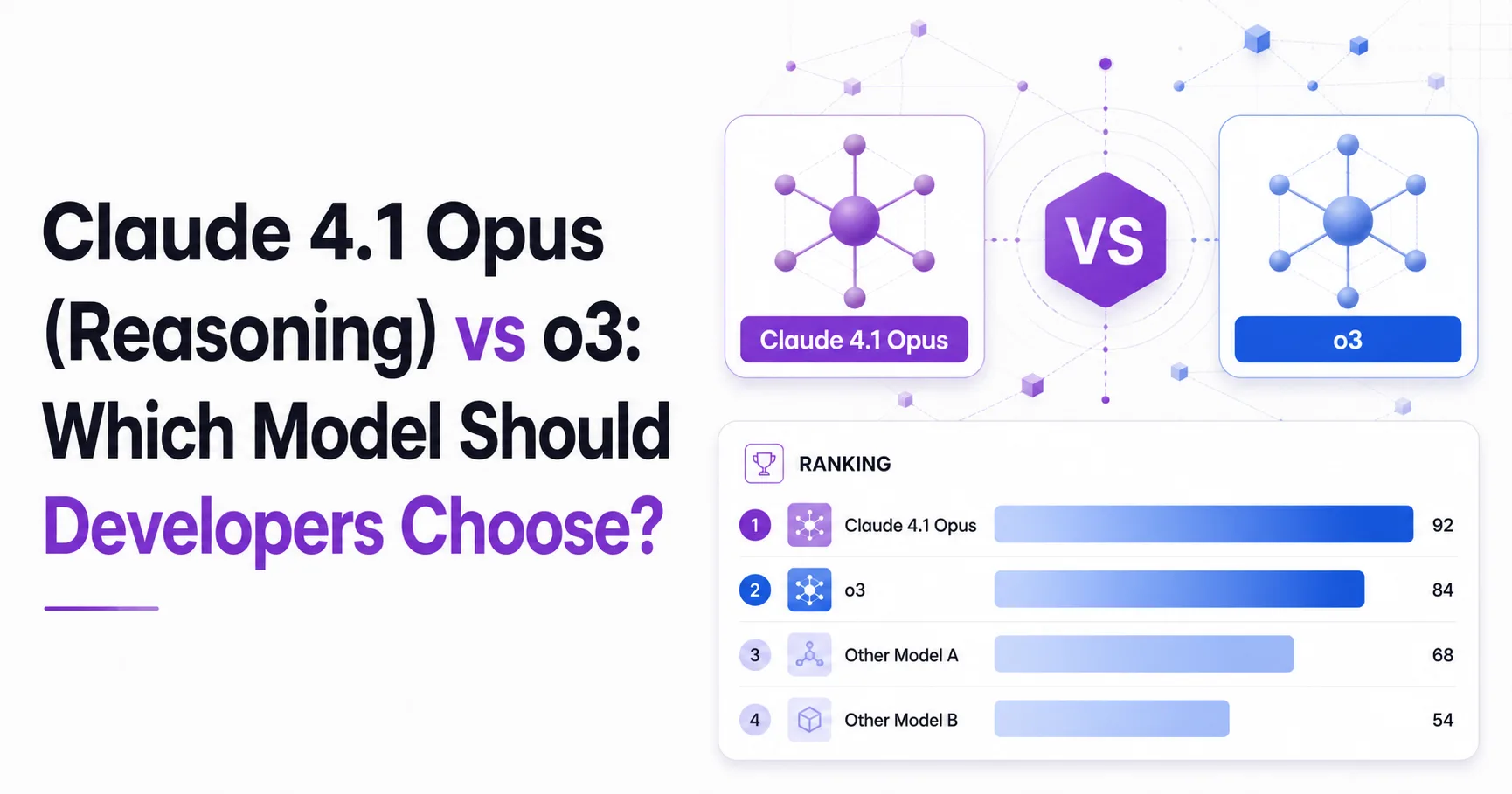
Claude 4.1 Opus (Reasoning) leads the available general intelligence score, while o3 combines stronger mathematics, known output speed, and dramatically lower measured cost. The comparison therefore depends on whether your application values broad capability or economical reasoning throughput.
The evidence is uneven. Artificial Analysis provides comparable evaluation and pricing data, but the supplied official documentation does not fully confirm current model availability, stable aliases, context windows, or model-specific capabilities. Anthropic’s pricing page lists Claude Opus 4.1 as retired, with Bedrock and Google Cloud exceptions, while OpenAI’s current model directory does not list o3. Anthropic’s pricing documentation and OpenAI’s model directory should therefore be checked before implementation.
Data provided by https://artificialanalysis.ai/
Claude 4.1 Opus (Reasoning) is the broader-score leader, but o3 is the more practical default for cost-sensitive developer workloads. Artificial Analysis records Claude at 33.7 on its Intelligence Index and o3 at 30.4. That advantage does not extend to the Math Index, where o3 scores 88.3 and Claude scores 80.3.
The most important selection signal is the size of the cost gap. Claude’s blended price is $30 per 1M tokens, compared with $3.5 for o3. Claude also costs $15 per 1M input tokens and $75 per 1M output tokens, versus $2 and $8 for o3. Those prices make repeated retries, long generated answers, and agentic loops much more expensive with Claude.
The operational picture is less settled. Artificial Analysis reports 0.3-second latency for each model, but only o3 has a reported median output speed, at 128.056 tokens per second. Missing speed data for Claude is not evidence that Claude is slower. It means the supplied comparison cannot establish a speed winner from throughput.
Availability creates a separate risk. Anthropic’s official pricing page marks Claude Opus 4.1 as retired except for Bedrock and Google Cloud. Anthropic’s model overview does not independently confirm the supplied name, slug, API ID, or stable alias. OpenAI’s current model directory does not list o3, and the current pricing page does not provide an o3 price. The measured data is useful for comparative testing, but it is not a deployment guarantee.
Claude 4.1 Opus (Reasoning) has the higher measured general intelligence score, while o3 has the clearer advantage for mathematics and reported generation throughput. The Intelligence Index favors Claude at 33.7 versus 30.4 for o3. The Math Index reverses the result, with o3 at 88.3 versus Claude at 80.3.
That pattern matters for developers because “reasoning quality” is not one workload. A planning agent that must interpret ambiguous requirements, maintain a coherent solution strategy, and make cross-domain judgments may benefit from Claude’s higher general index. A system that solves formal problems, checks quantitative transformations, or generates mathematically constrained outputs may fit o3 better because its Math Index is higher.
The score gap should not be treated as a universal ranking. The supplied brief does not identify the benchmark tasks, prompt mix, sample size, or error categories behind either index. It also contains no reliable community tests for coding experience, tool use, long-context behavior, or failure modes. A developer choosing between these models should therefore validate representative repository tasks, structured outputs, tool calls, and refusal behavior before treating the index result as production evidence.
Speed evidence is asymmetric. Both models have a reported latency of 0.3 seconds, so the supplied data does not distinguish their initial responsiveness. o3 additionally has a median output speed of 128.056 tokens per second. Claude has no reported value in the data brief. That missing value prevents a fair throughput comparison, especially for applications where generated output dominates total request time.
The official documentation also leaves important capability questions open. Anthropic’s current overview describes current Claude models as supporting text and image input, text output, multilingual ability, and vision, but the brief says that wording does not specifically confirm Claude Opus 4.1. OpenAI’s supplied documentation does not provide o3-specific context, output, parameter, or multimodal details. Anthropic’s overview and OpenAI’s model documentation therefore support caution, not a complete capability verdict.
o3 is the clear price choice for workloads that generate or retry frequently, while Claude can become rational only when its broader measured score produces enough task-quality savings. The chart shows o3 at $3.5 per 1M blended tokens against Claude at $30. Input pricing is $2 for o3 versus $15 for Claude, and output pricing is $8 versus $75.
The practical consequence is larger than a simple invoice comparison. Developer agents often repeat context, request revised plans, call tools, and produce multi-step answers. High output pricing makes verbose generations particularly costly on Claude. High input pricing also matters when every turn resends repository instructions, specifications, logs, or retrieved documents. A cheaper model can be more expensive in practice if it needs substantially more retries, manual review, or downstream repair, but the brief provides no retry-rate or task-success data to measure that tradeoff.
Claude’s prompt caching terms add another condition. The supplied official pricing material lists cache-write prices of $18.75 per 1M tokens for 5-minute caching and $30 per 1M tokens for 1-hour caching, with cache hits and refreshes at $1.50 per 1M tokens. Those options may improve repeated-context economics, but the brief does not provide a workload mix that shows when caching offsets Claude’s standard rates.
Pricing availability is itself uncertain for o3. OpenAI’s current pricing page does not list o3, so the Artificial Analysis price should be treated as comparison data rather than a confirmed current quote. OpenAI pricing documentation does not resolve that gap. Claude’s listed price is clearer in the supplied official material, but its retirement status limits where that price can be used.
o3 leads on 3 of 3 metrics
o3 is the recommended starting point for most new developer systems, while Claude 4.1 Opus (Reasoning) is a targeted choice for teams that can access it through an approved cloud route and value broader measured intelligence. o3 has the lower blended price, the higher Math Index, and the only reported median output speed. Those advantages reduce the risk of expensive experimentation and make o3 easier to test across many prompts.
Choose o3 first for mathematical reasoning, code-generation pipelines with frequent iterations, batch evaluation, and agent loops where token volume controls operating cost. Its 88.3 Math Index and $3.5 blended price support that recommendation. The recommendation still needs an availability check because the supplied OpenAI model directory does not list o3, and the supplied pricing page does not confirm its current rate.
Choose Claude 4.1 Opus (Reasoning) when your evaluation emphasizes broad problem solving, ambiguous specifications, or cross-domain planning. Its 33.7 Intelligence Index leads o3’s 30.4. The choice is defensible only if your deployment path is real and stable. Anthropic’s official pricing page marks Claude Opus 4.1 as retired except for Bedrock and Google Cloud, and the official overview does not confirm the supplied model name or slug. Anthropic pricing is the key operational source.
Do not select either model solely from the supplied benchmark snapshot for coding quality, context handling, tool use, or failure behavior. The research brief explicitly found no reliable community evaluations with verifiable methods for either model. It also found no model-specific official limitations for either system. The evidence is sufficient to rank measured scores and listed costs, but insufficient to predict production reliability.
A sensible evaluation gate is task-based: test the same representative prompts, record successful completion and repair effort, then include real input and output token distributions. Compare the result against the published prices and verify the available API channel immediately before launch. That process is necessary because current documentation visibility differs from the benchmark snapshot.
Claude 4.1 Opus (Reasoning) is not the safest default if deployment availability is a hard requirement. Anthropic’s pricing page marks Claude Opus 4.1 as retired except for Bedrock and Google Cloud, while the supplied overview does not confirm the exact supplied model identifier. Anthropic’s model overview should be checked alongside the target cloud provider’s catalog.
o3 is not fully confirmed as a current direct API choice by the supplied official sources. OpenAI’s current model directory does not list o3, and its pricing page does not show an o3 price. Developers should verify endpoint access, model naming, and billing before committing architecture.
The evidence does not establish which model is better at coding. The supplied brief contains no reliable, methodologically documented community tests and no model-specific official coding benchmark. Artificial Analysis’s Intelligence Index may inform screening, but repository-level evaluation remains necessary.
The evidence does not establish that Claude is slower. Both models have 0.3-second latency in the data brief, but only o3 has a reported median output speed of 128.056 tokens per second. Claude’s missing throughput value prevents a direct output-speed comparison.
Claude 4.1 Opus (Reasoning) has the higher available general intelligence score, at 33.7 versus 30.4 for o3, but the supplied evidence does not prove superior coding, planning, or production reliability.
o3 is cheaper in the supplied comparison, at $3.5 per 1M blended tokens versus $30 for Claude 4.1 Opus (Reasoning), with lower input and output prices as well.
o3 is the stronger mathematical choice in the supplied data, scoring 88.3 on the Math Index versus 80.3 for Claude 4.1 Opus (Reasoning), although task-specific validation is still required.
Claude 4.1 Opus (Reasoning) is not shown as generally available through Anthropic’s own API in the supplied research, because the official pricing page marks Claude Opus 4.1 as retired except for Bedrock and Google Cloud.
The supplied evidence cannot establish a complete speed winner. Both models have 0.3-second latency, while only o3 has a reported median output speed of 128.056 tokens per second.