
Time to First Token · Claude 4.1 Opus (Reasoning)
0ms
Time to First Token · o3-pro
0ms
Deep dive into reasoning, benchmarks, and latency insights.
The current catalog does not contain complete performance evidence for both models, so this page does not declare an overall winner. Use the available fields as comparison signals and validate the models on your own workload.
Key decision metrics at a glance.
| Model | Metric | Value | Unit | Source / snapshot |
|---|---|---|---|---|
| Claude 4.1 Opus (Reasoning) | Reasoning | 8.0 | benchmark or capability score | Artificial Analysis · current catalog |
| o3-pro | Reasoning | 6.0 | benchmark or capability score | Artificial Analysis · current catalog |
| Claude 4.1 Opus (Reasoning) | Coding | 6.0 | benchmark or capability score | Artificial Analysis · current catalog |
| o3-pro | Coding | 6.0 | benchmark or capability score | Artificial Analysis · current catalog |
| Claude 4.1 Opus (Reasoning) | Multimodal | 3.0 | benchmark or capability score | Artificial Analysis · current catalog |
| o3-pro | Multimodal | 3.0 | benchmark or capability score | Artificial Analysis · current catalog |
| Claude 4.1 Opus (Reasoning) | Long Context | 4.0 | benchmark or capability score | Artificial Analysis · current catalog |
| o3-pro | Long Context | 4.0 | benchmark or capability score | Artificial Analysis · current catalog |
| Claude 4.1 Opus (Reasoning) | Blended Price / 1M tokens | $30 | USD per 1M tokens | Artificial Analysis · current catalog |
| o3-pro | Blended Price / 1M tokens | $35 | USD per 1M tokens | Artificial Analysis · current catalog |
| Claude 4.1 Opus (Reasoning) | P95 Latency | — | milliseconds | Artificial Analysis · current catalog |
| o3-pro | P95 Latency | — | milliseconds | Artificial Analysis · current catalog |
| Claude 4.1 Opus (Reasoning) | Tokens per second | 0 | tokens per second | Artificial Analysis · current catalog |
| o3-pro | Tokens per second | 0 | tokens per second | Artificial Analysis · current catalog |
Data provided by Artificial Analysis; live values use the current catalog.
This radar chart visually maps the core capabilities (reasoning, coding, math proxy, multimodal, long context) of `Claude 4.1 Opus (Reasoning)` vs `o3-pro`.
This grouped bar chart provides a side-by-side comparison for each benchmark metric.
Lower time to first token is better; higher tokens per second is better.
Compare input and output pricing in USD per 1M tokens.
Claude 4.1 Opus (Reasoning)$33.75
o3-pro$40
Claude 4.1 Opus (Reasoning) costs $6.25 less per run
This article is a dated snapshot published on 2026-08-07. Live cards above use the current catalog; missing live fields are not inferred.
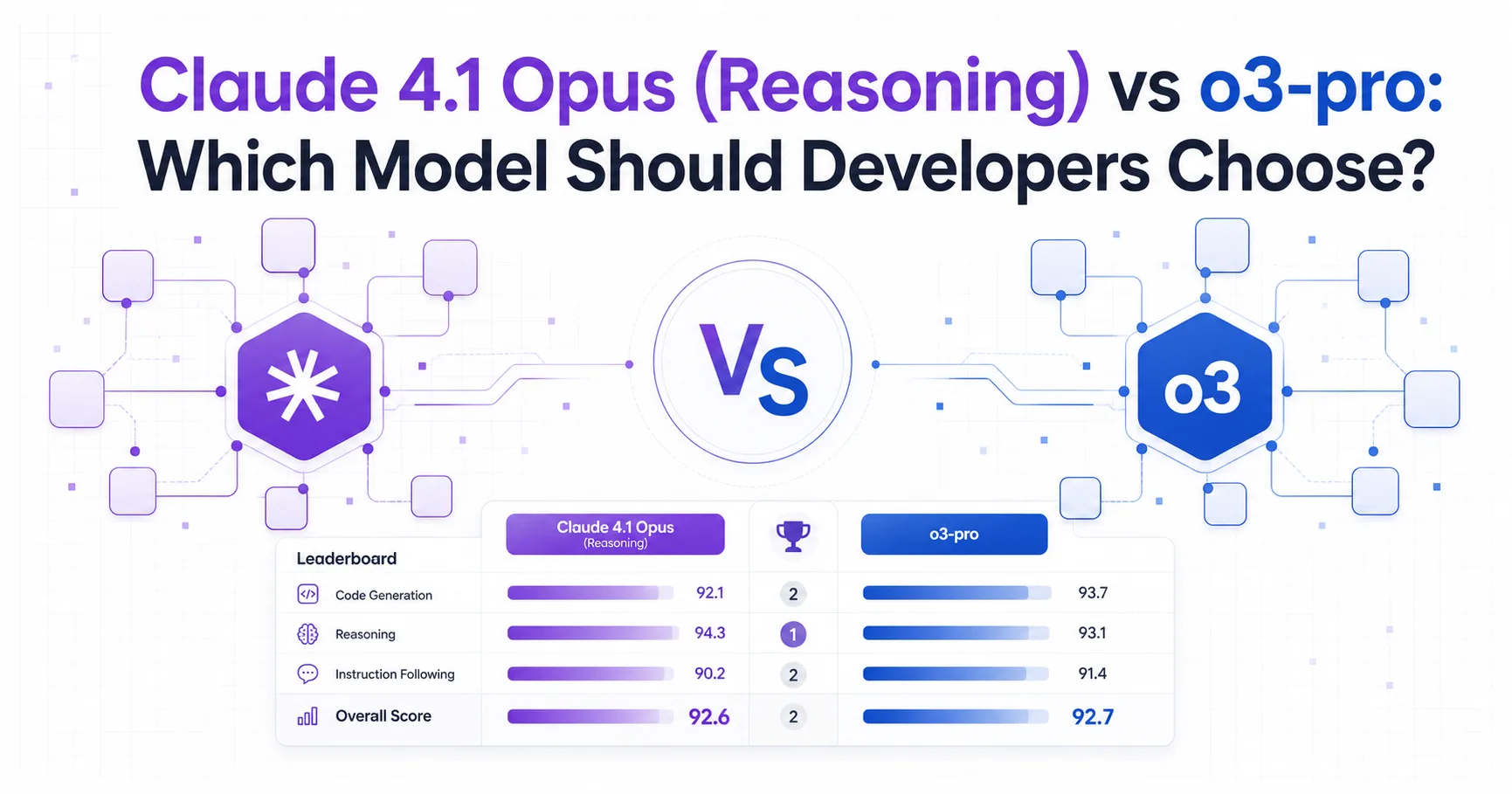
o3-pro API alias and fixed version o3-pro-2025-06-10Claude 4.1 Opus (Reasoning) is the stronger measured choice, but o3-pro is the clearer integration choice for developers who value documented API identity. The supplied Artificial Analysis data gives Claude 4.1 Opus (Reasoning) an Intelligence Index of 33.7, compared with 32.5 for o3-pro. Claude also has the only supplied Math Index, at 80.3, so the evidence favors Claude on measured capability while leaving cross-model math comparison unresolved.\n\nThe practical decision is less simple than the scores suggest. Anthropic lists Claude Opus 4.1 as retired, with Bedrock and Google Cloud exceptions, in its Claude pricing documentation. OpenAI documents o3-pro as a reasoning model with the alias o3-pro and version ID o3-pro-2025-06-10 in the o3-pro Model Documentation.
Claude 4.1 Opus (Reasoning) offers the better measured value, while o3-pro offers the better documented identity and reasoning workflow. Claude leads the supplied Intelligence Index by 1.2 points, and its blended price is $30 per 1M tokens versus $35 for o3-pro. Input pricing is $15 versus $20, while output pricing is $75 versus $80.\n\nThat advantage does not prove Claude will solve every developer task better. The supplied data has no Claude output-speed value, no o3-pro Math Index, and no complete benchmark protocol. The official Anthropic overview does not separately document the supplied Claude 4.1 Opus (Reasoning) name or slug, and it does not confirm a model-specific context window or output limit. The Claude models overview describes general Claude capabilities, including text and image input, text output, multilingual ability, and vision, but the evidence does not confirm that every description still applies specifically to this model.\n\nOpenAI positions o3-pro for complex science, mathematics, and programming tasks, with longer reasoning intended to produce more reliable answers, according to Introducing o3-pro. That positioning is useful for architecture decisions, but the supplied material does not include reproducible task-level results. Developers should treat the comparison as a decision under incomplete evidence, not as a universal capability ranking.
Claude 4.1 Opus (Reasoning) has the stronger supplied general score, but the evidence is insufficient to predict which model will finish a specific coding workflow faster or more reliably. The Intelligence Index is 33.7 for Claude and 32.5 for o3-pro. That gap supports a modest preference for Claude in broad capability selection, yet it does not identify the tasks responsible for the difference.\n\nClaude's supplied Math Index of 80.3 is potentially important for symbolic reasoning, algorithm design, and verification-heavy work. However, o3-pro has no corresponding Math Index in the supplied data. The missing value prevents a fair mathematical comparison. A missing score is not evidence that o3-pro is weaker.\n\nLatency is tied at 0.3 seconds for each model. That result suggests no measured latency advantage in the supplied snapshot, but it does not settle interactive experience. The data has no median output tokens per second for either model. Developers therefore cannot infer streaming speed, time to complete a long response, or the effect of extended reasoning from this comparison.\n\nOpenAI's Reasoning models guide states that reasoning models spend more time reasoning before producing an answer and are mainly used through the Responses API. This makes o3-pro's workflow more explicit. Anthropic's overview describes general Claude input and output capabilities, but it does not provide equivalent model-specific limits for Claude 4.1 Opus (Reasoning).
Claude 4.1 Opus (Reasoning) is cheaper on every supplied token price, but deployment availability can outweigh the nominal price advantage. Its blended price is $30 per 1M tokens, compared with $35 for o3-pro. Claude's input price is $15 and output price is $75, while o3-pro is priced at $20 for input and $80 for output, according to OpenAI API Pricing and Anthropic's Claude pricing documentation.\n\nFor a workload with repeated long instructions, Claude's prompt caching terms may materially change the economics. Anthropic lists cache writes at $18.75 per 1M tokens for a 5-minute cache and $30 per 1M tokens for a 1-hour cache. Cache hits and refreshes are listed at $1.50 per 1M tokens. Those prices can help applications that reuse large prompts, but the supplied evidence does not show cache hit rates or application traffic patterns.\n\nClaude's lower price can become less attractive if retirement forces a migration, a different cloud contract, or a restricted deployment path. Anthropic marks Claude Opus 4.1 as retired, with Bedrock and Google Cloud exceptions. OpenAI's supplied material does not provide a directly citable current availability statement for o3-pro. The result is a pricing comparison with asymmetric lifecycle certainty.\n\nThe right cost test is therefore total operating cost: token spend, migration risk, provider fit, caching behavior, and the engineering cost of validating a model whose official identity is not fully documented in the supplied overview.
Claude 4.1 Opus (Reasoning) leads on 3 of 3 metrics
Claude 4.1 Opus (Reasoning) is the best pick for a controlled evaluation where measured capability and token price matter more than broad first-party availability. The supplied data gives Claude the higher Intelligence Index, the only reported Math Index, and a $5 lower blended price per 1M tokens. Teams running on Amazon Bedrock or Google Cloud may find its retirement status compatible with their existing procurement and deployment path.\n\no3-pro is the safer pick when API naming, version pinning, and reasoning-model documentation are the primary requirements. OpenAI documents the o3-pro alias and o3-pro-2025-06-10 version ID. OpenAI also explicitly frames the model around longer reasoning for complex science, mathematics, and programming tasks in Introducing o3-pro. That makes o3-pro easier to specify in an implementation plan, even though the supplied evidence does not establish that it is currently available or that it has a performance advantage on a given workload.\n\nNeither model should be selected solely from the supplied benchmark snapshot for production coding assistance. The evidence lacks comparable context windows, maximum output limits, output-speed measurements, task-level benchmark protocols, and reliable community testing. These omissions matter for repository analysis, agent loops, tool calls, and user-facing latency.\n\nA sensible selection process is to test both models on the team's own representative tasks, then record correctness, repair rate, tool-call behavior, response completion time, and total token cost. The supplied evidence supports starting with Claude for value and o3-pro for integration clarity. It does not justify claiming a universal winner across all developer workloads.
o3-pro is the easier model to identify in official API documentation, while Claude 4.1 Opus (Reasoning) has the stronger supplied measured value. Developers should resolve availability, version stability, context limits, output behavior, and task-specific reliability before committing production traffic. The Claude models overview does not independently confirm the supplied Claude name or slug, while the o3-pro Model Documentation does document its alias and fixed version ID.\n\nThe central unresolved issue is evidence quality. The supplied benchmark values come from Artificial Analysis, but the research brief does not provide complete test methods for the measured indexes. Community evidence is also insufficient for either model, so claims about coding style, speed perception, or recurring failure modes should be validated locally.
Claude 4.1 Opus (Reasoning) is the better measured overall choice because it leads the supplied Intelligence Index and costs less, but the evidence does not establish a universal advantage across coding, tools, context length, or production availability.
Claude 4.1 Opus (Reasoning) is cheaper on the supplied blended, input, and output prices, but retirement restrictions may add migration or infrastructure costs that token pricing alone cannot reveal.
Neither model is faster on the supplied latency measure because Claude 4.1 Opus (Reasoning) and o3-pro are both listed at 0.3 seconds, while output-speed data is unavailable for each.
A new integration should use Claude 4.1 Opus (Reasoning) only after confirming an eligible Bedrock or Google Cloud route, because Anthropic lists Claude Opus 4.1 as retired.
Developers should consider o3-pro for complex reasoning when documented API identity and version pinning matter, but they should still validate task accuracy because the supplied benchmark evidence lacks a complete reproducible protocol.