
Time to First Token · Claude 4.5 Haiku (Reasoning)
9041ms
Time to First Token · GPT-5 (high)
0ms
Deep dive into reasoning, benchmarks, and latency insights.
The current catalog does not contain complete performance evidence for both models, so this page does not declare an overall winner. Use the available fields as comparison signals and validate the models on your own workload.
Key decision metrics at a glance.
| Model | Metric | Value | Unit | Source / snapshot |
|---|---|---|---|---|
| Claude 4.5 Haiku (Reasoning) | Reasoning | 8.0 | benchmark or capability score | Artificial Analysis · current catalog |
| GPT-5 (high) | Reasoning | 9.0 | benchmark or capability score | Artificial Analysis · current catalog |
| Claude 4.5 Haiku (Reasoning) | Coding | 4.0 | benchmark or capability score | Artificial Analysis · current catalog |
| GPT-5 (high) | Coding | 4.0 | benchmark or capability score | Artificial Analysis · current catalog |
| Claude 4.5 Haiku (Reasoning) | Multimodal | 2.0 | benchmark or capability score | Artificial Analysis · current catalog |
| GPT-5 (high) | Multimodal | 3.0 | benchmark or capability score | Artificial Analysis · current catalog |
| Claude 4.5 Haiku (Reasoning) | Long Context | 4.0 | benchmark or capability score | Artificial Analysis · current catalog |
| GPT-5 (high) | Long Context | 4.0 | benchmark or capability score | Artificial Analysis · current catalog |
| Claude 4.5 Haiku (Reasoning) | Blended Price / 1M tokens | $2 | USD per 1M tokens | Artificial Analysis · current catalog |
| GPT-5 (high) | Blended Price / 1M tokens | $3.438 | USD per 1M tokens | Artificial Analysis · current catalog |
| Claude 4.5 Haiku (Reasoning) | P95 Latency | — | milliseconds | Artificial Analysis · current catalog |
| GPT-5 (high) | P95 Latency | — | milliseconds | Artificial Analysis · current catalog |
| Claude 4.5 Haiku (Reasoning) | Tokens per second | 104.7 | tokens per second | Artificial Analysis · current catalog |
| GPT-5 (high) | Tokens per second | 0 | tokens per second | Artificial Analysis · current catalog |
Data provided by Artificial Analysis; live values use the current catalog.
This radar chart visually maps the core capabilities (reasoning, coding, math proxy, multimodal, long context) of `Claude 4.5 Haiku (Reasoning)` vs `GPT-5 (high)`.
This grouped bar chart provides a side-by-side comparison for each benchmark metric.
Lower time to first token is better; higher tokens per second is better.
Compare input and output pricing in USD per 1M tokens.
Claude 4.5 Haiku (Reasoning)$2.25
GPT-5 (high)$3.75
Claude 4.5 Haiku (Reasoning) costs $1.5 less per run
This article is a dated snapshot published on 2026-08-07. Live cards above use the current catalog; missing live fields are not inferred.
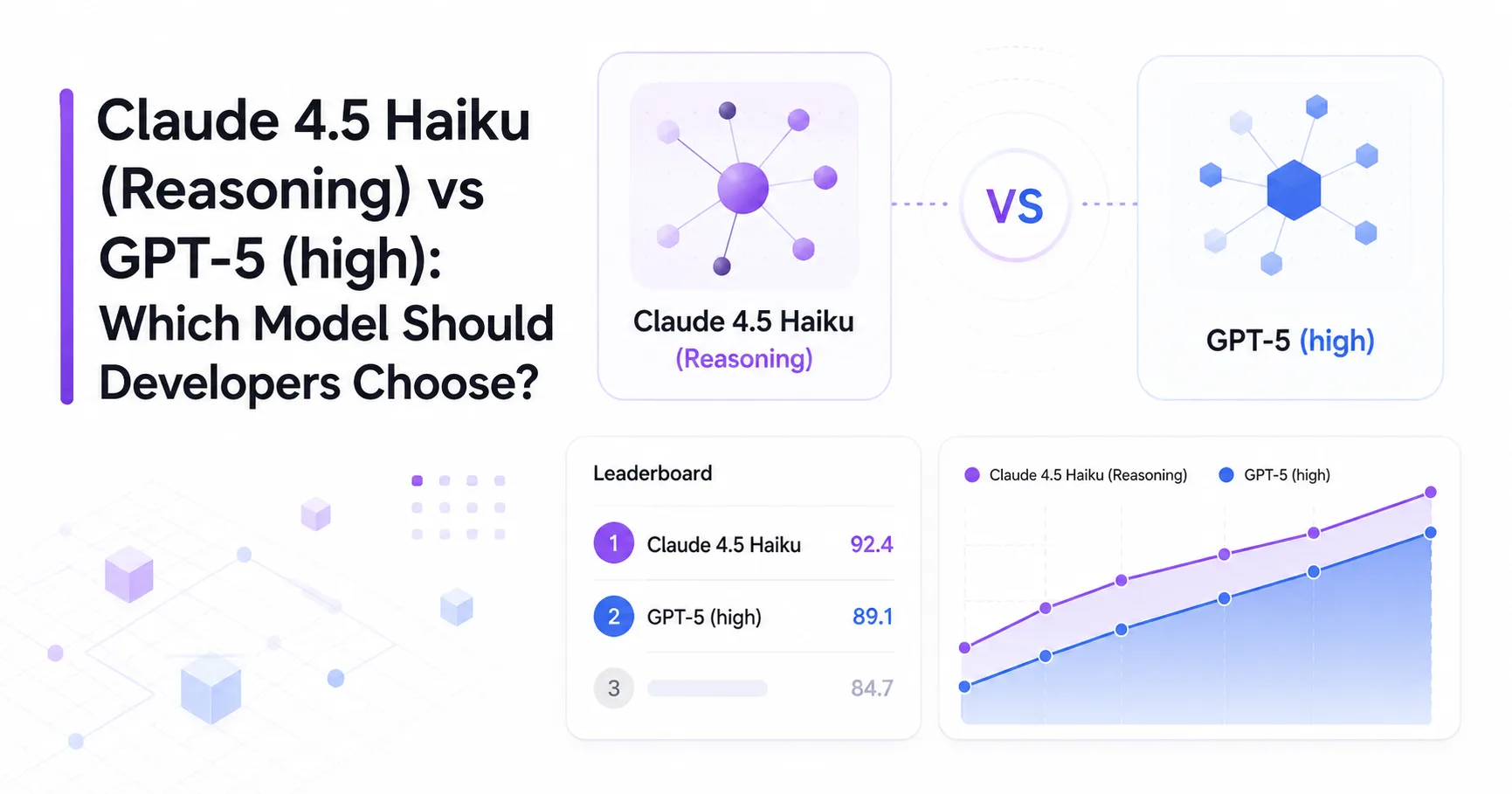
Claude 4.5 Haiku (Reasoning) is the better default for cost-sensitive coding workloads, while GPT-5 (high) is the stronger specialist for mathematical reasoning. The data brief gives Claude a coding index of 43.9 versus GPT-5 (high) at 37.8, but GPT-5 (high) leads the intelligence index at 34.7 versus 29.6 and the math index at 94.3 versus 83.7. Claude also has the lower blended price at $2 versus $3.4375 per 1M blended tokens.\n\nThe comparison is not a simple quality ranking. Claude is positioned by Anthropic as its fastest model with near-frontier intelligence, and its official documentation confirms extended thinking support through the thinking.type: "enabled" parameter. Anthropic model documentation GPT-5 is positioned by OpenAI for coding, reasoning, and agentic tasks, with configurable reasoning effort and verbosity. OpenAI developer announcement\n\nThe practical choice depends on the dominant failure cost in your application. Choose Claude when throughput, coding performance, and predictable token economics matter together. Choose GPT-5 when mathematical depth or broader reasoning quality justifies the higher output price. Neither the data brief nor the research establishes a controlled, task-matched reliability comparison.
Claude 4.5 Haiku (Reasoning) offers the more attractive engineering default, but GPT-5 (high) has the clearer case for math-heavy and broadly reasoning-intensive workloads.\n\n| Decision factor | Claude 4.5 Haiku (Reasoning) | GPT-5 (high) | What it means |\n|---|---:|---:|---|\n| Coding index | 43.9 | 37.8 | Claude has the stronger measured coding result in the data brief. |\n| Intelligence index | 29.6 | 34.7 | GPT-5 has the stronger general intelligence result. |\n| Math index | 83.7 | 94.3 | GPT-5 has the clearer advantage for mathematical reasoning. |\n| Blended price per 1M tokens | $2 | $3.4375 | Claude costs less under the brief's blended pricing view. |\n| Median output speed | 141.506 | Not provided | Claude has measurable speed evidence; GPT-5 cannot be ranked on this metric. |\n| Latency | 0.3 seconds | 0.3 seconds | The reported latency is tied. |\n\nData provided by https://artificialanalysis.ai/.\n\nThe most important unresolved question is whether the benchmark differences persist on your own prompts, repository structure, tool loop, and output constraints. The research contains official benchmark claims for GPT-5, including 74.9% on SWE-bench Verified, but no official benchmark values for Claude. GPT-5 developer announcement That makes cross-source benchmark reconciliation incomplete. The data brief should guide a shortlist, not replace a production-shaped evaluation.
Claude 4.5 Haiku (Reasoning) is the stronger measured coding option, while GPT-5 (high) is the stronger measured math and general-intelligence option.\n\nA coding index of 43.9 for Claude versus 37.8 for GPT-5 (high) suggests that Claude may be the better first candidate for code editing, implementation tasks, and developer-facing assistants. The result does not prove that Claude writes better software in every repository. Coding quality also depends on patch scope, test execution, tool permissions, and how much context the model receives.\n\nGPT-5 (high) leads the math index by a wider margin, with 94.3 versus 83.7. That difference matters for symbolic reasoning, algorithmic analysis, constraint-heavy planning, and tasks where a plausible answer is less useful than a carefully verified derivation. OpenAI reports GPT-5 as a reasoning model for coding, reasoning, and agentic tasks. GPT-5 developer announcement\n\nThe general intelligence index also favors GPT-5, at 34.7 versus 29.6. That points toward GPT-5 for mixed workloads where the prompt may shift between analysis, planning, and judgment. Claude remains compelling when speed is observable and important: the brief reports 141.506 median output tokens per second for Claude, while it provides no comparable GPT-5 value. The latency result is tied at 0.3 seconds, so first-response behavior and sustained generation should be tested separately.\n\nEvidence is insufficient for a reliable claim about community-perceived coding speed or consistent failure patterns. The available GPT-5 community report describes useful small debugging work but also possible hallucinations and incorrect changes in complex repositories, based on an uncontrolled personal test. Reddit coding impressions No equivalent verified community evidence was found for Claude.
GPT-5 (high) leads on 2 of 3 metrics
Claude 4.5 Haiku (Reasoning) is cheaper on every reported token-price view, but GPT-5 (high) can still be economically rational when it prevents expensive retries or review work.\n\nThe blended price is $2 for Claude and $3.4375 for GPT-5 (high). Input pricing is $1 for Claude versus $1.25 for GPT-5, while output pricing is $5 versus $10. The output gap matters more for agentic workflows that produce long plans, patches, explanations, or tool-call transcripts. A model that is cheaper per request may not be cheaper per completed task if it needs more retries, larger prompts, or more human correction.\n\nClaude's price advantage is strongest in high-volume developer tools, classification-and-routing steps, iterative code assistance, and applications where responses are usually short enough to keep quality stable. Anthropic also documents prompt caching options, which may improve economics for repeated context patterns. Claude pricing documentation\n\nGPT-5's higher cost is easier to justify for difficult mathematical reasoning, complex planning, or workflows where a stronger general-intelligence score reduces downstream orchestration. OpenAI documents cached input pricing and support for tool-oriented API workflows. GPT-5 model documentation\n\nThe evidence does not establish a task-completion cost for either model. The data brief reports token prices, not retry rates, tool-call counts, reviewer time, or production error costs. Teams should therefore compare cost per accepted result, not cost per API call. A small evaluation should record tokens, retries, correction time, and successful task completion for the exact workflow.
Claude 4.5 Haiku (Reasoning) leads on 3 of 3 metrics
Claude 4.5 Haiku (Reasoning) should be the default pick for coding products, while GPT-5 (high) should be reserved for workloads where reasoning depth has a measurable business value.\n\nPick Claude for an IDE assistant that performs frequent code edits, repository navigation, test-oriented changes, and short feedback loops. Its coding index is 43.9, its blended price is $2 per 1M tokens, and its reported median output speed is 141.506 tokens per second. Those attributes align with interactive developer experiences where responsiveness and volume both affect adoption. Anthropic documents text and image inputs, text output, multilingual capability, vision, and extended thinking for Claude. Claude model overview\n\nPick GPT-5 for mathematical analysis, demanding planning, and mixed agentic tasks that require stronger general reasoning. Its math index is 94.3 and intelligence index is 34.7. OpenAI documents configurable reasoning effort, verbosity, function calling, structured outputs, streaming, and custom tools. GPT-5 developer announcement\n\nUse a two-model routing strategy only if your evaluation shows that routing reduces accepted-task cost. Claude can handle the high-volume baseline, while GPT-5 handles escalations involving proofs, difficult constraints, or uncertain plans. Keep the policy explicit and observable.\n\nOne lifecycle concern cuts against GPT-5 for new long-lived integrations: OpenAI marks the fixed snapshot gpt-5-2025-08-07 as Deprecated and recommends a newer model. GPT-5 model documentation Claude's official model page still lists Claude Haiku 4.5 as available, but the research does not verify the reported release date. Neither source set proves long-term availability beyond the current documentation state.
Claude 4.5 Haiku (Reasoning) is the safer starting point for most cost-sensitive developer pilots because it combines the stronger coding index with lower blended pricing.\n\nThe unresolved evidence concerns production reliability, repository-specific behavior, and GPT-5 output speed. Those questions require a controlled evaluation using representative tasks, fixed prompts, identical tool permissions, and human acceptance criteria.\n\nThe model names also need careful handling. “Reasoning” in the Claude material refers to extended thinking, while “high” for GPT-5 refers to the reasoning_effort setting rather than a separate API model. Claude model overview GPT-5 model documentation\n\nDevelopers should avoid treating the data brief's indexes as a complete product score. The indexes reveal useful tradeoffs, but they do not describe every prompt family, tool loop, latency distribution, or failure recovery behavior.
Claude 4.5 Haiku (Reasoning) is the stronger measured coding choice, with a coding index of 43.9 versus 37.8 for GPT-5 (high), although repository-specific testing is still required before production selection.
A developer may choose GPT-5 (high) when mathematical reasoning or broad reasoning quality matters more than token cost, because its math index is 94.3 and intelligence index is 34.7.
Claude 4.5 Haiku (Reasoning) is the only model with a reported median output speed, at 141.506 tokens per second; the data brief reports identical latency of 0.3 seconds for both models.
GPT-5 (high) does not identify a separate API model in the research; “high” describes the reasoning_effort setting applied to GPT-5, whose stable alias is gpt-5.
A new application should treat the fixed GPT-5 snapshot cautiously because OpenAI marks gpt-5-2025-08-07 as Deprecated, making migration planning and current documentation checks part of the integration decision.
The available evidence cannot predict coding mistake rates with confidence because Claude lacks official benchmark values in the research and the GPT-5 community reports are uncontrolled, anecdotal observations.