
Time to First Token · Claude Fable 5 (Adaptive Reasoning, Max Effort, Opus 4.8 Fallback)
57985ms
Time to First Token · Claude Opus 5 (Adaptive Reasoning, Xhigh Effort)
26692ms
Deep dive into reasoning, benchmarks, and latency insights.
The current catalog does not contain complete performance evidence for both models, so this page does not declare an overall winner. Use the available fields as comparison signals and validate the models on your own workload.
Key decision metrics at a glance.
| Model | Metric | Value | Unit | Source / snapshot |
|---|---|---|---|---|
| Claude Fable 5 (Adaptive Reasoning, Max Effort, Opus 4.8 Fallback) | Reasoning | 6.0 | benchmark or capability score | Artificial Analysis · current catalog |
| Claude Opus 5 (Adaptive Reasoning, Xhigh Effort) | Reasoning | 6.0 | benchmark or capability score | Artificial Analysis · current catalog |
| Claude Fable 5 (Adaptive Reasoning, Max Effort, Opus 4.8 Fallback) | Coding | 8.0 | benchmark or capability score | Artificial Analysis · current catalog |
| Claude Opus 5 (Adaptive Reasoning, Xhigh Effort) | Coding | 8.0 | benchmark or capability score | Artificial Analysis · current catalog |
| Claude Fable 5 (Adaptive Reasoning, Max Effort, Opus 4.8 Fallback) | Multimodal | 5.0 | benchmark or capability score | Artificial Analysis · current catalog |
| Claude Opus 5 (Adaptive Reasoning, Xhigh Effort) | Multimodal | 5.0 | benchmark or capability score | Artificial Analysis · current catalog |
| Claude Fable 5 (Adaptive Reasoning, Max Effort, Opus 4.8 Fallback) | Long Context | 8.0 | benchmark or capability score | Artificial Analysis · current catalog |
| Claude Opus 5 (Adaptive Reasoning, Xhigh Effort) | Long Context | 8.0 | benchmark or capability score | Artificial Analysis · current catalog |
| Claude Fable 5 (Adaptive Reasoning, Max Effort, Opus 4.8 Fallback) | Blended Price / 1M tokens | $20 | USD per 1M tokens | Artificial Analysis · current catalog |
| Claude Opus 5 (Adaptive Reasoning, Xhigh Effort) | Blended Price / 1M tokens | $10 | USD per 1M tokens | Artificial Analysis · current catalog |
| Claude Fable 5 (Adaptive Reasoning, Max Effort, Opus 4.8 Fallback) | P95 Latency | — | milliseconds | Artificial Analysis · current catalog |
| Claude Opus 5 (Adaptive Reasoning, Xhigh Effort) | P95 Latency | — | milliseconds | Artificial Analysis · current catalog |
| Claude Fable 5 (Adaptive Reasoning, Max Effort, Opus 4.8 Fallback) | Tokens per second | 67.465 | tokens per second | Artificial Analysis · current catalog |
| Claude Opus 5 (Adaptive Reasoning, Xhigh Effort) | Tokens per second | 53.473 | tokens per second | Artificial Analysis · current catalog |
Data provided by Artificial Analysis; live values use the current catalog.
This radar chart visually maps the core capabilities (reasoning, coding, math proxy, multimodal, long context) of `Claude Fable 5 (Adaptive Reasoning, Max Effort, Opus 4.8 Fallback)` vs `Claude Opus 5 (Adaptive Reasoning, Xhigh Effort)`.
This grouped bar chart provides a side-by-side comparison for each benchmark metric.
Lower time to first token is better; higher tokens per second is better.
Compare input and output pricing in USD per 1M tokens.
Claude Fable 5 (Adaptive Reasoning, Max Effort, Opus 4.8 Fallback)$22.5
Claude Opus 5 (Adaptive Reasoning, Xhigh Effort)$11.25
Claude Opus 5 (Adaptive Reasoning, Xhigh Effort) costs $11.25 less per run
This article is a dated snapshot published on 2026-08-04. Live cards above use the current catalog; missing live fields are not inferred.
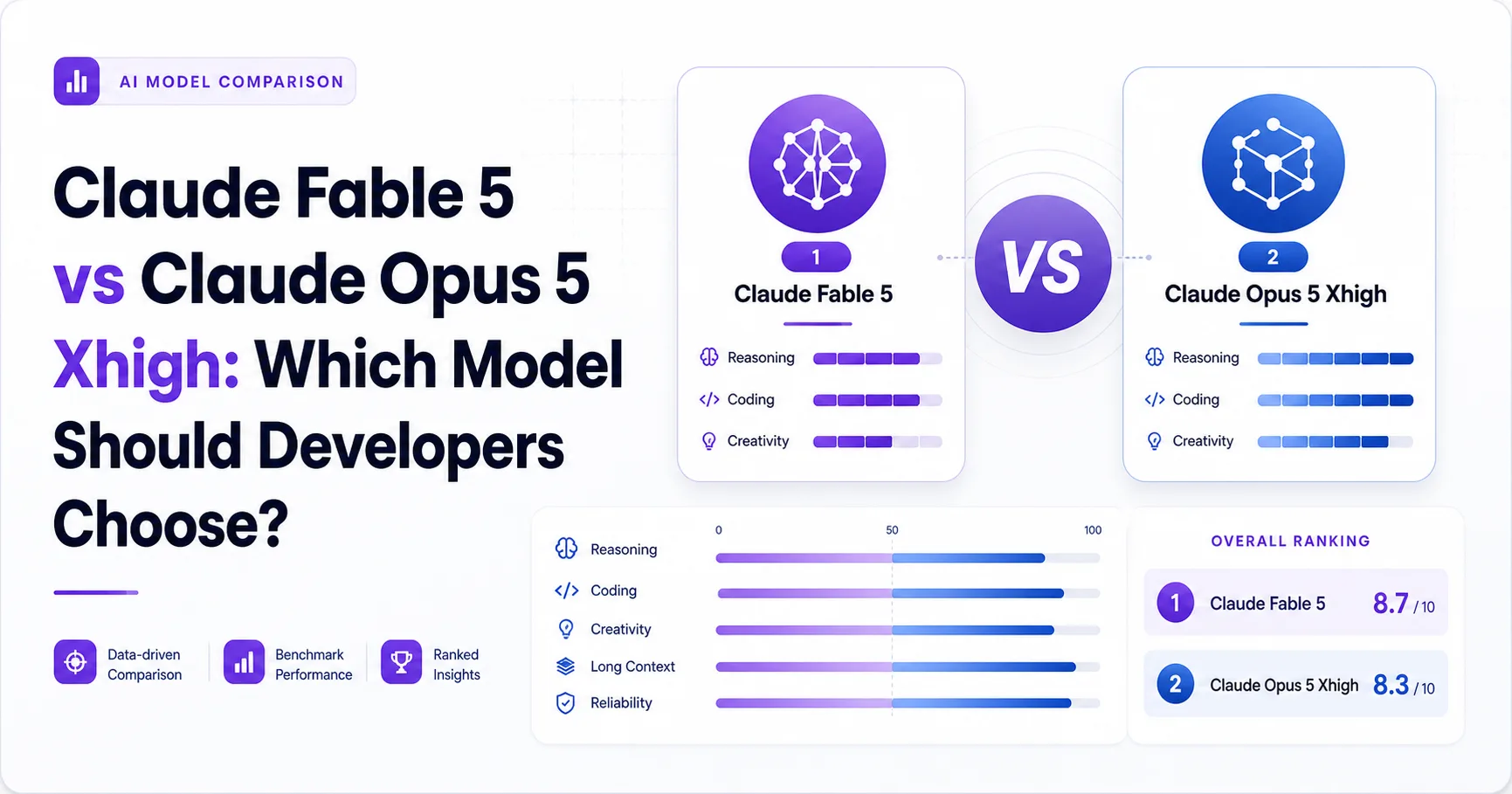
Claude Opus 5 is the better default for most developer integrations because it leads the supplied quality indexes while costing less. Artificial Analysis data places Claude Opus 5 at 77 on the coding index and 60.1 on the intelligence index, against Claude Fable 5 at 76.5 and 59.9. Claude Fable 5 produces output faster at 70.509 median output tokens per second, while both models show 0.3-second latency. Opus 5 therefore fits quality-sensitive and cost-conscious systems. Fable 5 fits interactive agents where visible streaming speed and autonomous tool use matter. Data provided by https://artificialanalysis.ai/.
Claude Opus 5 wins the supplied aggregate comparison, while Claude Fable 5 remains the faster streaming option for tool-heavy sessions. The Artificial Analysis snapshot gives Opus 5 the higher coding and intelligence results, plus the lower blended price. Fable 5 leads output speed. The latency result is tied, so the practical difference appears after generation begins.
| Decision area | Claude Fable 5 | Claude Opus 5 Xhigh |
|---|---|---|
| Coding index | 76.5 | 77 |
| Intelligence index | 59.9 | 60.1 |
| Blended price per 1M tokens | $20 | $10 |
| Median output tokens per second | 70.509 | 53.917 |
| Latency | 0.3 seconds | 0.3 seconds |
The official model identity also matters. Anthropic lists Fable's stable API model as claude-fable-5 and Opus's stable API model as claude-opus-5 in the models overview. The xhigh label is an effort setting, not a separate Opus API model. Fable's Max Effort label is likewise a configuration rather than another model ID, as described in the Fable model documentation, the effort documentation, and the Opus release documentation.
The official positioning differs. Anthropic describes Fable 5 as a model for long-running agents, while Opus 5 targets complex agentic coding and enterprise work. The Fable announcement claims leadership across many capability benchmarks. The Opus announcement lists a different evaluation portfolio without publishing a complete comparable table. The supplied snapshot therefore looks less like a contradiction than a benchmark mismatch. The briefs do not provide a controlled, identical task suite that resolves which model wins every developer workload.
Both models remain listed as current in Anthropic's models overview. The Fable access pause and later restoration documented in the restoration notice make availability checks sensible, but the materials do not show a current deprecation issue. The model deprecations page also does not establish a retirement concern for Opus 5.
Claude Fable 5 is the faster model after generation starts, while Claude Opus 5 edges it on the supplied quality indexes. Fable's 70.509 median output tokens per second can make long responses feel more responsive once the model begins writing. The tied 0.3-second latency result means neither model has a measured initial-delay advantage in the supplied data. Developers should therefore separate time to first output from time to a successful completed task.
The chart cannot show how much adaptive thinking each request consumes, how many tool calls an agent makes, how often a harness retries, or how long a task takes from prompt to verified result. Fable keeps adaptive thinking enabled and exposes effort controls, while Opus also uses adaptive thinking and treats effort as a central runtime setting. These behaviors are described in the thinking documentation, the effort documentation, and the Opus implementation notes.
Fable's official capability list favors long-running agent workflows with memory, code execution, context editing, compaction, programmatic tool calling, and vision. Opus's official positioning emphasizes multi-file coding, code review, bug diagnosis, visual work, long-context tasks, documents, tables, and multi-agent collaboration. Those descriptions suggest different operating styles, but they are not a substitute for a shared task benchmark.
Community evidence reinforces that distinction without settling it. A Hacker News report on Fable describes work on a difficult Python WASM engineering problem. Another Fable report describes browser inspection, screenshots, and verification after a frontend change. These examples suggest strong autonomous execution, but neither uses a standardized repeated protocol.
Opus feedback is more divided. A Reddit discussion reports slow responses, verbosity, overthinking, and instruction drift alongside strong planned execution. Lenny's review describes a more cautious style that often seeks human judgment. A Hacker News discussion also notes that Opus may keep constructing workarounds when direct input is missing. A separate service discussion reports long-running sessions and recovery concerns, but does not isolate model capability from service conditions.
For performance-sensitive selection, measure time to a verified result, tool-call count, recovery behavior, and user-visible responsiveness. The supplied evidence supports Fable for fast interactive streaming. It does not prove that Fable completes real software tasks faster overall.
Claude Opus 5 (Adaptive Reasoning, Xhigh Effort) leads on 2 of 2 metrics
Claude Opus 5 is the cheaper production default, but Claude Fable 5 can still win when faster completion reduces developer waiting. The supplied comparison prices Opus at $10 versus Fable at $20 per 1M blended tokens. The official Anthropic pricing page supports the same underlying price relationship across input and output usage.
The blended figure assumes comparable token consumption. Agentic systems rarely perform identical work at identical token counts. Adaptive thinking cannot be fully disabled for Fable, and Opus's higher effort settings can also consume substantial response budget before producing the final answer. Effort tuning, tool permissions, context size, stopping rules, and recovery prompts can therefore matter as much as the listed model rate. The official Fable thinking guidance and Opus configuration guidance make those runtime differences explicit.
Fable's faster output may reduce perceived waiting in an interactive coding agent, but speed does not prove fewer total tokens or fewer tool calls. The Fable browser-verification report illustrates the hidden-cost problem: an agent may perform additional inspection and validation work around a small change. The example is not a controlled cost test, so it should be treated as a risk pattern rather than a general billing estimate.
Opus can create a different cost risk. Community reports describe long reasoning, verbose delivery, and continued autonomous planning in situations where a developer might prefer a clarification request. The Opus Reddit discussion and Hacker News discussion provide anecdotal evidence, not a measured cost distribution.
Prompt caching can change the economics of repeated context, as documented on the pricing page. The briefs do not provide cache-hit behavior, token use per successful task, failure rates, or recovery costs. Developers should not interpret the $10 versus $20 blended comparison as total cost per shipped feature. The cheaper model can become more expensive if it needs more retries, while the faster model can become expensive if it performs unnecessary verification.
Claude Opus 5 (Adaptive Reasoning, Xhigh Effort) leads on 3 of 3 metrics
Claude Opus 5 should be the default pick for most new integrations, while Claude Fable 5 deserves a targeted trial for latency-sensitive autonomous workflows. Opus combines the higher supplied coding result of 77 with the lower blended price of $10. Fable scores 76.5 on coding and costs $20 per 1M blended tokens, so its case depends on workflow behavior rather than headline benchmark advantage.
Choose Opus when the application needs strong multi-file coding, code review, bug investigation, enterprise documents, or complex planning. Anthropic explicitly positions Opus for these workloads in the Opus release announcement and the Opus model documentation. Opus is also the cleaner starting point for teams that want lower listed API spend and a stable model identifier.
Choose Fable when users benefit from rapid visible output, long-running agent execution, browser or visual verification, and broad tool orchestration. Anthropic describes those capabilities in the Fable announcement, while the Fable engineering report and Fable browser report show why developers may value its proactive behavior. Those reports are useful hypotheses for testing, not reliable universal performance claims.
Treat configuration as part of the model choice. Call Opus through claude-opus-5 and set xhigh as the effort configuration when appropriate. Do not treat claude-opus-5-xhigh as the official API model ID. Keep thinking enabled for high Opus effort settings, because the official Opus documentation describes compatibility and response-budget constraints.
Build refusal handling into Fable integrations. A refused Messages API request can return a successful HTTP response with stop_reason set to refusal, so HTTP status alone is insufficient. Use the documented refusal and fallback behavior when the application needs recovery.
Fable also has a data-retention constraint: Anthropic's documentation says it is not available under Zero Data Retention. The supplied materials do not establish an equivalent retention comparison for Opus, so compliance teams should verify both models before selecting a production path.
The strongest selection method is a private pilot using identical prompts, tools, permissions, success criteria, and recovery logic. Record verified task success, total tokens, tool calls, end-to-end completion time, refusal handling, and human intervention. The current evidence supports Opus as the rational default and Fable as the targeted speed experiment, but it does not justify treating either model as universally superior.
Claude Opus 5 is the safer starting point for implementation questions because its official model identity is clear, while Xhigh is only an effort setting. The unresolved issues are operational: which model completes the team's real tasks with fewer tool calls, whether recovery behavior fits the harness, whether response length fits the budget, and whether Fable's retention policy meets compliance requirements.
Community reports point in opposite directions. Fable users describe proactive execution and fast progress, while Opus users describe both strong autonomy and excessive reasoning. The Fable community discussion and Opus review do not use a common test method. Treat those reports as test hypotheses rather than product specifications. The FAQ below turns the main uncertainties into concrete selection decisions.
Choose Claude Opus 5 by default for a new integration because the supplied snapshot gives it the higher coding and intelligence results and the lower blended price. The decision remains provisional until your own tasks measure success, tool use, recovery, and completion time. Artificial Analysis data supports the supplied comparison.
No, Claude Opus 5 Xhigh is an effort configuration applied to the official claude-opus-5 model, not a separate API model identifier. Anthropic documents xhigh as part of the effort setting and lists the stable model ID in the models overview and Opus configuration guide.
Choose Claude Fable 5 when interactive output speed, long-running autonomy, and visual or browser verification matter more than minimum API spend. Its supplied median output speed is 70.509 tokens per second, while community examples describe autonomous engineering and browser checks. Those examples remain anecdotal, as shown by the Hacker News reports and Fable Reddit discussion.
No, the supplied indexes favor Claude Opus 5 narrowly, but the briefs do not provide a controlled head-to-head task suite or complete comparable benchmark tables. Anthropic's announcements describe different evaluation portfolios, so the Fable announcement and Opus announcement cannot establish a universal ranking.
Handle thinking, refusal, and recovery paths first because model behavior can consume the response budget or return a refusal through a successful HTTP response. Keep the relevant thinking configuration explicit, inspect stop_reason, and implement fallback behavior using Anthropic's refusal documentation and thinking guidance.