
Time to First Token · Claude Fable 5 (Adaptive Reasoning, Max Effort, Opus 4.8 Fallback)
57985ms
Time to First Token · GPT-4o mini
0ms
Deep dive into reasoning, benchmarks, and latency insights.
The current catalog does not contain complete performance evidence for both models, so this page does not declare an overall winner. Use the available fields as comparison signals and validate the models on your own workload.
Key decision metrics at a glance.
| Model | Metric | Value | Unit | Source / snapshot |
|---|---|---|---|---|
| Claude Fable 5 (Adaptive Reasoning, Max Effort, Opus 4.8 Fallback) | Reasoning | 6.0 | benchmark or capability score | Artificial Analysis · current catalog |
| GPT-4o mini | Reasoning | 1.0 | benchmark or capability score | Artificial Analysis · current catalog |
| Claude Fable 5 (Adaptive Reasoning, Max Effort, Opus 4.8 Fallback) | Coding | 8.0 | benchmark or capability score | Artificial Analysis · current catalog |
| GPT-4o mini | Coding | 1.0 | benchmark or capability score | Artificial Analysis · current catalog |
| Claude Fable 5 (Adaptive Reasoning, Max Effort, Opus 4.8 Fallback) | Multimodal | 5.0 | benchmark or capability score | Artificial Analysis · current catalog |
| GPT-4o mini | Multimodal | 1.0 | benchmark or capability score | Artificial Analysis · current catalog |
| Claude Fable 5 (Adaptive Reasoning, Max Effort, Opus 4.8 Fallback) | Long Context | 8.0 | benchmark or capability score | Artificial Analysis · current catalog |
| GPT-4o mini | Long Context | 1.0 | benchmark or capability score | Artificial Analysis · current catalog |
| Claude Fable 5 (Adaptive Reasoning, Max Effort, Opus 4.8 Fallback) | Blended Price / 1M tokens | $20 | USD per 1M tokens | Artificial Analysis · current catalog |
| GPT-4o mini | Blended Price / 1M tokens | $0.262 | USD per 1M tokens | Artificial Analysis · current catalog |
| Claude Fable 5 (Adaptive Reasoning, Max Effort, Opus 4.8 Fallback) | P95 Latency | — | milliseconds | Artificial Analysis · current catalog |
| GPT-4o mini | P95 Latency | — | milliseconds | Artificial Analysis · current catalog |
| Claude Fable 5 (Adaptive Reasoning, Max Effort, Opus 4.8 Fallback) | Tokens per second | 67.465 | tokens per second | Artificial Analysis · current catalog |
| GPT-4o mini | Tokens per second | 0 | tokens per second | Artificial Analysis · current catalog |
Data provided by Artificial Analysis; live values use the current catalog.
This radar chart visually maps the core capabilities (reasoning, coding, math proxy, multimodal, long context) of `Claude Fable 5 (Adaptive Reasoning, Max Effort, Opus 4.8 Fallback)` vs `GPT-4o mini`.
This grouped bar chart provides a side-by-side comparison for each benchmark metric.
Lower time to first token is better; higher tokens per second is better.
Compare input and output pricing in USD per 1M tokens.
Claude Fable 5 (Adaptive Reasoning, Max Effort, Opus 4.8 Fallback)$22.5
GPT-4o mini$0.3
GPT-4o mini costs $22.2 less per run
This article is a dated snapshot published on 2026-08-07. Live cards above use the current catalog; missing live fields are not inferred.
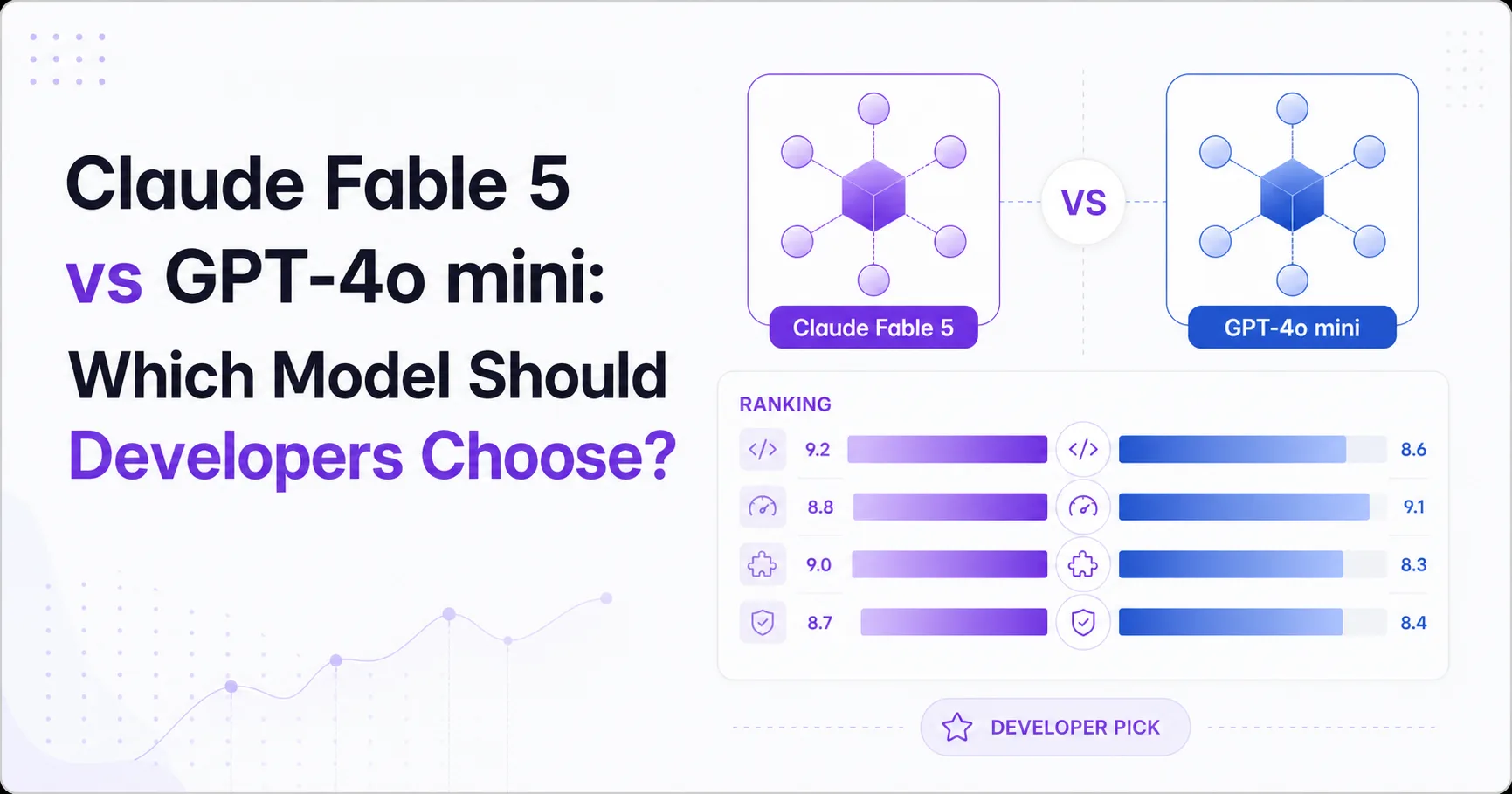
Claude Fable 5 is the stronger choice for demanding developer workflows, while GPT-4o mini is the safer cost choice for simple, high-volume automation. The Artificial Analysis snapshot gives Claude Fable 5 a coding index of 76.5 and GPT-4o mini a coding index of 11.4, while the blended-token prices are $20 and $0.2625 respectively. These figures describe a large capability and cost separation, but they do not establish that either model wins every production workload.
Claude Fable 5 is positioned for long-running agents, software engineering, knowledge work, vision, science, and long-context tasks in Anthropic's official model overview and launch announcement. GPT-4o mini was introduced as a small model for frequent, cost-efficient tasks, with text and image input and text output in OpenAI's release announcement.
The practical decision is therefore not simply which model has the higher benchmark score. Developers must decide whether the application needs autonomous persistence, strong code reasoning, and tool orchestration, or whether low unit cost matters more than deeper task completion. The supplied evidence does not include a controlled head-to-head workload test, so teams should validate their own prompts, tools, failure handling, and output quality before committing.
Claude Fable 5 offers substantially stronger measured intelligence and coding results, while GPT-4o mini offers dramatically lower listed benchmark-snapshot pricing. The Artificial Analysis data reports an intelligence index of 59.9 for Claude Fable 5 and 6.9 for GPT-4o mini, plus a coding-index difference of 65.1 in Claude Fable 5's favor.
| Decision factor | Claude Fable 5 | GPT-4o mini |
|---|---|---|
| Primary role | Long-running agents and demanding engineering work | Frequent, cost-efficient tasks |
| Coding index | 76.5 | 11.4 |
| Intelligence index | 59.9 | 6.9 |
| Blended price per 1M tokens | $20 | $0.2625 |
| Input price per 1M tokens | $10 | $0.15 |
| Output price per 1M tokens | $50 | $0.6 |
| Reported latency | 0.3 seconds | 0.3 seconds |
Claude Fable 5 also supports adaptive thinking, effort control, memory, code execution, programmatic tool calling, context editing, compaction, and vision according to Anthropic's introduction to Fable 5. Adaptive thinking is always enabled, so developers can control reasoning depth through the effort parameter rather than disabling thinking, as described in Anthropic's effort documentation.
GPT-4o mini has a documented context window of 128,000 tokens and a maximum output of 16,384 tokens in its model documentation. Claude Fable 5 has a 1M-token context window and a maximum Messages API output of 128k tokens in the Anthropic model overview. The evidence supports a clear capability distinction, but it does not show how either model performs on a specific private codebase or domain dataset.
Claude Fable 5 is the better performance choice for complex coding and agent tasks, even though the supplied latency figure is identical for both models. The data snapshot reports 0.3 seconds for each model, so the available latency evidence does not distinguish their initial responsiveness. Claude Fable 5 additionally records a median output speed of 70.509 tokens per second, while no corresponding GPT-4o mini value is supplied.
The meaningful difference appears in task depth. A coding-index gap of 65.1 suggests that Claude Fable 5 is more suitable when the model must understand a repository, make coordinated changes, inspect results, and recover from intermediate failures. Anthropic's launch material describes software-engineering cases involving complex codebase migrations, while an independent Hacker News report describes Claude Fable 5 working on micropython-wasm and generating a wheel intended to support complete Python WASM: engineering task report. That report is a concrete anecdote, not a controlled benchmark.
Claude Fable 5's proactive behavior can improve completion on visual or browser-based tasks. A separate Hacker News discussion reports that the model launched a browser, inspected a window, captured screenshots, and verified a frontend fix: browser verification report. The same behavior can increase tool calls, review burden, and cost. Developers should therefore treat autonomy as a capability with an operational price, not as free performance.
GPT-4o mini remains a plausible choice for classification, extraction, routing, lightweight generation, and other tasks where the prompt and expected answer are narrow. OpenAI's release announcement reports MMLU at 82.0%, MGSM at 87.0%, HumanEval at 87.2%, and MMMU at 59.4% at launch: GPT-4o mini benchmark announcement. Those results cannot be directly compared with the Artificial Analysis indices because they use different evaluation systems. The supplied research also contains no reliable community testing for GPT-4o mini's current coding experience, speed, or behavioral tendencies.
GPT-4o mini is the clear unit-cost winner in the supplied data, but Claude Fable 5 can be economically preferable when failed task completion creates more work than inference spend. The blended-token prices are $0.2625 for GPT-4o mini and $20 for Claude Fable 5, while Claude Fable 5's input and output prices are $10 and $50 per 1M tokens compared with $0.15 and $0.6 for GPT-4o mini.
The price gap changes the architecture decision. GPT-4o mini is well suited to high-volume paths where each request has a small failure surface and where a retry, human review, or downstream correction is inexpensive. Claude Fable 5 is more defensible when one request must carry out a long chain of reasoning, edit code, call tools, inspect artifacts, and produce a verified result. Its higher token price may buy fewer manual interventions, but the supplied material does not provide a controlled completion-cost comparison.
Prompt caching may change Claude Fable 5's economics for applications with repeated context. Anthropic lists five-minute cache writes at $12.50 per 1M tokens, one-hour cache writes at $20 per 1M tokens, and cache hits and refreshes at $1 per 1M tokens in its pricing documentation. The relevant question is whether the application repeatedly reuses large instructions, repository context, or reference material. Without the application's cache-hit rate and request distribution, no break-even claim can be supported.
The largest cost risk is uncontrolled agency. One Hacker News report attributes approximately $12 to a task involving extra browser checks and validation, but the post is not a controlled cost test: tool-use cost report. Reddit users also report rapid quota consumption during complex work, although those accounts lack a reproducible test method: community discussion. Teams should budget by completed workflow, not by token price alone.
GPT-4o mini leads on 3 of 3 metrics
Claude Fable 5 is the recommended default for high-consequence engineering agents, while GPT-4o mini is the recommended default for narrow workloads with strict cost ceilings. The measured coding-index difference of 65.1 supports choosing Claude Fable 5 when correctness depends on repository-level reasoning, multi-step execution, or visual verification.
Choose Claude Fable 5 when the application must do more than produce a plausible response. Long-running coding agents, migration assistants, research workflows, and browser-operated developer tools fit its documented positioning and feature set. The model can use adaptive thinking, memory, code execution, programmatic tool calling, context editing, compaction, and vision according to Anthropic's feature documentation. Developers should expose explicit tool budgets, capture intermediate events, and monitor unexpected verification loops.
Choose GPT-4o mini when the task is bounded, repetitive, and cheap to retry. Request classification, structured extraction, simple summarization, content transformation, and lightweight multimodal processing are better aligned with its small-model positioning in OpenAI's release announcement. Its documented text-and-image input boundary also makes it a poor fit when the product requires native audio or video handling, because the supplied model documentation does not list those capabilities.
Treat availability as a separate gate. Anthropic's overview currently lists Claude Fable 5 as an available model and names Claude API, Amazon Bedrock, Claude Platform on AWS, Google Cloud, and Microsoft Foundry as access channels: current model overview. Anthropic also documented an earlier access suspension and later restoration: restoration notice. OpenAI's current model directory emphasizes the GPT-5 family and does not list GPT-4o mini's current product positioning: OpenAI model directory. OpenAI's current pricing page also does not list a price for gpt-4o-mini: OpenAI pricing page. Therefore, GPT-4o mini's snapshot price should be treated as historical or account-dependent until the target endpoint confirms it.
Claude Fable 5 also has a data-retention constraint. Anthropic states that the model uses 30-day data retention and is not available with Zero Data Retention, so regulated deployments must review the boundary before adoption: Fable 5 introduction. The evidence is insufficient to rank the models on current enterprise compliance without a more complete policy comparison.
Claude Fable 5 is the stronger candidate for developers who value completed complex workflows over minimum inference cost. The data shows a coding index of 76.5 for Claude Fable 5 and 11.4 for GPT-4o mini, but the research does not include a controlled test on your codebase, tool stack, or acceptance criteria.
GPT-4o mini is the stronger candidate for low-cost workloads with narrow outputs and cheap retries. Its blended snapshot price is $0.2625 per 1M tokens, compared with $20 for Claude Fable 5, but OpenAI's current pricing page does not list the model, so production availability and billing must be verified.
Claude Fable 5 is more suitable for long-running agents because Anthropic documents memory, code execution, programmatic tool calling, context editing, compaction, vision, and adjustable effort. Those features can support deeper workflows, but they can also create extra tool calls and higher operational complexity.
Claude Fable 5 is the stronger starting point for an autonomous coding agent because its coding index is 76.5, and Anthropic documents long-running agents, code execution, memory, tool calling, context editing, compaction, and vision. The evidence does not guarantee success on a private repository, so acceptance tests and tool-level monitoring remain necessary.
GPT-4o mini is cheaper in the supplied pricing snapshot at $0.2625 per 1M blended tokens, compared with $20 for Claude Fable 5. OpenAI's current pricing page does not list GPT-4o mini, so developers must confirm that the account and endpoint still accept the model before relying on that cost.
Claude Fable 5 does not have a demonstrated latency advantage in the supplied comparison because both models are reported at 0.3 seconds. Claude Fable 5 has a reported median output speed of 70.509 tokens per second, while the data brief provides no matching GPT-4o mini speed value.
GPT-4o mini can replace Claude Fable 5 for bounded engineering utilities, such as classification, extraction, or simple transformations, where retries are cheap. The supplied coding indices favor Claude Fable 5 by 65.1, but no controlled private-codebase evaluation proves how that difference maps to a particular team's completion rate.
Claude Fable 5's main production risks are high output pricing, potentially extensive tool use, conservative safety refusals, and fixed data-retention constraints. Anthropic documents refusal handling and fallback behavior, while community reports describe quota consumption and long pauses without a reproducible testing method, so teams should instrument retries and cost boundaries.