
Time to First Token · Claude Fable 5 (Adaptive Reasoning, Max Effort, Opus 4.8 Fallback)
57985ms
Time to First Token · GPT-5.6 Sol (max)
75247ms
Deep dive into reasoning, benchmarks, and latency insights.
The current catalog does not contain complete performance evidence for both models, so this page does not declare an overall winner. Use the available fields as comparison signals and validate the models on your own workload.
Key decision metrics at a glance.
| Model | Metric | Value | Unit | Source / snapshot |
|---|---|---|---|---|
| Claude Fable 5 (Adaptive Reasoning, Max Effort, Opus 4.8 Fallback) | Reasoning | 6.0 | benchmark or capability score | Artificial Analysis · current catalog |
| GPT-5.6 Sol (max) | Reasoning | 6.0 | benchmark or capability score | Artificial Analysis · current catalog |
| Claude Fable 5 (Adaptive Reasoning, Max Effort, Opus 4.8 Fallback) | Coding | 8.0 | benchmark or capability score | Artificial Analysis · current catalog |
| GPT-5.6 Sol (max) | Coding | 8.0 | benchmark or capability score | Artificial Analysis · current catalog |
| Claude Fable 5 (Adaptive Reasoning, Max Effort, Opus 4.8 Fallback) | Multimodal | 5.0 | benchmark or capability score | Artificial Analysis · current catalog |
| GPT-5.6 Sol (max) | Multimodal | 5.0 | benchmark or capability score | Artificial Analysis · current catalog |
| Claude Fable 5 (Adaptive Reasoning, Max Effort, Opus 4.8 Fallback) | Long Context | 8.0 | benchmark or capability score | Artificial Analysis · current catalog |
| GPT-5.6 Sol (max) | Long Context | 8.0 | benchmark or capability score | Artificial Analysis · current catalog |
| Claude Fable 5 (Adaptive Reasoning, Max Effort, Opus 4.8 Fallback) | Blended Price / 1M tokens | $20 | USD per 1M tokens | Artificial Analysis · current catalog |
| GPT-5.6 Sol (max) | Blended Price / 1M tokens | $11.25 | USD per 1M tokens | Artificial Analysis · current catalog |
| Claude Fable 5 (Adaptive Reasoning, Max Effort, Opus 4.8 Fallback) | P95 Latency | — | milliseconds | Artificial Analysis · current catalog |
| GPT-5.6 Sol (max) | P95 Latency | — | milliseconds | Artificial Analysis · current catalog |
| Claude Fable 5 (Adaptive Reasoning, Max Effort, Opus 4.8 Fallback) | Tokens per second | 67.465 | tokens per second | Artificial Analysis · current catalog |
| GPT-5.6 Sol (max) | Tokens per second | 68.734 | tokens per second | Artificial Analysis · current catalog |
Data provided by Artificial Analysis; live values use the current catalog.
This radar chart visually maps the core capabilities (reasoning, coding, math proxy, multimodal, long context) of `Claude Fable 5 (Adaptive Reasoning, Max Effort, Opus 4.8 Fallback)` vs `GPT-5.6 Sol (max)`.
This grouped bar chart provides a side-by-side comparison for each benchmark metric.
Lower time to first token is better; higher tokens per second is better.
Compare input and output pricing in USD per 1M tokens.
Claude Fable 5 (Adaptive Reasoning, Max Effort, Opus 4.8 Fallback)$22.5
GPT-5.6 Sol (max)$12.5
GPT-5.6 Sol (max) costs $10 less per run
This article is a dated snapshot published on 2026-08-04. Live cards above use the current catalog; missing live fields are not inferred.
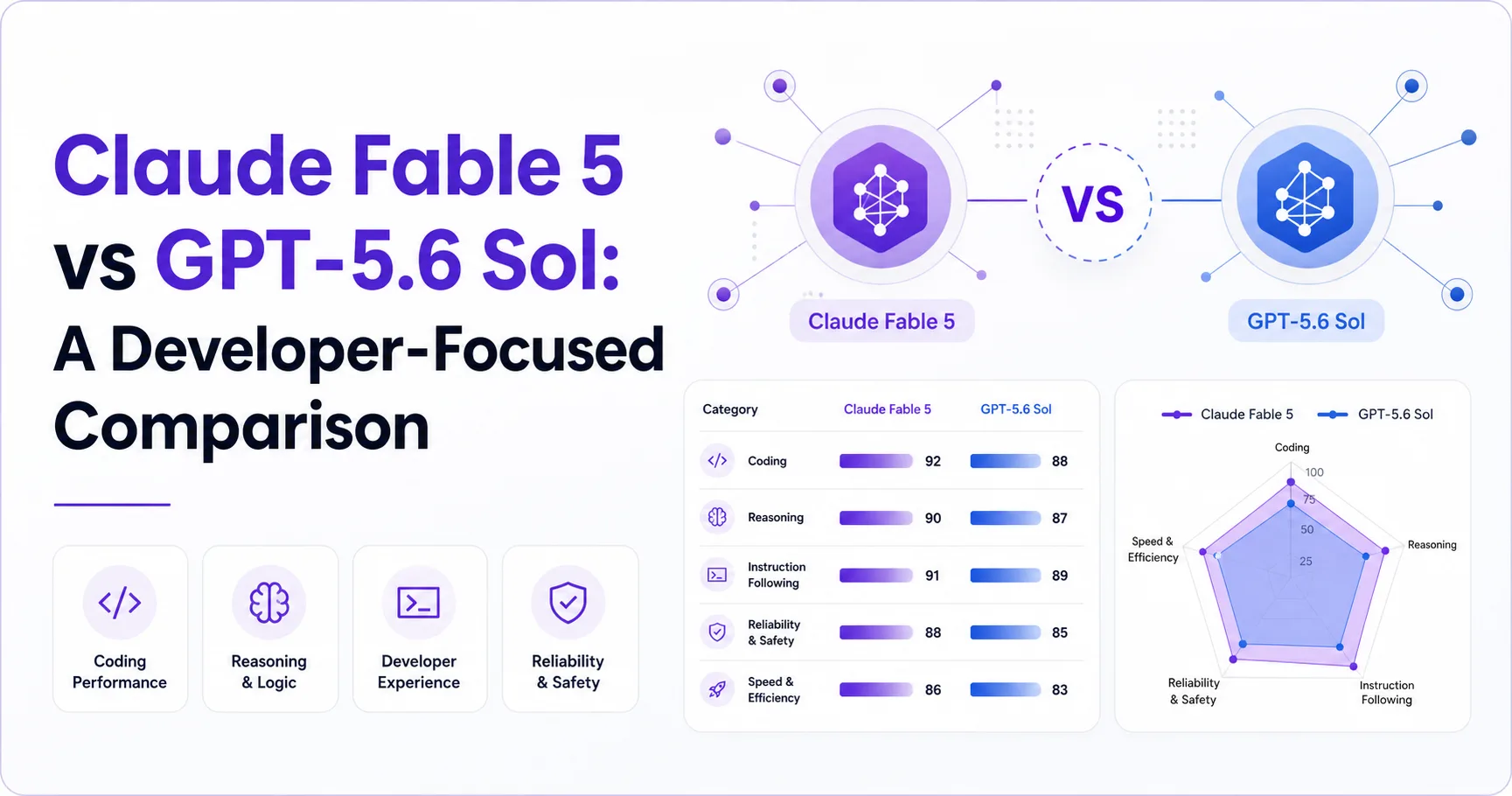
GPT-5.6 Sol (max) is the better default for most developer teams because it pairs the lower blended price with the higher coding score, while Claude Fable 5 has the stronger general-intelligence result.
The supplied comparison data, provided by https://artificialanalysis.ai/, gives GPT-5.6 Sol the advantage in coding, output speed, and blended token cost. Claude Fable 5 leads the supplied intelligence index. That split matters because software development is rarely a single benchmark task.
Anthropic positions Claude Fable 5 for long-running agents, visual work, memory-heavy workflows, and extended engineering tasks. OpenAI positions GPT-5.6 Sol for complex reasoning, programming, professional work, and tool-rich Responses API workflows.
Both models remain listed in their current official catalogs. Anthropic's model overview lists Fable 5 as available, while OpenAI's model directory and GPT-5.6 Sol model page list Sol without a deprecation signal. Fable 5 had an access interruption that Anthropic later addressed in its redeployment notice, so availability history deserves operational review.
The names also conceal important configuration differences. Fable's Max Effort is an effort setting rather than a separate API model, according to Anthropic's launch documentation and effort guide. GPT-5.6 Sol (max) similarly describes a model paired with maximum reasoning effort, not a different model family.
Claude Fable 5 wins the general-intelligence index, while GPT-5.6 Sol wins coding, speed, and cost in the supplied data.
Data provided by https://artificialanalysis.ai/ supports the following selection map:
| Decision lens | Better fit | Evidence from the supplied data | Practical interpretation |
|---|---|---|---|
| General intelligence | Claude Fable 5 | 59.9 vs 58.9 | Prefer Fable when tasks span research, planning, visual interpretation, and broad knowledge work. |
| Coding | GPT-5.6 Sol | 77.4 vs 76.5 | Prefer Sol for implementation-heavy agents where repository changes and test loops dominate. |
| Output speed | GPT-5.6 Sol | 77.617 vs 70.509 | Sol should finish streamed generations sooner under the measured conditions. |
| Blended cost | GPT-5.6 Sol | $11.25 vs $20 | Sol gives more room for repeated agent turns, retries, and production volume. |
The benchmark split is more useful than a single winner label. Anthropic's official announcement says Fable 5 leads across most covered capability areas, but the announcement does not provide a complete numeric table for direct verification. OpenAI's GPT-5.6 announcement publishes selected benchmark results, but those benchmarks are not the same as the Artificial Analysis indexes in the supplied snapshot. Official claims therefore establish positioning, not a complete head-to-head verdict.
The product surfaces also differ. Fable supports adaptive thinking, memory, compaction, context editing, programmatic tool calling, code execution, and vision through the capabilities described in Anthropic's model documentation. Sol exposes tool-rich Responses API workflows, including code execution, computer use, hosted shell, MCP, file search, and structured output through its model details. The right choice depends on which surface your agent uses repeatedly.
GPT-5.6 Sol is the speed and coding leader in the supplied measurements, but Claude Fable 5 remains the better general-intelligence result.
Sol's median output speed is 77.617 tokens per second, compared with 70.509 for Fable 5. Measured latency is tied at 0.3 seconds. The practical distinction is therefore generation throughput, not a clear first-response advantage. Faster generation helps interactive coding loops, but it does not guarantee faster task completion when a model spends more time reasoning or calling tools.
The coding result is also close. Sol records 77.4 on the supplied coding index, while Fable records 76.5. That lead supports Sol as the starting point for compile, test, patch, and review workflows. It does not prove that Sol will produce fewer regressions in a specific repository. The dataset does not report tool-call counts, rework, test pass rates, or task completion time.
Fable keeps adaptive thinking enabled and lets developers adjust effort rather than disabling reasoning, as described in Anthropic's thinking guide and effort guide. Sol exposes selectable reasoning effort and a pro mode for difficult tasks through OpenAI's reasoning guide. That gives Sol a clearer control surface when teams need to trade reasoning depth against latency and spend.
Community reports complicate the raw speed picture. A Hacker News engineering example describes Fable handling a difficult, long-running technical problem. Another Hacker News report describes Fable opening a browser, inspecting a window, taking screenshots, and verifying a frontend fix. Those actions may improve reliability, but they add orchestration work. Sol users similarly report broad investigations and overextended conclusions, while another report says lower reasoning effort improved the experience in Hacker News. These are useful warning signals, not controlled performance evidence.
GPT-5.6 Sol is the clear price leader for the supplied token mix, but Claude Fable 5's agent behavior can change the effective cost of a task.
The supplied blended comparison puts Sol at $11.25 per 1M tokens versus $20 for Fable 5. That advantage is meaningful for agents that make many turns, retry failed edits, or process large volumes of routine coding work. Sol also has the lower input and output prices in the supplied data, so the basic token economics do not flip simply because a task produces more output.
The blended figure still assumes a particular input-to-output pattern. A real coding agent pays for hidden reasoning tokens, tool-related turns, context replay, failed attempts, and human review. OpenAI explains in its reasoning documentation that reasoning tokens occupy the context window and are billed as output tokens. Higher reasoning effort can therefore make a nominally cheap request more expensive. Fable's always-on adaptive thinking creates a similar budgeting concern, although the control mechanism differs.
Caching can change repeated-context economics. Anthropic documents prompt caching and cache refresh behavior in its pricing documentation. OpenAI documents separate Standard, Batch, Flex, and Fast pricing paths in its API pricing documentation. Those options matter when workloads are asynchronous, bursty, latency-sensitive, or dominated by repeated repository context.
Tool behavior is the less visible cost driver. The Fable browser-verification report describes a task that generated substantial additional tool activity, but it was not a controlled cost test. The Reddit discussion about Fable also contains conflicting reports about fast delivery and rapid quota consumption. The correct production metric is cost per successful task, not cost per model call.
GPT-5.6 Sol (max) leads on 3 of 3 metrics
GPT-5.6 Sol is the default pick for production coding agents, while Claude Fable 5 is the specialist pick for autonomous, broad-context work.
| Choose | Recommended scenario | Why |
|---|---|---|
| GPT-5.6 Sol | Repository implementation, test-driven patching, tool-heavy coding, and cost-sensitive production traffic | Sol leads the supplied coding index, output speed, and blended cost measures. Its reasoning controls also give teams a direct way to reduce effort for simpler tasks. |
| Claude Fable 5 | Long-running engineering investigations, visual workflows, memory-heavy agents, and tasks that benefit from proactive verification | Anthropic documents memory, compaction, context editing, code execution, programmatic tool calling, and vision in Fable's capability documentation. A separate Hacker News case shows the kind of extended technical work users associate with the model. |
| Pilot both | High-risk migrations, autonomous browser tasks, or applications where refusal and review cost matter | The supplied data has no controlled measure for tool overhead, rework, refusal rate, or human intervention. |
Fable needs an explicit refusal path. Anthropic says a refusal can arrive through a successful API response with a refusal stop reason, so callers should inspect the response body rather than relying only on transport-level errors. The refusal and fallback guide describes fallback handling. Anthropic also acknowledges that conservative safety tuning can block some harmless requests in its official announcement.
Sol needs a reasoning budget and scope guard. Community users report over-designed implementations and investigations that search irrelevant areas in Reddit and Hacker News. These reports lack reproducible protocols, but they justify logging repository scope, tool calls, generated output, retries, and final test results.
Fable's documented retention policy may rule it out for strict data-governance requirements, while Sol's model page lists audio, video, and fine-tuning as unsupported capabilities. Confirm those constraints in Anthropic's model documentation and OpenAI's model details before deployment. The evidence is insufficient for a universal winner, so a matched task pilot remains the decisive next step.
Claude Fable 5 and GPT-5.6 Sol require different production guardrails, so a model choice without task-level logging leaves key cost and reliability questions unanswered.
Start by freezing the exact model configuration. Fable's Max Effort label refers to an effort setting, and its Opus fallback refers to a fallback mechanism, not a separate Fable API alias. Sol's max configuration likewise combines the Sol model with maximum reasoning effort. Record these settings with every evaluation run.
Next, separate model quality from orchestration quality. A proactive agent may appear stronger because it performs more checks, yet those checks can increase cost and review burden. A faster model may still finish later if it investigates too broadly. Measure successful task completion, generated output, tool calls, retries, reviewer edits, and total spend.
Finally, treat community feedback as hypothesis generation. Fable discussions report both fast delivery and rapid quota use in Reddit. Sol discussions report both overengineering and improvement after reducing reasoning effort in Hacker News. Neither source provides a controlled comparison, so neither should replace a task set from your own codebase.
GPT-5.6 Sol is the default choice for a coding agent because the supplied snapshot gives it a 77.4 coding index, 77.617 median output speed, and $11.25 blended cost. Data provided by https://artificialanalysis.ai/ supports that default, although repository-specific testing should still measure regressions, tool calls, and rework.
Claude Fable 5 is better on the supplied general-intelligence index, with 59.9 versus 58.9 for GPT-5.6 Sol. That result supports Fable for broad research and planning, but Anthropic's official announcement does not provide a complete numeric comparison table, so it cannot establish a universal advantage.
Claude Fable 5's Max Effort is an effort setting rather than a separate API model, while GPT-5.6 Sol (max) combines the Sol model with maximum reasoning effort. Anthropic explains this distinction in its effort documentation, and OpenAI documents the corresponding configuration in its reasoning guide.
GPT-5.6 Sol offers selectable reasoning effort, including lower-effort settings for simpler tasks, while Claude Fable 5 keeps adaptive thinking enabled and uses effort controls instead of a full disable switch. The relevant controls are described in Anthropic's thinking guide and OpenAI's reasoning guide.
Developers should monitor successful task completion, total spend, output tokens, tool calls, retries, human edits, and refusal handling. Fable refusals can appear inside successful API responses, while Sol's reasoning tokens can increase billed output, as documented by Anthropic and OpenAI.