
Time to First Token · Claude Fable 5 (Adaptive Reasoning, Max Effort, Opus 4.8 Fallback)
57985ms
Time to First Token · GPT-5.6 Sol (xhigh)
31324ms
Deep dive into reasoning, benchmarks, and latency insights.
The current catalog does not contain complete performance evidence for both models, so this page does not declare an overall winner. Use the available fields as comparison signals and validate the models on your own workload.
Key decision metrics at a glance.
| Model | Metric | Value | Unit | Source / snapshot |
|---|---|---|---|---|
| Claude Fable 5 (Adaptive Reasoning, Max Effort, Opus 4.8 Fallback) | Reasoning | 6.0 | benchmark or capability score | Artificial Analysis · current catalog |
| GPT-5.6 Sol (xhigh) | Reasoning | 6.0 | benchmark or capability score | Artificial Analysis · current catalog |
| Claude Fable 5 (Adaptive Reasoning, Max Effort, Opus 4.8 Fallback) | Coding | 8.0 | benchmark or capability score | Artificial Analysis · current catalog |
| GPT-5.6 Sol (xhigh) | Coding | 8.0 | benchmark or capability score | Artificial Analysis · current catalog |
| Claude Fable 5 (Adaptive Reasoning, Max Effort, Opus 4.8 Fallback) | Multimodal | 5.0 | benchmark or capability score | Artificial Analysis · current catalog |
| GPT-5.6 Sol (xhigh) | Multimodal | 5.0 | benchmark or capability score | Artificial Analysis · current catalog |
| Claude Fable 5 (Adaptive Reasoning, Max Effort, Opus 4.8 Fallback) | Long Context | 8.0 | benchmark or capability score | Artificial Analysis · current catalog |
| GPT-5.6 Sol (xhigh) | Long Context | 7.0 | benchmark or capability score | Artificial Analysis · current catalog |
| Claude Fable 5 (Adaptive Reasoning, Max Effort, Opus 4.8 Fallback) | Blended Price / 1M tokens | $20 | USD per 1M tokens | Artificial Analysis · current catalog |
| GPT-5.6 Sol (xhigh) | Blended Price / 1M tokens | $11.25 | USD per 1M tokens | Artificial Analysis · current catalog |
| Claude Fable 5 (Adaptive Reasoning, Max Effort, Opus 4.8 Fallback) | P95 Latency | — | milliseconds | Artificial Analysis · current catalog |
| GPT-5.6 Sol (xhigh) | P95 Latency | — | milliseconds | Artificial Analysis · current catalog |
| Claude Fable 5 (Adaptive Reasoning, Max Effort, Opus 4.8 Fallback) | Tokens per second | 67.465 | tokens per second | Artificial Analysis · current catalog |
| GPT-5.6 Sol (xhigh) | Tokens per second | 64.533 | tokens per second | Artificial Analysis · current catalog |
Data provided by Artificial Analysis; live values use the current catalog.
This radar chart visually maps the core capabilities (reasoning, coding, math proxy, multimodal, long context) of `Claude Fable 5 (Adaptive Reasoning, Max Effort, Opus 4.8 Fallback)` vs `GPT-5.6 Sol (xhigh)`.
This grouped bar chart provides a side-by-side comparison for each benchmark metric.
Lower time to first token is better; higher tokens per second is better.
Compare input and output pricing in USD per 1M tokens.
Claude Fable 5 (Adaptive Reasoning, Max Effort, Opus 4.8 Fallback)$22.5
GPT-5.6 Sol (xhigh)$12.5
GPT-5.6 Sol (xhigh) costs $10 less per run
This article is a dated snapshot published on 2026-08-05. Live cards above use the current catalog; missing live fields are not inferred.
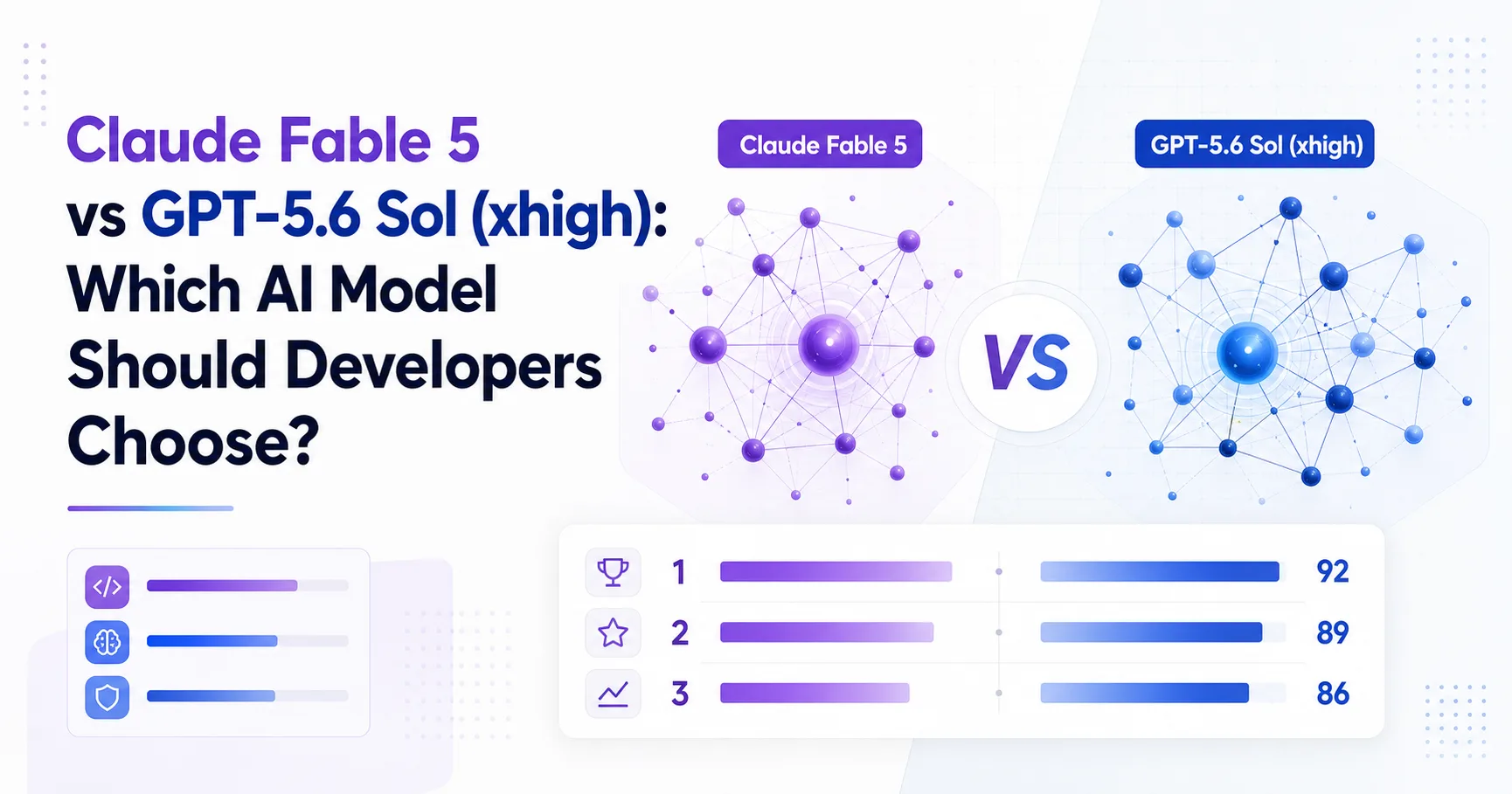
GPT-5.6 Sol (xhigh) is the stronger default for software teams that prioritize coding quality, response speed, and token economics. The supplied comparison gives GPT-5.6 Sol (xhigh) a coding index of 78.3, median output speed of 73.479 tokens per second, and a 3-to-1 blended price of $11.25 per 1M tokens. Claude Fable 5 leads the intelligence index at 59.9 and remains a serious choice for broad analysis and long-running agent work. The comparison is therefore a workload decision, not a universal quality ranking. Data provided by https://artificialanalysis.ai/. The comparison dataset is also available from Artificial Analysis. Product behavior and availability are grounded in the Claude model overview and GPT-5.6 Sol model page.
GPT-5.6 Sol (xhigh) wins the practical default decision, while Claude Fable 5 wins the supplied general intelligence index.
That split matters because developer products combine code editing, tool use, user-facing explanation, and open-ended analysis. A model can lead one layer while remaining a weaker choice for another.
| Dimension | Claude Fable 5 | GPT-5.6 Sol (xhigh) |
|---|---|---|
| Supplied release date | 2026-06-09 | 2026-07-09 |
| Artificial Analysis intelligence index | 59.9 | 57.7 |
| Artificial Analysis coding index | 76.5 | 78.3 |
| Blended price per 1M tokens | $20 | $11.25 |
| Median output tokens per second | 70.509 | 73.479 |
| Latency seconds | 0.3 | 0.3 |
GPT-5.6 Sol (xhigh) has the later supplied release date, but recency is not a decisive advantage. The OpenAI model catalog and Claude model overview present both models as currently callable in the supplied research window. Claude's official material also records restored access after an interruption in the Fable 5 announcement and the access restoration notice. Availability history belongs in operational planning.
Official benchmark positioning does not settle the comparison. Anthropic's launch announcement describes broad leadership without a complete, itemized table. OpenAI's GPT-5.6 announcement publishes its own benchmark results, while also describing special conditions for some safety evaluations. These announcements provide useful signals, not a shared and independently reproduced test protocol.
GPT-5.6 Sol (xhigh) is the better performance choice for coding agents, while Claude Fable 5 deserves testing for broad analytical work.
The supplied coding index favors GPT at 78.3 versus Claude at 76.5. For repository tasks, that lead should first appear in planning accuracy, edit selection, test repair, and tool handoffs. It does not guarantee clean diffs. A coding index compresses many behaviors into a single score, so it cannot show whether a model preserves architecture, asks for clarification, or stops after a valid fix. Your acceptance test should measure those outcomes directly.
Claude's higher general intelligence result changes the interpretation. A model that trails on coding can still produce stronger synthesis for product requirements, research-heavy tickets, and ambiguous investigations. The supplied intelligence result gives Claude 59.9 versus GPT at 57.7. That supports a Claude pilot for analysis-heavy traces, not a claim that Claude will outperform on every codebase.
GPT's median output speed is 73.479 tokens per second, while reported latency is 0.3 for each model. Equal latency means the user-visible difference is more likely to appear during streaming and long completions than at request start. The Reasoning models guide says xhigh can increase reasoning time and token use. Anthropic's effort documentation explains how Fable adjusts effort, while its thinking documentation describes adaptive thinking behavior. The missing evidence is task-level time-to-correct-result under identical tools and prompts. Neither benchmark speed nor community anecdotes supplies that measurement.
GPT-5.6 Sol (xhigh) is the cheaper baseline, but workflow design can erase its apparent advantage.
On the data brief's 3-to-1 blended measure, GPT is $11.25 per 1M tokens and Claude is $20. That makes GPT the logical starting point for high-volume coding assistance, automated review, and workloads with predictable token patterns. The OpenAI pricing page and Claude pricing page show that input, output, and cached token categories matter separately. A blended figure is therefore a screening metric, not an invoice forecast.
The cheaper model can become more expensive when it reasons longer, emits larger patches, retries tool calls, or triggers additional validation. The Reasoning models guide explains that xhigh increases reasoning time and token consumption. A Hacker News report describes Fable 5 proactively opening a browser, taking screenshots, and running supporting scripts during a frontend fix. That behavior may improve confidence, but it creates more tool execution and review overhead.
Claude can still deliver better economic value when autonomy prevents engineer rework. GPT can lose value through overengineering or excessive code, as one community report claims, while another community report describes a useful feature completed in a single prompt. These are conflicting anecdotes, not measured cost studies. A Claude community discussion likewise reports both rapid delivery and rapid quota consumption Reddit. The evidence is insufficient to predict total cost from model price alone.
Use the chart for the list-price decision, then pilot with your own tool loop, cache pattern, output mix, and human review policy. The right budget metric is cost per accepted result, not cost per generated token.
GPT-5.6 Sol (xhigh) leads on 3 of 3 metrics
GPT-5.6 Sol (xhigh) is the recommended first pilot for most developer products, while Claude Fable 5 merits a parallel pilot for long-running agents and broad analysis.
| Decision signal | Prefer Claude Fable 5 | Prefer GPT-5.6 Sol (xhigh) |
|---|---|---|
| Primary work | Long-running agents, broad analysis, and complex research | Coding agents, repository changes, and structured development workflows |
| Reasoning model | Adaptive thinking with effort control | Reasoning effort with xhigh configuration |
| Tool surface | Memory Tool, Code Execution, Programmatic Tool Calling, Context Editing, Compaction, and Vision | Structured outputs, Web search, File search, Code Interpreter, Hosted shell, Computer use, MCP, Apply patch, and Skills |
| Provider reach | Claude API, Amazon Bedrock, Google Cloud, and Microsoft Foundry | Chat Completions API and Responses API |
Anthropic's Fable 5 introduction and model overview document Claude's long-running agent features and provider options. OpenAI's model page documents GPT's tool surface and API support. A Hacker News engineering report also describes Fable 5 handling a complex, long-running software task, but the report does not provide a repeatable evaluation protocol.
Treat the names correctly in code. Claude's API ID and stable alias are claude-fable-5. GPT's API ID is gpt-5.6-sol, while xhigh is a reasoning setting rather than a separate model. The Reasoning models guide and official model pages support that distinction.
Claude's always-on adaptive thinking and fallback behavior suit applications that accept variable internal effort and explicit refusal handling. The API can return a refusal in a successful HTTP response, so callers need to inspect model-level status. The refusals and fallback documentation explains the required handling.
Capability boundaries should shape routing. The supplied materials document text and image input for both models, with text output, while GPT does not support audio or video. The briefs do not establish a native audio or video advantage for Claude, so media-heavy products need a separate model path. GPT also does not support fine-tuning, and Claude's documented data-retention posture needs compliance review.
Operationally, define retries, provider fallback, and refusal handling before launch. Claude's material records a temporary access interruption followed by restored availability. GPT remains listed in the official model catalog. This does not reject Claude, but it makes resilience planning part of the selection decision. The decisive unmeasured variable is accepted result per dollar on your tools and data, and the supplied material does not answer it.
Claude Fable 5 and GPT-5.6 Sol (xhigh) need a workload-specific pilot before production selection.
Use representative repository tasks, ambiguous tickets, long-context analysis, tool use, refusal handling, and human review. Track accepted-result rate, rework, latency, token spend, tool calls, and failure recovery. Keep prompts, permissions, and evaluation criteria consistent across the models.
The supplied values establish useful priors: GPT leads the coding index at 78.3, while Claude leads the intelligence index at 59.9. They do not reveal how either model behaves in your repository or agent loop. Community reports also conflict and lack standardized protocols, including the GPT coding reports cited above and the Claude community discussion. Treat the answers below as routing guidance, not a substitute for a production-shaped pilot.
GPT-5.6 Sol (xhigh) is the better starting choice for a coding agent because it leads the supplied coding index at 78.3 and costs $11.25 per 1M blended tokens. Validate that advantage against your repository, tools, test suite, and review process.
Claude Fable 5 is the stronger candidate for broad analytical work because it leads the supplied intelligence index at 59.9 versus GPT's 57.7, although the available evidence does not establish a universal winner across every research or planning task.
GPT-5.6 Sol (xhigh) names a model configuration, not a separate API model ID; the model ID is gpt-5.6-sol, and xhigh selects reasoning effort for the request.
Claude Fable 5 keeps adaptive thinking enabled and exposes effort controls, while GPT-5.6 Sol (xhigh) uses reasoning effort settings. Neither configuration guarantees fixed latency or token use across different prompts and tool loops.
GPT-5.6 Sol (xhigh) is cheaper on the supplied 3-to-1 blended measure at $11.25 versus Claude Fable 5 at $20 per 1M tokens, but tool calls, retries, caching, output mix, and human rework can change total cost.
No universal winner is proven by the supplied evidence. Artificial Analysis favors GPT on coding and Claude on intelligence, while community anecdotes lack controlled protocols for comparing total quality, latency, autonomy, or accepted-result cost.