
Time to First Token · Claude Opus 4.7 (Adaptive Reasoning, Max Effort)
0ms
Time to First Token · GPT-5 (high)
0ms
Deep dive into reasoning, benchmarks, and latency insights.
The current catalog does not contain complete performance evidence for both models, so this page does not declare an overall winner. Use the available fields as comparison signals and validate the models on your own workload.
Key decision metrics at a glance.
| Model | Metric | Value | Unit | Source / snapshot |
|---|---|---|---|---|
| Claude Opus 4.7 (Adaptive Reasoning, Max Effort) | Reasoning | 6.0 | benchmark or capability score | Artificial Analysis · current catalog |
| GPT-5 (high) | Reasoning | 9.0 | benchmark or capability score | Artificial Analysis · current catalog |
| Claude Opus 4.7 (Adaptive Reasoning, Max Effort) | Coding | 7.0 | benchmark or capability score | Artificial Analysis · current catalog |
| GPT-5 (high) | Coding | 4.0 | benchmark or capability score | Artificial Analysis · current catalog |
| Claude Opus 4.7 (Adaptive Reasoning, Max Effort) | Multimodal | 5.0 | benchmark or capability score | Artificial Analysis · current catalog |
| GPT-5 (high) | Multimodal | 3.0 | benchmark or capability score | Artificial Analysis · current catalog |
| Claude Opus 4.7 (Adaptive Reasoning, Max Effort) | Long Context | 7.0 | benchmark or capability score | Artificial Analysis · current catalog |
| GPT-5 (high) | Long Context | 4.0 | benchmark or capability score | Artificial Analysis · current catalog |
| Claude Opus 4.7 (Adaptive Reasoning, Max Effort) | Blended Price / 1M tokens | $10 | USD per 1M tokens | Artificial Analysis · current catalog |
| GPT-5 (high) | Blended Price / 1M tokens | $3.438 | USD per 1M tokens | Artificial Analysis · current catalog |
| Claude Opus 4.7 (Adaptive Reasoning, Max Effort) | P95 Latency | — | milliseconds | Artificial Analysis · current catalog |
| GPT-5 (high) | P95 Latency | — | milliseconds | Artificial Analysis · current catalog |
| Claude Opus 4.7 (Adaptive Reasoning, Max Effort) | Tokens per second | 0 | tokens per second | Artificial Analysis · current catalog |
| GPT-5 (high) | Tokens per second | 0 | tokens per second | Artificial Analysis · current catalog |
Data provided by Artificial Analysis; live values use the current catalog.
This radar chart visually maps the core capabilities (reasoning, coding, math proxy, multimodal, long context) of `Claude Opus 4.7 (Adaptive Reasoning, Max Effort)` vs `GPT-5 (high)`.
This grouped bar chart provides a side-by-side comparison for each benchmark metric.
Lower time to first token is better; higher tokens per second is better.
Compare input and output pricing in USD per 1M tokens.
Claude Opus 4.7 (Adaptive Reasoning, Max Effort)$11.25
GPT-5 (high)$3.75
GPT-5 (high) costs $7.5 less per run
This article is a dated snapshot published on 2026-08-07. Live cards above use the current catalog; missing live fields are not inferred.
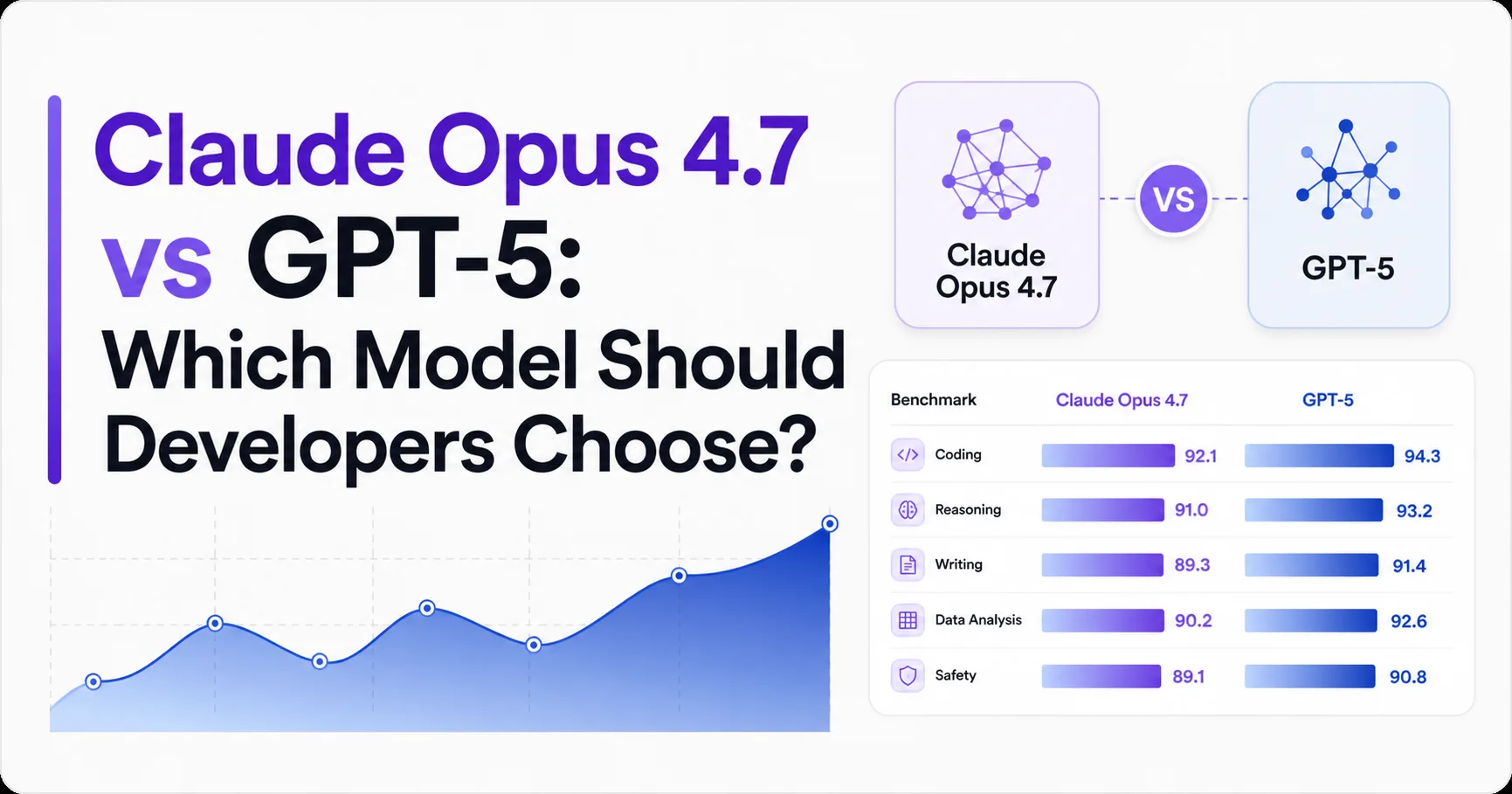
Claude Opus 4.7 is the stronger default for demanding software engineering, while GPT-5 is the more economical choice for high-volume developer workloads. The Artificial Analysis snapshot gives Claude Opus 4.7 a coding index of 73.6, compared with 37.8 for GPT-5. GPT-5 remains materially cheaper, with a blended price of $3.4375 per 1M tokens versus $10 for Claude Opus 4.7.
The models also represent different product decisions. Anthropic presents Claude Opus 4.7 as a model for complex, persistent engineering and agentic work. OpenAI presents GPT-5 as a reasoning model for coding, tool use, and agentic tasks. Those descriptions overlap, but the available data points in different directions: Claude leads the supplied coding and intelligence indexes, while GPT-5 leads the supplied mathematics index with 94.3.
This comparison is therefore not a simple quality ranking. It is a choice between stronger measured coding performance and lower operating cost. The best decision depends on whether the application spends most of its budget on difficult model decisions or on repeated, scalable requests.
Claude Opus 4.7 is the better fit for developers who need sustained codebase work, while GPT-5 is the better fit for cost-sensitive automation. Claude Opus 4.7 leads GPT-5 by 35.8 points on the supplied Artificial Analysis coding index and by 18.799999999999997 points on the intelligence index. GPT-5 leads on the supplied mathematics index at 94.3, while Claude Opus 4.7 has no corresponding value in the snapshot.
| Decision factor | Claude Opus 4.7 | GPT-5 |
|---|---|---|
| Coding index | 73.6 | 37.8 |
| Intelligence index | 53.5 | 34.7 |
| Mathematics index | Not provided | 94.3 |
| Blended price per 1M tokens | $10 | $3.4375 |
| Input price per 1M tokens | $5 | $1.25 |
| Output price per 1M tokens | $25 | $10 |
| Median latency | 0.3 seconds | 0.3 seconds |
The numbers do not answer every production question. The snapshot provides no output-speed value for either model, so it cannot establish a throughput winner. It also does not show task-level error rates, tool-call recovery, or total cost after retries. Those omissions matter because a cheaper model can become expensive if it requires more correction loops.
The qualitative evidence is similarly mixed. The Claude community discussion contains reports of both strong coding performance and frustratingly long planning. The GPT-5 discussion describes useful small bug fixes but also concerns about incomplete application generation and incorrect changes. Neither source is a controlled experiment, so both should inform testing rather than replace it.
Claude Opus 4.7 offers the clearer measured advantage for coding workflows, while GPT-5 retains a narrower advantage for the supplied mathematics result. The Artificial Analysis coding index places Claude Opus 4.7 at 73.6 and GPT-5 at 37.8. In practical terms, that gap supports testing Claude first for repository-wide changes, multi-step debugging, code review, and tasks where the model must preserve intent across several edits.
The result does not prove that Claude will win every coding task. The supplied index is an aggregate measure, and the research brief does not provide its task composition or error distribution. OpenAI's developer announcement reports strong results on coding and agentic evaluations, but those evaluations are not directly interchangeable with the Artificial Analysis index. The evidence supports a directional conclusion, not a universal ranking.
GPT-5's mathematics index of 94.3 is important for workloads dominated by mathematical reasoning, numerical analysis, or formal problem solving. Claude Opus 4.7 has no mathematics value in the snapshot, so the comparison cannot determine how large the mathematics gap is. Developers should treat GPT-5 as the more defensible first candidate for math-heavy tasks, then validate it against representative prompts.
Latency does not separate the models in the supplied data. Both have a median latency of 0.3 seconds. Output speed is unavailable for both models, so streaming responsiveness, long-answer completion time, and sustained generation throughput remain unresolved. The Hacker News discussion also raises concerns about long-context retrieval stability for Claude, but it cites community interpretation rather than an independent reproducible test. Large context capacity should therefore be tested with the application's actual documents.
GPT-5 is substantially cheaper at the token level, making it the safer starting point for applications with large request volume or strict unit economics. GPT-5 costs $1.25 per 1M input tokens and $10 per 1M output tokens. Claude Opus 4.7 costs $5 for input and $25 for output. The blended figures show the same direction: $3.4375 for GPT-5 versus $10 for Claude Opus 4.7.
That price difference is most meaningful when requests are routine, outputs are short, and the application can accept similar completion quality. It is less decisive when a failed answer triggers a human review, a second model call, a tool retry, or a rollback. The data brief does not provide retry rates, task success rates, or cost per completed software change. Those missing measurements prevent a reliable total-cost conclusion.
Claude's higher coding index may justify its price for tasks where one successful attempt is much more valuable than a low token bill. A repository migration, difficult production diagnosis, or long-running coding agent can benefit from stronger instruction adherence and persistent execution, according to Anthropic's official release material. However, the same material warns that stronger literal instruction following can require prompt and harness changes.
GPT-5's lower price favors classification, code explanation, test generation, routine refactoring, and high-volume assistant features. The GPT-5 model documentation also documents its API pricing and current model status. Developers should budget for migration risk because the fixed GPT-5 snapshot is marked Deprecated, even though the stable gpt-5 alias remains documented. Claude's pricing page still lists Opus 4.7, but the model overview and migration material create a separate availability question. Neither model should be selected without checking the exact deployment channel.
GPT-5 (high) leads on 3 of 3 metrics
Claude Opus 4.7 should be the first evaluation candidate for complex coding agents, while GPT-5 should be the first evaluation candidate for cost-sensitive and mathematics-heavy systems. Choose Claude Opus 4.7 when the application must modify an existing repository, follow detailed constraints, inspect documentation, and continue through several dependent actions. Its supplied coding index of 73.6 gives that choice stronger evidence than the available GPT-5 coding value of 37.8.
Choose GPT-5 when the workload is broad, repetitive, or dominated by mathematical reasoning. Its blended price is $3.4375 per 1M tokens, and its mathematics index is 94.3. These advantages make it attractive for developer tools that handle many small requests, provided evaluation shows that additional corrections do not erase the price benefit.
Use a split strategy when the product has distinct task classes. GPT-5 can handle inexpensive triage, summarization, test scaffolding, or first-pass analysis. Claude Opus 4.7 can receive difficult failures, repository-wide changes, or tasks that need deeper persistence. This routing design is a recommendation based on the supplied quality and price signals, not a measured production result.
Before committing, run the same private evaluation suite against both models. Include successful completion, correction count, tool-call validity, regression rate, output length, and time to accepted change. The research brief does not provide those measurements. Community reports remain divided for Claude and mixed for GPT-5, with no reliable independent consensus on overall developer experience.
The main version risk differs by vendor. OpenAI's fixed GPT-5 snapshot is marked Deprecated, while Anthropic's documentation has inconsistent signals between its pricing page and current model overview. The Anthropic migration guide recommends checking supported model behavior and adapting older API patterns. Verify availability through the relevant provider before building a long-lived integration.
GPT-5 is the better first test for mathematics-heavy applications because its supplied mathematics index is 94.3, while Claude Opus 4.7 has no mathematics value in the snapshot. That result does not establish performance on every mathematical workload, so representative validation remains necessary.
Claude Opus 4.7 is the better first test for demanding software engineering because its supplied coding index is 73.6, compared with 37.8 for GPT-5. The index is not a guarantee for every repository, especially where tool integration, prompt design, or project conventions dominate outcomes.
Neither model is faster according to the supplied latency data because both have a median latency of 0.3 seconds. Output speed is unavailable for both models, so developers cannot infer streaming throughput or long-response completion time from this comparison.
GPT-5 is cheaper for token consumption because its blended price is $3.4375 per 1M tokens, compared with $10 for Claude Opus 4.7. The cheaper model may still cost more per accepted task if it needs more retries, corrections, or human review, and the brief does not measure those factors.
Claude Opus 4.7 is the stronger first candidate for coding agents because its Artificial Analysis coding index is 73.6 versus 37.8 for GPT-5. Developers should still validate repository-specific tool use and correction behavior.
GPT-5 is cheaper for production APIs, with a blended price of $3.4375 per 1M tokens versus $10 for Claude Opus 4.7. Total workflow cost may differ if success rates and retry counts diverge.
GPT-5 is the more defensible first choice for mathematics-heavy tasks because its supplied mathematics index is 94.3. Claude Opus 4.7 has no corresponding mathematics value in the provided snapshot.
The supplied data shows no latency difference because Claude Opus 4.7 and GPT-5 both have a median latency of 0.3 seconds. Output speed is unavailable for both models, so throughput remains uncertain.
GPT-5 requires version planning because the fixed snapshot is marked Deprecated, even though the stable gpt-5 alias remains documented. Teams should verify migration requirements before locking production behavior.
Claude Opus 4.7 has several production risks, including possible prompt incompatibilities, higher token consumption, long-context retrieval uncertainty, and inconsistent availability signals across official documentation. Each risk needs workload-specific testing.