
Time to First Token · Claude Opus 4.7 (Adaptive Reasoning, Max Effort)
0ms
Time to First Token · GPT-5 nano (high)
0ms
Deep dive into reasoning, benchmarks, and latency insights.
The current catalog does not contain complete performance evidence for both models, so this page does not declare an overall winner. Use the available fields as comparison signals and validate the models on your own workload.
Key decision metrics at a glance.
| Model | Metric | Value | Unit | Source / snapshot |
|---|---|---|---|---|
| Claude Opus 4.7 (Adaptive Reasoning, Max Effort) | Reasoning | 6.0 | benchmark or capability score | Artificial Analysis · current catalog |
| GPT-5 nano (high) | Reasoning | 8.0 | benchmark or capability score | Artificial Analysis · current catalog |
| Claude Opus 4.7 (Adaptive Reasoning, Max Effort) | Coding | 7.0 | benchmark or capability score | Artificial Analysis · current catalog |
| GPT-5 nano (high) | Coding | 6.0 | benchmark or capability score | Artificial Analysis · current catalog |
| Claude Opus 4.7 (Adaptive Reasoning, Max Effort) | Multimodal | 5.0 | benchmark or capability score | Artificial Analysis · current catalog |
| GPT-5 nano (high) | Multimodal | 2.0 | benchmark or capability score | Artificial Analysis · current catalog |
| Claude Opus 4.7 (Adaptive Reasoning, Max Effort) | Long Context | 7.0 | benchmark or capability score | Artificial Analysis · current catalog |
| GPT-5 nano (high) | Long Context | 3.0 | benchmark or capability score | Artificial Analysis · current catalog |
| Claude Opus 4.7 (Adaptive Reasoning, Max Effort) | Blended Price / 1M tokens | $10 | USD per 1M tokens | Artificial Analysis · current catalog |
| GPT-5 nano (high) | Blended Price / 1M tokens | $0.138 | USD per 1M tokens | Artificial Analysis · current catalog |
| Claude Opus 4.7 (Adaptive Reasoning, Max Effort) | P95 Latency | — | milliseconds | Artificial Analysis · current catalog |
| GPT-5 nano (high) | P95 Latency | — | milliseconds | Artificial Analysis · current catalog |
| Claude Opus 4.7 (Adaptive Reasoning, Max Effort) | Tokens per second | 0 | tokens per second | Artificial Analysis · current catalog |
| GPT-5 nano (high) | Tokens per second | 0 | tokens per second | Artificial Analysis · current catalog |
Data provided by Artificial Analysis; live values use the current catalog.
This radar chart visually maps the core capabilities (reasoning, coding, math proxy, multimodal, long context) of `Claude Opus 4.7 (Adaptive Reasoning, Max Effort)` vs `GPT-5 nano (high)`.
This grouped bar chart provides a side-by-side comparison for each benchmark metric.
Lower time to first token is better; higher tokens per second is better.
Compare input and output pricing in USD per 1M tokens.
Claude Opus 4.7 (Adaptive Reasoning, Max Effort)$11.25
GPT-5 nano (high)$0.15
GPT-5 nano (high) costs $11.1 less per run
This article is a dated snapshot published on 2026-08-07. Live cards above use the current catalog; missing live fields are not inferred.
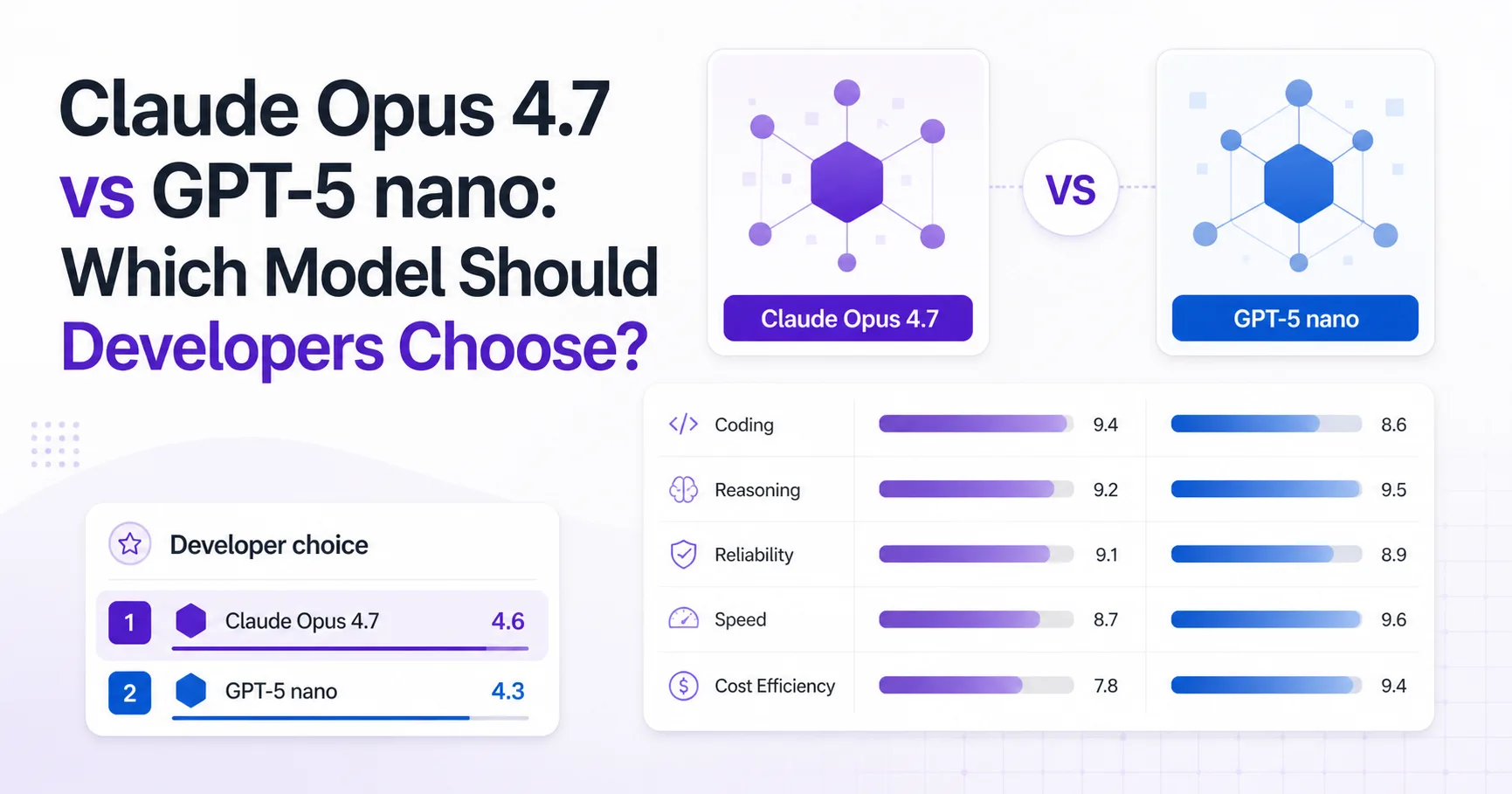
Claude Opus 4.7 is the safer choice for demanding developer workflows, while GPT-5 nano is the lower-cost option with limited current documentation. Anthropic positions Claude Opus 4.7 for complex, long-running software engineering and agent tasks. Its Artificial Analysis Intelligence Index is 53.5, compared with 19.9 for GPT-5 nano in the supplied data. GPT-5 nano has an Artificial Analysis Math Index of 83.7, but the available material does not provide a directly comparable Claude mathematics score. The same evidence gap affects coding: Claude Opus 4.7 has a coding index of 73.6, while no GPT-5 nano coding score appears in the data brief. Cost changes the decision sharply. GPT-5 nano is listed at $0.1375 per 1M blended tokens, compared with $10 for Claude Opus 4.7. However, OpenAI's current model catalog does not list GPT-5 nano, so its production availability and exact API identity require verification before adoption. Data provided by https://artificialanalysis.ai/.
Claude Opus 4.7 offers stronger documented general capability, while GPT-5 nano offers a much lower listed cost with greater uncertainty. The supplied data gives Claude Opus 4.7 a 53.5 Artificial Analysis Intelligence Index and GPT-5 nano a 19.9 score. That difference supports Claude for broad reasoning, complex implementation, and tasks where failure correction is expensive. Anthropic describes Opus 4.7 as a model for sustained execution, instruction following, and output verification in its launch announcement. GPT-5 nano has the stronger available mathematics signal, at 83.7, but the comparison lacks a Claude mathematics value and therefore cannot establish a cross-model mathematics winner. The coding comparison is similarly incomplete. Claude has a 73.6 coding index, while GPT-5 nano has no coding index in the supplied dataset. The largest practical distinction is operational certainty. OpenAI's model documentation does not currently identify GPT-5 nano, and the OpenAI pricing page lists gpt-5.4-nano instead. Developers should treat GPT-5 nano as a candidate requiring validation, not as a confirmed current product.
Claude Opus 4.7 has the stronger broad capability evidence, while neither model has a documented speed advantage in the supplied data. Both models are listed with 0.3 seconds latency, and neither has a median output-tokens-per-second value. That means the available performance data cannot distinguish interactive responsiveness through generation speed. The meaningful separation appears in task coverage. Claude Opus 4.7 records a 53.5 Artificial Analysis Intelligence Index and a 73.6 coding index. GPT-5 nano records a 19.9 Intelligence Index and an 83.7 Math Index. These values suggest different evidence profiles, not a complete ranking. Claude has broader documented evidence for software and general reasoning work. GPT-5 nano has a strong mathematics result, but its coding and general production behavior remain underdocumented. Anthropic reports additional task results, including 90.9% on BigLaw Bench, 0.715 on an internal research-agent benchmark, 70% on CursorBench, and 98.5% on the XBOW visual-acuity benchmark in the Opus 4.7 announcement. Those vendor-reported results are not directly comparable with the Artificial Analysis values and should not be treated as a shared test. Long-context behavior also needs caution. Community discussion citing Anthropic material reports 59.2% in 128k–256k testing and 32.2% in 524k–1024k testing, but the Hacker News discussion is not an independent controlled replication. The evidence is insufficient to claim stable retrieval quality near the maximum context window.
GPT-5 nano is the cheaper listed model, while Claude Opus 4.7 can become economically preferable when task failure and rework dominate. The data brief lists GPT-5 nano at $0.1375 per 1M blended tokens, compared with $10 for Claude Opus 4.7. GPT-5 nano also has lower listed input and output prices, at $0.05 and $0.4 per 1M tokens, while Claude is listed at $5 and $25. That gap makes GPT-5 nano attractive for high-volume classification, routing, lightweight transformations, and mathematics-focused workloads if the model can be called reliably. The cost conclusion can reverse for complex agent workflows. Anthropic documents adaptive thinking and effort controls for Opus 4.7, while higher effort can increase reasoning and output consumption according to the migration guide. Claude's newer tokenizer may also produce about 30% more tokens for the same text, according to Anthropic's pricing documentation. Developers therefore need workload-level measurement, not only nominal rates. The largest unresolved issue is GPT-5 nano's current status. OpenAI's pricing documentation does not list gpt-5-nano, and its listed gpt-5.4-nano price must not be substituted. The supplied evidence is insufficient to confirm GPT-5 nano's live price, availability, or billing behavior. Claude also offers Batch API pricing at $2.50 input and $12.50 output per MTok, which may change batch economics for suitable workloads.
GPT-5 nano (high) leads on 3 of 3 metrics
Claude Opus 4.7 is the better default for high-consequence development work, while GPT-5 nano should enter production only after identity and behavior checks. Choose Claude Opus 4.7 for repository-scale coding, multi-step debugging, long-running agents, document-heavy implementation, and tasks where the model must follow detailed instructions across sustained execution. Anthropic explicitly positions it around complex software engineering and agent workflows in the official release post. Its 73.6 coding index provides useful supporting evidence, although the absence of a GPT-5 nano coding score prevents a complete benchmark comparison. Choose GPT-5 nano for cost-sensitive experiments, narrow mathematical workloads, or high-volume requests where a validated deployment exists. Its 83.7 Math Index is the strongest task-specific signal in the supplied data, but it does not establish superiority for coding or general reasoning. Teams should verify the exact model ID through an API request, then test representative prompts, structured outputs, tool calls, retries, and token usage. Claude also needs prompt migration work. Anthropic warns that stronger literal instruction following can change results from prompts designed for older models. Higher effort can increase latency and output consumption, and non-default sampling parameters may be rejected. GPT-5 nano has a more fundamental evidence gap: the current official catalog does not confirm the model. The practical recommendation is therefore conditional. Use Claude when reliability and capability evidence matter most. Use GPT-5 nano only when its endpoint, terms, and observed quality are confirmed in the target environment.
GPT-5 nano should not be treated as a confirmed current OpenAI model until the target account and API catalog verify it. The cited OpenAI documentation does not list the model, so developers cannot infer its current alias, context limit, API parameters, or retirement status from the available evidence. Claude Opus 4.7 has clearer official documentation, but its listed status still deserves a channel-specific check because the model overview and migration material do not align perfectly. Anthropic's pricing page continues to list Opus 4.7, while the current model overview no longer lists it as a latest model. Developers should query the relevant Models API before committing application logic. The comparison also has incomplete benchmark coverage. Claude has a coding score of 73.6, while GPT-5 nano has no supplied coding score. GPT-5 nano has a mathematics score of 83.7, while Claude has no supplied mathematics score. Any final selection should therefore include a representative evaluation set rather than relying on a single index. Cost estimates also need observed tokenization. Anthropic documents about 30% more tokens for the same text on newer tokenizers, while the GPT-5 nano pricing itself is not confirmed by the cited current pricing page.
Claude Opus 4.7 is the stronger default for complex coding agents because Anthropic explicitly targets sustained software engineering and agent work, and the supplied data gives it a 73.6 coding index. GPT-5 nano lacks a comparable coding score and current official model listing.
GPT-5 nano has the lower listed cost at $0.1375 per 1M blended tokens, but its current official availability and price are not confirmed. Developers should verify the exact endpoint before basing a production cost model on that figure.
GPT-5 nano has the stronger available mathematics evidence, with an Artificial Analysis Math Index of 83.7. The supplied data does not include a comparable Claude Opus 4.7 mathematics score, so the evidence does not establish a complete mathematics ranking.
The supplied data shows no latency difference because both Claude Opus 4.7 and GPT-5 nano are listed at 0.3 seconds. Neither model has a supplied median output-tokens-per-second value, so generation speed remains unresolved.
Claude Opus 4.7 supports a 1M token context window, but the available evidence does not prove stable retrieval throughout that capacity. Community discussion citing Anthropic material reports lower retrieval results at larger context ranges, without independent controlled replication.