
Time to First Token · Claude Opus 4.8 (Adaptive Reasoning, Max Effort)
0ms
Time to First Token · Claude Opus 5 (Adaptive Reasoning, High Effort)
10316ms
Deep dive into reasoning, benchmarks, and latency insights.
The current catalog does not contain complete performance evidence for both models, so this page does not declare an overall winner. Use the available fields as comparison signals and validate the models on your own workload.
Key decision metrics at a glance.
| Model | Metric | Value | Unit | Source / snapshot |
|---|---|---|---|---|
| Claude Opus 4.8 (Adaptive Reasoning, Max Effort) | Reasoning | 6.0 | benchmark or capability score | Artificial Analysis · current catalog |
| Claude Opus 5 (Adaptive Reasoning, High Effort) | Reasoning | 6.0 | benchmark or capability score | Artificial Analysis · current catalog |
| Claude Opus 4.8 (Adaptive Reasoning, Max Effort) | Coding | 7.0 | benchmark or capability score | Artificial Analysis · current catalog |
| Claude Opus 5 (Adaptive Reasoning, High Effort) | Coding | 8.0 | benchmark or capability score | Artificial Analysis · current catalog |
| Claude Opus 4.8 (Adaptive Reasoning, Max Effort) | Multimodal | 5.0 | benchmark or capability score | Artificial Analysis · current catalog |
| Claude Opus 5 (Adaptive Reasoning, High Effort) | Multimodal | 5.0 | benchmark or capability score | Artificial Analysis · current catalog |
| Claude Opus 4.8 (Adaptive Reasoning, Max Effort) | Long Context | 7.0 | benchmark or capability score | Artificial Analysis · current catalog |
| Claude Opus 5 (Adaptive Reasoning, High Effort) | Long Context | 8.0 | benchmark or capability score | Artificial Analysis · current catalog |
| Claude Opus 4.8 (Adaptive Reasoning, Max Effort) | Blended Price / 1M tokens | $10 | USD per 1M tokens | Artificial Analysis · current catalog |
| Claude Opus 5 (Adaptive Reasoning, High Effort) | Blended Price / 1M tokens | $10 | USD per 1M tokens | Artificial Analysis · current catalog |
| Claude Opus 4.8 (Adaptive Reasoning, Max Effort) | P95 Latency | — | milliseconds | Artificial Analysis · current catalog |
| Claude Opus 5 (Adaptive Reasoning, High Effort) | P95 Latency | — | milliseconds | Artificial Analysis · current catalog |
| Claude Opus 4.8 (Adaptive Reasoning, Max Effort) | Tokens per second | 0 | tokens per second | Artificial Analysis · current catalog |
| Claude Opus 5 (Adaptive Reasoning, High Effort) | Tokens per second | 51.106 | tokens per second | Artificial Analysis · current catalog |
Data provided by Artificial Analysis; live values use the current catalog.
This radar chart visually maps the core capabilities (reasoning, coding, math proxy, multimodal, long context) of `Claude Opus 4.8 (Adaptive Reasoning, Max Effort)` vs `Claude Opus 5 (Adaptive Reasoning, High Effort)`.
This grouped bar chart provides a side-by-side comparison for each benchmark metric.
Lower time to first token is better; higher tokens per second is better.
Compare input and output pricing in USD per 1M tokens.
Claude Opus 4.8 (Adaptive Reasoning, Max Effort)$11.25
Claude Opus 5 (Adaptive Reasoning, High Effort)$11.25
This article is a dated snapshot published on 2026-08-05. Live cards above use the current catalog; missing live fields are not inferred.
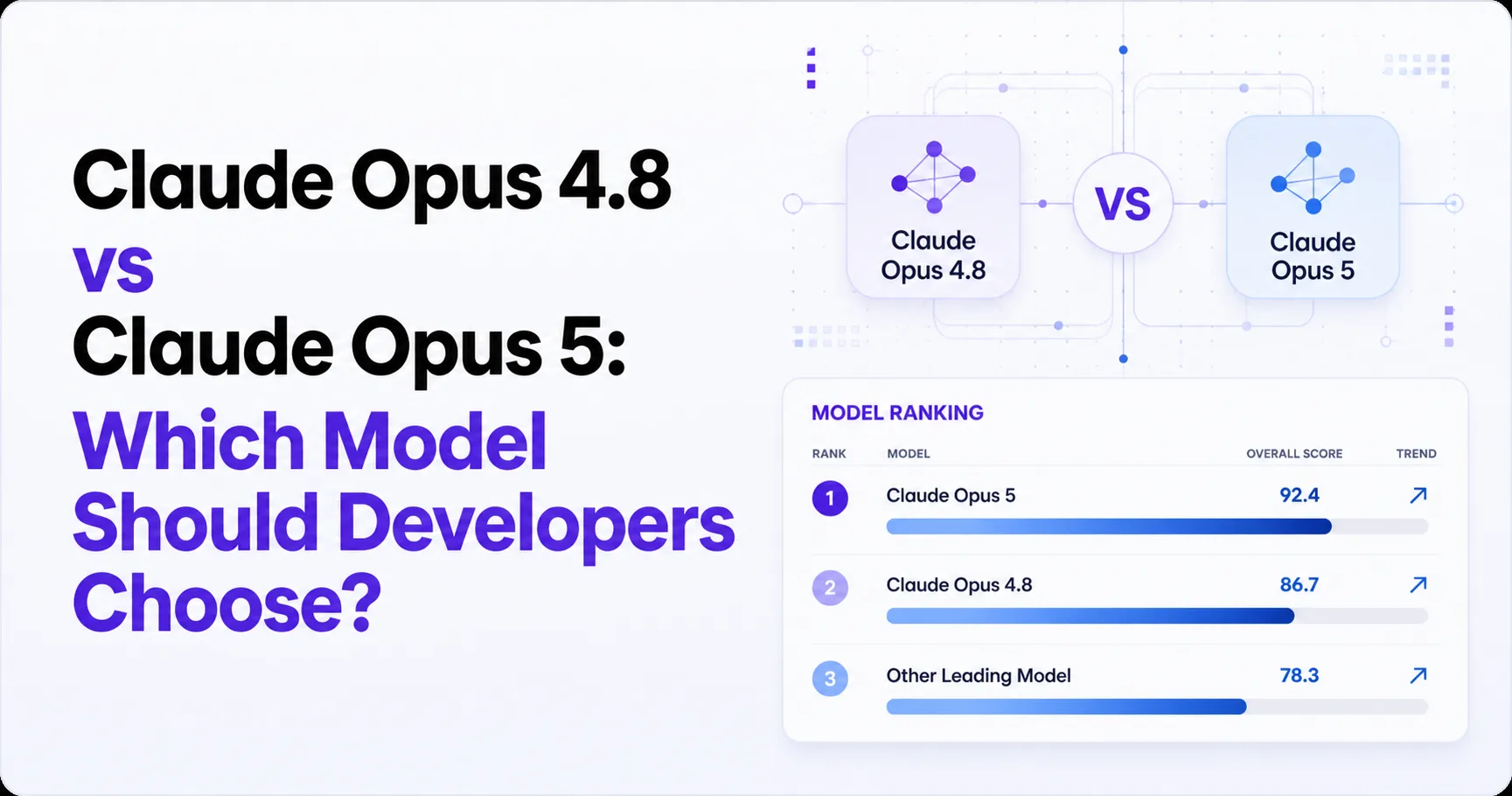
Claude Opus 5 is the stronger default for new developer workloads, scoring 58.9 intelligence and 76.5 coding at the same listed cost. The supplied Artificial Analysis snapshot places Claude Opus 5 above Claude Opus 4.8 on both reported indexes. Claude Opus 4.8 records 55.7 intelligence and 74.3 coding, while both models cost $10 per 1M blended tokens. That combination makes the upgrade case simple for greenfield systems: the measured capability signal favors Opus 5, and the listed token price creates no direct penalty.\n\nThe case is less simple for existing systems. Anthropic still lists Claude Opus 4.8 as Active and not deprecated in its model lifecycle documentation, while Claude Opus 5 is the newer model in the current model overview. Developers should separate two decisions: which model looks stronger now, and whether a working integration can absorb behavior changes. This comparison answers the first with Opus 5, but keeps Opus 4.8 as a valid continuity option.\n\nData provided by https://artificialanalysis.ai/.
Claude Opus 5 wins the supplied head-to-head evidence, while Claude Opus 4.8 remains the safer continuity choice. The comparison below combines the supplied Artificial Analysis data with official documentation and clearly labeled community reports. The indexes are comparable evidence; community comments are directional evidence, not a measured population sample.\n\n| Decision area | Claude Opus 4.8 | Claude Opus 5 | Selection meaning |
|---|---:|---:|---|
| Intelligence index | 55.7 | 58.9 | Opus 5 has the stronger supplied general-capability signal |
| Coding index | 74.3 | 76.5 | Opus 5 has the stronger supplied coding signal |
| Blended price per 1M tokens | $10 | $10 | Listed price does not decide the choice |
| Latency | 0.3 seconds | 0.3 seconds | The supplied latency field is tied |
| Median output speed | Not reported | 54.599 tokens per second | The speed comparison is incomplete |
\nAnthropic positions Claude Opus 5 for complex agent coding and enterprise work in its release announcement. Claude Opus 4.8 was also positioned for complex coding, agent workflows, and professional knowledge work in its release announcement. The supplied evidence therefore supports a model improvement, not a completely different product category.\n\nThe main unresolved question is production reliability. The supplied sources do not provide an independent, reproducible Opus 5 versus Opus 4.8 study for latency, tool-call completion, patch acceptance, or total rework. Opus 4.8 uses the stable API ID claude-opus-4-8; Opus 5 uses claude-opus-5. The comparison page slug claude-opus-5-high is not the official API ID, so integration code should follow Anthropic's model overview and model ID versioning guide.
Claude Opus 5 shows stronger supplied capability evidence, but no supplied benchmark proves faster end-to-end completion. The coding index moves from 74.3 for Claude Opus 4.8 to 76.5 for Claude Opus 5. The intelligence index moves from 55.7 to 58.9. Those results make Opus 5 the better first candidate for repository changes, multi-step reasoning, and agent tasks that depend on broad capability. They do not guarantee higher test-pass rates in a specific codebase.\n\nA benchmark index cannot show whether a model edits the right files, follows a required tool sequence, or stops after the requested scope. Anthropic's Opus 5 announcement emphasizes agent coding, long-running tasks, visual work, and enterprise workflows. Anthropic's Opus 4.8 announcement also emphasizes complex coding and agent use, including uncertainty signaling and self-correction. The practical difference is therefore a stronger measured signal for Opus 5, not proof that Opus 4.8 fails at those workloads.\n\nThe speed evidence needs more caution. The supplied data reports 54.599 median output tokens per second for Opus 5 and no matching value for Opus 4.8. The latency field is 0.3 seconds for both models. A tied latency reading can describe initial response behavior, but it cannot settle total completion time when reasoning, tool calls, retries, and generated output vary. The data is insufficient to declare a complete speed winner.\n\nCommunity reports explain why developers should test the full workflow. One Opus 4.8 user described better answer-length control and occasional self-correction, but also reported skipped steps and messy paths during multi-step agent work in a Reddit field report. Opus 5 users describe useful long autonomous runs, but other reports mention overthinking, slow responses, and broad changes made before scope was fully confirmed in a separate Reddit discussion. These accounts are mixed and lack reproducible test sets.\n\nFor production selection, measure accepted patches, tool-call validity, required-step completion, reviewer corrections, and total wall time. The supplied evidence supports starting with Opus 5, but it does not replace a task-specific harness.
Claude Opus 5 (Adaptive Reasoning, High Effort) leads on 2 of 2 metrics
Claude Opus 5 is not cheaper, because both models carry the same listed token rates. The supplied comparison lists $10 per 1M blended tokens, $5 per 1M input tokens, and $25 per 1M output tokens for each model. Price therefore removes the simplest reason to stay on Claude Opus 4.8.\n\nEqual rates do not create equal bills. Claude Opus 5 may cost less in practice if its stronger capability signal reduces retries, rejected patches, or reviewer intervention. It may cost more if adaptive reasoning spends additional output on simple requests or if autonomous changes require extensive review. The same logic applies to Opus 4.8. A model that appears cheaper per request can become more expensive after failed tool calls, repeated prompts, rollback work, and engineering review.\n\nAnthropic documents adaptive thinking and effort as behavior controls rather than precise spending guarantees in its Effort documentation. Developers should not treat a lower effort setting as a hard token ceiling. For Opus 5, thinking and final output share the configured output limit, as described in the thinking documentation and the Opus 5 update notes. That behavior can affect both latency and spend.\n\nThe most important cost variable is task shape. Repeated repository context, long tool traces, and large generated patches increase usage under either model. Prompt caching and platform routing can also change effective economics, so teams should validate those assumptions against Anthropic's current pricing documentation. The supplied data supports a price tie, not a claim that operational cost will be identical.\n\nA sensible rollout compares cost per accepted outcome rather than cost per request. Track the token bill alongside retries, failed actions, manual corrections, and time spent reviewing generated changes. If Opus 5 produces more accepted work at the same listed rate, its value is better. If its extra reasoning creates little quality gain for routine tasks, Opus 4.8 may remain more efficient for that workload.
Claude Opus 5 should be the default for new quality-sensitive coding and agent workflows, while Claude Opus 4.8 suits continuity-first deployments. The supplied indexes favor Opus 5, and the listed prices are tied. The remaining decision depends on integration risk, process controls, and tolerance for behavior changes.\n\nChoose Claude Opus 5 when:\n\n- You are starting a new coding or agent system and can evaluate behavior with a task-specific harness. Anthropic's official positioning targets complex agent coding and enterprise work.\n- You want the stronger supplied coding and intelligence signals, with scores of 76.5 and 58.9.\n- You can tolerate adaptive reasoning and design around variable thinking effort.\n- You need a model candidate for long-running autonomous work, provided tool permissions, checkpoints, and scope validation are in place. Community feedback suggests that explicit goals can work well, but reports also describe overreach and excessive analysis in the Opus 5 discussion.\n\nChoose Claude Opus 4.8 when:\n\n- You already have a stable integration, prompts, evaluations, and operational expectations built around claude-opus-4-8. Anthropic still lists the model as Active in its lifecycle documentation.\n- Migration risk matters more than the stronger supplied index results. The evidence does not quantify how often an Opus 5 migration changes tool traces, patch shape, or review burden.\n- Your workload benefits from preserving known behavior while you run a controlled comparison against Opus 5.\n\nKeep thinking enabled for Opus 5 when strict tool protocols matter. Anthropic documents that disabling thinking can produce tool calls as ordinary text or expose internal XML-like content, while some effort configurations reject disabled thinking in Opus 5 update notes.\n\nThe safest decision rule is straightforward: use Opus 5 for new systems, retain Opus 4.8 for stable systems, and run a controlled migration before changing a high-value workflow. If strict process adherence is mandatory, neither model has enough supplied public evidence to justify trust without runtime validation.
Claude Opus 5 needs a migration checklist before developers treat it as a drop-in replacement. The first check is model identity. Anthropic's official API ID is claude-opus-5, while claude-opus-5-high is a comparison-page slug rather than the API identifier. The model overview and versioning guide should be the source of truth for integration configuration.\n\nThe second check is request behavior. Opus 5 uses adaptive thinking by default, and thinking contributes to the configured output limit. Existing max_tokens assumptions may therefore need review. Developers should also test tool calls with thinking enabled, because Anthropic documents malformed tool behavior when thinking is disabled in certain configurations through the thinking guide and Opus 5 migration notes.\n\nThe third check is human review. A Claude Code issue collects user complaints about verbosity, terminology, readability, and style drift. Those reports do not establish a confirmed model defect, but they justify testing generated explanations and collaboration output.\n\nFinally, separate model quality from service operations. Anthropic's status incident record documents an Opus 5 elevated-errors event that later recovered. That event is operational evidence, not a capability score. The supplied research also lacks a reliable independent study of real-world success rates, average latency, and stability for either model. Developers should keep an evaluation path open even when the initial choice is clear.
Yes, Claude Opus 5 is the better starting point for a new application because it scores 58.9 on intelligence and 76.5 on coding while matching Opus 4.8's $10 blended price in the supplied Artificial Analysis data. The recommendation still requires workflow testing because the data does not measure production reliability.
No, Claude Opus 4.8 does not require immediate replacement because Anthropic lists it as Active, and the supplied evidence does not measure migration risk or production success in the model lifecycle documentation. A controlled comparison is safer.
No, Claude Opus 5 has a reported median output speed of 54.599 tokens per second, but Opus 4.8 has no matching value, so the supplied data cannot prove a head-to-head speed winner. The latency field is tied at 0.3 seconds.
Claude Opus 5's main implementation risk is adaptive reasoning behavior that can consume output budget, increase latency, or produce invalid tool behavior when thinking is disabled, according to Anthropic's thinking documentation and update notes.
Neither model has sufficient public evidence for strict process compliance; Opus 4.8 reports skipped steps and Opus 5 reports broad autonomous changes, so developers need runtime checks, scoped permissions, and approval gates around either model. The reports are anecdotal in the Opus 4.8 discussion and Opus 5 discussion.