
Time to First Token · Claude Opus 4.8 (Adaptive Reasoning, Max Effort)
0ms
Time to First Token · Claude Opus 5 (Adaptive Reasoning, Medium Effort)
6909ms
Deep dive into reasoning, benchmarks, and latency insights.
The current catalog does not contain complete performance evidence for both models, so this page does not declare an overall winner. Use the available fields as comparison signals and validate the models on your own workload.
Key decision metrics at a glance.
| Model | Metric | Value | Unit | Source / snapshot |
|---|---|---|---|---|
| Claude Opus 4.8 (Adaptive Reasoning, Max Effort) | Reasoning | 6.0 | benchmark or capability score | Artificial Analysis · current catalog |
| Claude Opus 5 (Adaptive Reasoning, Medium Effort) | Reasoning | 6.0 | benchmark or capability score | Artificial Analysis · current catalog |
| Claude Opus 4.8 (Adaptive Reasoning, Max Effort) | Coding | 7.0 | benchmark or capability score | Artificial Analysis · current catalog |
| Claude Opus 5 (Adaptive Reasoning, Medium Effort) | Coding | 7.0 | benchmark or capability score | Artificial Analysis · current catalog |
| Claude Opus 4.8 (Adaptive Reasoning, Max Effort) | Multimodal | 5.0 | benchmark or capability score | Artificial Analysis · current catalog |
| Claude Opus 5 (Adaptive Reasoning, Medium Effort) | Multimodal | 5.0 | benchmark or capability score | Artificial Analysis · current catalog |
| Claude Opus 4.8 (Adaptive Reasoning, Max Effort) | Long Context | 7.0 | benchmark or capability score | Artificial Analysis · current catalog |
| Claude Opus 5 (Adaptive Reasoning, Medium Effort) | Long Context | 7.0 | benchmark or capability score | Artificial Analysis · current catalog |
| Claude Opus 4.8 (Adaptive Reasoning, Max Effort) | Blended Price / 1M tokens | $10 | USD per 1M tokens | Artificial Analysis · current catalog |
| Claude Opus 5 (Adaptive Reasoning, Medium Effort) | Blended Price / 1M tokens | $10 | USD per 1M tokens | Artificial Analysis · current catalog |
| Claude Opus 4.8 (Adaptive Reasoning, Max Effort) | P95 Latency | — | milliseconds | Artificial Analysis · current catalog |
| Claude Opus 5 (Adaptive Reasoning, Medium Effort) | P95 Latency | — | milliseconds | Artificial Analysis · current catalog |
| Claude Opus 4.8 (Adaptive Reasoning, Max Effort) | Tokens per second | 0 | tokens per second | Artificial Analysis · current catalog |
| Claude Opus 5 (Adaptive Reasoning, Medium Effort) | Tokens per second | 50.537 | tokens per second | Artificial Analysis · current catalog |
Data provided by Artificial Analysis; live values use the current catalog.
This radar chart visually maps the core capabilities (reasoning, coding, math proxy, multimodal, long context) of `Claude Opus 4.8 (Adaptive Reasoning, Max Effort)` vs `Claude Opus 5 (Adaptive Reasoning, Medium Effort)`.
This grouped bar chart provides a side-by-side comparison for each benchmark metric.
Lower time to first token is better; higher tokens per second is better.
Compare input and output pricing in USD per 1M tokens.
Claude Opus 4.8 (Adaptive Reasoning, Max Effort)$11.25
Claude Opus 5 (Adaptive Reasoning, Medium Effort)$11.25
This article is a dated snapshot published on 2026-08-05. Live cards above use the current catalog; missing live fields are not inferred.
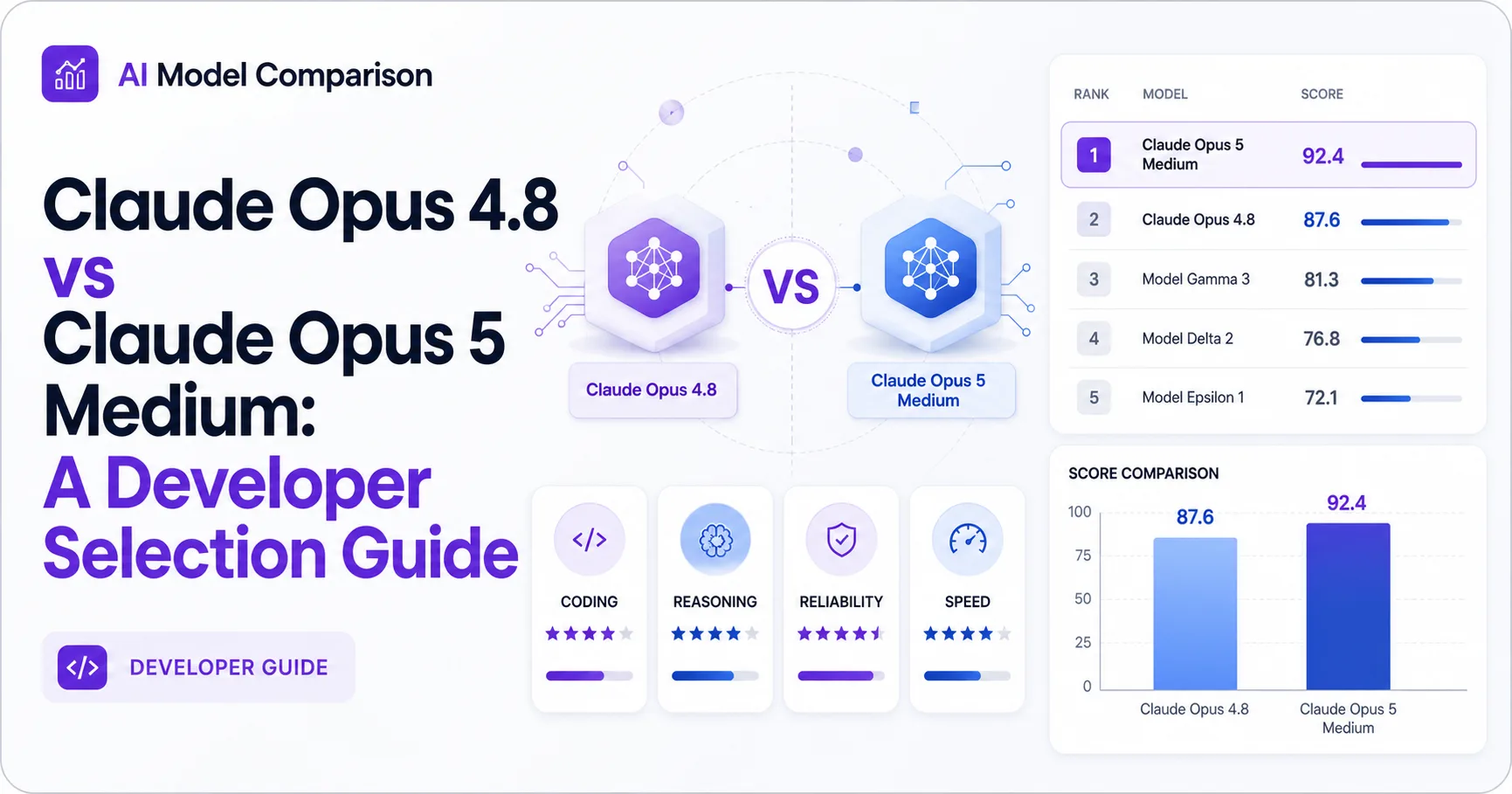
Claude Opus 5 is the stronger default for developers who want the highest measured general-intelligence result at the same listed price. The supplied Artificial Analysis snapshot places Claude Opus 5 at 56.3 on the Intelligence Index versus 55.7 for Claude Opus 4.8, while the Coding Index is tied at 74.3 and the blended price is tied at $10 per 1M tokens (Data provided by).
Claude Opus 5 is not a separate Medium API model. Developers call claude-opus-5 and set effort to medium, according to Anthropic's model overview and Opus 5 update notes. Claude Opus 4.8 uses the stable API ID claude-opus-4-8 and remains listed as active rather than deprecated or retired in the official model lifecycle documentation.
The practical decision is therefore not a price comparison. It is a choice between Opus 5's measured intelligence lead and newer agent positioning, versus Opus 4.8's validated behavior in an existing integration. The comparison also mixes Max Effort for Opus 4.8 with Medium Effort for Opus 5, so the data does not isolate model generation from reasoning configuration.
Claude Opus 5 wins the default-selection case because it leads intelligence while matching coding, price, and reported latency measurements. The comparison data from Artificial Analysis supports a narrow advantage, not a complete replacement claim.
| Decision signal | Claude Opus 4.8 | Claude Opus 5 Medium | Selection meaning |
|---|---|---|---|
| Intelligence Index | 55.7 | 56.3 | Opus 5 leads the supplied general-intelligence measure |
| Coding Index | 74.3 | 74.3 | The measured coding result is a tie |
| Blended price per 1M tokens | $10 | $10 | Neither model is cheaper on the supplied rate |
| Reported latency | 0.3 | 0.3 | The reported latency result is tied |
| Median output tokens per second | Not reported | 54.838 | Only Opus 5 has a reported output-speed value |
The labels also hide a configuration issue. Claude Opus 4.8 is represented with Max Effort, while Claude Opus 5 is represented with Medium Effort. Anthropic describes effort as a runtime control with several levels, and its effort documentation warns that the setting is not a strict token budget. The Opus 5 documentation separately says that the evaluated medium configuration should be set explicitly.
The official product positioning also differs. Anthropic presents Claude Opus 4.8 for complex coding, agent workflows, and professional knowledge work. Anthropic positions Claude Opus 5 around complex agentic coding, long-running development, code review, and enterprise work. Those claims describe intended use, not independent proof that every repository will improve.
The best summary is simple: Opus 5 has the stronger measured default profile, Opus 4.8 remains competitive for coding, and neither model has a demonstrated price advantage.
Claude Opus 5 has the stronger measured intelligence result, but the supplied evidence does not prove a universal coding or speed advantage. The Coding Index is tied at 74.3, so developers should not switch from Claude Opus 4.8 expecting an automatic coding-quality gain from the benchmark result alone (Artificial Analysis).
The intelligence result points to a different selection question. Claude Opus 5 scores 56.3 versus 55.7 for Claude Opus 4.8 on the supplied Intelligence Index. That lead gives Opus 5 a reasonable advantage for work involving ambiguity, competing constraints, or broader task judgment. It does not establish better repository edits, fewer regressions, or better tool decisions for a specific codebase.
Output speed is harder to interpret. Claude Opus 5 has a reported median output speed of 54.838 tokens per second, while Claude Opus 4.8 has no comparable value in the snapshot. Opus 5 is therefore the only model with an available output-speed observation, not a proven faster model. Reported latency is tied at 0.3, but latency and throughput answer different questions. Equal reported latency does not establish equal time to a completed patch, test cycle, or agent loop.
Community evidence reinforces that uncertainty. A user describing direct use of Opus 4.8 reported useful self-correction but also skipped steps and messy paths in multi-step agent work. Opus 5 feedback is similarly mixed: one long-task report describes sustained editing, testing, and rework, while another report describes complex work as slow and a separate report describes it as fast. None provides a controlled head-to-head experiment.
The evidence is insufficient to rank total wall-clock performance. The effort mismatch also matters, because Max Effort and Medium Effort can produce different reasoning behavior even when the underlying model comparison looks close.
Claude Opus 5 (Adaptive Reasoning, Medium Effort) leads on 1 of 2 metrics
Claude Opus 5 and Claude Opus 4.8 are tied on listed token prices, so output behavior determines the practical cost risk. The supplied data gives both models a $10 blended price per 1M tokens, with matching $5 input and $25 output rates (Artificial Analysis; Anthropic pricing).
That removes the simple question of which model is cheaper. The more useful question is how much work each request causes the model to perform. Anthropic says Opus 5 may produce longer responses and delivery documents, narrate progress more often, verify more aggressively, and delegate more work in agent workflows (Opus 5 update notes). At identical token rates, those behaviors can increase spend when a workflow is output-heavy or uses many tool turns.
Claude Opus 4.8 Max Effort is not automatically a low-cost mode either. Anthropic describes effort as a behavior signal rather than a strict token ceiling, and the effort documentation describes Max as a setting for pursuing the highest capability without limiting token consumption. Lowering effort therefore does not guarantee a fixed cost or latency ceiling.
Prompt caching adds another workload variable. The official pricing documentation treats cached input separately from standard input, so production teams should measure cache behavior instead of assuming the blended rate predicts every request.
A model with equal rates can become more expensive if it needs retries, manual corrections, or extra validation. Opus 4.8 reports describe skipped steps, while Opus 5 reports describe over-planning and excess testing (Opus 4.8 user report; Opus 5 planning feedback). The supplied evidence does not quantify cost per completed task, so neither model can be called cheaper for a real production workflow without local measurement.
Claude Opus 5 is the recommended default for new developer workflows, while Claude Opus 4.8 remains a rational continuity choice for validated integrations. The recommendation follows the supplied intelligence lead, tied coding result, equal price, and current official positioning (Artificial Analysis; Anthropic's Opus 5 announcement).
Choose Claude Opus 5 for new agentic coding, broad code review, and workflows that benefit from stronger task judgment. Anthropic explicitly targets Opus 5 at complex agentic coding and enterprise work. Use the real API ID claude-opus-5 with effort set to medium when reproducing this comparison, rather than creating a dependency on the evaluation label (model overview; Opus 5 update notes).
Choose Claude Opus 4.8 when your prompts, tool schemas, review process, and deployment behavior have already been validated against claude-opus-4-8. The model remains active in Anthropic's lifecycle documentation, and its tied Coding Index result makes continued use defensible when local evidence favors it. A new model should not replace a stable integration merely because it has a newer release date.
For either model, require explicit checks before granting broad autonomy. Community reports describe Opus 5 ignoring project instructions, making unrequested changes, and sometimes abandoning native tools. Another report describes contradictory reasoning in a long-context task (context failure report). Opus 4.8 users have also reported skipped process steps, while Claude Code users have raised concerns about verbose, unclear explanations and style drift (Opus 4.8 report; Claude Code issue).
Run a local bake-off with the same repository, tools, prompts, review gates, and effort settings. Measure completed task quality, correction effort, retries, tool compliance, output length, and total spend. The strongest recommendation from the supplied material is Opus 5 for new work, with Opus 4.8 retained wherever your own workflow evidence is stronger.
Claude Opus 5 answers the main selection questions more favorably, but the evidence still requires task-specific validation before autonomous use. Its 56.3 Intelligence Index result leads Claude Opus 4.8 at 55.7, while the Coding Index remains tied at 74.3 (Artificial Analysis).
The most important caveat is configuration. The comparison uses Opus 4.8 at Max Effort and Opus 5 at Medium Effort, so observed differences may reflect both model generation and reasoning settings. Speed is also unresolved because only Opus 5 has a reported output-speed value, while community reports disagree about its real-world pace. The answers below separate measured evidence, official API behavior, and community signals.
Developers should choose Claude Opus 5 by default for new work because it leads the supplied Intelligence Index at 56.3, matches the 74.3 Coding Index, and has the same listed blended price (Artificial Analysis).
Claude Opus 5 Medium is an evaluation configuration, not a separate API model; developers should call claude-opus-5 and set effort to medium, according to Anthropic's model overview and Opus 5 update notes.
Claude Opus 5 has a reported median output speed of 54.838 tokens per second, but the supplied data has no comparable output-speed value for Claude Opus 4.8, so a faster-model claim remains unproven (Artificial Analysis).
Neither model is cheaper on listed pricing: each has a $10 blended price per 1M tokens, with matching $5 input and $25 output rates in the supplied data (Artificial Analysis).
Neither model should be trusted without review for high-stakes autonomous coding because community reports describe skipped steps, instruction drift, unrequested edits, and over-planning, while official materials document Opus 5 limitations (Opus 4.8 report; Opus 5 feedback; Anthropic's Opus 5 announcement).