
Time to First Token · Claude Opus 4.8 (Adaptive Reasoning, Max Effort)
0ms
Time to First Token · DeepSeek V4 Pro 0813 (Reasoning, Max Effort)
1043ms
Deep dive into reasoning, benchmarks, and latency insights.
The current catalog does not contain complete performance evidence for both models, so this page does not declare an overall winner. Use the available fields as comparison signals and validate the models on your own workload.
Key decision metrics at a glance.
| Model | Metric | Value | Unit | Source / snapshot |
|---|---|---|---|---|
| Claude Opus 4.8 (Adaptive Reasoning, Max Effort) | Reasoning | 6.0 | benchmark or capability score | Artificial Analysis · current catalog |
| DeepSeek V4 Pro 0813 (Reasoning, Max Effort) | Reasoning | 6.0 | benchmark or capability score | Artificial Analysis · current catalog |
| Claude Opus 4.8 (Adaptive Reasoning, Max Effort) | Coding | 7.0 | benchmark or capability score | Artificial Analysis · current catalog |
| DeepSeek V4 Pro 0813 (Reasoning, Max Effort) | Coding | 7.0 | benchmark or capability score | Artificial Analysis · current catalog |
| Claude Opus 4.8 (Adaptive Reasoning, Max Effort) | Multimodal | 5.0 | benchmark or capability score | Artificial Analysis · current catalog |
| DeepSeek V4 Pro 0813 (Reasoning, Max Effort) | Multimodal | 4.0 | benchmark or capability score | Artificial Analysis · current catalog |
| Claude Opus 4.8 (Adaptive Reasoning, Max Effort) | Long Context | 7.0 | benchmark or capability score | Artificial Analysis · current catalog |
| DeepSeek V4 Pro 0813 (Reasoning, Max Effort) | Long Context | 7.0 | benchmark or capability score | Artificial Analysis · current catalog |
| Claude Opus 4.8 (Adaptive Reasoning, Max Effort) | Blended Price / 1M tokens | $10 | USD per 1M tokens | Artificial Analysis · current catalog |
| DeepSeek V4 Pro 0813 (Reasoning, Max Effort) | Blended Price / 1M tokens | $1.98 | USD per 1M tokens | Artificial Analysis · current catalog |
| Claude Opus 4.8 (Adaptive Reasoning, Max Effort) | P95 Latency | — | milliseconds | Artificial Analysis · current catalog |
| DeepSeek V4 Pro 0813 (Reasoning, Max Effort) | P95 Latency | — | milliseconds | Artificial Analysis · current catalog |
| Claude Opus 4.8 (Adaptive Reasoning, Max Effort) | Tokens per second | 0 | tokens per second | Artificial Analysis · current catalog |
| DeepSeek V4 Pro 0813 (Reasoning, Max Effort) | Tokens per second | 75.255 | tokens per second | Artificial Analysis · current catalog |
Data provided by Artificial Analysis; live values use the current catalog.
This radar chart visually maps the core capabilities (reasoning, coding, math proxy, multimodal, long context) of `Claude Opus 4.8 (Adaptive Reasoning, Max Effort)` vs `DeepSeek V4 Pro 0813 (Reasoning, Max Effort)`.
This grouped bar chart provides a side-by-side comparison for each benchmark metric.
Lower time to first token is better; higher tokens per second is better.
Compare input and output pricing in USD per 1M tokens.
Claude Opus 4.8 (Adaptive Reasoning, Max Effort)$11.25
DeepSeek V4 Pro 0813 (Reasoning, Max Effort)$2.31
DeepSeek V4 Pro 0813 (Reasoning, Max Effort) costs $8.94 less per run
This article is a dated snapshot published on 2026-08-13. Live cards above use the current catalog; missing live fields are not inferred.
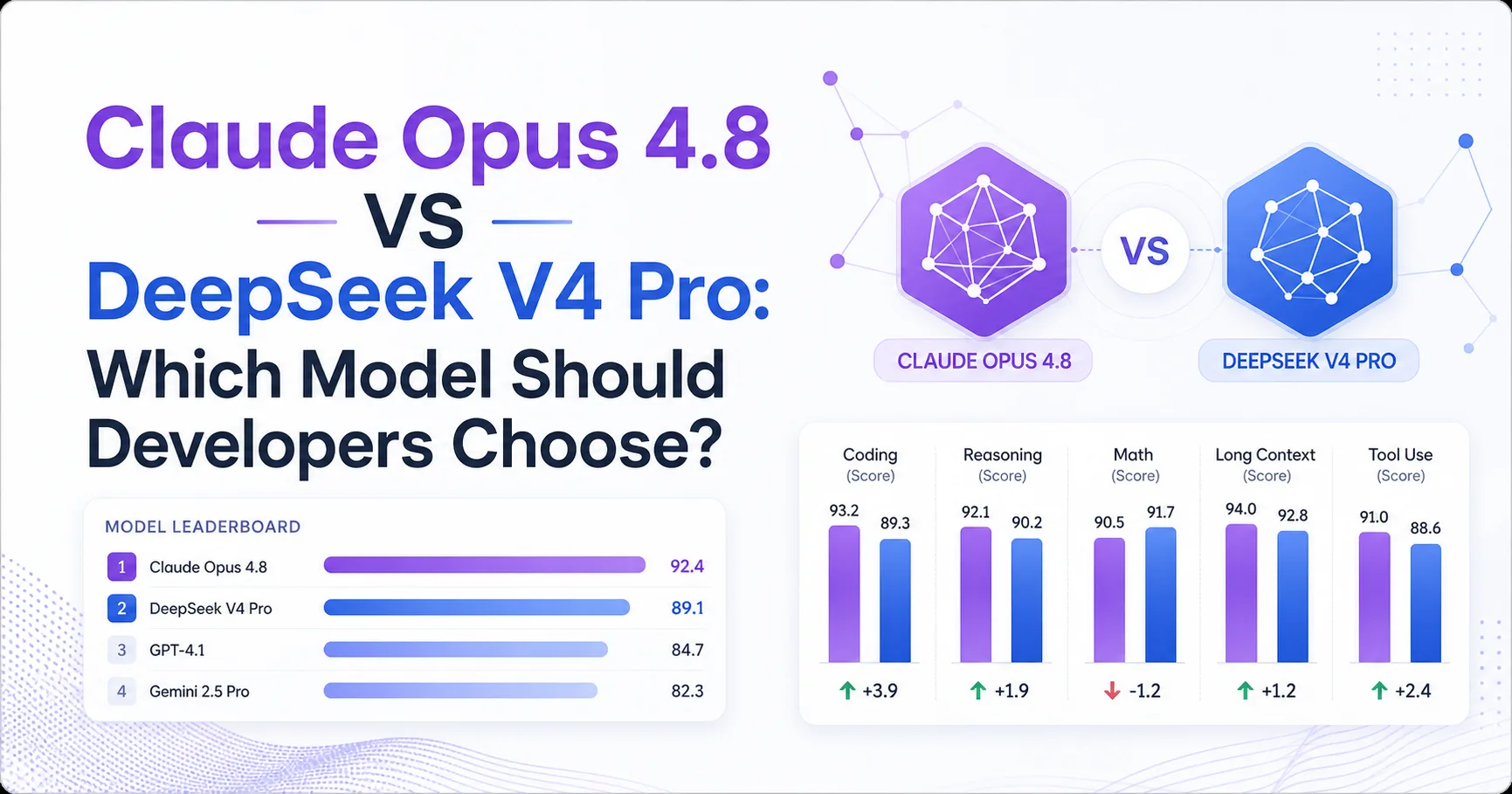
Claude Opus 4.8 is the stronger measured choice for demanding software work, while DeepSeek V4 Pro is the much cheaper and faster option for high-volume workloads. The comparison data gives Claude a 74.3 coding index and a 57.3 intelligence index, ahead of DeepSeek at 68.8 and 53 respectively (Artificial Analysis data). DeepSeek counters with a blended price of $0.544 per 1M tokens versus Claude’s $10, plus a reported median output speed of 67.102 tokens per second (Artificial Analysis data).
The practical decision is therefore not a universal model ranking. Claude fits tasks where fewer failed steps, stronger coding results, and broader evaluated coverage justify premium pricing. DeepSeek fits workloads where unit economics, throughput, and OpenAI-compatible or Anthropic-compatible integration dominate. Evidence remains incomplete for direct latency comparison, multimodal behavior, and several common benchmarks. Developers should treat those gaps as deployment risks, not as proof that either model wins.
Claude Opus 4.8 offers the safer quality-first default, while DeepSeek V4 Pro offers a cost-first alternative with credible but narrower evidence. Anthropic positions Claude Opus 4.8 for complex coding, agent workflows, and professional knowledge work, and documents the stable API ID claude-opus-4-8 (Anthropic release announcement, Claude models overview). DeepSeek lists DeepSeek-V4-Pro-0813 under the deepseek-v4-pro identifier and supports JSON output, tool calling, Responses API, and Anthropic-format requests (DeepSeek pricing and models).
| Decision factor | Claude Opus 4.8 | DeepSeek V4 Pro |
|---|---|---|
| Overall measured index | 57.3 | 53 |
| Coding index | 74.3 | 68.8 |
| Blended price per 1M tokens | $10 | $0.544 |
| Output price per 1M tokens | $25 | $0.87 |
| Median output speed | 0 reported | 67.102 |
| Release date | 2026-05-28 | 2026-08-13 |
Claude leads on coding, the overall index, HLE at 0.487, SciCode at 0.535, and TerminalBench v2.1 at 0.846441947565543 (Artificial Analysis data). DeepSeek edges Claude on GPQA at 0.928 versus 0.92, LCR at 0.753333333333333 versus 0.73, and tau banking at 0.395876288659794 versus 0.342268041237113 (Artificial Analysis data). Those reversals matter because they show specialization rather than a clean sweep.
The most important evidence gap is independent DeepSeek community feedback. The research brief found no reliable Reddit, Hacker News, or X posts that support claims about its coding style, stability, or response behavior. Claude has more anecdotal feedback, but that evidence is also uncontrolled and sometimes contradictory (Reddit user report).
Claude Opus 4.8 is more likely to repay its premium on complex coding and multi-step engineering tasks, based on the measured capability gap. Claude’s coding index is 74.3 versus DeepSeek’s 68.8, a difference large enough to matter when a task requires repository-wide edits, debugging, and sustained context (Artificial Analysis data). Claude also leads on SciCode at 0.535 versus 0.492 and TerminalBench v2.1 at 0.846441947565543 versus 0.786516853932584 (Artificial Analysis data). These results suggest a better fit for code changes that must survive tests and operational edge cases, although benchmark scores cannot guarantee production correctness.
DeepSeek V4 Pro is still competitive on targeted reasoning. It scores 0.928 on GPQA against Claude’s 0.92, and 0.753333333333333 on LCR against Claude’s 0.73 (Artificial Analysis data). A team building focused question-answering or long-context retrieval workflows may see little reason to pay for Claude if its own validation set resembles those tasks.
Agent control is the harder distinction. Anthropic claims Claude emphasizes uncertainty disclosure and self-correction, but that statement is vendor-reported rather than an independent experiment (Anthropic release announcement). A community user reported that Claude improved error awareness but sometimes skipped explicit steps in multi-step agents (Reddit user report). Another commenter said Adaptive thinking sometimes underestimates hidden subtask difficulty (Reddit discussion). DeepSeek has no comparable public evidence in the brief, so neither model should run unsupervised without tool-result checks, tests, and stop conditions.
Speed needs careful interpretation. DeepSeek reports 67.102 median output tokens per second, while Claude’s value is 0 in the dataset (Artificial Analysis data). The zero may represent missing measurement rather than instant output, so the data cannot establish a trustworthy latency winner. Measure first-token delay, total completion time, streaming smoothness, and retry rates on your own prompts.
Claude Opus 4.8 (Adaptive Reasoning, Max Effort) leads on 2 of 2 metrics
DeepSeek V4 Pro wins the price comparison by a wide margin, but total engineering cost depends on how often outputs need review, retries, or model escalation. Its blended price is $0.544 per 1M tokens versus $10 for Claude Opus 4.8, and its output price is $0.87 versus $25 (Artificial Analysis data). That difference favors DeepSeek for batch classification, routine extraction, test generation, and other workloads with predictable prompts and automated checks.
Claude’s premium is easier to justify when one failed answer creates expensive downstream work. A coding agent that edits several files, breaks a build, or misses a migration step can consume developer time that dwarfs the token bill. Anthropic’s pricing page lists prompt caching options, including cache-hit pricing of $0.50 per 1M tokens, which can improve economics for repeated context (Anthropic pricing). The research brief does not provide a comparable DeepSeek caching workflow beyond its listed cached-input price, so teams should benchmark cache behavior rather than assume equivalent savings (DeepSeek pricing and models).
DeepSeek also carries price volatility risk. Its official page warns that API prices may increase substantially in the future (DeepSeek pricing and models). The same page lists a concurrency limit of 500, which may require queueing, throttling, and retry logic for bursty workloads (DeepSeek pricing and models). Claude’s effort setting can change capability and token use, but Anthropic explicitly describes it as a behavior signal rather than a strict token or latency budget (Effort documentation).
The cost conclusion is conditional: DeepSeek minimizes predictable token spend, while Claude may minimize cost per accepted result when verification and rework dominate.
DeepSeek V4 Pro 0813 (Reasoning, Max Effort) leads on 3 of 3 metrics
Claude Opus 4.8 is the best default for high-consequence coding agents, while DeepSeek V4 Pro is the best default for price-sensitive scale. Choose Claude when the workflow includes repository-level changes, difficult debugging, tool orchestration, or professional analysis where the 74.3 coding index and 0.846441947565543 TerminalBench v2.1 result align with your acceptance criteria (Artificial Analysis data). Keep human review in the loop because community reports describe skipped steps, guessed paths, and style drift in Claude Code conversations (Reddit user report, Claude Code issue #77136).
Choose DeepSeek when requests are numerous, outputs are short or structured, and automated validation can reject bad responses. Its $0.544 blended price and 67.102 reported output speed support high-volume services (Artificial Analysis data). Its documented JSON output and tool calling also suit API-centric pipelines (DeepSeek pricing and models). Avoid relying on FIM completion in reasoning mode because the official documentation limits FIM to non-thinking mode (DeepSeek pricing and models).
A two-model router is sensible when workloads vary. Route high-risk coding and agent planning to Claude, then send routine transformations or overflow traffic to DeepSeek. Set quality gates around tests, schema validation, tool-call verification, and escalation. The research brief does not establish a direct, reproducible comparison of production latency, multimodal quality, or DeepSeek coding behavior, so those should be measured in a small shadow deployment before committing to one provider.
Claude Opus 4.8 is the better starting point when your primary risk is incorrect code or incomplete agent execution. The measured coding index is 74.3 versus 68.8, while community reports still describe occasional skipped steps, so acceptance tests remain necessary (Artificial Analysis data, Reddit user report).
Claude Opus 4.8 is the stronger first candidate for an autonomous coding agent because it leads the coding index at 74.3 versus 68.8 and leads TerminalBench v2.1 at 0.846441947565543 versus 0.786516853932584. However, community reports describe skipped steps and unverified guesses, so tests, tool checks, and human review remain required (Artificial Analysis data, Reddit user report).
DeepSeek V4 Pro can fit production APIs that enforce schemas, validate tool results, and tolerate provider price changes. Its official documentation lists JSON output, tool calling, and a concurrency limit of 500, while the data shows a $0.544 blended price per 1M tokens. The research brief does not provide independent production reliability or coding evidence, so run a shadow test before migration (DeepSeek pricing and models, Artificial Analysis data).
DeepSeek V4 Pro is cheaper by the listed token rates, costing $0.544 per 1M blended tokens versus $10 for Claude Opus 4.8, with output priced at $0.87 versus $25. The cheaper rate can disappear if lower-quality answers create retries, manual review, or escalation traffic, so compare cost per accepted result rather than invoice cost alone (Artificial Analysis data).
DeepSeek V4 Pro has a reported median output speed of 67.102 tokens per second, while Claude Opus 4.8 is recorded as 0 in the dataset. That zero may indicate missing measurement, so the available evidence cannot prove a latency winner. Measure time to first token, completion time, and retry rates using your own workload (Artificial Analysis data).
Claude Adaptive thinking should not be treated as a guarantee that every hidden subtask receives deep reasoning. One community commenter reported that Adaptive thinking sometimes judged a task too simple and omitted difficult substeps, while Anthropic presents uncertainty handling and self-correction as a vendor claim. Use explicit checklists, higher effort settings when appropriate, and automated verification (Reddit discussion, Anthropic release announcement, Effort documentation).