
Time to First Token · Claude Opus 4.8 (Adaptive Reasoning, Max Effort)
0ms
Time to First Token · GPT-5.6 Terra (max)
109872ms
Deep dive into reasoning, benchmarks, and latency insights.
The current catalog does not contain complete performance evidence for both models, so this page does not declare an overall winner. Use the available fields as comparison signals and validate the models on your own workload.
Key decision metrics at a glance.
| Model | Metric | Value | Unit | Source / snapshot |
|---|---|---|---|---|
| Claude Opus 4.8 (Adaptive Reasoning, Max Effort) | Reasoning | 6.0 | benchmark or capability score | Artificial Analysis · current catalog |
| GPT-5.6 Terra (max) | Reasoning | 6.0 | benchmark or capability score | Artificial Analysis · current catalog |
| Claude Opus 4.8 (Adaptive Reasoning, Max Effort) | Coding | 7.0 | benchmark or capability score | Artificial Analysis · current catalog |
| GPT-5.6 Terra (max) | Coding | 8.0 | benchmark or capability score | Artificial Analysis · current catalog |
| Claude Opus 4.8 (Adaptive Reasoning, Max Effort) | Multimodal | 5.0 | benchmark or capability score | Artificial Analysis · current catalog |
| GPT-5.6 Terra (max) | Multimodal | 5.0 | benchmark or capability score | Artificial Analysis · current catalog |
| Claude Opus 4.8 (Adaptive Reasoning, Max Effort) | Long Context | 7.0 | benchmark or capability score | Artificial Analysis · current catalog |
| GPT-5.6 Terra (max) | Long Context | 7.0 | benchmark or capability score | Artificial Analysis · current catalog |
| Claude Opus 4.8 (Adaptive Reasoning, Max Effort) | Blended Price / 1M tokens | $10 | USD per 1M tokens | Artificial Analysis · current catalog |
| GPT-5.6 Terra (max) | Blended Price / 1M tokens | $4.5 | USD per 1M tokens | Artificial Analysis · current catalog |
| Claude Opus 4.8 (Adaptive Reasoning, Max Effort) | P95 Latency | — | milliseconds | Artificial Analysis · current catalog |
| GPT-5.6 Terra (max) | P95 Latency | — | milliseconds | Artificial Analysis · current catalog |
| Claude Opus 4.8 (Adaptive Reasoning, Max Effort) | Tokens per second | 0 | tokens per second | Artificial Analysis · current catalog |
| GPT-5.6 Terra (max) | Tokens per second | 117.141 | tokens per second | Artificial Analysis · current catalog |
Data provided by Artificial Analysis; live values use the current catalog.
This radar chart visually maps the core capabilities (reasoning, coding, math proxy, multimodal, long context) of `Claude Opus 4.8 (Adaptive Reasoning, Max Effort)` vs `GPT-5.6 Terra (max)`.
This grouped bar chart provides a side-by-side comparison for each benchmark metric.
Lower time to first token is better; higher tokens per second is better.
Compare input and output pricing in USD per 1M tokens.
Claude Opus 4.8 (Adaptive Reasoning, Max Effort)$11.25
GPT-5.6 Terra (max)$5
GPT-5.6 Terra (max) costs $6.25 less per run
This article is a dated snapshot published on 2026-08-05. Live cards above use the current catalog; missing live fields are not inferred.
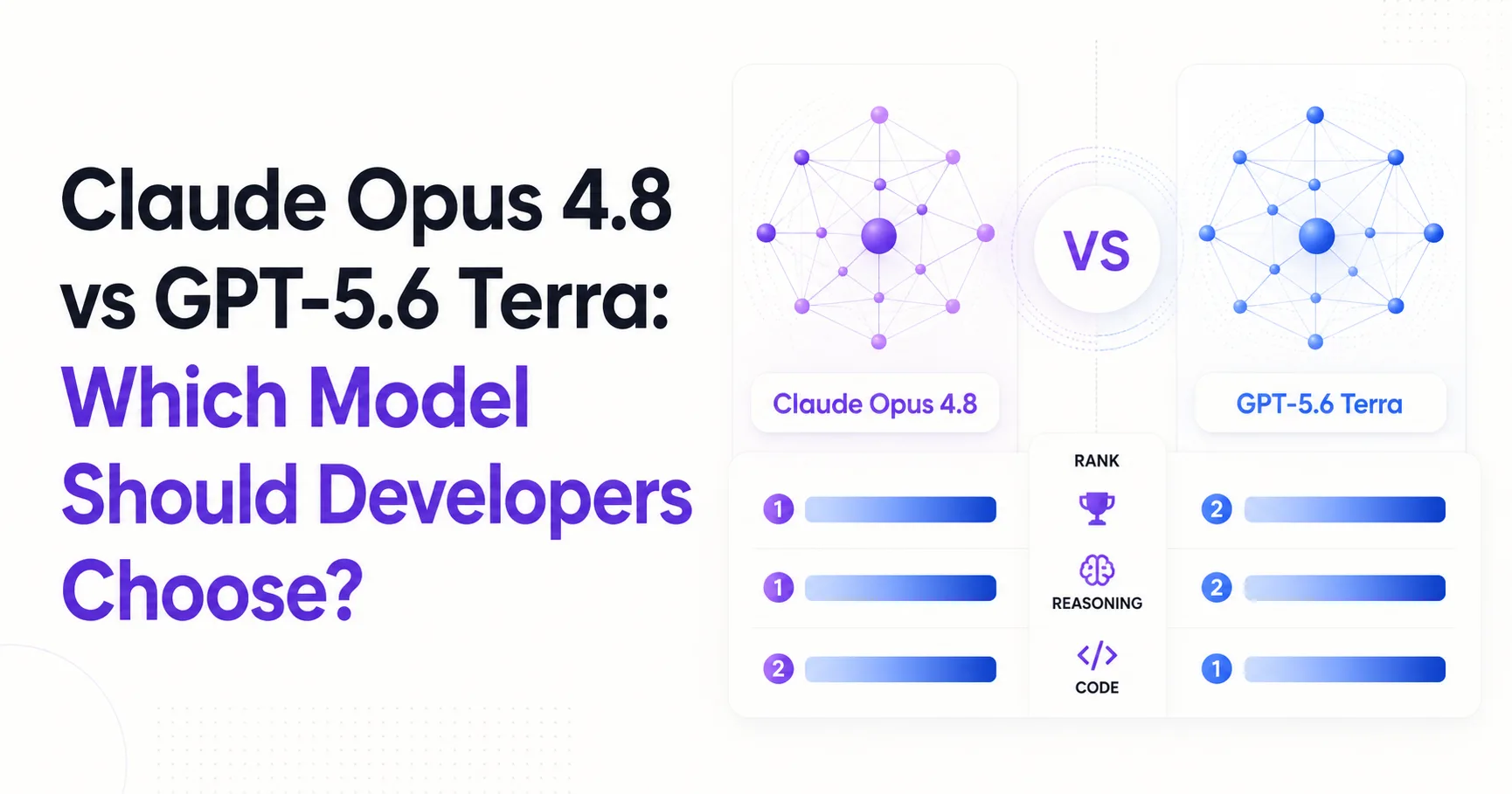
GPT-5.6 Terra (max) is the better default for most developer workloads, leading coding at 76.7 and costing $4.500000000000001 per 1M blended tokens.
Claude Opus 4.8 remains the quality-first alternative: its intelligence index is 55.7 versus Terra's 55, and Anthropic positions it for complex coding, Agent workflows, and professional knowledge work (Introducing Claude Opus 4.8).
Terra's coding index is 76.7 versus Claude's 74.3 in the supplied Artificial Analysis snapshot, so the practical decision is not a simple premium-versus-basic split. Terra is cheaper and stronger on the measured coding signal. Claude has a narrow general-intelligence edge, plus controls for adaptive thinking and effort that may suit tasks where answer depth matters (Claude models overview; Effort).
Neither model has a complete public reliability case in the supplied evidence. A Reddit report describes stronger self-correction and useful effort tuning for Claude, but also skipped steps in multi-step Agent tasks; no comparable Terra community record is available (Reddit report).
Use Terra as the starting point for production evaluation. Keep Claude in the test set for complex review, research, and long-horizon coding, especially when your team can inspect process quality rather than only final answers.
Data provided by https://artificialanalysis.ai/.
GPT-5.6 Terra (max) is the stronger value winner, while Claude Opus 4.8 offers the narrow general-intelligence edge.
| Signal | Claude Opus 4.8 | GPT-5.6 Terra (max) | Selection reading |
|---|---|---|---|
| Coding index | 74.3 | 76.7 | Terra has the stronger measured coding signal. |
| Intelligence index | 55.7 | 55 | Claude has the higher measured general-intelligence signal. |
| Blended price, 3-to-1 | $10 | $4.500000000000001 | Terra has the lower blended price. |
| Input price per 1M tokens | $5 | $2 | Terra has the lower input price. |
| Output price per 1M tokens | $25 | $12 | Terra has the lower output price. |
| Reported latency | 0.3 seconds | 0.3 seconds | The supplied snapshot reports a tie. |
Terra's advantage is unusually coherent for a developer default: it wins the coding index, costs less on every supplied standard price, and has the only reported median output rate. Claude's advantage is narrower but meaningful: it leads the intelligence index and offers a reasoning interface designed around adaptive effort. Data provided by https://artificialanalysis.ai/.
Official product differences reinforce, but do not prove, that split. Anthropic documents image input, adaptive thinking, and broad deployment paths. OpenAI documents structured outputs, function calling, file search, web search, and other tools for Terra (Claude models overview; GPT-5.6 Terra Model).
Model lifecycle is not a strong tie-breaker today. Anthropic's lifecycle documentation keeps Claude Opus 4.8 Active, while OpenAI's deprecation page does not list GPT-5.6 Terra (Claude deprecations; OpenAI deprecations). The status evidence supports deployment testing now, but it does not guarantee future pricing, limits, or product behavior.
GPT-5.6 Terra (max) leads the measured coding index, but the public evidence does not prove a universal speed or reliability win.
Artificial Analysis reports coding at 76.7 for Terra and 74.3 for Claude, while the intelligence index is 55 for Terra and 55.7 for Claude (Artificial Analysis). This is a profile difference, not a universal leaderboard. A coding lead can change the outcome for patch generation, test repair, code search, and tool-mediated edits. The intelligence lead matters more for open-ended synthesis, judgment, and explanation. The snapshot cannot tell you whether either lead survives your language mix, repository shape, or acceptance criteria.
Latency is 0.3 seconds for each model in the supplied data. Terra also has a reported median output speed of 144.252 tokens per second, while Claude has no reported value. Terra is therefore the only model with a throughput measurement, not a proven faster model. Treat first-token delay, total completion time, and output rate as separate production metrics.
Claude's official announcement says Opus 4.8 is designed to surface uncertainty and self-correct in Agent work. A Reddit report describes better self-correction and length control, but also says multi-step tasks can skip explicit steps or reach correct results through messy paths (Introducing Claude Opus 4.8; Reddit report). The report is useful as a failure hypothesis, not a benchmark because it discloses no reproducible task set or measurements.
A separate Claude Code issue records user complaints about verbose, jargon-heavy explanations and style drift across turns, so readability and instruction persistence deserve explicit tests (Claude Code Issue #77136). Terra's official reasoning guidance adds a different failure mode: reasoning tokens share the output budget, so an overly restrictive cap can end a response before visible text is produced (Reasoning models).
That warning says more about orchestration than raw ability. Build evaluation around complete responses, valid tool calls, hidden tests, recovery after failures, and compliance with process instructions. The supplied brief does not provide comparable scores for those behaviors.
GPT-5.6 Terra (max) is the cost winner for the supplied 3-to-1 blend, but workload shape can change the effective bill.
Artificial Analysis lists $4.500000000000001 for Terra and $10 for Claude on a 3-to-1 blended basis. It also lists Terra at $2 input and $12 output per 1M tokens, versus Claude at $5 and $25 (Artificial Analysis).
That ranking is decisive for steady workloads with similar completion behavior. It is not a complete invoice for agents. Output-heavy loops amplify generated-token prices. Input-heavy repository analysis depends on context reuse, cache hits, and request size. A cheaper request can become more expensive if it retries, emits longer reasoning traces, or creates more downstream validation work.
Both vendors document prompt caching, but their cache-write and cache-hit rules differ (Claude pricing; GPT pricing). Use your own traffic mix to model uncached input, cached input, cache writes, output, retries, and failed tool calls. The supplied blended metric is a useful starting point, not a universal total-cost result.
Long-context billing is another reason to avoid extrapolating from the chart. OpenAI's Terra documentation describes higher pricing for sufficiently large input requests, while the supplied data snapshot leaves context_window unreported for both models (GPT-5.6 Terra Model). That means the benchmark snapshot cannot settle which model is cheaper for very large prompts.
Claude's effort control also does not function as a precise token or latency ceiling, according to Anthropic's documentation (Effort). Teams should record actual token consumption and completion outcomes at the chosen effort setting. Terra is the obvious low-cost default, but Claude can be cheaper in practice if its answers reduce retries, human edits, or tool failures. The supplied brief contains no data to quantify that inversion, so a pilot is required.
GPT-5.6 Terra (max) leads on 3 of 3 metrics
GPT-5.6 Terra (max) is the recommended starting model for most developer teams, while Claude Opus 4.8 merits targeted validation for high-stakes reasoning work.
Pick Terra when coding is the main workload, the product relies on function calls or structured outputs, or unit cost is a central constraint. OpenAI's model page lists these interfaces alongside file search, web search, hosted shell, Apply Patch, MCP, and other tools (GPT-5.6 Terra Model). The coding index of 76.7 and blended price of $4.500000000000001 make Terra the rational starting candidate for code agents, developer tools, and high-volume automation.
Pick Claude when your team values Anthropic's adaptive thinking controls, image-aware workflows, or a workflow already built around Claude APIs and Bedrock, AWS, Google Cloud, or Microsoft Foundry (Claude models overview). Anthropic's release positions Opus 4.8 for complex coding and professional knowledge work (Introducing Claude Opus 4.8). Those are reasons to test it, not proof that it beats Terra on your tasks. The Reddit evidence also makes process adherence a specific check, especially for unattended multi-step agents (Reddit report).
Do not make the final choice from the index alone. Run the same representative tasks through both models, then compare accepted outputs, hidden-test pass rates, tool-call correctness, process adherence, human correction time, cache behavior, and total spend. Include prompts that require refusal, uncertainty handling, and recovery after tool errors. OpenAI offers no Terra-specific public benchmark in the supplied brief, and Anthropic's community evidence is anecdotal, so your own task set is the missing evidence.
Overall, start with Terra, retain Claude as a targeted challenger, and promote Claude only where its measured task outcomes justify its higher price.
Claude Opus 4.8 and GPT-5.6 Terra (max) lack a directly comparable public reliability study in the supplied evidence.
The benchmark snapshot gives a useful score, price, latency, and a reported throughput value. It does not show task-level success, retry rates, process adherence, cache hit behavior, or complete throughput parity. The research material gives Claude some real-world anecdotes, but it gives Terra no reliable community track record. That asymmetry should reduce confidence in any claim about personality, stability, or unattended Agent performance.
Several questions remain open: whether Terra's coding lead survives your repository and test suite, whether Claude's intelligence lead reduces human correction, and whether cache and retry patterns reverse the unit-price ranking. The right next step is a representative evaluation with production-like prompts and a fixed scoring rubric. Treat the chart as a shortlist tool, not a substitute for acceptance testing.
The evidence also does not establish that Claude's adaptive reasoning or Terra's reasoning controls consistently produce better process compliance. Both models need tests that inspect intermediate actions, tool arguments, incomplete responses, and recovery behavior. Those results are more decision-relevant than a single aggregate index.
GPT-5.6 Terra (max) is the better overall default for most developers because it leads coding at 76.7, matches Claude's 0.3-second latency, and costs $4.500000000000001 versus $10 per 1M blended tokens. Claude Opus 4.8 remains worth testing when general intelligence, adaptive thinking, or Anthropic-specific workflows matter.
Claude Opus 4.8 has the higher supplied intelligence index at 55.7 versus GPT-5.6 Terra's 55, but the evidence is insufficient to call Claude broadly better at reasoning. Anthropic's adaptive thinking supports a targeted trial, while community feedback warns that adaptive behavior may under-estimate hidden subtask difficulty (Effort; Reddit report).
GPT-5.6 Terra (max) is cheaper on the supplied 3-to-1 blend at $4.500000000000001 per 1M tokens versus Claude Opus 4.8 at $10. Actual bills can differ because cache hits, cache writes, output length, retries, and long-input pricing are workload-specific (Claude pricing; GPT pricing).
GPT-5.6 Terra (max) is the only model with a reported median output speed, at 144.252 tokens per second, so the evidence does not prove a head-to-head speed win. Both models show 0.3-second latency in the supplied snapshot, and Claude has no comparable throughput value.
GPT-5.6 Terra (max) is the safer starting test for tool-heavy agents, while Claude Opus 4.8 requires explicit process checks. OpenAI documents broad tool support, but Claude community reports mention skipped steps and messy paths, and neither source establishes unattended reliability (GPT-5.6 Terra Model; Reddit report).