
Time to First Token · Claude Opus 4.8 (Adaptive Reasoning, Max Effort)
0ms
Time to First Token · GPT-5 nano (high)
0ms
Deep dive into reasoning, benchmarks, and latency insights.
The current catalog does not contain complete performance evidence for both models, so this page does not declare an overall winner. Use the available fields as comparison signals and validate the models on your own workload.
Key decision metrics at a glance.
| Model | Metric | Value | Unit | Source / snapshot |
|---|---|---|---|---|
| Claude Opus 4.8 (Adaptive Reasoning, Max Effort) | Reasoning | 6.0 | benchmark or capability score | Artificial Analysis · current catalog |
| GPT-5 nano (high) | Reasoning | 8.0 | benchmark or capability score | Artificial Analysis · current catalog |
| Claude Opus 4.8 (Adaptive Reasoning, Max Effort) | Coding | 7.0 | benchmark or capability score | Artificial Analysis · current catalog |
| GPT-5 nano (high) | Coding | 6.0 | benchmark or capability score | Artificial Analysis · current catalog |
| Claude Opus 4.8 (Adaptive Reasoning, Max Effort) | Multimodal | 5.0 | benchmark or capability score | Artificial Analysis · current catalog |
| GPT-5 nano (high) | Multimodal | 2.0 | benchmark or capability score | Artificial Analysis · current catalog |
| Claude Opus 4.8 (Adaptive Reasoning, Max Effort) | Long Context | 7.0 | benchmark or capability score | Artificial Analysis · current catalog |
| GPT-5 nano (high) | Long Context | 3.0 | benchmark or capability score | Artificial Analysis · current catalog |
| Claude Opus 4.8 (Adaptive Reasoning, Max Effort) | Blended Price / 1M tokens | $10 | USD per 1M tokens | Artificial Analysis · current catalog |
| GPT-5 nano (high) | Blended Price / 1M tokens | $0.138 | USD per 1M tokens | Artificial Analysis · current catalog |
| Claude Opus 4.8 (Adaptive Reasoning, Max Effort) | P95 Latency | — | milliseconds | Artificial Analysis · current catalog |
| GPT-5 nano (high) | P95 Latency | — | milliseconds | Artificial Analysis · current catalog |
| Claude Opus 4.8 (Adaptive Reasoning, Max Effort) | Tokens per second | 0 | tokens per second | Artificial Analysis · current catalog |
| GPT-5 nano (high) | Tokens per second | 0 | tokens per second | Artificial Analysis · current catalog |
Data provided by Artificial Analysis; live values use the current catalog.
This radar chart visually maps the core capabilities (reasoning, coding, math proxy, multimodal, long context) of `Claude Opus 4.8 (Adaptive Reasoning, Max Effort)` vs `GPT-5 nano (high)`.
This grouped bar chart provides a side-by-side comparison for each benchmark metric.
Lower time to first token is better; higher tokens per second is better.
Compare input and output pricing in USD per 1M tokens.
Claude Opus 4.8 (Adaptive Reasoning, Max Effort)$11.25
GPT-5 nano (high)$0.15
GPT-5 nano (high) costs $11.1 less per run
This article is a dated snapshot published on 2026-08-07. Live cards above use the current catalog; missing live fields are not inferred.
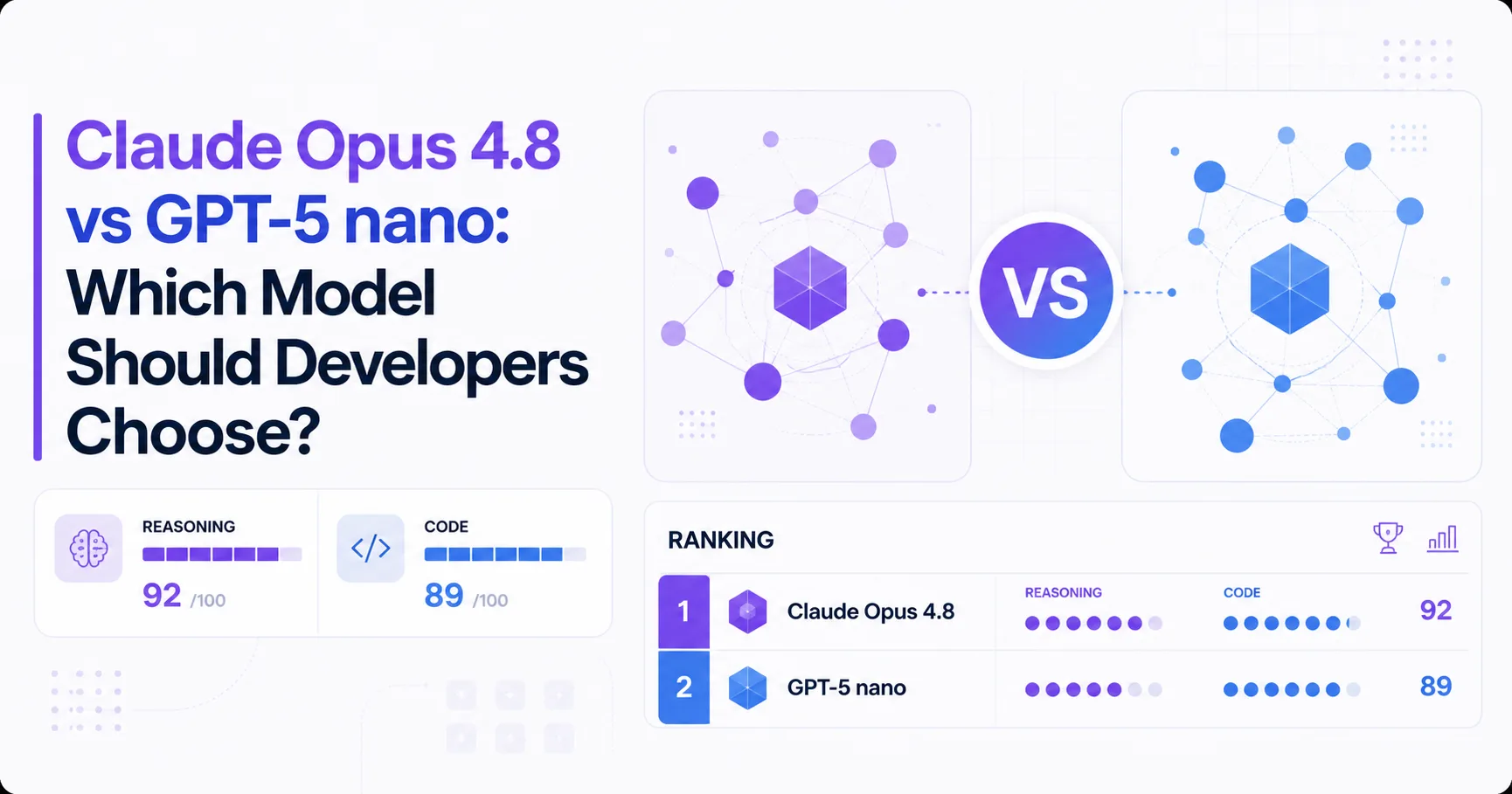
Claude Opus 4.8 is the safer overall choice for developers who value demonstrated general capability and complex software work. The Artificial Analysis Intelligence Index gives Claude Opus 4.8 a score of 55.7, compared with 19.9 for GPT-5 nano. The same data gives GPT-5 nano a Math Index of 83.7, while Claude Opus 4.8 has the available Coding Index score of 74.3. That split matters: the comparison does not establish a coding winner because GPT-5 nano has no supplied coding score.\n\nClaude Opus 4.8 also has a clearer production story. Anthropic documents its API identity, supported platforms, reasoning controls, and lifecycle status in the model overview and model deprecations page. OpenAI's current model directory does not list GPT-5 nano, so the name, availability, context window, output limit, and API behavior cannot be confirmed from the supplied official documentation.\n\nThe price difference is extreme, however. GPT-5 nano costs $0.1375 per 1M blended tokens in the supplied data, while Claude Opus 4.8 costs $10. Latency is tied at 0.3 seconds. Data provided by https://artificialanalysis.ai/.
Claude Opus 4.8 offers the stronger documented general-capability signal, while GPT-5 nano offers the lower measured price and a strong mathematics signal. The Artificial Analysis Intelligence Index difference is 35.800000000000004 points in Claude Opus 4.8's favor. GPT-5 nano's Math Index of 83.7 prevents a simple conclusion that the cheaper model is weak at every demanding task.\n\nClaude Opus 4.8 is explicitly positioned for complex coding, agent workflows, and professional knowledge work in Anthropic's announcement. Its documented controls include Adaptive thinking and an effort setting with several levels, as described in the Effort documentation. Those controls create a practical way to trade response depth against resource use, although the documentation says effort is a behavior signal rather than a strict token or latency ceiling.\n\nGPT-5 nano has a more serious evidence problem than a normal low-cost model. The supplied OpenAI model documentation does not confirm a current listing for GPT-5 nano, and no supplied community evidence establishes its coding quality, speed experience, or failure patterns. The comparison therefore supports a cost hypothesis, not a complete production evaluation. Developers should treat GPT-5 nano as an attractive candidate for controlled experiments, not as a fully documented replacement for Claude Opus 4.8.
Claude Opus 4.8 has the stronger available general-intelligence result, while GPT-5 nano has the stronger available mathematics result. Claude Opus 4.8 records an Artificial Analysis Intelligence Index of 55.7 and an Artificial Analysis Coding Index of 74.3. GPT-5 nano records an Intelligence Index of 19.9 and a Math Index of 83.7. Because the supplied data has no GPT-5 nano coding score and no Claude Opus 4.8 math score, the benchmark evidence cannot prove which model is better for software development across the board.\n\nFor coding agents, Claude Opus 4.8 has the more relevant direct evidence. Anthropic reports an Online-Mind2Web result of 84% and describes stronger uncertainty signaling and self-correction in agent tasks in its release announcement. That remains a vendor claim, not an independent reproduction. A Reddit user reported that Claude Opus 4.8 can skip requested steps or take messy paths while still reaching a correct result, so process compliance still needs verification. The same community report says effort can materially affect output quality, but it provides no reproducible test set.\n\nThe latency chart also needs careful interpretation. Both models show 0.3 seconds of median latency, so neither has a measured latency advantage in this dataset. The data contains no median output-token speed for either model. That means streaming behavior, long-response completion time, and tool-call throughput remain unproven. GPT-5 nano could still be useful for short mathematical or classification workloads, but the supplied evidence does not establish its coding reliability, context handling, or agent discipline.
GPT-5 nano is dramatically cheaper on the supplied token prices, but its lower unit cost does not by itself establish lower application cost. GPT-5 nano costs $0.05 per 1M input tokens and $0.4 per 1M output tokens, compared with $5 and $25 for Claude Opus 4.8. The blended comparison is $0.1375 versus $10 per 1M tokens.\n\nThe important question is what happens after a wrong answer. A cheap model can become expensive when developers must add retries, validators, human review, routing logic, or extra tool calls to compensate for uncertain behavior. The supplied materials do not provide failure rates, retry rates, output lengths, or task-level accuracy for GPT-5 nano, so no break-even calculation is justified. They also do not show an independent cost-quality curve for Claude Opus 4.8.\n\nClaude Opus 4.8 has documented prompt caching options in the Anthropic pricing documentation, which may matter for applications that repeatedly send the same large instructions or repository context. GPT-5 nano's current official pricing situation is less clear because the OpenAI pricing page does not list gpt-5-nano; it lists gpt-5.4-nano, which must not be treated as the same model. The chart supports GPT-5 nano for price-sensitive pilots, but not a guaranteed production bill.
GPT-5 nano (high) leads on 3 of 3 metrics
Claude Opus 4.8 is the better default for complex coding and agent workflows that require a documented model identity and stronger general-capability evidence. Its available Coding Index is 74.3, and Anthropic explicitly targets complex coding and agent work in the official announcement. Its Active lifecycle status, stable model identifier, and documented API availability are described in the model overview and lifecycle documentation.\n\nGPT-5 nano is the better experiment for high-volume, cost-sensitive tasks where mathematics is central and failures are cheap to detect. Its Math Index is 83.7, its blended price is $0.1375 per 1M tokens, and its measured latency is tied with Claude Opus 4.8 at 0.3 seconds. That makes it worth testing for narrow scoring, extraction, routing, or mathematical workloads. The recommendation should remain conditional because the supplied official OpenAI model directory does not confirm the model's current listing or limits.\n\nNeither model should be selected solely from a benchmark headline. Claude Opus 4.8 has community reports of skipped agent steps and possible under-thinking on some subtasks. Its style can also become verbose or drift across conversations, according to Claude Code Issue #77136. GPT-5 nano lacks comparable public failure evidence, which is an evidence gap rather than proof of reliability. Run the same repository tasks, mathematical cases, tool-use checks, and review policy against both models before committing.
Claude Opus 4.8 is easier to approve from the supplied evidence, but unresolved questions still determine whether its premium is justified. The most important unknowns concern GPT-5 nano's current availability, context limits, coding behavior, and operational failure rate. The supplied official OpenAI documentation does not answer those questions for this model.\n\nGPT-5 nano may still win a narrowly defined workload if its mathematics result transfers to the target task and its low price reduces total cost after validation. Claude Opus 4.8 may justify its higher price if its stronger general-capability signal reduces retries, manual review, or agent recovery work. The supplied sources do not measure those downstream effects, so the final choice requires task-specific testing.
Claude Opus 4.8 is the better-supported coding choice because it has an available Coding Index of 74.3 and explicit official positioning for complex coding, while GPT-5 nano has no supplied coding score.
GPT-5 nano is the cheaper candidate at $0.1375 per 1M blended tokens, but developers should first verify its availability, coding quality, failure rate, and validation overhead because the supplied sources do not establish them.
Claude Opus 4.8 and GPT-5 nano are tied on the supplied latency measure at 0.3 seconds, while median output-token speed is unavailable for both models, so streaming throughput remains unresolved.
GPT-5 nano has the stronger available mathematics signal with an Artificial Analysis Math Index of 83.7, but the supplied comparison has no Claude Opus 4.8 math score and cannot establish a complete task-level winner.
Claude Opus 4.8 should not be trusted without verification because community feedback reports skipped steps and messy paths in multi-step agent tasks, even when the final result is sometimes correct.