
Time to First Token · Claude Opus 5 (Adaptive Reasoning, High Effort)
10316ms
Time to First Token · Claude Opus 5 (Adaptive Reasoning, Medium Effort)
6909ms
Deep dive into reasoning, benchmarks, and latency insights.
The current catalog does not contain complete performance evidence for both models, so this page does not declare an overall winner. Use the available fields as comparison signals and validate the models on your own workload.
Key decision metrics at a glance.
| Model | Metric | Value | Unit | Source / snapshot |
|---|---|---|---|---|
| Claude Opus 5 (Adaptive Reasoning, High Effort) | Reasoning | 6.0 | benchmark or capability score | Artificial Analysis · current catalog |
| Claude Opus 5 (Adaptive Reasoning, Medium Effort) | Reasoning | 6.0 | benchmark or capability score | Artificial Analysis · current catalog |
| Claude Opus 5 (Adaptive Reasoning, High Effort) | Coding | 8.0 | benchmark or capability score | Artificial Analysis · current catalog |
| Claude Opus 5 (Adaptive Reasoning, Medium Effort) | Coding | 7.0 | benchmark or capability score | Artificial Analysis · current catalog |
| Claude Opus 5 (Adaptive Reasoning, High Effort) | Multimodal | 5.0 | benchmark or capability score | Artificial Analysis · current catalog |
| Claude Opus 5 (Adaptive Reasoning, Medium Effort) | Multimodal | 5.0 | benchmark or capability score | Artificial Analysis · current catalog |
| Claude Opus 5 (Adaptive Reasoning, High Effort) | Long Context | 8.0 | benchmark or capability score | Artificial Analysis · current catalog |
| Claude Opus 5 (Adaptive Reasoning, Medium Effort) | Long Context | 7.0 | benchmark or capability score | Artificial Analysis · current catalog |
| Claude Opus 5 (Adaptive Reasoning, High Effort) | Blended Price / 1M tokens | $10 | USD per 1M tokens | Artificial Analysis · current catalog |
| Claude Opus 5 (Adaptive Reasoning, Medium Effort) | Blended Price / 1M tokens | $10 | USD per 1M tokens | Artificial Analysis · current catalog |
| Claude Opus 5 (Adaptive Reasoning, High Effort) | P95 Latency | — | milliseconds | Artificial Analysis · current catalog |
| Claude Opus 5 (Adaptive Reasoning, Medium Effort) | P95 Latency | — | milliseconds | Artificial Analysis · current catalog |
| Claude Opus 5 (Adaptive Reasoning, High Effort) | Tokens per second | 51.106 | tokens per second | Artificial Analysis · current catalog |
| Claude Opus 5 (Adaptive Reasoning, Medium Effort) | Tokens per second | 50.537 | tokens per second | Artificial Analysis · current catalog |
Data provided by Artificial Analysis; live values use the current catalog.
This radar chart visually maps the core capabilities (reasoning, coding, math proxy, multimodal, long context) of `Claude Opus 5 (Adaptive Reasoning, High Effort)` vs `Claude Opus 5 (Adaptive Reasoning, Medium Effort)`.
This grouped bar chart provides a side-by-side comparison for each benchmark metric.
Lower time to first token is better; higher tokens per second is better.
Compare input and output pricing in USD per 1M tokens.
Claude Opus 5 (Adaptive Reasoning, High Effort)$11.25
Claude Opus 5 (Adaptive Reasoning, Medium Effort)$11.25
This article is a dated snapshot published on 2026-08-05. Live cards above use the current catalog; missing live fields are not inferred.
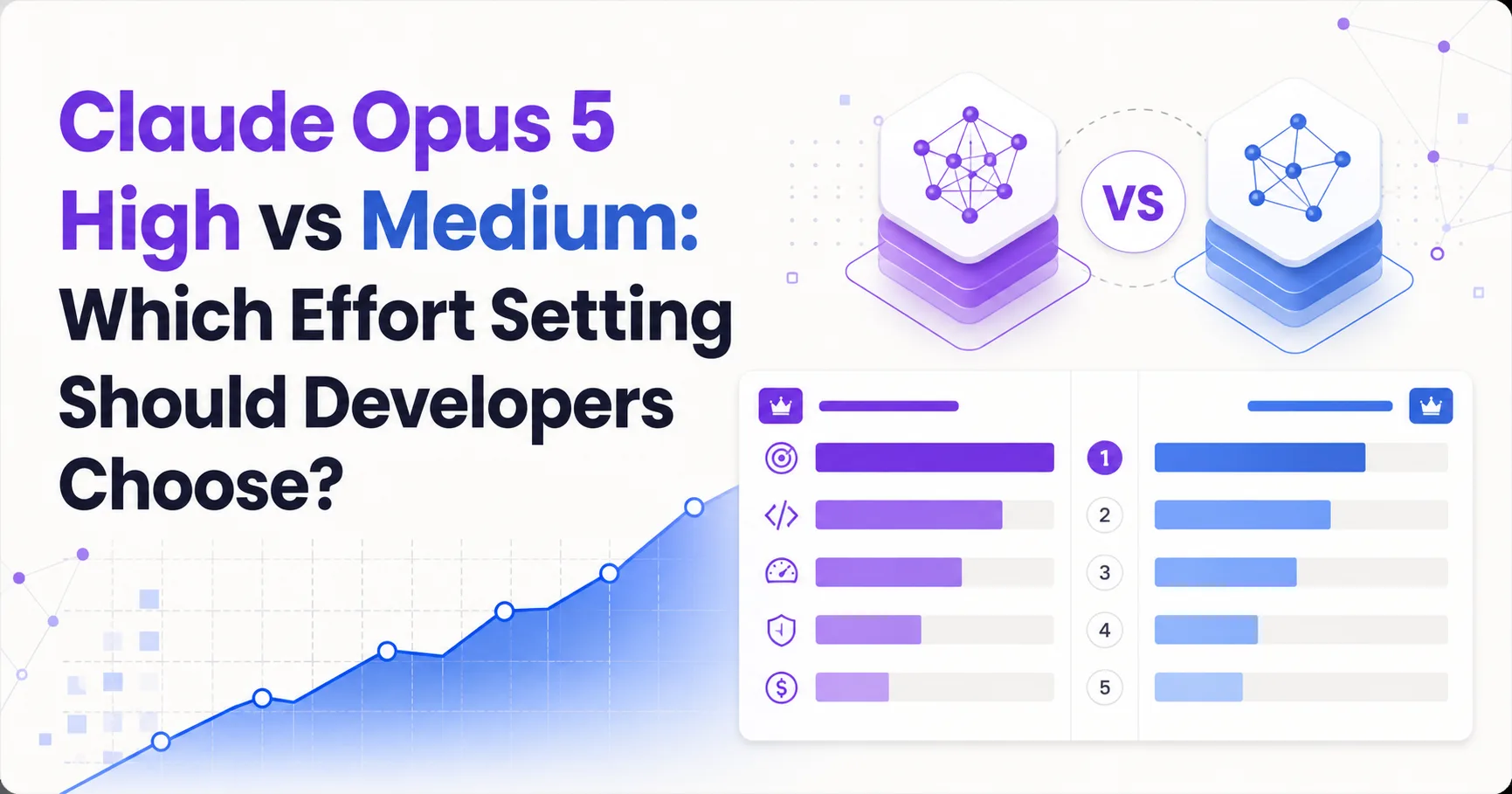
Claude Opus 5 (Adaptive Reasoning, High Effort) is the stronger default for developers who value measured quality over a marginal speed edge.
The High and Medium labels describe effort configurations of the same Claude Opus 5 API model, not separate Anthropic model releases. Anthropic documents claude-opus-5 as the API model and describes Medium as effort: "medium", while High is the default behavior in standard usage. See the model overview and Opus 5 update notes.
That distinction changes how developers should integrate the model. Keep the API model ID stable, then make effort an explicit runtime policy. The comparison below separates measured outcomes from assumptions that the supplied evidence cannot verify. Data provided by https://artificialanalysis.ai/. The quantitative snapshot is published by Artificial Analysis.
Claude Opus 5 (Adaptive Reasoning, High Effort) leads the quality measures, while Medium matches price and posts the slightly higher measured output rate.
| Decision lens | High Effort | Medium Effort | Practical meaning |
|---|---|---|---|
| Coding Index | 76.5 | 74.3 | High has the stronger measured coding signal |
| Intelligence Index | 58.9 | 56.3 | High has the stronger measured general capability signal |
| Median output speed | 54.599 | 54.838 | Medium has the higher reported throughput |
| Reported latency | 0.3 | 0.3 | The snapshot shows a tie |
| Blended price per 1M tokens | $10 | $10 | Effort does not change the listed blended rate |
The apparent model-version difference is a naming artifact. Anthropic's model overview describes the same model-level support for text and image input, text output, multilingual use, and visual understanding. The research also finds no official API identifier named claude-opus-5-medium; Medium should be implemented through an effort setting.
High is the rational starting point for difficult autonomous coding when a higher measured capability signal matters more than output throughput. Medium is rational for interactive development when the team wants the same listed price and a slightly higher measured output rate. The evidence does not show whether either setting produces better end-to-end results after tool calls, retries, reviews, or human intervention.
The Artificial Analysis comparison supplies the numerical snapshot. Anthropic's official announcement supplies the product positioning, but it does not provide a complete, independently reproducible configuration for every claim.
Claude Opus 5 (Adaptive Reasoning, High Effort) is the better quality choice, while Medium is a practical throughput choice with nearly tied measured responsiveness.
The supplied comparison gives High a Coding Index of 76.5 versus 74.3 for Medium. It also gives High an Intelligence Index of 58.9 versus 56.3 for Medium. Those results support a directional preference for High on ambiguous coding tasks, multi-step changes, and work that benefits from deeper reasoning. They do not equal task completion rates, defect rates, or acceptance rates.
Anthropic positions Claude Opus 5 for complex agentic coding, enterprise work, long-running tasks, visual understanding, and multi-agent collaboration in its official announcement. That positioning fits the High result, but the announcement's broad benchmark claims do not provide complete raw scores and reproducible settings for every evaluation. Developers should treat the Artificial Analysis indices as useful comparative signals, not as a substitute for workload testing.
Medium reports 54.838 median output tokens per second, compared with 54.599 for High. Reported latency is 0.3 for each setting. The result therefore favors Medium on measured output speed, while the latency measure shows no winner. Output speed is only one part of an agent's wall-clock behavior. Tool execution, queueing, reasoning time, streamed delivery, and retries can dominate the user experience.
The community evidence is divided. Some developers describe Opus 5 completing long autonomous coding tasks with repeated edits, tests, and rework, as documented in this long-task report. Other users report overplanning, excessive testing, missed work, and unrequested additions in this critical report. A separate r/ClaudeAI discussion reports verbosity, slowness, and overly broad changes, but its original poster had not used Opus 5.
The evidence gap is important: no public controlled test in the supplied material isolates High from Medium while holding prompts, tools, repositories, and acceptance criteria constant. High is therefore the evidence-led quality pick, not a guaranteed winner for every development workflow.
Claude Opus 5 (Adaptive Reasoning, High Effort) leads on 2 of 2 metrics
Claude Opus 5 (Adaptive Reasoning, High Effort) and Claude Opus 5 (Adaptive Reasoning, Medium Effort) have identical published prices, so the meaningful cost choice is token consumption and rework.
The data snapshot lists a $10 blended price per 1M tokens for each configuration. Anthropic's pricing documentation presents pricing at the underlying model level, not as a separate rate card for each effort setting. Medium is therefore not cheaper at the point of purchase.
Real task cost can still diverge. Anthropic explains in its Opus 5 update notes and Thinking documentation that thinking tokens and ordinary response tokens share the max_tokens ceiling. Longer reasoning can increase consumption, delay, and the chance that an integration needs a larger output allowance. High may therefore spend more tokens on difficult work even though its listed rate matches Medium.
Medium does not guarantee lower spend. The Effort documentation describes effort as a behavior signal rather than a strict token budget. Medium can still reason extensively on a hard task. If its result needs another request, more tool calls, or additional human review, the end-to-end cost can exceed a successful High completion.
The supplied evidence is insufficient to declare a real-world cost winner. It does not report token consumption by effort setting, retry frequency, tool-call count, human review time, or task success. Teams should measure those factors together rather than infer savings from the identical rate card.
A practical cost policy is to use Medium for routine work only after measuring rework, then reserve High for tasks where failure carries meaningful engineering cost. Set max_tokens when a hard spending boundary matters, and remember that the ceiling includes thinking tokens.
Claude Opus 5 (Adaptive Reasoning, High Effort) should be the default for autonomous, high-consequence coding, while Claude Opus 5 (Adaptive Reasoning, Medium Effort) suits interactive workloads that prioritize steady throughput.
| Workflow | Recommended setting | Reasoning | Confidence |
|---|---|---|---|
| Autonomous multi-file implementation | High Effort | Higher measured Coding and Intelligence Index values align with Anthropic's complex coding positioning | Medium |
| Interactive coding and review loops | Medium Effort | Same listed price and higher measured output speed can improve iteration flow | Medium |
| Strict tool-driven automation | Either, with adaptive thinking enabled | The underlying model supports the same tool-oriented integration, but protocol behavior needs validation | Medium |
| Cost-capped production automation | Pilot both | Published rates tie, while actual token use and rework remain unreported | Low |
| High-consequence code changes | High Effort with review gates | Quality signals favor High, but community reports warn against unbounded autonomy | Medium |
The correct API pattern is a stable model ID with an effort policy:
{
  "model": "claude-opus-5",
  "thinking": {"type": "adaptive"},
  "effort": "high"
}
Switch effort to medium for the alternate configuration. Do not send the comparison slugs claude-opus-5-high or claude-opus-5-medium as if they were official API IDs. Anthropic's model ID documentation and model overview identify claude-opus-5 as the stable model identifier.
Keep adaptive thinking enabled in tool-reliant systems. Anthropic documents failure modes after disabling thinking, including tool calls appearing in ordinary text or internal XML becoming visible. The Thinking documentation also describes configuration constraints around effort and sampling parameters.
A credible pilot should replay the same repository tasks with explicit High and Medium settings. Track accepted changes, regressions, tool calls, output tokens, retries, review time, and end-to-end latency. The supplied comparison establishes a useful starting hypothesis, but it cannot establish the winner for a private codebase.
Claude Opus 5 (Adaptive Reasoning, Medium Effort) is the first configuration to test for throughput-sensitive workloads because it keeps the same published price and has the higher measured output rate.
The FAQ below separates integration facts from evidence gaps. The key decision is not whether Medium is a different model. The key decision is whether your workload benefits more from High's measured quality lead or Medium's measured throughput edge. Neither setting has a proven universal advantage across tool use, retries, review burden, and task completion.
Developers should also validate request limits during migration. Thinking affects the output budget, and effort choices can interact with older sampling or tool settings. A small, controlled evaluation is more informative than relying on community anecdotes that do not isolate the effort configuration.
No, Claude Opus 5 Medium is not a separate official API model; developers should call claude-opus-5 and set effort: "medium", as Anthropic's model overview and update notes describe.
Claude Opus 5 High Effort is the better starting point for autonomous agentic coding because it leads the supplied Coding Index at 76.5 versus Medium at 74.3, while Anthropic positions Opus 5 for complex agentic coding in its official announcement.
Claude Opus 5 Medium is not cheaper on the published rate card because High and Medium each cost $10 per 1M blended tokens; actual task cost can still diverge through thinking, retries, and review work. See the Artificial Analysis snapshot and Anthropic's pricing documentation.
Claude Opus 5 should generally keep adaptive thinking enabled for tool-reliant workflows because Anthropic warns that disabling thinking can expose tool calls as text or internal XML, and some effort settings reject that configuration. See the Opus 5 update notes.
Claude Opus 5 High Effort does not have a proven universal win because public community reports conflict, and the available anecdotes do not isolate effort settings or provide reproducible task-level success rates. Compare the long-task report, critical report, and r/ClaudeAI discussion.