
Time to First Token · Claude Opus 5 (Adaptive Reasoning, High Effort)
10316ms
Time to First Token · GPT-4
0ms
Deep dive into reasoning, benchmarks, and latency insights.
The current catalog does not contain complete performance evidence for both models, so this page does not declare an overall winner. Use the available fields as comparison signals and validate the models on your own workload.
Key decision metrics at a glance.
| Model | Metric | Value | Unit | Source / snapshot |
|---|---|---|---|---|
| Claude Opus 5 (Adaptive Reasoning, High Effort) | Reasoning | 6.0 | benchmark or capability score | Artificial Analysis · current catalog |
| GPT-4 | Reasoning | 6.0 | benchmark or capability score | Artificial Analysis · current catalog |
| Claude Opus 5 (Adaptive Reasoning, High Effort) | Coding | 8.0 | benchmark or capability score | Artificial Analysis · current catalog |
| GPT-4 | Coding | 1.0 | benchmark or capability score | Artificial Analysis · current catalog |
| Claude Opus 5 (Adaptive Reasoning, High Effort) | Multimodal | 5.0 | benchmark or capability score | Artificial Analysis · current catalog |
| GPT-4 | Multimodal | 1.0 | benchmark or capability score | Artificial Analysis · current catalog |
| Claude Opus 5 (Adaptive Reasoning, High Effort) | Long Context | 8.0 | benchmark or capability score | Artificial Analysis · current catalog |
| GPT-4 | Long Context | 1.0 | benchmark or capability score | Artificial Analysis · current catalog |
| Claude Opus 5 (Adaptive Reasoning, High Effort) | Blended Price / 1M tokens | $10 | USD per 1M tokens | Artificial Analysis · current catalog |
| GPT-4 | Blended Price / 1M tokens | $37.5 | USD per 1M tokens | Artificial Analysis · current catalog |
| Claude Opus 5 (Adaptive Reasoning, High Effort) | P95 Latency | — | milliseconds | Artificial Analysis · current catalog |
| GPT-4 | P95 Latency | — | milliseconds | Artificial Analysis · current catalog |
| Claude Opus 5 (Adaptive Reasoning, High Effort) | Tokens per second | 51.106 | tokens per second | Artificial Analysis · current catalog |
| GPT-4 | Tokens per second | 0 | tokens per second | Artificial Analysis · current catalog |
Data provided by Artificial Analysis; live values use the current catalog.
This radar chart visually maps the core capabilities (reasoning, coding, math proxy, multimodal, long context) of `Claude Opus 5 (Adaptive Reasoning, High Effort)` vs `GPT-4`.
This grouped bar chart provides a side-by-side comparison for each benchmark metric.
Lower time to first token is better; higher tokens per second is better.
Compare input and output pricing in USD per 1M tokens.
Claude Opus 5 (Adaptive Reasoning, High Effort)$11.25
GPT-4$45
Claude Opus 5 (Adaptive Reasoning, High Effort) costs $33.75 less per run
This article is a dated snapshot published on 2026-08-07. Live cards above use the current catalog; missing live fields are not inferred.
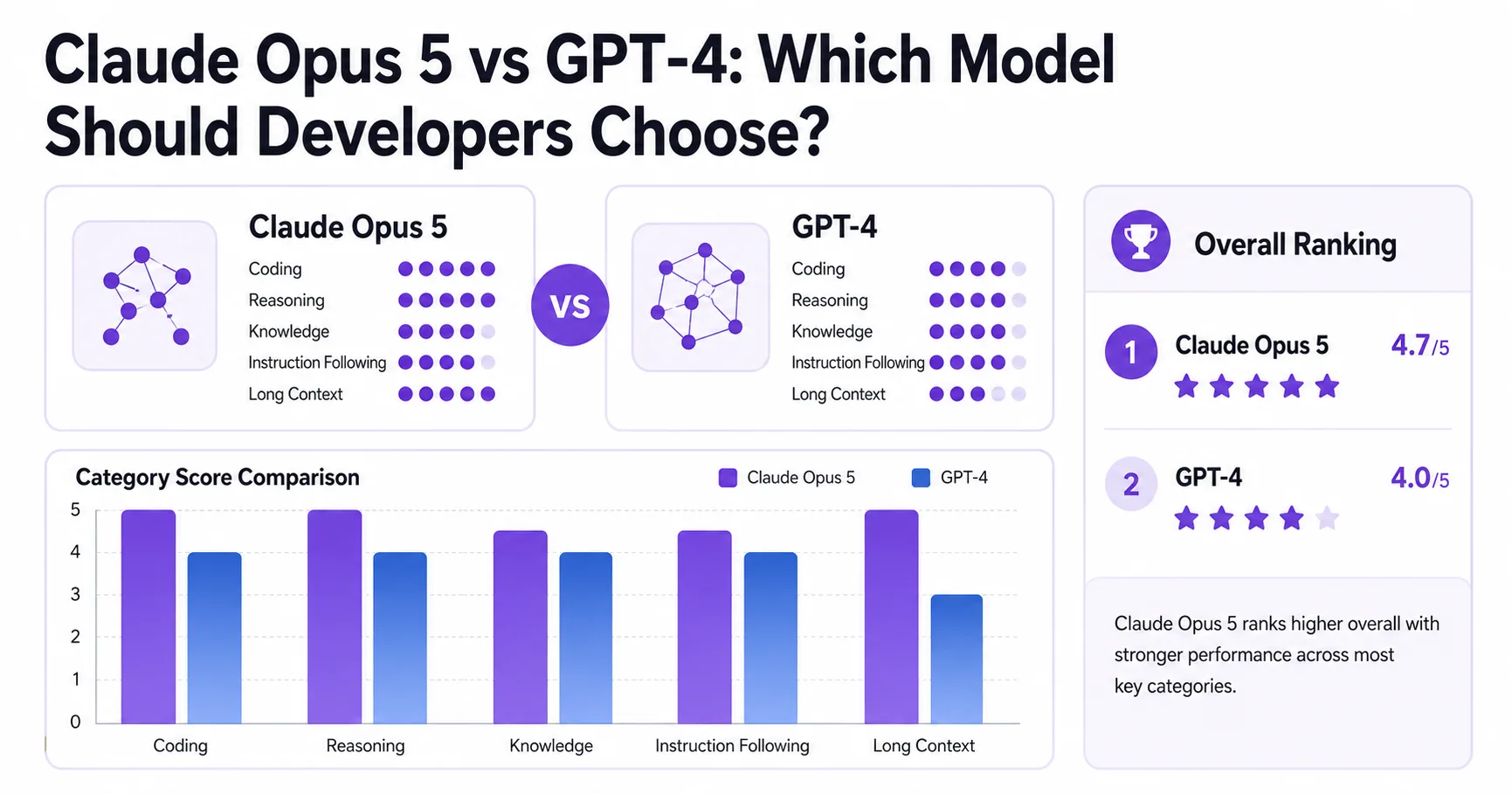
Claude Opus 5 is the stronger default for new developer workloads because the available data shows higher coding and intelligence scores at a lower blended price. Artificial Analysis reports a coding index of 76.5 for Claude Opus 5 versus 13.1 for GPT-4, while the intelligence index is 58.9 versus 7. Data provided by https://artificialanalysis.ai/
Claude Opus 5 also has a listed blended price of $10 per 1M tokens, compared with $37.5 for GPT-4. Its median output speed is 54.599 tokens per second, while GPT-4 has no comparable value in the supplied data brief. Both models show 0.3 seconds of latency in the comparison data.
The more important qualification is product status. Anthropic presents Claude Opus 5 as a current model for complex agentic coding and enterprise work in its release announcement, while the reviewed OpenAI model documentation does not provide current GPT-4 capability details. That makes Claude Opus 5 the evidence-backed choice, but not proof that every GPT-4 deployment is unavailable or unsuitable.
Claude Opus 5 has a substantially stronger documented selection case than GPT-4, but the comparison is asymmetric because current GPT-4 documentation is sparse.
Anthropic lists Claude Opus 5 as available, with text and image input, text output, multilingual ability, and visual understanding across the Claude API, Amazon Bedrock, Google Cloud, and Microsoft Foundry. The current model overview also identifies claude-opus-5 as both the official API ID and stable alias. The versioning documentation clarifies that this is a fixed snapshot identifier, not an alias that automatically moves to a future model.
GPT-4 has a different problem: the reviewed OpenAI pages do not state its current context window, output limit, multimodal boundary, parameter behavior, or official API availability. The OpenAI model directory focuses on newer model families, and the OpenAI pricing page does not list GPT-4 or its older dated variants.
That gap matters more than a simple feature checklist. A developer selecting a production model needs a stable endpoint, known limits, and a supportable billing path. Claude Opus 5 has documented answers for those questions. GPT-4 may still work in an existing integration, but the reviewed evidence does not establish its present lifecycle or migration path.
The community evidence is also uneven. Users in a r/ClaudeAI discussion describe verbosity, slow responses, overthinking, and overly broad autonomous changes, but the thread has no reproducible test method. A Hacker News discussion mentions a FreeCAD reconstruction case, yet the case originated from Anthropic's own announcement and is not an independent replication.
Claude Opus 5 is the safer performance choice for difficult coding and reasoning workflows, although the supplied benchmark data cannot predict every repository or task.
The coding index gap is large enough to affect architecture. Claude Opus 5 scores 76.5, while GPT-4 scores 13.1 in the supplied comparison. That difference supports using Claude Opus 5 for repository-level planning, multi-step implementation, debugging across files, and tool-driven work. It does not guarantee a matching success rate for a specific codebase, because the brief provides no task distribution, error taxonomy, or independent reproduction protocol. Data provided by https://artificialanalysis.ai/
The intelligence index points in the same direction, with Claude Opus 5 at 58.9 and GPT-4 at 7. This makes Claude Opus 5 more attractive when the model must maintain a plan, interpret ambiguous requirements, or coordinate several actions. The result should still be treated as directional evidence, not a substitute for an evaluation built from the developer's own tickets.
Speed is less straightforward than the headline scores. Claude Opus 5 has a median output speed of 54.599 tokens per second, but GPT-4 has no comparable speed value in the data brief. Both models have 0.3 seconds of listed latency. Therefore, the available data supports a throughput advantage for Claude Opus 5, but it does not establish a complete end-to-end response-time advantage for every request.
Claude Opus 5's adaptive thinking creates an operational tradeoff. The thinking documentation explains that thinking tokens count toward the strict max_tokens ceiling. The Opus 5 update notes also warn that long reasoning can increase latency and cost. Developers should test whether stronger task completion offsets longer outputs and more complex request handling.
Independent evidence is insufficient to summarize GPT-4's current coding behavior or Claude Opus 5's real-world success distribution. The reviewed materials contain no reproducible community benchmark for either question.
Claude Opus 5 (Adaptive Reasoning, High Effort) leads on 2 of 2 metrics
Claude Opus 5 is the lower-cost option under every supplied token-price comparison, but thinking behavior can change the cost of a completed task.
The data brief lists Claude Opus 5 at $10 per 1M blended tokens, versus $37.5 for GPT-4. Input pricing is $5 versus $30 per 1M tokens, and output pricing is $25 versus $60 per 1M tokens. Those figures favor Claude Opus 5 for both ordinary completion traffic and workloads with substantial output. Data provided by https://artificialanalysis.ai/
The practical question is not only the price of a token. Claude Opus 5 defaults to adaptive thinking, and thinking tokens share the output ceiling with the final response. A task that requires repeated reasoning, tool calls, or long autonomous execution may consume more tokens than a shallow request. The effort documentation describes effort as a behavior signal rather than a strict token budget. Developers who need a hard ceiling should use max_tokens and measure completed-task cost.
Caching can improve the economics of repeated context. Anthropic's pricing documentation lists separate cache-write and cache-hit prices, while the Opus 5 update notes identify a minimum cacheable prompt length of 512 tokens. That matters for agents repeatedly sending repository instructions, schemas, or policy text.
GPT-4's apparent price disadvantage may be even harder to evaluate because the current OpenAI pricing page does not list a direct GPT-4 price. The data brief supplies a comparison value, but the reviewed official page does not confirm a current public billing entry. Teams should verify the actual account-level route before budgeting an existing GPT-4 integration.
The cost conclusion can reverse only if Claude Opus 5's higher reasoning consumption causes materially more attempts, retries, or human review. The supplied materials do not quantify those factors, so no task-level break-even point can be established.
Claude Opus 5 (Adaptive Reasoning, High Effort) leads on 3 of 3 metrics
Claude Opus 5 is the recommended starting point for new production systems that prioritize coding depth, agent autonomy, and documented current availability.
Choose Claude Opus 5 for repository agents, complex refactoring, debugging that spans multiple files, enterprise workflow automation, and tasks where the model must sustain a plan over many tool interactions. Anthropic explicitly positions the model for complex agentic coding and enterprise work in its official announcement. Its listed coding index of 76.5 and intelligence index of 58.9 reinforce that positioning. Data provided by https://artificialanalysis.ai/
Claude Opus 5 is also the stronger choice when deployment flexibility matters. The model overview lists the Claude API, Amazon Bedrock, Google Cloud, and Microsoft Foundry. The model has a 1M-token context window and a 128k-token maximum output in the reviewed Anthropic documentation, although the data brief does not provide a comparison value for GPT-4. Do not assume that GPT-4 has equivalent limits from the absence of current documentation.
Keep GPT-4 only when an existing application has a verified working integration, a tested prompt and tool protocol, and a business reason to avoid migration. The reviewed OpenAI materials do not confirm its current price, availability, context window, output limit, or present API status. That is evidence insufficiency, not evidence that every GPT-4 endpoint has stopped working.
Before committing, run a small private evaluation using representative coding tasks, tool calls, refusal cases, and long-context requests. Record completion quality, review effort, retries, output length, and total task cost. The public materials do not provide enough information to predict those outcomes for your codebase.
Claude Opus 5 still needs guardrails. Community reports describe over-analysis and unapproved broad changes, while Anthropic documents tool-call and XML-tag risks when thinking is disabled. Keep approval boundaries explicit, validate tool outputs, and avoid assuming that a higher benchmark score removes the need for orchestration.
Claude Opus 5 is the better-documented option, but developers still need to validate task-level behavior and operational fit before migration.
The reviewed sources do not establish a reliable independent success rate for either model. Community reports about Claude Opus 5 are anecdotal, and no verified current GPT-4 community evaluations were found. The safest decision process combines the public evidence with a private test set drawn from real engineering work.
Claude Opus 5 is the stronger evidence-backed coding choice because its Artificial Analysis coding index is 76.5 versus 13.1 for GPT-4. That result supports deeper coding workflows, but it does not guarantee success on every repository or task type.
Claude Opus 5 is cheaper under the supplied comparison, with a $10 price per 1M blended tokens versus $37.5 for GPT-4. Actual task cost can still rise if adaptive thinking produces longer outputs, retries, or additional review work.
GPT-4's current direct availability is not confirmed by the reviewed OpenAI documentation. The current model directory and pricing page do not provide a clear lifecycle or billing entry, so existing users should verify their account and endpoint before planning a migration.
Developers should generally keep thinking enabled for strict tool-driven workflows because Anthropic warns that disabling it can cause tool calls to appear as ordinary text or expose internal XML tags. Configuration should still be tested against the application's protocol.
Claude Opus 5 has a supplied median output speed of 54.599 tokens per second, while GPT-4 has no comparable value in the data brief. Both models show 0.3 seconds of latency, so the evidence does not prove faster end-to-end responses in every workload.