
Time to First Token · Claude Opus 5 (Adaptive Reasoning, High Effort)
10316ms
Time to First Token · GPT-4o mini
0ms
Deep dive into reasoning, benchmarks, and latency insights.
The current catalog does not contain complete performance evidence for both models, so this page does not declare an overall winner. Use the available fields as comparison signals and validate the models on your own workload.
Key decision metrics at a glance.
| Model | Metric | Value | Unit | Source / snapshot |
|---|---|---|---|---|
| Claude Opus 5 (Adaptive Reasoning, High Effort) | Reasoning | 6.0 | benchmark or capability score | Artificial Analysis · current catalog |
| GPT-4o mini | Reasoning | 1.0 | benchmark or capability score | Artificial Analysis · current catalog |
| Claude Opus 5 (Adaptive Reasoning, High Effort) | Coding | 8.0 | benchmark or capability score | Artificial Analysis · current catalog |
| GPT-4o mini | Coding | 1.0 | benchmark or capability score | Artificial Analysis · current catalog |
| Claude Opus 5 (Adaptive Reasoning, High Effort) | Multimodal | 5.0 | benchmark or capability score | Artificial Analysis · current catalog |
| GPT-4o mini | Multimodal | 1.0 | benchmark or capability score | Artificial Analysis · current catalog |
| Claude Opus 5 (Adaptive Reasoning, High Effort) | Long Context | 8.0 | benchmark or capability score | Artificial Analysis · current catalog |
| GPT-4o mini | Long Context | 1.0 | benchmark or capability score | Artificial Analysis · current catalog |
| Claude Opus 5 (Adaptive Reasoning, High Effort) | Blended Price / 1M tokens | $10 | USD per 1M tokens | Artificial Analysis · current catalog |
| GPT-4o mini | Blended Price / 1M tokens | $0.262 | USD per 1M tokens | Artificial Analysis · current catalog |
| Claude Opus 5 (Adaptive Reasoning, High Effort) | P95 Latency | — | milliseconds | Artificial Analysis · current catalog |
| GPT-4o mini | P95 Latency | — | milliseconds | Artificial Analysis · current catalog |
| Claude Opus 5 (Adaptive Reasoning, High Effort) | Tokens per second | 51.106 | tokens per second | Artificial Analysis · current catalog |
| GPT-4o mini | Tokens per second | 0 | tokens per second | Artificial Analysis · current catalog |
Data provided by Artificial Analysis; live values use the current catalog.
This radar chart visually maps the core capabilities (reasoning, coding, math proxy, multimodal, long context) of `Claude Opus 5 (Adaptive Reasoning, High Effort)` vs `GPT-4o mini`.
This grouped bar chart provides a side-by-side comparison for each benchmark metric.
Lower time to first token is better; higher tokens per second is better.
Compare input and output pricing in USD per 1M tokens.
Claude Opus 5 (Adaptive Reasoning, High Effort)$11.25
GPT-4o mini$0.3
GPT-4o mini costs $10.95 less per run
This article is a dated snapshot published on 2026-08-07. Live cards above use the current catalog; missing live fields are not inferred.
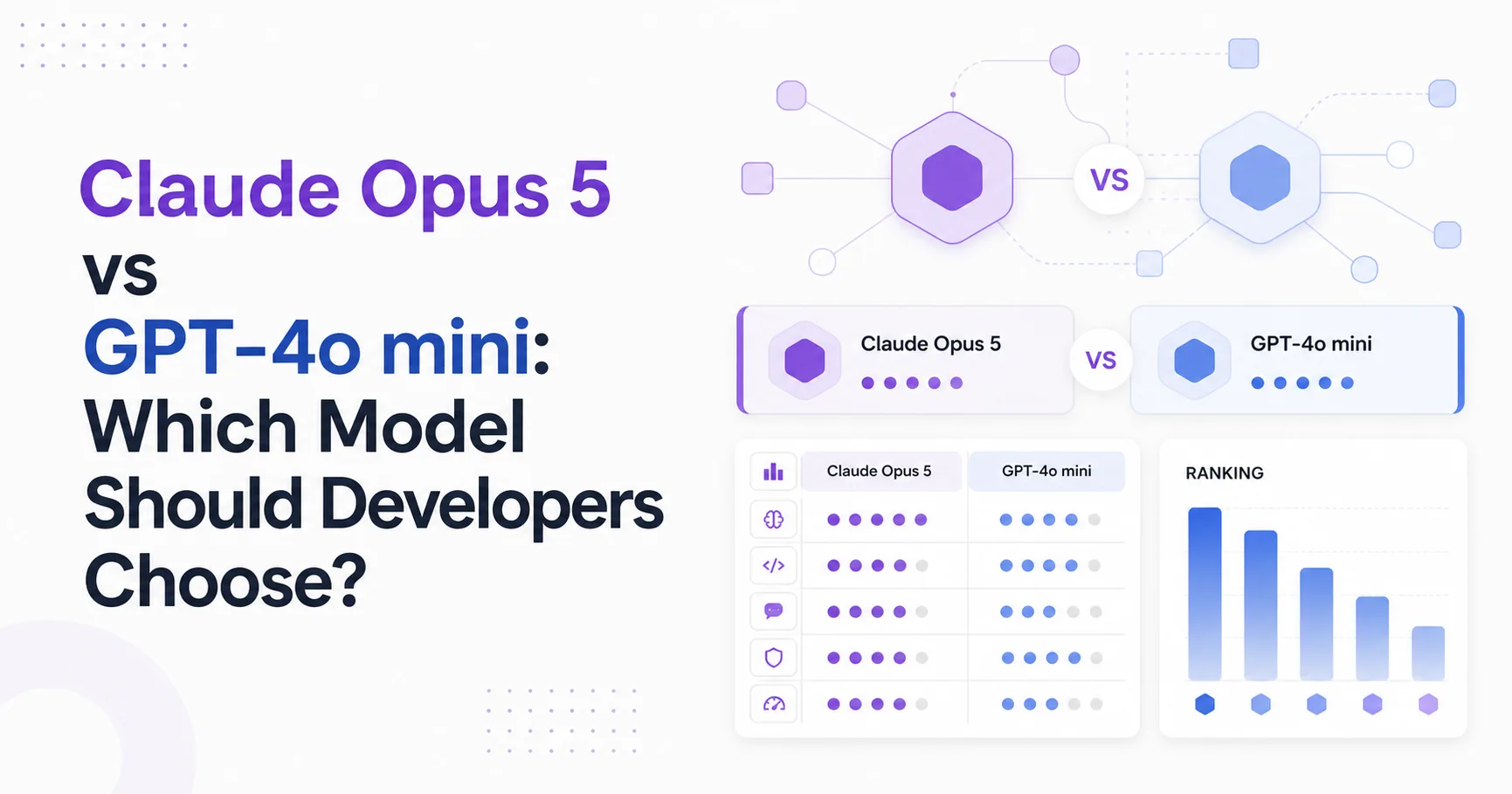
Claude Opus 5 (Adaptive Reasoning, High Effort) is the stronger choice for difficult software work, while GPT-4o mini is the safer economic choice for high-volume simple tasks. The Artificial Analysis data snapshot gives Claude Opus 5 a Coding Index of 76.5 and an Intelligence Index of 58.9, compared with 11.4 and 6.9 for GPT-4o mini. Artificial Analysis provides the comparison data.
The models serve different operating assumptions. Anthropic positions Claude Opus 5 around complex agentic coding and enterprise work, while OpenAI introduced GPT-4o mini for frequent, cost-efficient tasks. Those positions are supported by the vendors’ own descriptions, not by a shared benchmark methodology. Anthropic’s launch announcement describes long-running agentic coding and enterprise use. OpenAI’s launch announcement describes GPT-4o mini as a small model for cost-efficient intelligence.
The practical decision is therefore not “which model wins every task?” Claude Opus 5 has the clearer capability advantage for complex reasoning and coding. GPT-4o mini has the much lower listed blended price in the supplied data. The correct selection depends on whether failures, review time, and output volume dominate your application economics.
Claude Opus 5 (Adaptive Reasoning, High Effort) is the capability leader, but GPT-4o mini can remain the better production choice when each request has low complexity and high volume.
| Decision factor | Claude Opus 5 | GPT-4o mini |
|---|---|---|
| Coding Index | 76.5 | 11.4 |
| Intelligence Index | 58.9 | 6.9 |
| Math Index | No supplied value | 14.7 |
| Blended price per 1M tokens | $10 | $0.2625 |
| Input price per 1M tokens | $5 | $0.15 |
| Output price per 1M tokens | $25 | $0.6 |
| Latency | 0.3 seconds | 0.3 seconds |
| Release date | 2026-07-24 | 2024-07-18 |
The capability gap is large in the supplied Artificial Analysis snapshot. The Coding Index difference is 65.1 points, and the Intelligence Index difference is 52 points. That gap matters most when the model must maintain constraints, reason across a repository, choose tools, or recover from intermediate failures.
The price gap is equally decisive for workloads that do not need frontier-level reasoning. GPT-4o mini’s blended price is $0.2625, while Claude Opus 5’s is $10. However, the current OpenAI pricing page does not list GPT-4o mini, so the data snapshot should not be treated as proof of a currently purchasable price. OpenAI’s current pricing page leaves that point unresolved.
Claude Opus 5 is currently listed as available by Anthropic and is not marked deprecated or retired. Anthropic’s model overview supports that status. The current OpenAI model directory does not clearly establish whether GPT-4o mini remains directly callable or has been formally replaced. OpenAI’s model directory supports the evidence gap.
Claude Opus 5 (Adaptive Reasoning, High Effort) is the better fit when a request requires sustained reasoning, coding judgment, or autonomous task execution.
The supplied chart shows a Coding Index of 76.5 for Claude Opus 5 and 11.4 for GPT-4o mini. That 65.1-point difference should be read as a model-selection signal, not as a guaranteed task success-rate difference. The benchmark does not tell you how either model behaves on your repository, test suite, tool definitions, or acceptance criteria.
Claude’s default adaptive thinking changes the engineering tradeoff. Thinking tokens and final output share the synchronous Messages API’s max_tokens ceiling, so a configuration designed for a non-thinking model may truncate or under-budget difficult requests. Anthropic’s Opus 5 update notes describe this behavior, while Anthropic’s thinking documentation explains the shared output limit.
Claude Opus 5 also exposes effort levels from low through max, with high as the default. Effort can reduce token use, but it is not a strict token budget. Applications requiring a hard ceiling should control max_tokens directly. Anthropic’s effort documentation makes that distinction explicit.
The supplied latency value is 0.3 seconds for each model, so latency does not separate them in this snapshot. Claude Opus 5 additionally reports a median output speed of 54.599 tokens per second, while no corresponding GPT-4o mini value is supplied. That means the evidence is insufficient to claim a speed winner.
Community feedback points to a different performance risk. Some Claude users report excessive verbosity, overthinking, and unapproved broad changes, but the discussion has no standardized test method. The r/ClaudeAI discussion is useful for identifying failure modes, not for estimating their frequency.
GPT-4o mini’s launch benchmarks include HumanEval at 87.2%, MMLU at 82.0%, MGSM at 87.0%, and MMMU at 59.4%. These results cannot be directly ranked against the Artificial Analysis indices because they use different evaluations. OpenAI’s launch announcement does not establish performance across all coding or reasoning tasks.
GPT-4o mini is dramatically cheaper in the supplied snapshot, but Claude Opus 5 can be economically rational when weak outputs create review, retry, or integration costs.
The chart lists GPT-4o mini at $0.2625 per 1M blended tokens, compared with $10 for Claude Opus 5. GPT-4o mini also has lower listed input and output prices, at $0.15 and $0.6 per 1M tokens. Claude Opus 5 is listed at $5 for input and $25 for output per 1M tokens. These figures make GPT-4o mini the natural starting point for classification, extraction, lightweight transformation, and other repetitive workloads.
The price comparison becomes less simple for agentic coding. A cheap model that needs repeated retries, extensive validation, or human correction can consume more engineering time than its token bill suggests. The supplied data does not measure retry rates, review time, tool-call success, or total task completion cost, so no precise break-even point can be established.
Claude Opus 5’s adaptive thinking can increase both latency and token consumption on long tasks. Lowering effort may reduce token use, but Anthropic describes effort as a behavioral signal rather than a strict budget. Anthropic’s effort documentation therefore supports tuning, not a guaranteed spend limit.
Caching may change the effective economics for repeated prompts. Anthropic lists a minimum cacheable prompt length of 512 tokens, with separate write and cache-hit prices. Anthropic’s pricing documentation contains those terms. GPT-4o mini’s current cache pricing is not confirmed in the supplied official materials.
A major purchasing caveat remains unresolved. The supplied data includes GPT-4o mini pricing, but OpenAI’s current pricing page does not list the model. Developers should verify account and endpoint acceptance before using the snapshot price in a budget or procurement decision.
GPT-4o mini leads on 3 of 3 metrics
Claude Opus 5 (Adaptive Reasoning, High Effort) should be the default for complex agentic coding, while GPT-4o mini should be tested first for inexpensive, repetitive operations.
Choose Claude Opus 5 when the model must understand a large codebase, plan across multiple files, use tools, maintain a long task state, or produce work that is expensive to review manually. Anthropic documents a 1M-token context window and a 128k-token maximum output for the model. The model overview and the Opus 5 update notes describe those limits and capabilities.
Choose GPT-4o mini when the task is narrow, highly repetitive, easy to validate, and sensitive to token cost. Its official documentation lists a 128,000-token context window and a 16,384-token maximum output. The GPT-4o mini model documentation supports that configuration. The smaller output ceiling may be an advantage when the application wants compact responses, provided the task does not require extended reasoning.
For tool-driven Claude applications, keep adaptive thinking enabled when strict tool behavior matters. Anthropic warns that disabling thinking can cause tool calls to appear in ordinary text or expose internal XML tags. Disabling thinking also fails with xhigh or max effort. Anthropic’s Opus 5 update notes document these migration constraints.
For GPT-4o mini, the evidence is thinner around current operations. OpenAI’s current catalog does not clearly state whether the model remains directly available or has been formally superseded. OpenAI’s model directory leaves that lifecycle question unanswered. A production team should confirm the model identifier, pricing, quota behavior, and regional availability before committing.
A sensible selection process is to route simple validated tasks to GPT-4o mini and reserve Claude Opus 5 for tasks where reasoning quality changes the outcome. The supplied data supports that economic split, but it does not provide routing accuracy or total-cost measurements. Teams should measure successful task completion, correction time, retries, and user acceptance on representative workloads.
Claude Opus 5 (Adaptive Reasoning, High Effort) is the stronger candidate for difficult developer workflows, but the available evidence does not prove that it is better for every production request.
The questions below focus on decisions that the supplied benchmarks and official product pages do not fully answer.
Claude Opus 5 (Adaptive Reasoning, High Effort) is the stronger coding candidate because its Artificial Analysis Coding Index is 76.5 versus 11.4 for GPT-4o mini. That comparison does not guarantee success on every repository, language, tool configuration, or test suite.
GPT-4o mini is cheaper in the supplied data, at $0.2625 per 1M blended tokens versus $10 for Claude Opus 5. OpenAI’s current pricing page does not list GPT-4o mini, so teams must verify that price and model availability before budgeting.
Neither model wins on the supplied latency measurement because both are listed at 0.3 seconds. Claude Opus 5 reports 54.599 median output tokens per second, but no corresponding GPT-4o mini output-speed value is provided.
Developers should not use Claude Opus 5 for every request because its supplied blended price is $10, while GPT-4o mini is listed at $0.2625. Claude is more defensible for complex tasks, but simple validated tasks may not justify its cost.
GPT-4o mini’s current direct availability is not established by the supplied official OpenAI pages. The model documentation lists the gpt-4o-mini alias and the gpt-4o-mini-2024-07-18 snapshot, but the current model catalog does not clearly confirm its active product status.
Claude Opus 5 can support tool-driven workflows, but developers should preserve adaptive thinking when strict tool behavior matters. Anthropic warns that disabling thinking can produce ordinary-text tool calls or internal XML tags, creating parser and orchestration risks.