
Time to First Token · Claude Opus 5 (Adaptive Reasoning, High Effort)
10316ms
Time to First Token · GPT-5 (high)
0ms
Deep dive into reasoning, benchmarks, and latency insights.
The current catalog does not contain complete performance evidence for both models, so this page does not declare an overall winner. Use the available fields as comparison signals and validate the models on your own workload.
Key decision metrics at a glance.
| Model | Metric | Value | Unit | Source / snapshot |
|---|---|---|---|---|
| Claude Opus 5 (Adaptive Reasoning, High Effort) | Reasoning | 6.0 | benchmark or capability score | Artificial Analysis · current catalog |
| GPT-5 (high) | Reasoning | 9.0 | benchmark or capability score | Artificial Analysis · current catalog |
| Claude Opus 5 (Adaptive Reasoning, High Effort) | Coding | 8.0 | benchmark or capability score | Artificial Analysis · current catalog |
| GPT-5 (high) | Coding | 4.0 | benchmark or capability score | Artificial Analysis · current catalog |
| Claude Opus 5 (Adaptive Reasoning, High Effort) | Multimodal | 5.0 | benchmark or capability score | Artificial Analysis · current catalog |
| GPT-5 (high) | Multimodal | 3.0 | benchmark or capability score | Artificial Analysis · current catalog |
| Claude Opus 5 (Adaptive Reasoning, High Effort) | Long Context | 8.0 | benchmark or capability score | Artificial Analysis · current catalog |
| GPT-5 (high) | Long Context | 4.0 | benchmark or capability score | Artificial Analysis · current catalog |
| Claude Opus 5 (Adaptive Reasoning, High Effort) | Blended Price / 1M tokens | $10 | USD per 1M tokens | Artificial Analysis · current catalog |
| GPT-5 (high) | Blended Price / 1M tokens | $3.438 | USD per 1M tokens | Artificial Analysis · current catalog |
| Claude Opus 5 (Adaptive Reasoning, High Effort) | P95 Latency | — | milliseconds | Artificial Analysis · current catalog |
| GPT-5 (high) | P95 Latency | — | milliseconds | Artificial Analysis · current catalog |
| Claude Opus 5 (Adaptive Reasoning, High Effort) | Tokens per second | 51.106 | tokens per second | Artificial Analysis · current catalog |
| GPT-5 (high) | Tokens per second | 0 | tokens per second | Artificial Analysis · current catalog |
Data provided by Artificial Analysis; live values use the current catalog.
This radar chart visually maps the core capabilities (reasoning, coding, math proxy, multimodal, long context) of `Claude Opus 5 (Adaptive Reasoning, High Effort)` vs `GPT-5 (high)`.
This grouped bar chart provides a side-by-side comparison for each benchmark metric.
Lower time to first token is better; higher tokens per second is better.
Compare input and output pricing in USD per 1M tokens.
Claude Opus 5 (Adaptive Reasoning, High Effort)$11.25
GPT-5 (high)$3.75
GPT-5 (high) costs $7.5 less per run
This article is a dated snapshot published on 2026-08-06. Live cards above use the current catalog; missing live fields are not inferred.
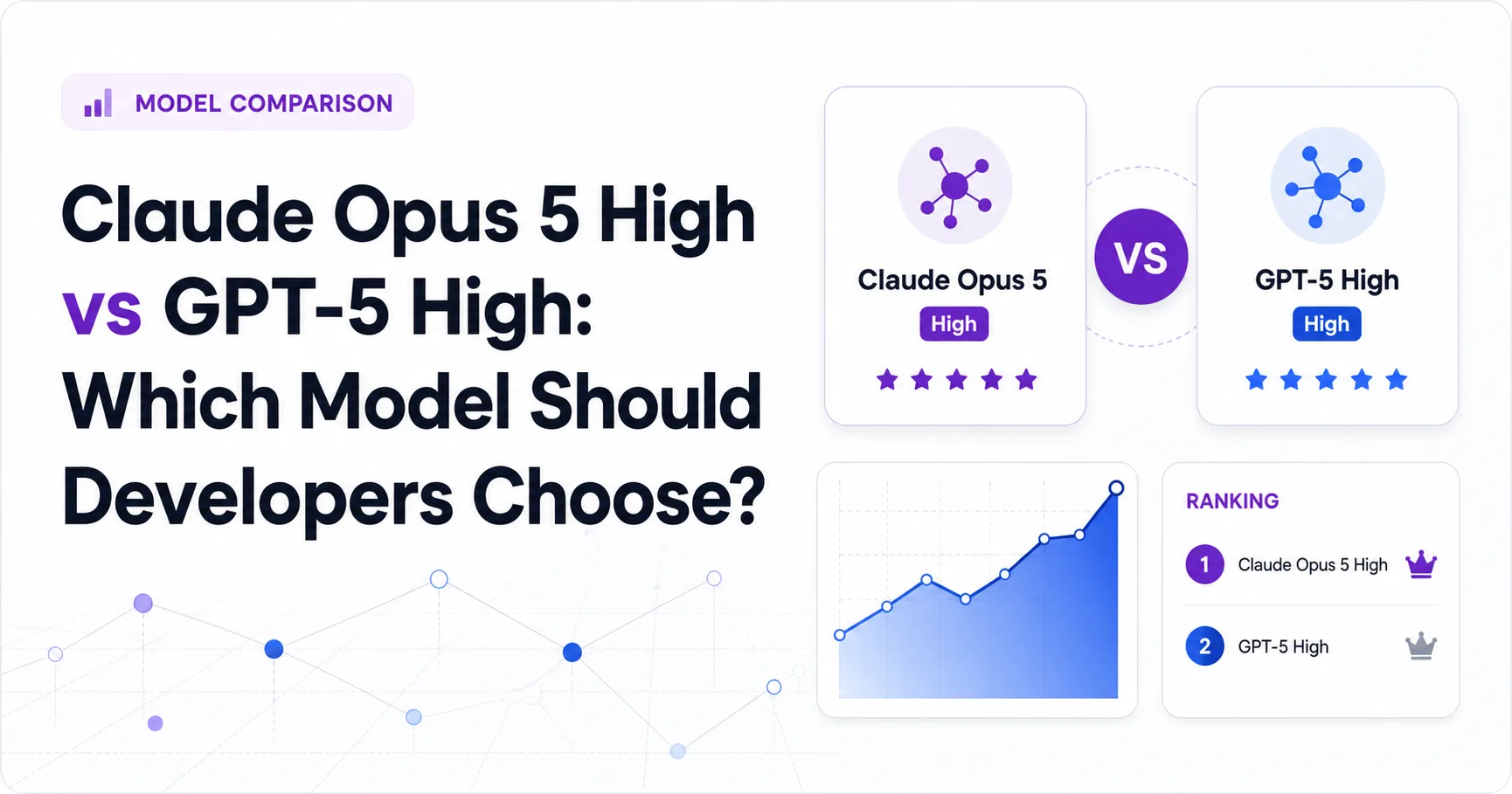
Claude Opus 5 is the stronger default for demanding agentic coding, while GPT-5 is the stronger budget choice. The Artificial Analysis coding index is 76.5 for Claude Opus 5 and 37.8 for GPT-5, a gap that matters when the model must plan, edit, test, and recover across a codebase. Artificial Analysis supplies the comparison data.
Anthropic positions Claude Opus 5 for complex agentic coding and enterprise work in its official announcement. OpenAI positions GPT-5 for coding, reasoning, and agentic tasks in its developer documentation. Those positions overlap, but the models are not interchangeable in practical selection.
The central trade-off is simple: Claude Opus 5 buys a much higher measured coding score and a measured output speed of 54.599 median output tokens per second, while GPT-5 costs $3.4375 per 1M blended tokens instead of $10. The right choice depends on whether failed edits, review time, and supervision cost outweigh API spend.
Claude Opus 5 offers the clearer capability advantage, while GPT-5 offers the clearer economic advantage.
Claude Opus 5 leads the Artificial Analysis coding index at 76.5 versus 37.8 for GPT-5. It also leads the Artificial Analysis intelligence index at 58.9 versus 34.7. GPT-5 has a reported Artificial Analysis math index of 94.3, but Claude Opus 5 has no corresponding value in the supplied data. That means GPT-5 may be attractive for math-heavy workloads, but the comparison does not establish a general reasoning win for it.
The official materials reinforce a difference in operating style. Claude Opus 5 enables adaptive thinking by default and exposes effort levels through its model overview. GPT-5 exposes reasoning effort and verbosity controls through its developer guide. Claude therefore makes extended internal work a central part of the default experience, while GPT-5 gives developers a more explicit control surface for reasoning intensity.
The lifecycle picture also differs. Anthropic currently lists Claude Opus 5 as available in its model overview. OpenAI still lists the gpt-5 alias as callable, but its fixed snapshot is marked deprecated in the GPT-5 model documentation. Developers should distinguish a callable alias from a stable, non-deprecated snapshot before committing production behavior.
Community evidence is weaker than the benchmark evidence. Claude users report excessive verbosity, slow-feeling work, overthinking, and broad autonomous changes in a r/ClaudeAI discussion. GPT-5 users report useful small fixes but occasional hallucinations or incorrect changes in existing codebases in a r/vibecoding discussion. Neither discussion provides a controlled test, so neither should override a workload-specific evaluation.
Claude Opus 5 is the better performance bet for multi-step coding work, but the supplied evidence does not prove a universal win across every development task.
The coding-index gap is large enough to change workflow design. A model scoring 76.5 rather than 37.8 is more plausible as the primary agent for repository-wide changes, difficult debugging, and tasks that require maintaining a plan across many tool calls. The score does not tell you whether every patch is correct, nor does it measure the review burden for your repository. It does, however, support choosing Claude Opus 5 when coding reliability is the dominant selection criterion.
GPT-5 remains credible for narrower engineering loops. OpenAI reports 74.9% on SWE-bench Verified, 88% on Aider polyglot, and 96.7% on τ²-bench telecom in its developer announcement. Those results show strong task-specific capability, but they are not directly equivalent to the Artificial Analysis coding index. OpenAI also notes that the SWE-bench result excluded 23 problems from the tested set, so the result requires careful interpretation.
Claude Opus 5 has a measured median output speed of 54.599 tokens per second, while the supplied GPT-5 data has no comparable output-speed value. Both models show 0.3 seconds of latency in the data brief. The fair conclusion is that initial latency is tied in this snapshot, while streaming throughput favors Claude Opus 5 only on the available measurement. GPT-5 should not be called slower because its corresponding value is missing.
The reasoning configuration can reverse the user experience. Anthropic explains that effort is a behavior signal rather than a strict token budget in its effort documentation. Lower effort may reduce usage, but difficult tasks can still trigger substantial thinking. OpenAI exposes high reasoning effort for GPT-5, and its reported Aider result used that setting. A production comparison should therefore test the exact effort configuration that the application will ship.
The evidence gap is important: neither brief provides controlled measurements for end-to-end coding success, correction rate, tool-call reliability, or developer supervision time. Those are the metrics most likely to decide whether the higher-scoring model saves engineering time.
GPT-5 is substantially cheaper at the API level, but Claude Opus 5 can still be cheaper at the workflow level if it prevents enough rework.
GPT-5 costs $3.4375 per 1M blended tokens, compared with $10 for Claude Opus 5. Its input price is $1.25 and its output price is $10, while Claude Opus 5 costs $5 for input and $25 for output. These differences make GPT-5 the natural first candidate for high-volume classification, routine transformations, short debugging loops, and workloads where human review is already mandatory. The official prices are listed in the GPT-5 model documentation and Anthropic pricing documentation.
The blended price is not the same as a bill. Reasoning-heavy requests can consume more output budget, and Claude Opus 5 includes thinking within the synchronous Messages API output limit. Anthropic documents that thinking and final text share the output ceiling in its thinking documentation. A cheaper model that needs extra retries, larger prompts, or more human correction can lose its apparent advantage.
Caching changes the calculation for repeated context. Claude Opus 5 has a minimum cacheable prompt length of 512 tokens, with separate write and cache-hit prices documented by Anthropic. GPT-5 lists cached input at $0.125 per 1M tokens in its model documentation. Teams sending large, repeated repository instructions should compare cache hit rates and invalidation behavior, not just list prices.
Claude Opus 5 is therefore expensive in direct usage but potentially rational for high-value autonomous work. GPT-5 is financially safer when requests are frequent, outputs are bounded, and a person or deterministic test catches mistakes early. The supplied data does not include total cost per successful code change, so no definitive workflow-level cost winner can be claimed.
GPT-5 (high) leads on 3 of 3 metrics
Claude Opus 5 is the recommended primary agent for complex repository work, while GPT-5 is the recommended economical model for bounded engineering tasks.
Choose Claude Opus 5 when the task requires sustained autonomy, broad repository understanding, multi-step tool use, or difficult code generation. Anthropic explicitly targets complex agentic coding and enterprise work in its product announcement. The higher coding index supports that positioning, and the measured 54.599 median output tokens per second reduces concern that stronger reasoning must always mean slower visible output.
Choose GPT-5 when price, predictable request boundaries, or existing OpenAI integration matter most. Its $3.4375 blended-token price is materially lower than Claude Opus 5's $10. GPT-5 also supports function calling, structured outputs, streaming, and custom tools according to the developer guide. Those controls fit services that need constrained responses and clear validation boundaries.
Use Claude Opus 5 with explicit supervision for high-impact edits. Community reports describe cases where the model overexplains, overthinks simple work, or makes broad changes before confirming scope in the Claude discussion. The reports are not systematic, but they point to a practical guardrail: require a plan, restrict write permissions, and validate each change with tests.
Use GPT-5 with equally strict validation in unfamiliar codebases. A community report describes fast small fixes but also possible hallucinations and incorrect modifications in existing applications in the GPT-5 discussion. The report is subjective, yet it supports keeping repository tests and human review in the loop.
Version management should influence the final choice. Claude Opus 5 is listed as available, while the fixed GPT-5 snapshot is deprecated. OpenAI documents the distinction between stable aliases and snapshots in its model documentation. Anthropic documents its fixed model-ID approach in Model IDs and versioning. Before launch, pin the exact production identifier and define a migration test.
The final recommendation is Claude Opus 5 for capability-first coding agents and GPT-5 for cost-sensitive, tightly validated services. A private pilot remains necessary because the supplied briefs do not establish real-world success rates, correction rates, or supervision time.
Claude Opus 5 is the safer capability-first choice, but developers should validate operational behavior before production adoption.
The most important unknowns are not visible in the headline scores. Teams should measure successful task completion, rollback frequency, test-passing changes, tool-call correctness, review time, and total cost per accepted change. The supplied research does not provide controlled evidence for those measures.
Claude Opus 5 also has documented configuration constraints. Anthropic states that disabling thinking at xhigh or max effort returns a 400 error, and it warns that disabled thinking can produce tool calls as ordinary text or expose internal XML tags in the Opus 5 update notes. Applications with strict tool protocols should test those paths explicitly.
Operational availability also deserves monitoring. Anthropic recorded an elevated-errors incident affecting Claude Opus 5 in its official status record. This is a service event, not a capability score, but it matters for failover planning.
Claude Opus 5 is the stronger coding choice in the supplied comparison, with a 76.5 Artificial Analysis coding index versus 37.8 for GPT-5. That advantage supports complex repository work, but it does not prove higher success on every private codebase or task type.
GPT-5 is cheaper for direct API usage, costing $3.4375 per 1M blended tokens versus $10 for Claude Opus 5. The cheaper list price may disappear if GPT-5 requires more retries, longer prompts, human correction, or additional validation.
Claude Opus 5 has the only supplied output-throughput measurement, at 54.599 median output tokens per second. Both models show 0.3-second latency, but the brief does not provide a comparable GPT-5 output-speed value, so a complete speed ranking is not supported.
Developers can use Claude Opus 5 for autonomous workflows, but they should constrain permissions, require plans, and run tests before accepting changes. Community reports describe overthinking and broad edits, although those reports lack controlled methods and cannot establish a general failure rate.
GPT-5 can still suit a new application through its callable alias, especially when price and OpenAI tooling matter. Developers should review the deprecated fixed snapshot status, pin the intended identifier, and maintain migration tests because the supplied materials do not guarantee long-term snapshot availability.