
Time to First Token · Claude Opus 5 (Adaptive Reasoning, High Effort)
10316ms
Time to First Token · GPT-5.6 Sol (high)
10785ms
Deep dive into reasoning, benchmarks, and latency insights.
The current catalog does not contain complete performance evidence for both models, so this page does not declare an overall winner. Use the available fields as comparison signals and validate the models on your own workload.
Key decision metrics at a glance.
| Model | Metric | Value | Unit | Source / snapshot |
|---|---|---|---|---|
| Claude Opus 5 (Adaptive Reasoning, High Effort) | Reasoning | 6.0 | benchmark or capability score | Artificial Analysis · current catalog |
| GPT-5.6 Sol (high) | Reasoning | 6.0 | benchmark or capability score | Artificial Analysis · current catalog |
| Claude Opus 5 (Adaptive Reasoning, High Effort) | Coding | 8.0 | benchmark or capability score | Artificial Analysis · current catalog |
| GPT-5.6 Sol (high) | Coding | 8.0 | benchmark or capability score | Artificial Analysis · current catalog |
| Claude Opus 5 (Adaptive Reasoning, High Effort) | Multimodal | 5.0 | benchmark or capability score | Artificial Analysis · current catalog |
| GPT-5.6 Sol (high) | Multimodal | 5.0 | benchmark or capability score | Artificial Analysis · current catalog |
| Claude Opus 5 (Adaptive Reasoning, High Effort) | Long Context | 8.0 | benchmark or capability score | Artificial Analysis · current catalog |
| GPT-5.6 Sol (high) | Long Context | 7.0 | benchmark or capability score | Artificial Analysis · current catalog |
| Claude Opus 5 (Adaptive Reasoning, High Effort) | Blended Price / 1M tokens | $10 | USD per 1M tokens | Artificial Analysis · current catalog |
| GPT-5.6 Sol (high) | Blended Price / 1M tokens | $11.25 | USD per 1M tokens | Artificial Analysis · current catalog |
| Claude Opus 5 (Adaptive Reasoning, High Effort) | P95 Latency | — | milliseconds | Artificial Analysis · current catalog |
| GPT-5.6 Sol (high) | P95 Latency | — | milliseconds | Artificial Analysis · current catalog |
| Claude Opus 5 (Adaptive Reasoning, High Effort) | Tokens per second | 51.106 | tokens per second | Artificial Analysis · current catalog |
| GPT-5.6 Sol (high) | Tokens per second | 60.874 | tokens per second | Artificial Analysis · current catalog |
Data provided by Artificial Analysis; live values use the current catalog.
This radar chart visually maps the core capabilities (reasoning, coding, math proxy, multimodal, long context) of `Claude Opus 5 (Adaptive Reasoning, High Effort)` vs `GPT-5.6 Sol (high)`.
This grouped bar chart provides a side-by-side comparison for each benchmark metric.
Lower time to first token is better; higher tokens per second is better.
Compare input and output pricing in USD per 1M tokens.
Claude Opus 5 (Adaptive Reasoning, High Effort)$11.25
GPT-5.6 Sol (high)$12.5
Claude Opus 5 (Adaptive Reasoning, High Effort) costs $1.25 less per run
This article is a dated snapshot published on 2026-08-05. Live cards above use the current catalog; missing live fields are not inferred.
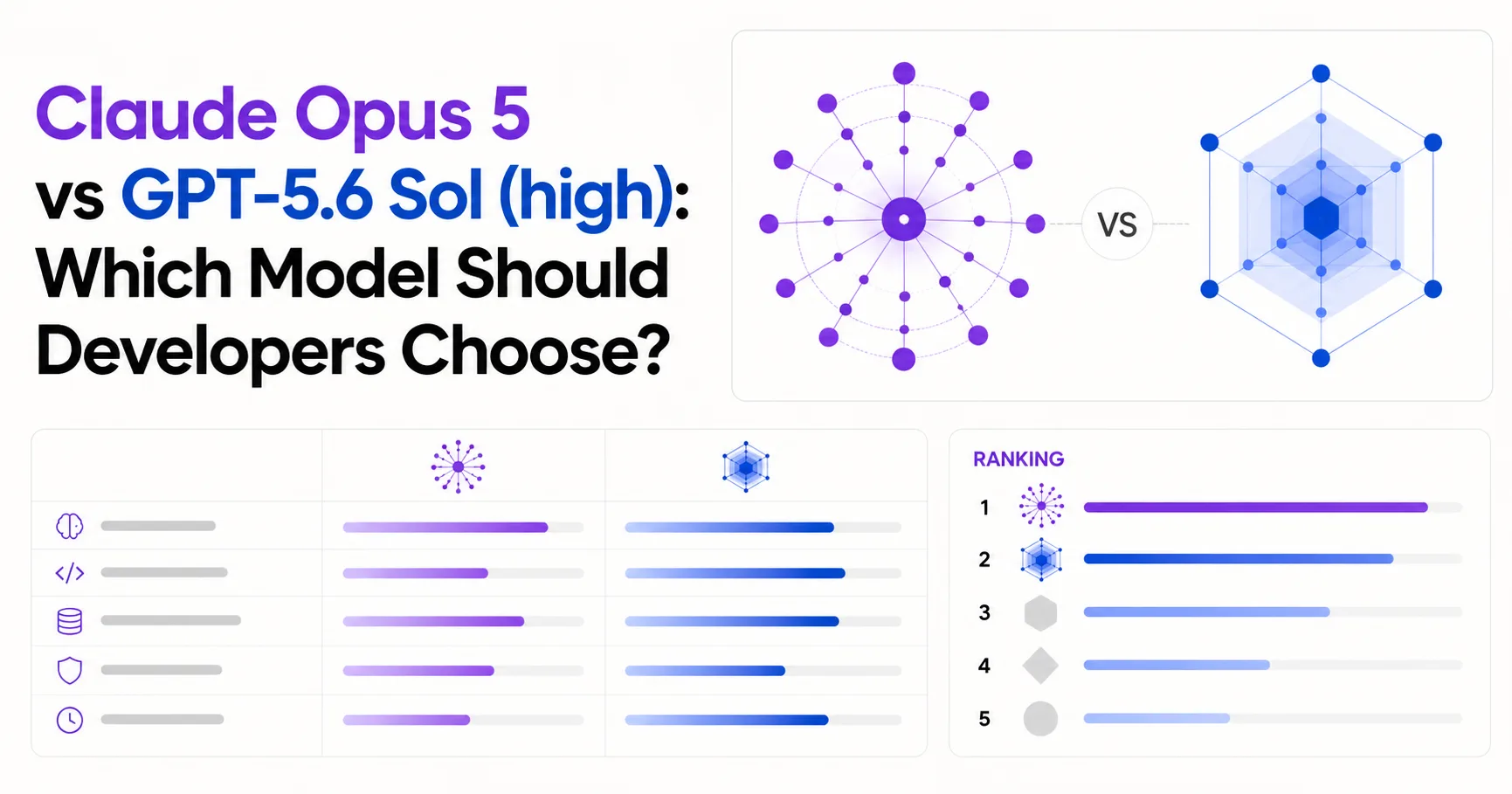
Claude Opus 5 is the better default for broad, cost-aware engineering work, while GPT-5.6 Sol is the better speed-first coding engine. Artificial Analysis gives Claude the higher Intelligence Index, 58.9 versus 55.9, and the lower blended price, $10 versus $11.25 per 1M tokens. GPT leads the Coding Index, 77.2 versus 76.5, and produces 73.648 median output tokens per second versus 54.599. Both report 0.3 seconds of latency in the snapshot, so the practical choice depends on what happens after the first response arrives.
The names also describe different API decisions. Claude Opus 5 is the official Anthropic API ID and stable alias, while claude-opus-5-high is a site slug rather than the API name. Anthropic's model overview documents the model as available across Claude API, Amazon Bedrock, Google Cloud, and Microsoft Foundry. GPT-5.6 Sol (high) is a configuration label, not a separate model ID. OpenAI's model page identifies gpt-5.6-sol as the fixed model and gpt-5.6 as the stable alias; high belongs in the reasoning configuration.
Data provided by https://artificialanalysis.ai/ (snapshot source).
Claude Opus 5 wins the broad comparison on intelligence and blended price, while GPT-5.6 Sol wins coding index and output speed. Artificial Analysis provides the structured comparison behind that split.
| Decision lens | Claude Opus 5 | GPT-5.6 Sol | Practical meaning |
|---|---|---|---|
| Intelligence Index | 58.9 | 55.9 | Claude has the stronger broad aggregate result |
| Coding Index | 76.5 | 77.2 | GPT has a narrow coding lead |
| Blended price per 1M tokens | $10 | $11.25 | Claude is cheaper under the supplied mix |
| Median output speed | 54.599 tokens/s | 73.648 tokens/s | GPT produces visible output faster |
| Latency | 0.3 seconds | 0.3 seconds | The snapshot shows a tie at request latency |
Both models remain listed as available in their current official directories, so retirement status does not separate them in this comparison. See Anthropic's model overview and OpenAI's model directory.
Versioning creates a more important integration difference. Anthropic documents claude-opus-5 as a fixed snapshot identifier rather than an evergreen route to future versions in its versioning guide. OpenAI documents gpt-5.6 as a stable alias routed to gpt-5.6-sol on the model page. Teams that need reproducibility should pin the fixed identifier in either ecosystem and treat aliases as an explicit upgrade decision.
Official announcements also use different benchmark narratives. Anthropic highlights leading results across agentic, research, visual, and office tasks in its Claude Opus 5 announcement. OpenAI publishes strong results across coding, browsing, operating-system, and security evaluations in its GPT-5.6 announcement. Those claims do not settle this comparison because the supplied snapshot uses Artificial Analysis indices rather than one shared official leaderboard.
GPT-5.6 Sol is the faster model for sustained generation, while Claude Opus 5 remains competitive on initial latency. Artificial Analysis reports 73.648 median output tokens per second for GPT and 54.599 for Claude, while both models show 0.3 seconds of latency.
That speed gap matters most in interactive coding. Faster visible generation can shorten the wait for patches, test explanations, tool-result summaries, and review comments. The latency tie suggests that GPT's measured advantage appears after the response begins, not necessarily before the first token arrives. It does not prove lower end-to-end time, because tool execution, retries, reasoning depth, and output length can dominate a real agent run.
GPT's documented tool surface is especially attractive for tool-heavy products. The GPT-5.6 Sol model page lists structured outputs, function calling, file search, web search, prompt caching, image generation, code interpreter, hosted shell, computer use, MCP, and tool search. Claude's official positioning emphasizes complex agentic coding and enterprise work, with text and image input, visual understanding, and access through several cloud platforms. See Anthropic's announcement and model overview. These documented surfaces show integration options, not guaranteed success on a particular repository.
The benchmark split needs restraint. GPT's Coding Index lead is narrow in the supplied snapshot, while Claude's Intelligence Index lead points to a different aggregate strength. The figures do not establish which model writes fewer regressions, follows repository conventions better, or needs fewer tool retries.
Reasoning configuration can also blur the speed result. Claude enables adaptive thinking by default, and its effort documentation describes effort as a behavior signal rather than a strict token budget. Claude's update notes warn that thinking can increase latency and cost on long tasks. OpenAI similarly explains that reasoning tokens consume the output budget and can leave a response incomplete when the limit is reached in its reasoning guide.
Claude Opus 5 is cheaper on the provided blended workload, but GPT-5.6 Sol can become easier to justify when faster completion reduces human waiting. Artificial Analysis puts the blended comparison at $10 for Claude versus $11.25 for GPT per 1M tokens.
That price gap matters only under the supplied traffic mix. The snapshot shows equal input pricing and a lower output price for Claude, so Claude's advantage grows when requests produce substantial reasoning and visible output. GPT's faster generation can offset a higher token bill when developers wait for responses, review many intermediate steps, or operate a queue where completion time affects throughput. The brief does not provide human-time cost, output-length distributions, tool execution costs, or retry rates, so neither model can be declared cheaper for every application.
Reasoning changes actual spend. Anthropic explains that thinking and final text share the output ceiling, and that long tasks can increase both latency and cost in the Claude Opus 5 update notes and thinking guide. OpenAI states that reasoning tokens consume max_output_tokens and are billed as output tokens in its reasoning guide. A model with a lower listed rate can therefore become expensive if it thinks longer, repeats work, or produces verbose explanations.
Prompt reuse can change the ranking as well. Anthropic publishes separate cache-write and cache-hit prices in its pricing documentation. OpenAI documents prompt caching, cache input pricing, and several service modes in its API pricing documentation. The supplied data does not identify cache hit rate, long-context share, service tier, or batch eligibility. Teams with repeated system prompts should price a production-like trace rather than rely on blended price alone.
The cost decision is therefore a workflow decision. Claude is the safer choice for minimizing token spend under comparable output behavior. GPT can be the better economic choice when faster generation reduces expensive human or infrastructure idle time.
Claude Opus 5 (Adaptive Reasoning, High Effort) leads on 2 of 3 metrics
Claude Opus 5 is my overall pick for broad developer selection, while GPT-5.6 Sol is the sharper choice for speed-sensitive, tool-rich agents. Artificial Analysis gives Claude the stronger Intelligence Index and lower blended price, while GPT leads the Coding Index and output speed.
Choose Claude Opus 5 when:
Anthropic positions Claude Opus 5 around complex agentic coding and enterprise work in its launch announcement. The platform also recommends keeping thinking enabled for reliable tool behavior; its update notes warn that disabled thinking can produce malformed tool behavior or internal XML-like output. Community reports add risks of verbosity, overthinking, and large unconfirmed changes in the r/ClaudeAI discussion. Those reports are anecdotal, so treat them as reasons for guardrails rather than proof of a universal defect.
Choose GPT-5.6 Sol when:
OpenAI's model documentation lists a broad tool surface, and its reasoning guide describes high effort for complex debugging, planning, and coding. Community feedback still flags slow experiences, overengineering, irrelevant investigation, and defensive code in the Codex Reddit discussion and a Hacker News report. The evidence lacks a common task set, so the speed result should not be treated as a success-rate guarantee.
The practical rule is simple: choose Claude for quality-per-dollar in open-ended work, and choose GPT for generation throughput and platform tool coverage. If the decision remains close, run both models on the same repository tasks and compare accepted patch rate, human edit time, tool-call validity, total tokens, and failure recovery. The supplied evidence does not provide standardized independent results for those outcomes.
Claude Opus 5 and GPT-5.6 Sol need workload-specific acceptance tests before a production choice. The public evidence supports a directional recommendation, not a universal winner.
Test the failure costs that the comparison charts cannot show: wrong tool calls, incomplete responses, excessive diffs, irrelevant investigations, repeated retries, and reviewer rework. Claude's documentation describes tool-format risks when thinking is disabled in the update notes. OpenAI documents how reasoning tokens can consume the output budget and leave responses incomplete in the reasoning guide.
Treat community posts as hypotheses. The Claude discussion reports verbosity, speed concerns, and autonomous changes without a systematic test method in r/ClaudeAI. GPT discussions report overengineering, slow responses, and investigation drift without a unified benchmark in Reddit and Hacker News.
The largest evidence gap is real-world performance. Neither brief provides reliable, independently reproducible data for average latency, coding success, stability, tool-call validity, or total developer effort for the high configurations. Use the supplied snapshot to narrow the shortlist, then validate the final choice against your own repository, context mix, approval process, and cost model.
Claude Opus 5 is cheaper on the provided blended comparison at $10 versus $11.25 per 1M blended tokens. That advantage may shrink when GPT's faster generation reduces developer waiting, retries, or queue occupancy. See Artificial Analysis and Anthropic's pricing documentation.
GPT-5.6 Sol is faster for sustained output, reaching 73.648 median output tokens per second versus Claude Opus 5 at 54.599, while both models show 0.3 seconds of latency in the snapshot. See Artificial Analysis.
GPT-5.6 Sol is the better starting point for speed-sensitive coding agents, while Claude Opus 5 is stronger for broad, cost-aware, open-ended engineering work. GPT's documented tool surface is broad, while Anthropic emphasizes complex agentic coding in its announcement and Anthropic's announcement.
GPT-5.6 Sol (high) is not a separate official model ID; developers use gpt-5.6-sol or the gpt-5.6 alias and set the reasoning effort to high. Anthropic similarly distinguishes its official claude-opus-5 ID from the claude-opus-5-high site slug. See OpenAI's model page and Anthropic's versioning guide.
The benchmark results cannot predict real-world coding success by themselves because the supplied evidence lacks a standardized independent test of accepted patches, tool-call validity, regressions, and reviewer effort. Community reports for both models remain anecdotal, as shown in the Claude discussion and the GPT discussion.