
Time to First Token · Claude Opus 5 (Adaptive Reasoning, High Effort)
10316ms
Time to First Token · GPT-5.6 Sol (xhigh)
31324ms
Deep dive into reasoning, benchmarks, and latency insights.
The current catalog does not contain complete performance evidence for both models, so this page does not declare an overall winner. Use the available fields as comparison signals and validate the models on your own workload.
Key decision metrics at a glance.
| Model | Metric | Value | Unit | Source / snapshot |
|---|---|---|---|---|
| Claude Opus 5 (Adaptive Reasoning, High Effort) | Reasoning | 6.0 | benchmark or capability score | Artificial Analysis · current catalog |
| GPT-5.6 Sol (xhigh) | Reasoning | 6.0 | benchmark or capability score | Artificial Analysis · current catalog |
| Claude Opus 5 (Adaptive Reasoning, High Effort) | Coding | 8.0 | benchmark or capability score | Artificial Analysis · current catalog |
| GPT-5.6 Sol (xhigh) | Coding | 8.0 | benchmark or capability score | Artificial Analysis · current catalog |
| Claude Opus 5 (Adaptive Reasoning, High Effort) | Multimodal | 5.0 | benchmark or capability score | Artificial Analysis · current catalog |
| GPT-5.6 Sol (xhigh) | Multimodal | 5.0 | benchmark or capability score | Artificial Analysis · current catalog |
| Claude Opus 5 (Adaptive Reasoning, High Effort) | Long Context | 8.0 | benchmark or capability score | Artificial Analysis · current catalog |
| GPT-5.6 Sol (xhigh) | Long Context | 7.0 | benchmark or capability score | Artificial Analysis · current catalog |
| Claude Opus 5 (Adaptive Reasoning, High Effort) | Blended Price / 1M tokens | $10 | USD per 1M tokens | Artificial Analysis · current catalog |
| GPT-5.6 Sol (xhigh) | Blended Price / 1M tokens | $11.25 | USD per 1M tokens | Artificial Analysis · current catalog |
| Claude Opus 5 (Adaptive Reasoning, High Effort) | P95 Latency | — | milliseconds | Artificial Analysis · current catalog |
| GPT-5.6 Sol (xhigh) | P95 Latency | — | milliseconds | Artificial Analysis · current catalog |
| Claude Opus 5 (Adaptive Reasoning, High Effort) | Tokens per second | 51.106 | tokens per second | Artificial Analysis · current catalog |
| GPT-5.6 Sol (xhigh) | Tokens per second | 64.533 | tokens per second | Artificial Analysis · current catalog |
Data provided by Artificial Analysis; live values use the current catalog.
This radar chart visually maps the core capabilities (reasoning, coding, math proxy, multimodal, long context) of `Claude Opus 5 (Adaptive Reasoning, High Effort)` vs `GPT-5.6 Sol (xhigh)`.
This grouped bar chart provides a side-by-side comparison for each benchmark metric.
Lower time to first token is better; higher tokens per second is better.
Compare input and output pricing in USD per 1M tokens.
Claude Opus 5 (Adaptive Reasoning, High Effort)$11.25
GPT-5.6 Sol (xhigh)$12.5
Claude Opus 5 (Adaptive Reasoning, High Effort) costs $1.25 less per run
This article is a dated snapshot published on 2026-08-05. Live cards above use the current catalog; missing live fields are not inferred.
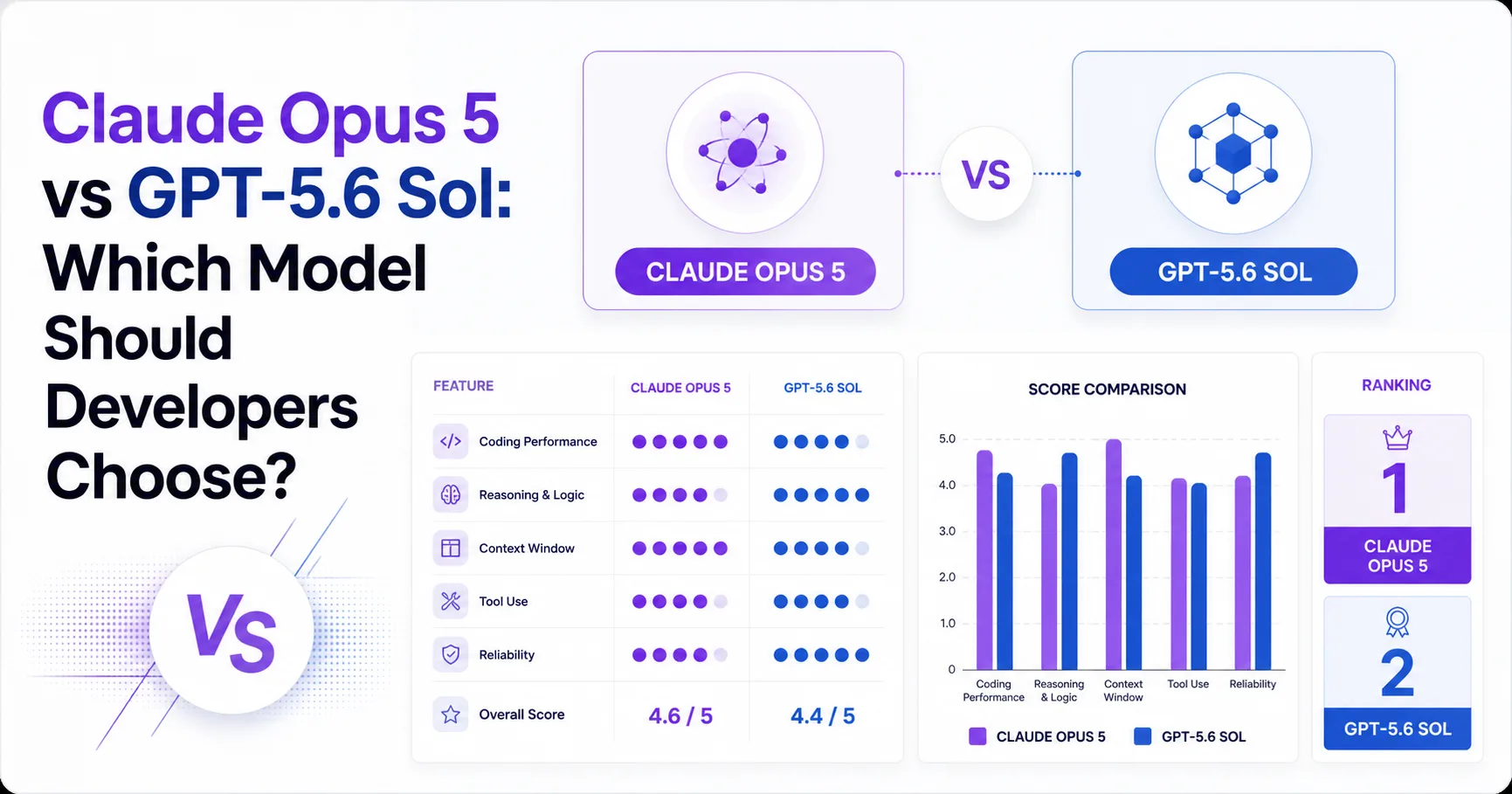
GPT-5.6 Sol is the stronger default for coding-heavy agents, while Claude Opus 5 offers lower blended cost and a higher general intelligence index.
The supplied scorecard gives GPT-5.6 Sol a coding index of 78.3 versus Claude Opus 5 at 76.5, plus median output of 73.479 versus 54.599 tokens per second. Claude Opus 5 leads the intelligence index at 58.9 versus 57.7 and costs $10 versus $11.25 per 1M blended tokens. Data provided by https://artificialanalysis.ai/
Anthropic positions Claude Opus 5 around complex agentic coding and enterprise work, while OpenAI presents GPT-5.6 Sol as a flagship model for complex reasoning, programming, and professional work. Anthropic's announcement OpenAI's announcement
The practical choice depends on whether your application values coding throughput, broad reasoning quality, lower output cost, or a larger built-in tool surface. The available evidence supports a clear coding and speed preference for GPT-5.6 Sol, but it does not establish a universal winner for every production workload.
Claude Opus 5 is the better value for broad reasoning workflows, while GPT-5.6 Sol is the better fit for coding throughput and tool-rich execution.
| Decision signal | Claude Opus 5 | GPT-5.6 Sol |
|---|---|---|
| Official model identity | claude-opus-5 |
gpt-5.6-sol |
| Stable alias | claude-opus-5 |
gpt-5.6 |
| Reasoning control | Adaptive thinking with configurable effort | Reasoning modes and configurable effort |
| Input and output | Text and image input, text output | Text and image input, text output |
| Platform reach | Claude API, Amazon Bedrock, Google Cloud, Microsoft Foundry | Chat Completions API and Responses API |
| Main selection advantage | Lower blended cost and higher intelligence index | Higher coding index and faster output |
Claude Opus 5 uses claude-opus-5 as its official API ID, while claude-opus-5-high is a site slug rather than the API identifier. Anthropic's model overview Anthropic's model ID guide
GPT-5.6 Sol uses gpt-5.6-sol as its fixed model ID, and gpt-5.6 as its stable alias. The xhigh label describes reasoning effort, not a separate model. GPT-5.6 Sol model page OpenAI reasoning guide
Claude Opus 5 is attractive for teams that need provider flexibility and adaptive reasoning. GPT-5.6 Sol is attractive for teams that want a Responses API workflow with function calling, structured outputs, web search, file search, code execution, hosted shell, computer use, MCP, apply patch, and skills. Anthropic's model overview GPT-5.6 Sol model page
The official catalogs currently present both models as available. That reduces immediate migration concern, but stable identifiers still matter for reproducibility, evaluation, and rollback planning. Anthropic's model overview OpenAI's model directory
GPT-5.6 Sol is faster and slightly stronger on the coding index, while Claude Opus 5 scores higher on the broader intelligence index.
GPT-5.6 Sol reaches a coding index of 78.3 versus Claude Opus 5 at 76.5. Its median output speed is 73.479 tokens per second versus 54.599 for Claude Opus 5, while the reported latency is 0.3 seconds for each model. Data provided by https://artificialanalysis.ai/
The speed difference matters most inside agent loops. A model that generates output faster can reduce the time spent waiting between tool calls, patches, test runs, and review steps. Equal reported latency means the advantage is mainly generation throughput, not necessarily a faster first response. That distinction matters for interactive coding assistants and long-running autonomous tasks.
GPT-5.6 Sol also offers a broad Responses API tool surface, including structured outputs, code execution, hosted shell, computer use, MCP, and apply patch. Those capabilities make it easier to build a single agent workflow around planning, execution, and repository changes. GPT-5.6 Sol model page
Claude Opus 5 takes a different route. Adaptive thinking is enabled by default, and effort controls can change how much reasoning the model applies. That behavior may suit difficult research, planning, and open-ended reasoning tasks, but effort is not a strict token budget. Claude Opus 5 update notes Anthropic effort guide
Official benchmark messaging does not close the comparison. Anthropic claims leading results across several agentic and professional evaluations, while OpenAI publishes its own benchmark set under its own testing conditions. The announcements do not provide a directly matched, independently reproduced comparison for these exact workloads. Anthropic's announcement OpenAI's announcement
The evidence gap is important: no supplied source establishes coding success rate, correction rate, or production reliability across a shared test set. Developers should treat the coding index as a useful directional signal, not a complete forecast of accepted patches.
Claude Opus 5 is cheaper under the supplied blended workload, while GPT-5.6 Sol can justify its premium when faster output reduces operator time.
The supplied comparison prices Claude Opus 5 at $10 versus GPT-5.6 Sol at $11.25 per 1M blended tokens. Input pricing is $5 for each model, while output pricing is $25 for Claude Opus 5 and $30 for GPT-5.6 Sol. Data provided by https://artificialanalysis.ai/
The blended figure is useful for ranking the models, but it is not a universal application bill. Output-heavy agents will feel the output price difference more strongly than retrieval-heavy applications. A workflow with repeated tool calls, long reasoning traces, retries, or human review can make a nominally cheaper model more expensive per accepted result.
Anthropic's official pricing also supports prompt caching and a Fast mode, while OpenAI exposes Standard, Batch, Flex, and Fast pricing paths. These options can change the preferred provider after traffic shape, service requirements, and cache behavior are included. Anthropic pricing Claude Opus 5 update notes OpenAI pricing
Reasoning configuration adds another cost variable. Claude's adaptive thinking consumes part of the output allowance, and GPT-5.6 Sol's xhigh setting increases reasoning time and token use. GPT documentation also warns that a low output limit can produce an incomplete response after input and reasoning tokens have already incurred charges. Anthropic thinking guide OpenAI reasoning guide
Community reports reinforce the need to measure accepted work rather than raw token price. Developers have described Claude Opus 5 as overly verbose and prone to overthinking, while GPT-5.6 Sol discussions include conflicting reports of high quality and over-engineered output. Neither discussion provides a reproducible cost-per-successful-task measurement. Claude community discussion GPT-5.6 community discussion
The supplied evidence cannot show whether retries, review time, or failed tool calls reverse the blended-price ranking. Measure cost per accepted patch, completed workflow, or resolved support case before making a final procurement decision.
Claude Opus 5 (Adaptive Reasoning, High Effort) leads on 2 of 3 metrics
GPT-5.6 Sol is the stronger first choice for autonomous coding agents, while Claude Opus 5 is the stronger value choice for general reasoning.
Choose GPT-5.6 Sol when the primary workload is repository modification, tool orchestration, or fast generation inside an agent loop. Its coding index is 78.3 versus 76.5 for Claude Opus 5, and its median output speed is 73.479 versus 54.599 tokens per second. The Responses API also exposes a broad set of tools for structured execution and computer-oriented workflows. Data provided by https://artificialanalysis.ai/ GPT-5.6 Sol model page
Choose Claude Opus 5 when general reasoning quality, lower blended cost, or provider portability matters more than coding throughput. Claude Opus 5 leads the supplied intelligence index at 58.9 versus 57.7 and costs $10 versus $11.25 per 1M blended tokens. Anthropic also documents access through the Claude API, Amazon Bedrock, Google Cloud, and Microsoft Foundry. Data provided by https://artificialanalysis.ai/ Anthropic's model overview
Treat reasoning settings as part of the product design. Claude defaults to adaptive thinking, while GPT-5.6 Sol requires deliberate reasoning configuration when using xhigh. Strict tool protocols should be tested with the selected settings because Anthropic documents tool-call formatting risks when thinking is disabled, and OpenAI documents incomplete responses when output limits are too low. Claude Opus 5 update notes Anthropic thinking guide OpenAI reasoning guide
Community evidence does not resolve the final decision. Claude reports emphasize verbosity, overthinking, and unsolicited changes, while GPT reports range from reliable execution to over-engineering and excessive code generation. The testing methods are not controlled, so neither report should define a production policy. Claude community discussion GPT-5.6 community discussion
The safest rollout is a shared acceptance suite covering patch correctness, tool-call validity, review burden, latency, and cost per accepted result. The supplied research does not provide those production measurements, so model selection should remain workload-specific.
Claude Opus 5 and GPT-5.6 Sol need different interpretation of their labels before developers compare API behavior.
Claude Opus 5 is the official model, claude-opus-5 is its API ID and stable alias, and claude-opus-5-high is a site slug. GPT-5.6 Sol is the official model, gpt-5.6-sol is the fixed ID, gpt-5.6 is the stable alias, and xhigh is a reasoning setting. Anthropic's model ID guide GPT-5.6 Sol model page OpenAI reasoning guide
The official materials establish strong capabilities and clear pricing, but they do not answer average production success rate, correction burden, or user experience distribution. Those questions require a controlled evaluation on the developer's own tasks.
GPT-5.6 Sol is the better starting point for a coding agent because it leads the supplied coding index, produces output faster, and exposes a broad Responses API tool surface. Data provided by https://artificialanalysis.ai/ GPT-5.6 Sol model page Claude Opus 5 remains a strong alternative when adaptive reasoning, lower blended cost, or multi-provider deployment matters more.
Claude Opus 5 is cheaper under the supplied blended comparison, at $10 versus GPT-5.6 Sol at $11.25 per 1M blended tokens. Data provided by https://artificialanalysis.ai/ Actual application cost can still change with output volume, reasoning behavior, caching, retries, and batch or fast service choices.
GPT-5.6 Sol is the model ID, while xhigh is a reasoning-effort setting rather than a separate model. GPT-5.6 Sol model page OpenAI reasoning guide Developers should record the model ID and reasoning configuration separately in evaluations because changing effort can affect latency, token use, and response completeness.
Neither vendor announcement alone proves a universal production winner because the published claims use different evaluation framing and do not provide a directly matched, independently reproduced comparison. Anthropic's announcement OpenAI's announcement Use the supplied scorecard for directional comparison, then validate accepted work on representative repositories and agent tasks.
GPT-5.6 Sol is unsuitable for native audio or video input and does not support fine-tuning, while the supplied Claude materials establish text and image input with text output but do not establish Claude fine-tuning support. GPT-5.6 Sol model page Applications requiring those capabilities should verify a separate model or provider before implementation.