
Time to First Token · Claude Opus 5 (Adaptive Reasoning, High Effort)
10316ms
Time to First Token · GPT-5.6 Terra (max)
109872ms
Deep dive into reasoning, benchmarks, and latency insights.
The current catalog does not contain complete performance evidence for both models, so this page does not declare an overall winner. Use the available fields as comparison signals and validate the models on your own workload.
Key decision metrics at a glance.
| Model | Metric | Value | Unit | Source / snapshot |
|---|---|---|---|---|
| Claude Opus 5 (Adaptive Reasoning, High Effort) | Reasoning | 6.0 | benchmark or capability score | Artificial Analysis · current catalog |
| GPT-5.6 Terra (max) | Reasoning | 6.0 | benchmark or capability score | Artificial Analysis · current catalog |
| Claude Opus 5 (Adaptive Reasoning, High Effort) | Coding | 8.0 | benchmark or capability score | Artificial Analysis · current catalog |
| GPT-5.6 Terra (max) | Coding | 8.0 | benchmark or capability score | Artificial Analysis · current catalog |
| Claude Opus 5 (Adaptive Reasoning, High Effort) | Multimodal | 5.0 | benchmark or capability score | Artificial Analysis · current catalog |
| GPT-5.6 Terra (max) | Multimodal | 5.0 | benchmark or capability score | Artificial Analysis · current catalog |
| Claude Opus 5 (Adaptive Reasoning, High Effort) | Long Context | 8.0 | benchmark or capability score | Artificial Analysis · current catalog |
| GPT-5.6 Terra (max) | Long Context | 7.0 | benchmark or capability score | Artificial Analysis · current catalog |
| Claude Opus 5 (Adaptive Reasoning, High Effort) | Blended Price / 1M tokens | $10 | USD per 1M tokens | Artificial Analysis · current catalog |
| GPT-5.6 Terra (max) | Blended Price / 1M tokens | $4.5 | USD per 1M tokens | Artificial Analysis · current catalog |
| Claude Opus 5 (Adaptive Reasoning, High Effort) | P95 Latency | — | milliseconds | Artificial Analysis · current catalog |
| GPT-5.6 Terra (max) | P95 Latency | — | milliseconds | Artificial Analysis · current catalog |
| Claude Opus 5 (Adaptive Reasoning, High Effort) | Tokens per second | 51.106 | tokens per second | Artificial Analysis · current catalog |
| GPT-5.6 Terra (max) | Tokens per second | 117.141 | tokens per second | Artificial Analysis · current catalog |
Data provided by Artificial Analysis; live values use the current catalog.
This radar chart visually maps the core capabilities (reasoning, coding, math proxy, multimodal, long context) of `Claude Opus 5 (Adaptive Reasoning, High Effort)` vs `GPT-5.6 Terra (max)`.
This grouped bar chart provides a side-by-side comparison for each benchmark metric.
Lower time to first token is better; higher tokens per second is better.
Compare input and output pricing in USD per 1M tokens.
Claude Opus 5 (Adaptive Reasoning, High Effort)$11.25
GPT-5.6 Terra (max)$5
GPT-5.6 Terra (max) costs $6.25 less per run
This article is a dated snapshot published on 2026-08-05. Live cards above use the current catalog; missing live fields are not inferred.
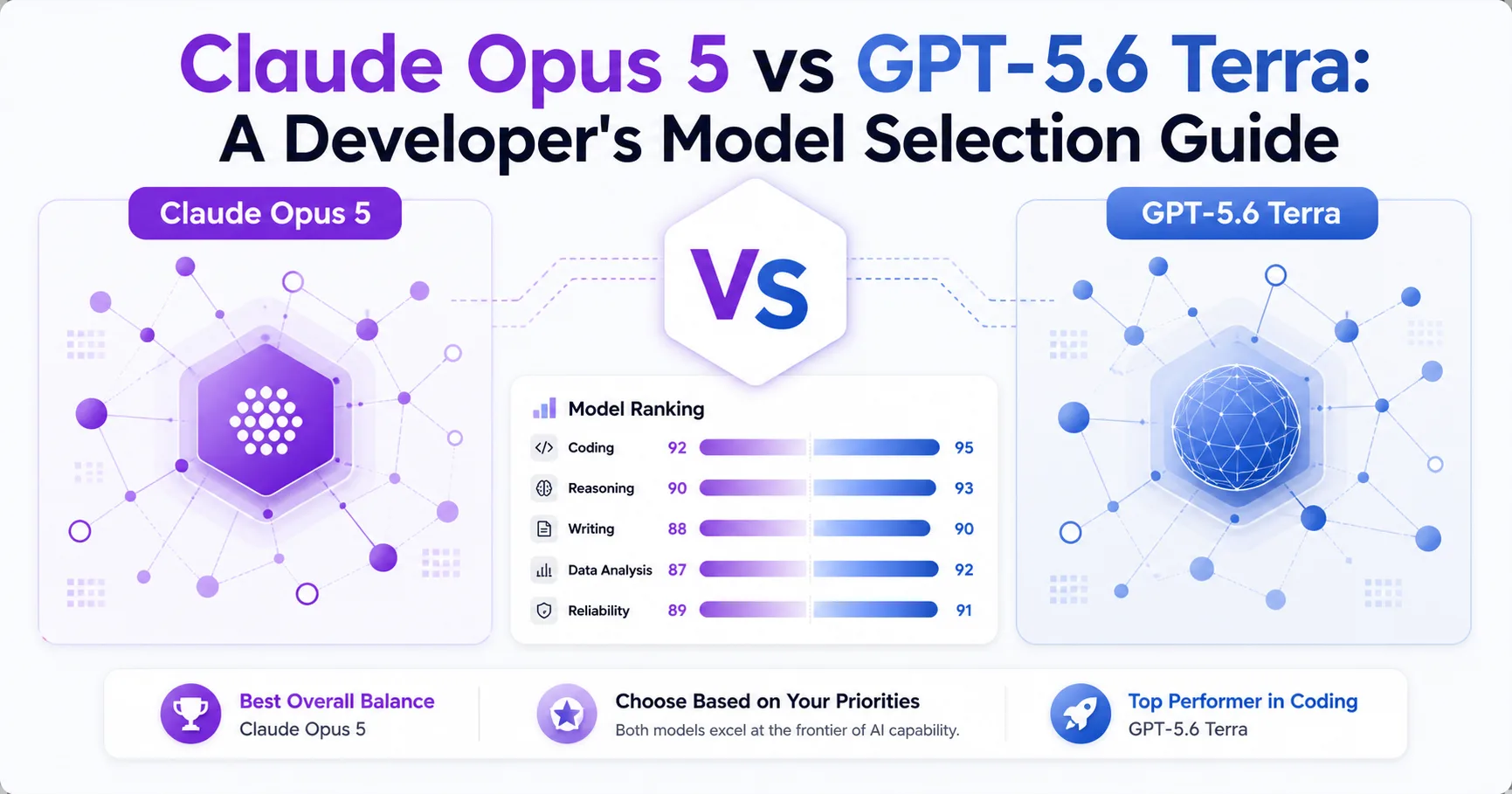
Claude Opus 5 is the stronger overall choice for high-stakes reasoning, while GPT-5.6 Terra is the better default for fast, cost-sensitive production.
That conclusion comes from the supplied comparison snapshot provided by Artificial Analysis. Claude Opus 5 records an Intelligence Index of 58.9 versus 55 for GPT-5.6 Terra. Coding is effectively tied, with scores of 76.5 and 76.7 respectively. The practical split is therefore not simply intelligence versus weakness. Claude leads on the broader intelligence measure, while Terra matches it on coding and delivers much higher output speed.
Anthropic positions Claude Opus 5 for complex agentic coding and enterprise work. OpenAI positions GPT-5.6 Terra as a general reasoning model that balances intelligence and cost, and places it within its broader Frontier models lineup. Those positions match the data, but they imply different buying decisions.
The evidence has an important limitation. Anthropic claims leading results across several evaluations in its official announcement, yet the announcement does not provide every underlying score. OpenAI's Terra model documentation does not publish Terra-specific benchmark results. Artificial Analysis supplies the most useful direct comparison, but it cannot establish success rates for your repository, tools, prompts, or approval workflow.
GPT-5.6 Terra is the better general-purpose default, but Claude Opus 5 buys the broader intelligence lead and a wider cloud deployment footprint.
| Decision axis | Better fit | What the evidence means |
|---|---|---|
| Broad intelligence | Claude Opus 5 | The Artificial Analysis Intelligence Index is 58.9 versus 55. |
| Coding | GPT-5.6 Terra | The coding index is 76.7 versus 76.5, so neither model has a meaningful measured lead here. |
| Output speed | GPT-5.6 Terra | The reported median output speed is 144.252 versus 54.599 tokens per second. |
| Blended cost | GPT-5.6 Terra | The reported price is $4.500000000000001 versus $10 per 1M blended tokens. |
| Deployment routes | Claude Opus 5 | Anthropic's model overview lists Claude API, Amazon Bedrock, Google Cloud, and Microsoft Foundry. |
| Tool and API surface | GPT-5.6 Terra | OpenAI's model page lists Responses API, Chat Completions API, Batch API, structured outputs, function calling, and hosted tools. |
Claude Opus 5 also has a more explicit behavior model for difficult tasks. Adaptive thinking is enabled by default, and the model exposes effort levels for controlling how much reasoning it attempts. Anthropic documents the default behavior and available effort levels, while its effort guide warns that effort is a behavior signal rather than a strict token budget.
GPT-5.6 Terra supports standard and pro reasoning modes, plus the reasoning effort values supported by the model family. OpenAI's reasoning guide does not provide a complete Terra-specific support matrix, so teams should verify their chosen settings before production rollout.
Version status also favors caution over assumptions. Anthropic's current model overview lists Opus 5 as available. OpenAI's deprecation page does not list Terra as deprecated. Those are positive signals, but they are not equivalent evidence of future support guarantees.
Community evidence is uneven. A r/ClaudeAI discussion reports complaints about verbosity, slow responses, and autonomous scope expansion, alongside users who prefer its long autonomous runs. The supplied research found no comparable reliable community evidence for the exact Terra model. That gap prevents a confident claim about real-world experience distributions.
GPT-5.6 Terra is the faster model after generation begins, while Claude Opus 5 holds the higher intelligence score.
The supplied Artificial Analysis snapshot reports a median output speed of 144.252 tokens per second for GPT-5.6 Terra and 54.599 for Claude Opus 5. Reported latency is 0.3 seconds for both models. That combination matters for interactive software: the models may begin responding at a similar point, but Terra can produce visible output much faster after generation starts.
Speed does not equal completed-task time. Claude Opus 5 enables adaptive thinking by default, so a difficult request may spend more of its output budget on internal reasoning before producing a final answer. Anthropic explains that thinking tokens and visible output share the output ceiling, and its thinking documentation describes how reasoning interacts with output limits and tool use. A low effort setting can reduce usage, but Anthropic's effort guidance makes clear that effort does not behave like a hard token reservation.
GPT-5.6 Terra has a similar planning concern under a different interface. OpenAI states that max_output_tokens covers reasoning tokens, visible output tokens, and other generated tokens. A limit that looks adequate for the final answer can still produce an incomplete response if reasoning consumes the budget first. Developers should therefore compare complete task duration, retry rates, and accepted changes, not only streaming speed.
Coding results do not justify choosing Opus solely for software work. The coding index is 76.5 for Claude Opus 5 and 76.7 for GPT-5.6 Terra. That near tie suggests that Terra's speed advantage may matter more for code review loops, interactive patching, and repeated tool calls, while Opus's broader intelligence lead may matter more when the task contains ambiguous requirements or several dependent decisions.
The qualitative evidence remains mixed. Developers in the Reddit discussion describe Opus as useful when given a clear goal and allowed to work for a long time, but frustrating when frequent human steering is required. The Hacker News discussion includes a technical reconstruction example, yet the case came from Anthropic's own announcement and is not an independent reproduction. No reliable public test supplied with this comparison establishes coding success rates, average completion time, or user-experience distributions for either model.
GPT-5.6 Terra is the lower-cost default, but reasoning behavior, cache use, and long-context pricing can narrow the practical gap.
The supplied comparison places GPT-5.6 Terra at $4.500000000000001 per 1M blended tokens versus $10 for Claude Opus 5. That difference strongly favors Terra for high-volume generation, broad product features, and workloads where each request has a predictable reasoning depth. The cost chart already shows the tariff advantage. The harder question is when that advantage translates into a lower cost per accepted result.
Claude Opus 5 can change its economics through prompt caching and Fast mode. Anthropic's pricing documentation lists separate cache and processing paths, while the Opus 5 update notes describe Fast mode as a separate research-preview option with limited cloud availability. Repeated system instructions, repository context, or stable tool definitions may therefore have a different effective cost from an uncached request.
GPT-5.6 Terra has its own cost boundary. OpenAI's Terra documentation describes higher pricing for very large inputs, and OpenAI's pricing page lists different schedules for standard, Batch, Flex, and Fast processing. A pipeline that sends large repository snapshots on every call can lose part of Terra's headline advantage even when its blended chart price remains lower.
Reasoning also changes the denominator. A model that produces a cheaper response but needs more retries, more reviewer corrections, or more tool-call recovery can cost more per accepted change. The supplied materials do not provide retry counts, correction rates, or success-per-dollar measurements. Those missing measurements are central for agents, where output quality includes whether the model stops at the requested scope and preserves the repository state.
The safest cost decision is workload-specific. Use Terra as the economic baseline for short, frequent, latency-sensitive calls. Trial Opus where better task completion, fewer corrections, or reusable cached context could offset its higher listed rate. Do not assume either model's blended price predicts your total bill without measuring reasoning tokens, output length, cache behavior, and retries.
GPT-5.6 Terra (max) leads on 3 of 3 metrics
Claude Opus 5 is the better specialist for autonomous, high-stakes agentic work, while GPT-5.6 Terra is the better default for interactive and high-volume workloads.
| Workload | Recommended model | Reasoning |
|---|---|---|
| Interactive coding assistant | GPT-5.6 Terra | Its reported output speed is 144.252 tokens per second, and its coding index is 76.7. |
| Long autonomous implementation task | Claude Opus 5 | Anthropic explicitly targets complex agentic coding and enterprise work in its launch announcement. Community reports also describe strong results when users provide a clear goal and allow extended execution, although those reports are anecdotal. |
| High-volume product feature | GPT-5.6 Terra | Its blended price is $4.500000000000001 per 1M tokens, giving teams a lower starting cost for broad traffic. |
| Multi-cloud enterprise procurement | Claude Opus 5 | Anthropic lists API access across several cloud routes, which can reduce dependence on a single serving path. |
| Strict tool protocol | Test both | Claude requires care because Anthropic documents incorrect tool-call text or internal XML exposure when thinking is disabled. Terra provides structured outputs and function calling in its official model documentation, but the supplied evidence does not establish comparative protocol reliability. |
The versioning contract deserves explicit attention. Claude's official API ID and stable alias are claude-opus-5, and Anthropic's versioning guide describes that identifier as a fixed snapshot rather than an evergreen pointer. GPT-5.6 Terra uses gpt-5.6-terra as both model ID and current snapshot. OpenAI's changelog also makes clear that gpt-5.6 refers to GPT-5.6 Sol, not Terra. Pin the exact ID in application configuration and record it in evaluation results.
Choose Claude Opus 5 when the failure cost of an incomplete plan, ambiguous change, or weak long-horizon decision exceeds the model's higher token price. Keep human approval boundaries clear, because the community reports include cases of broad changes before sufficient confirmation. The Reddit evidence is useful as a risk signal, not as a measured failure rate.
Choose GPT-5.6 Terra when response throughput, predictable spend, and standard API tooling dominate the decision. Its benchmark profile does not prove universal superiority, but the combination of near-tied coding results, higher measured output speed, and lower blended cost makes it the rational first trial for most new integrations.
Neither recommendation should be treated as a substitute for an application evaluation. The supplied materials do not answer how either model performs on your repository, tool schema, context packing strategy, reviewer policy, or recovery loop. Those are the conditions most likely to reverse the default choice.
GPT-5.6 Terra is the practical default for most new integrations, while Claude Opus 5 deserves an explicit trial for difficult autonomous tasks.
The evidence supports a routing decision rather than a universal winner. Terra leads on measured output speed and cost, while Opus leads on the supplied Intelligence Index and offers a stronger official fit for complex agentic work. Coding is nearly tied, and neither model has enough independent, reproducible community evidence to establish real-world success rates.
Build the acceptance test around completed tasks, not isolated answers. Include tool-call validity, scope control, retries, reviewer corrections, output budgets, cache patterns, and long-context behavior. The comparison data was supplied by Artificial Analysis. Data provided by https://artificialanalysis.ai/.
Choose Claude Opus 5 overall for high-stakes reasoning because the supplied comparison gives it an Intelligence Index of 58.9 versus 55, despite GPT-5.6 Terra's slightly higher coding index. Artificial Analysis provides the comparison snapshot.
Choose GPT-5.6 Terra for interactive coding because the comparison reports 144.252 median output tokens per second versus 54.599, while coding scores remain close at 76.7 and 76.5. Artificial Analysis supplies those measurements.
Claude Opus 5 is worth the higher $10 blended-token price when autonomous task quality, difficult reasoning, or multi-provider access matters more than maximum throughput. Anthropic's pricing documentation also makes caching an important part of the final calculation.
Benchmark results are not decisive because coding is nearly tied at 76.5 and 76.7, Anthropic does not publish every raw score in its announcement, and OpenAI publishes no Terra-specific benchmark results. Anthropic and OpenAI leave important application-level questions unanswered.
Pin the exact model IDs, claude-opus-5 and gpt-5.6-terra, because each identifies a specific snapshot contract. Anthropic's versioning guide and OpenAI's model documentation provide the relevant naming rules.