
Time to First Token · Claude Opus 5 (Adaptive Reasoning, High Effort)
10316ms
Time to First Token · GPT-5 mini (high)
0ms
Deep dive into reasoning, benchmarks, and latency insights.
The current catalog does not contain complete performance evidence for both models, so this page does not declare an overall winner. Use the available fields as comparison signals and validate the models on your own workload.
Key decision metrics at a glance.
| Model | Metric | Value | Unit | Source / snapshot |
|---|---|---|---|---|
| Claude Opus 5 (Adaptive Reasoning, High Effort) | Reasoning | 6.0 | benchmark or capability score | Artificial Analysis · current catalog |
| GPT-5 mini (high) | Reasoning | 9.0 | benchmark or capability score | Artificial Analysis · current catalog |
| Claude Opus 5 (Adaptive Reasoning, High Effort) | Coding | 8.0 | benchmark or capability score | Artificial Analysis · current catalog |
| GPT-5 mini (high) | Coding | 2.0 | benchmark or capability score | Artificial Analysis · current catalog |
| Claude Opus 5 (Adaptive Reasoning, High Effort) | Multimodal | 5.0 | benchmark or capability score | Artificial Analysis · current catalog |
| GPT-5 mini (high) | Multimodal | 2.0 | benchmark or capability score | Artificial Analysis · current catalog |
| Claude Opus 5 (Adaptive Reasoning, High Effort) | Long Context | 8.0 | benchmark or capability score | Artificial Analysis · current catalog |
| GPT-5 mini (high) | Long Context | 3.0 | benchmark or capability score | Artificial Analysis · current catalog |
| Claude Opus 5 (Adaptive Reasoning, High Effort) | Blended Price / 1M tokens | $10 | USD per 1M tokens | Artificial Analysis · current catalog |
| GPT-5 mini (high) | Blended Price / 1M tokens | $0.688 | USD per 1M tokens | Artificial Analysis · current catalog |
| Claude Opus 5 (Adaptive Reasoning, High Effort) | P95 Latency | — | milliseconds | Artificial Analysis · current catalog |
| GPT-5 mini (high) | P95 Latency | — | milliseconds | Artificial Analysis · current catalog |
| Claude Opus 5 (Adaptive Reasoning, High Effort) | Tokens per second | 51.106 | tokens per second | Artificial Analysis · current catalog |
| GPT-5 mini (high) | Tokens per second | 0 | tokens per second | Artificial Analysis · current catalog |
Data provided by Artificial Analysis; live values use the current catalog.
This radar chart visually maps the core capabilities (reasoning, coding, math proxy, multimodal, long context) of `Claude Opus 5 (Adaptive Reasoning, High Effort)` vs `GPT-5 mini (high)`.
This grouped bar chart provides a side-by-side comparison for each benchmark metric.
Lower time to first token is better; higher tokens per second is better.
Compare input and output pricing in USD per 1M tokens.
Claude Opus 5 (Adaptive Reasoning, High Effort)$11.25
GPT-5 mini (high)$0.75
GPT-5 mini (high) costs $10.5 less per run
This article is a dated snapshot published on 2026-08-07. Live cards above use the current catalog; missing live fields are not inferred.
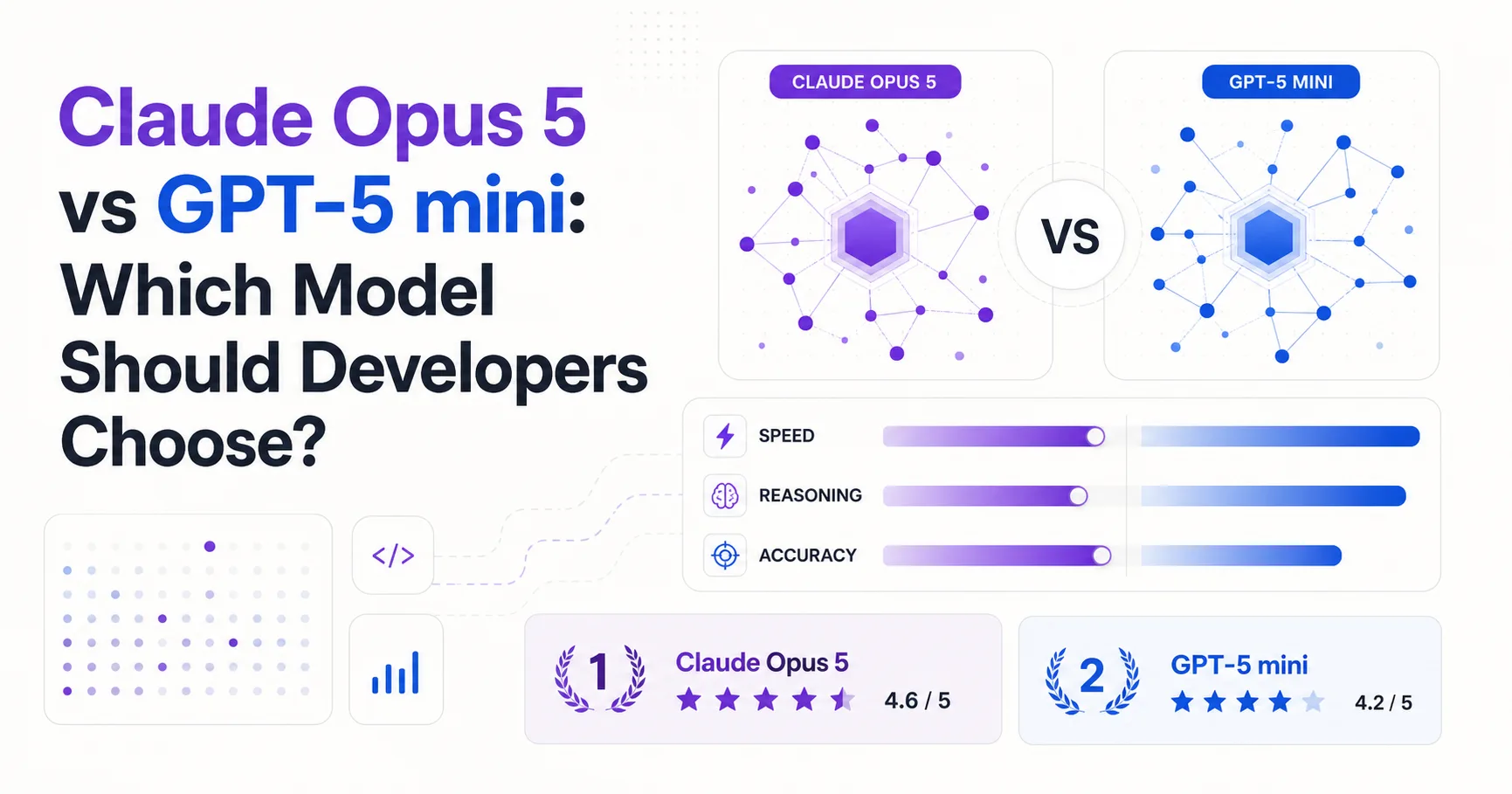
Claude Opus 5 is the safer overall choice for demanding developer workflows because the supplied benchmark data shows a much stronger coding index and clearer official API documentation.
The comparison is unusually asymmetric. Claude Opus 5 has current model documentation, published integration guidance, pricing, and operational notes. GPT-5 mini appears in the supplied data snapshot, but the current OpenAI model directory and pricing page do not provide a dedicated entry for gpt-5-mini or the display label GPT-5 mini (high). See OpenAI Models and OpenAI Pricing.
The quantitative data comes from Artificial Analysis. It reports Claude Opus 5 at 76.5 on the coding index and GPT-5 mini at 15.6. Claude Opus 5 also leads the intelligence index, while GPT-5 mini leads the available mathematics result. Those figures support a workload-specific decision, not a universal claim that one model wins every task.
For production selection, the central question is not simply capability versus price. It is whether the cheaper model is sufficiently documented, callable, and predictable for the workload. The supplied research cannot establish that for GPT-5 mini.
GPT-5 mini is the economic choice, but Claude Opus 5 is the better-documented choice for high-stakes coding and autonomous work.
Claude Opus 5 costs $10 per 1M blended tokens under the supplied three-to-one mix, compared with $0.6875 for GPT-5 mini. That price gap is large enough to dominate routine classification, extraction, lightweight transformations, and other workloads where model errors are cheap to detect. The comparison data also shows Claude Opus 5 leading the intelligence index at 58.9 versus 25.3.
The coding gap is more consequential for software teams. Claude Opus 5 scores 76.5 on the coding index, while GPT-5 mini scores 15.6. A difference of this size suggests that the models should not be treated as interchangeable coding agents, although the supplied benchmark does not disclose enough task detail to predict a particular repository's success rate.
GPT-5 mini has a mathematics index score of 90.7, while no corresponding Claude Opus 5 value is supplied. That result is a reason to test GPT-5 mini for narrowly defined mathematical workloads. It is not enough to establish broader reasoning superiority.
Claude Opus 5 has an official API ID and stable alias, documented platform availability, adaptive thinking controls, and published migration constraints in the model overview. GPT-5 mini lacks equivalent confirmation in the supplied OpenAI sources. The practical recommendation is to choose Claude for complex coding agents, and evaluate GPT-5 mini only after verifying access and behavior in the intended environment.
Claude Opus 5 is the stronger measured coding model, while GPT-5 mini remains a plausible specialist candidate for mathematical tasks.
The coding index gap is 60.9 points in Claude Opus 5's favor. Developers should interpret that gap as a warning against using GPT-5 mini as a drop-in replacement for repository-scale coding, debugging, refactoring, or agentic implementation. The benchmark does not reveal the exact task mix, so it cannot predict pass rates for a specific codebase. It does establish that the supplied evidence favors Claude for general coding capability.
The intelligence index tells a similar story. Claude Opus 5 records 58.9, compared with 25.3 for GPT-5 mini. This supports Claude for tasks that combine planning, tool use, code interpretation, and sustained decision-making. Anthropic positions Claude Opus 5 for complex agentic coding and enterprise work in its official announcement, but that positioning remains vendor-reported rather than an independent reproduction of every claimed evaluation.
GPT-5 mini's mathematics index is 90.7, and Claude Opus 5 has no supplied value for that index. A team building symbolic, quantitative, or verification-heavy features should therefore run a focused evaluation before assuming Claude is the right answer.
Latency is tied at 0.3 seconds in the supplied snapshot. Claude Opus 5 has a reported median output speed of 54.599 tokens per second, while GPT-5 mini has no supplied output-speed value. The evidence supports a Claude speed measurement, not a complete speed ranking.
Community reports add a usability concern for Claude. Some developers describe excessive verbosity, overthinking, and broad autonomous changes in a Reddit discussion. Those reports lack a consistent test method, so they should shape guardrails and acceptance tests rather than replace them.
GPT-5 mini is dramatically cheaper on token pricing, but Claude Opus 5 can be cheaper in total engineering cost when output quality prevents rework.
GPT-5 mini costs $0.25 per 1M input tokens and $2 per 1M output tokens. Claude Opus 5 costs $5 for input and $25 for output. Under the supplied three-to-one blended mix, GPT-5 mini costs $0.6875 and Claude Opus 5 costs $10. That makes GPT-5 mini the obvious first candidate for high-volume, low-risk requests.
The price advantage changes when each failed response creates human review, another model call, a failed build, or an unsafe repository change. Claude Opus 5's coding index is 76.5 versus 15.6 for GPT-5 mini, but the data does not provide token consumption, retry rates, or engineering rework. No honest total-cost conclusion can be calculated from the supplied evidence alone.
Claude's adaptive thinking also complicates simple price comparisons. Anthropic states that thinking tokens and final output share the output limit, and that lower effort can reduce token use without creating a strict token budget. The relevant implementation details appear in the effort documentation, the thinking documentation, and the Opus 5 update notes.
GPT-5 mini's cost appears attractive for workloads that are easy to validate automatically. The supplied sources do not confirm its current API availability, pricing mode, context limits, or output behavior. That uncertainty creates procurement and migration risk that the token chart cannot show.
Use GPT-5 mini for cheap experiments only after confirming the actual model ID and billable behavior. Use Claude Opus 5 when the cost of an incorrect or incomplete coding result is materially higher than the token bill.
GPT-5 mini (high) leads on 3 of 3 metrics
Claude Opus 5 is the default recommendation for complex coding agents, while GPT-5 mini should be considered for validated, cost-sensitive specialist workloads.
Choose Claude Opus 5 when the application must plan across files, use tools, maintain context through a long task, or produce code that receives limited human supervision. Anthropic documents adaptive thinking, effort levels, tool-call behavior, and integrations across its API and cloud partners in the model overview. The fixed model identifier and versioning rules are described in Model IDs and versioning, which helps teams reason about deployment stability.
Claude still needs operational controls. The supplied research reports that users sometimes experience verbose responses, over-analysis, and unrequested broad changes. The official documentation also describes configuration constraints around thinking, effort, and tool calls. Keep approvals around destructive actions, cap output with max_tokens, and test the exact SDK configuration used in production.
Choose GPT-5 mini when the task is inexpensive to check, the request volume makes Claude's pricing difficult to justify, and the team has verified that the required API access still exists. Its mathematics index of 90.7 makes it worth testing for mathematical workflows. Its low blended price of $0.6875 makes it attractive for high-volume automation.
Do not choose GPT-5 mini for production solely because the snapshot includes it. The supplied official OpenAI pages do not confirm a dedicated model entry, pricing, context window, or API parameter behavior. That evidence gap is itself a selection risk.
The strongest deployment pattern is staged evaluation. Start with a representative task set, measure correctness and rework, then compare total cost. The supplied research does not contain enough independent evidence to predict GPT-5 mini's real-world coding reliability or Claude Opus 5's average user experience.
GPT-5 mini requires more verification before production adoption because the supplied official OpenAI sources do not establish its current API identity or operational limits.
Developers should treat the data snapshot as a comparison input, not as proof that every listed model remains directly available. Claude Opus 5 has clearer current documentation, while GPT-5 mini's official status remains unresolved in the supplied material.
A local evaluation should test the exact prompts, tools, output formats, retries, and approval rules used by the application. That approach matters especially because Claude's community feedback is mixed and GPT-5 mini has no reliable community evidence in the supplied research.
Claude Opus 5 also experienced an official elevated-errors incident documented on the Claude status page. One incident record does not establish a long-term reliability rate, but it reinforces the need for provider monitoring and fallback planning.
Claude Opus 5 is the better-supported coding choice in the supplied evidence because its coding index is 76.5 versus 15.6, although repository-specific success still requires testing.
A developer would choose GPT-5 mini for validated, high-volume workloads because its blended price is $0.6875 per 1M tokens, far below Claude Opus 5's $10.
GPT-5 mini cannot be confirmed as production-ready from the supplied research because current official pages do not verify its dedicated model entry, pricing, limits, or API behavior.
Claude Opus 5 leads the supplied intelligence index at 58.9 versus 25.3, but GPT-5 mini has the available mathematics score of 90.7, so task-specific evaluation remains necessary.
Claude Opus 5 has a reported median output speed of 54.599 tokens per second, while both models show 0.3 seconds latency and GPT-5 mini lacks a supplied output-speed measurement.