
Time to First Token · Claude Opus 5 (Adaptive Reasoning, High Effort)
10316ms
Time to First Token · Grok-1
0ms
Deep dive into reasoning, benchmarks, and latency insights.
The current catalog does not contain complete performance evidence for both models, so this page does not declare an overall winner. Use the available fields as comparison signals and validate the models on your own workload.
Key decision metrics at a glance.
| Model | Metric | Value | Unit | Source / snapshot |
|---|---|---|---|---|
| Claude Opus 5 (Adaptive Reasoning, High Effort) | Reasoning | 6.0 | benchmark or capability score | Artificial Analysis · current catalog |
| Grok-1 | Reasoning | 6.0 | benchmark or capability score | Artificial Analysis · current catalog |
| Claude Opus 5 (Adaptive Reasoning, High Effort) | Coding | 8.0 | benchmark or capability score | Artificial Analysis · current catalog |
| Grok-1 | Coding | 6.0 | benchmark or capability score | Artificial Analysis · current catalog |
| Claude Opus 5 (Adaptive Reasoning, High Effort) | Multimodal | 5.0 | benchmark or capability score | Artificial Analysis · current catalog |
| Grok-1 | Multimodal | 1.0 | benchmark or capability score | Artificial Analysis · current catalog |
| Claude Opus 5 (Adaptive Reasoning, High Effort) | Long Context | 8.0 | benchmark or capability score | Artificial Analysis · current catalog |
| Grok-1 | Long Context | 1.0 | benchmark or capability score | Artificial Analysis · current catalog |
| Claude Opus 5 (Adaptive Reasoning, High Effort) | Blended Price / 1M tokens | $10 | USD per 1M tokens | Artificial Analysis · current catalog |
| Grok-1 | Blended Price / 1M tokens | $0 | USD per 1M tokens | Artificial Analysis · current catalog |
| Claude Opus 5 (Adaptive Reasoning, High Effort) | P95 Latency | — | milliseconds | Artificial Analysis · current catalog |
| Grok-1 | P95 Latency | — | milliseconds | Artificial Analysis · current catalog |
| Claude Opus 5 (Adaptive Reasoning, High Effort) | Tokens per second | 51.106 | tokens per second | Artificial Analysis · current catalog |
| Grok-1 | Tokens per second | 0 | tokens per second | Artificial Analysis · current catalog |
Data provided by Artificial Analysis; live values use the current catalog.
This radar chart visually maps the core capabilities (reasoning, coding, math proxy, multimodal, long context) of `Claude Opus 5 (Adaptive Reasoning, High Effort)` vs `Grok-1`.
This grouped bar chart provides a side-by-side comparison for each benchmark metric.
Lower time to first token is better; higher tokens per second is better.
Compare input and output pricing in USD per 1M tokens.
Claude Opus 5 (Adaptive Reasoning, High Effort)$11.25
Grok-1$0
Grok-1 costs $11.25 less per run
This article is a dated snapshot published on 2026-08-07. Live cards above use the current catalog; missing live fields are not inferred.
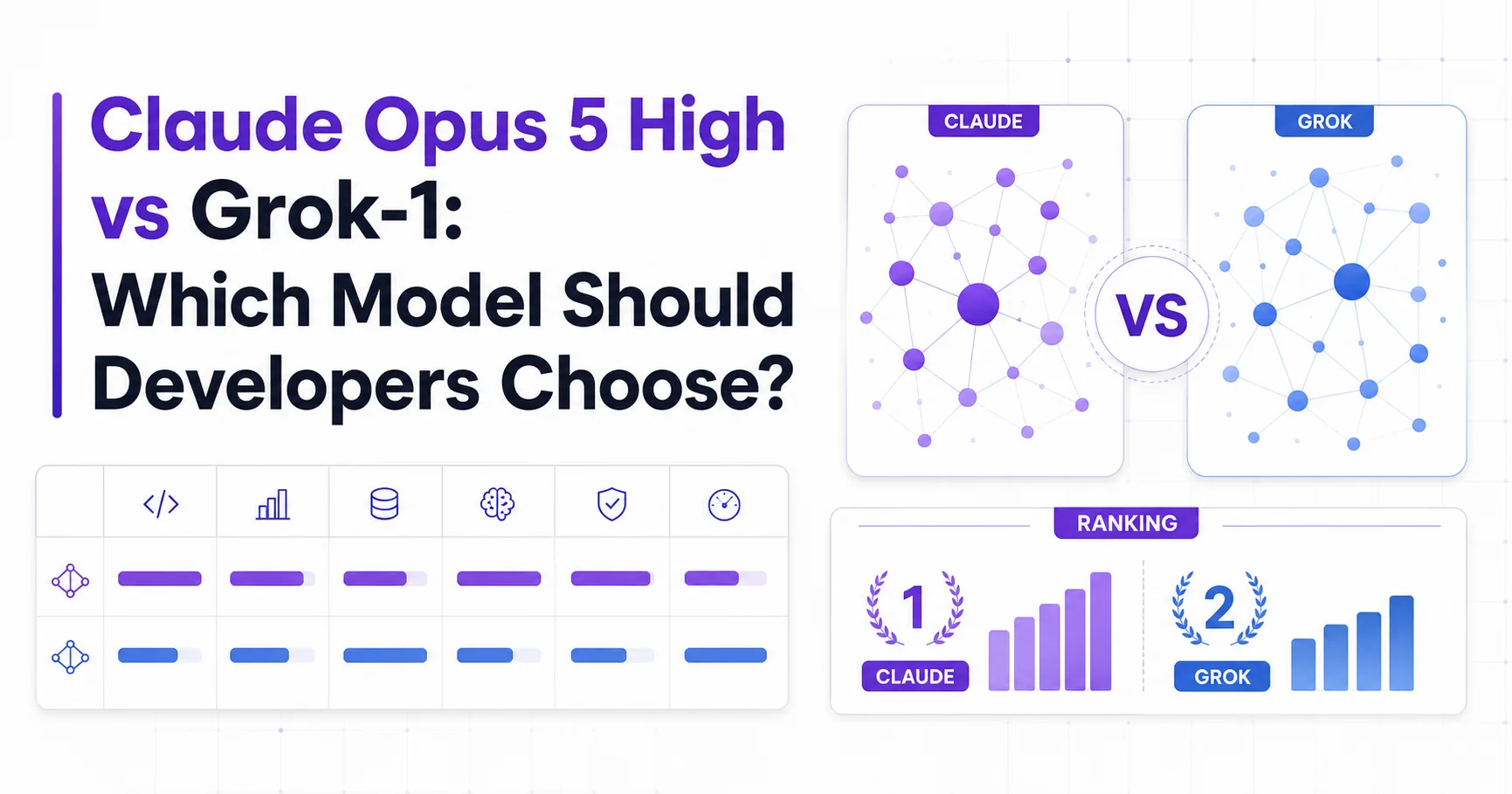
Claude Opus 5 High is the safer production choice because it has documented capabilities, current availability evidence, and materially stronger measured intelligence than Grok-1. The supplied data reports an Artificial Analysis Intelligence Index of 58.9 for Claude Opus 5 High and 6 for Grok-1. It also reports a blended price of $10 per 1M tokens for Claude Opus 5 High versus $15 for Grok-1. Artificial Analysis supplies the comparison data.
The comparison is asymmetric. Anthropic publishes current model documentation, API behavior, versioning rules, and pricing for Claude Opus 5. The research brief found no comparably verifiable official documentation for Grok-1. That gap prevents a confident comparison of context limits, output limits, API parameters, multimodal support, availability, or official benchmark claims.
Anthropic positions Claude Opus 5 for complex agentic coding and enterprise work in its release announcement. Its model overview documents supported modalities, deployment channels, model identifiers, and current status. Grok-1 may still be useful in a controlled legacy or research environment, but the supplied evidence does not establish a current, supportable production path.
Claude Opus 5 High wins the documented comparison, while Grok-1 remains an evidence gap rather than a proven alternative. Claude Opus 5 High records 58.9 on the Artificial Analysis Intelligence Index, compared with 6 for Grok-1. The supplied data does not report a comparable coding index for Grok-1, so Claude's coding result of 76.5 should not be framed as a head-to-head coding victory.
Claude Opus 5 High is also cheaper on every supplied price measure. Its blended price is $10 per 1M tokens, compared with $15 for Grok-1. Input pricing is $5 versus $10, while output pricing is $25 versus $30. These figures make Claude the stronger default for workloads that can use its documented API and deployment options.
The speed evidence is incomplete. Claude Opus 5 High has a reported median output rate of 54.599 tokens per second. Grok-1 has no reported output-speed value. Both models have a reported latency of 0.3 seconds in the supplied data, so the latency comparison is a tie rather than a reason to select either model.
The operational difference matters more than the raw score. Claude's versioning documentation explains that its stable identifier is a fixed snapshot ID. Grok-1 has no verified current identifier in the supplied research. Developers choosing a model for a maintained product should treat verifiability as part of model quality.
Claude Opus 5 High has the stronger measured intelligence result, but the available evidence cannot establish a complete coding or latency ranking. The Artificial Analysis Intelligence Index is 58.9 for Claude Opus 5 High and 6 for Grok-1. That gap suggests a meaningful advantage for tasks requiring broad reasoning, planning, interpretation, or multi-step decisions, but it does not predict every application outcome.
Claude Opus 5 High also reports a median output rate of 54.599 tokens per second. Grok-1 has no reported value in the supplied data. The missing Grok-1 measurement means developers should not convert Claude's reported rate into a universal speed claim. It means Claude has a measured result available for evaluation, while Grok-1 does not have a comparable result here.
The practical implication is that Claude is easier to evaluate before deployment. Anthropic documents adaptive thinking, effort controls, tool behavior, and output constraints in its Thinking documentation, Effort documentation, and Opus 5 update notes. Those controls allow a team to test how reasoning depth affects quality, latency, and token consumption.
The evidence still has boundaries. The research brief found no reliable, independently reproducible community study that summarizes Claude Opus 5 coding success, average latency, or user experience distribution. Reddit reports describe verbosity, overthinking, scope drift, and broad autonomous changes, but the discussion lacks a consistent test method. The Reddit discussion is useful for identifying workflow risks, not for estimating their frequency.
Hacker News adds a task example involving FreeCAD reconstruction, but the research brief says the case matches Anthropic's own published example and is therefore not an independent reproduction. The Hacker News discussion should be read as commentary, not as a separate benchmark.
Claude Opus 5 High is cheaper on the supplied price measures, but its reasoning behavior can make workload cost depend on configuration and task design. The blended price is $10 per 1M tokens for Claude Opus 5 High and $15 for Grok-1. Claude's input price is $5, compared with $10 for Grok-1, and its output price is $25, compared with $30.
Those prices favor Claude in a straightforward token-cost comparison. The conclusion can change for a workload that triggers long reasoning traces, repeated retries, or unnecessary autonomous work. Anthropic states that thinking tokens and final output share the output limit, and that long-running reasoning can increase latency and cost in its Opus 5 update notes. The Effort documentation further explains that effort is a behavior signal, not a strict token budget.
Developers should therefore compare completed-task cost, not only listed token rates. A model that finishes a complex repository change correctly may be cheaper than a lower-priced model that requires repeated human correction. Conversely, Claude's reported tendency toward verbosity and over-analysis can make simple requests unnecessarily expensive if prompts, effort settings, and stopping conditions are not controlled. These community observations remain anecdotal, as shown in the Reddit discussion.
The supplied evidence cannot determine Grok-1's real total cost because its current access path and production behavior are unverified. A nominal $15 blended price is not enough to estimate migration effort, retries, support overhead, or operational failure cost.
Grok-1 leads on 3 of 3 metrics
Claude Opus 5 High should be the default shortlist candidate for developers who need a documented model with strong measured reasoning and enterprise deployment options. Anthropic documents access through the Claude API, Amazon Bedrock, Google Cloud, and Microsoft Foundry in its model overview. The Opus 5 announcement positions the model around complex agentic coding, enterprise work, long-running tasks, and multi-agent collaboration.
Choose Claude Opus 5 High when the task involves repository-scale coding, tool orchestration, document-heavy analysis, scientific investigation, or autonomous execution with explicit boundaries. Use effort and thinking settings as part of the application design. Keep strict output limits where cost matters, and test tool-call parsing because Anthropic documents edge cases when thinking is disabled.
Treat Grok-1 as a candidate only when you already possess a verified access path and can run your own acceptance tests. The research brief does not establish its current availability, API contract, context window, output limit, multimodal support, or official benchmark record. That is not proof that Grok-1 cannot perform well. It is evidence that the supplied material cannot support a production recommendation for it.
Claude is not risk-free. Reddit users report excessive explanation, overthinking, instruction drift, and large changes made without sufficient confirmation. The Reddit source does not provide a reproducible rate for these behaviors. Anthropic also recorded an Opus 5 elevated-errors incident on its status page. Teams should add scope controls, approval gates, retries, and provider monitoring before granting broad write access.
Claude Opus 5 High is the model with enough published operational detail to support a structured pre-production evaluation. Anthropic documents its API behavior, effort controls, thinking behavior, deployment channels, and pricing across the model overview, pricing page, and Thinking documentation.
Grok-1 requires a separate verification exercise before a fair production comparison. The supplied research found no accessible, verifiable official source for its current interface or status. Developers should not fill that gap with assumptions based on the model name, release history, or unverified community discussion.
The most important pre-launch test is task completion under real controls. Measure correctness, required human intervention, retry frequency, token usage, and failure recovery on representative work. The available research supports a strong default recommendation for Claude, but it does not replace application-specific evaluation.
Claude Opus 5 High is the stronger default because its API identity, pricing, capabilities, deployment channels, and current model status are documented, while Grok-1 lacks equivalent verified evidence in the supplied research.
Claude Opus 5 High is cheaper on every supplied price measure: $10 versus $15 per 1M blended tokens, $5 versus $10 for input tokens, and $25 versus $30 for output tokens.
Claude Opus 5 High has the only reported output-speed measurement, at 54.599 median output tokens per second, while both models show 0.3 seconds of reported latency in the supplied data.
The supplied evidence cannot answer that confidently because Grok-1 has no comparable Artificial Analysis coding index, verified coding study, official benchmark source, or reproducible community evaluation.
Claude Opus 5 High can consume more tokens and time when adaptive thinking performs extended reasoning, while community reports also describe verbosity, overthinking, instruction drift, and unapproved broad changes.
Teams should verify Grok-1's current access path, API identifier, availability, context and output limits, pricing, tool behavior, reliability, and task performance because the supplied research does not confirm any of these details.