
Time to First Token · Claude Opus 5 (Adaptive Reasoning, Medium Effort)
6909ms
Time to First Token · Gemini 1.5 Pro (Sep '24)
0ms
Deep dive into reasoning, benchmarks, and latency insights.
The current catalog does not contain complete performance evidence for both models, so this page does not declare an overall winner. Use the available fields as comparison signals and validate the models on your own workload.
Key decision metrics at a glance.
| Model | Metric | Value | Unit | Source / snapshot |
|---|---|---|---|---|
| Claude Opus 5 (Adaptive Reasoning, Medium Effort) | Reasoning | 6.0 | benchmark or capability score | Artificial Analysis · current catalog |
| Gemini 1.5 Pro (Sep '24) | Reasoning | 6.0 | benchmark or capability score | Artificial Analysis · current catalog |
| Claude Opus 5 (Adaptive Reasoning, Medium Effort) | Coding | 7.0 | benchmark or capability score | Artificial Analysis · current catalog |
| Gemini 1.5 Pro (Sep '24) | Coding | 2.0 | benchmark or capability score | Artificial Analysis · current catalog |
| Claude Opus 5 (Adaptive Reasoning, Medium Effort) | Multimodal | 5.0 | benchmark or capability score | Artificial Analysis · current catalog |
| Gemini 1.5 Pro (Sep '24) | Multimodal | 1.0 | benchmark or capability score | Artificial Analysis · current catalog |
| Claude Opus 5 (Adaptive Reasoning, Medium Effort) | Long Context | 7.0 | benchmark or capability score | Artificial Analysis · current catalog |
| Gemini 1.5 Pro (Sep '24) | Long Context | 1.0 | benchmark or capability score | Artificial Analysis · current catalog |
| Claude Opus 5 (Adaptive Reasoning, Medium Effort) | Blended Price / 1M tokens | $10 | USD per 1M tokens | Artificial Analysis · current catalog |
| Gemini 1.5 Pro (Sep '24) | Blended Price / 1M tokens | $0 | USD per 1M tokens | Artificial Analysis · current catalog |
| Claude Opus 5 (Adaptive Reasoning, Medium Effort) | P95 Latency | — | milliseconds | Artificial Analysis · current catalog |
| Gemini 1.5 Pro (Sep '24) | P95 Latency | — | milliseconds | Artificial Analysis · current catalog |
| Claude Opus 5 (Adaptive Reasoning, Medium Effort) | Tokens per second | 50.537 | tokens per second | Artificial Analysis · current catalog |
| Gemini 1.5 Pro (Sep '24) | Tokens per second | 0 | tokens per second | Artificial Analysis · current catalog |
Data provided by Artificial Analysis; live values use the current catalog.
This radar chart visually maps the core capabilities (reasoning, coding, math proxy, multimodal, long context) of `Claude Opus 5 (Adaptive Reasoning, Medium Effort)` vs `Gemini 1.5 Pro (Sep '24)`.
This grouped bar chart provides a side-by-side comparison for each benchmark metric.
Lower time to first token is better; higher tokens per second is better.
Compare input and output pricing in USD per 1M tokens.
Claude Opus 5 (Adaptive Reasoning, Medium Effort)$11.25
Gemini 1.5 Pro (Sep '24)$0
Gemini 1.5 Pro (Sep '24) costs $11.25 less per run
This article is a dated snapshot published on 2026-08-07. Live cards above use the current catalog; missing live fields are not inferred.
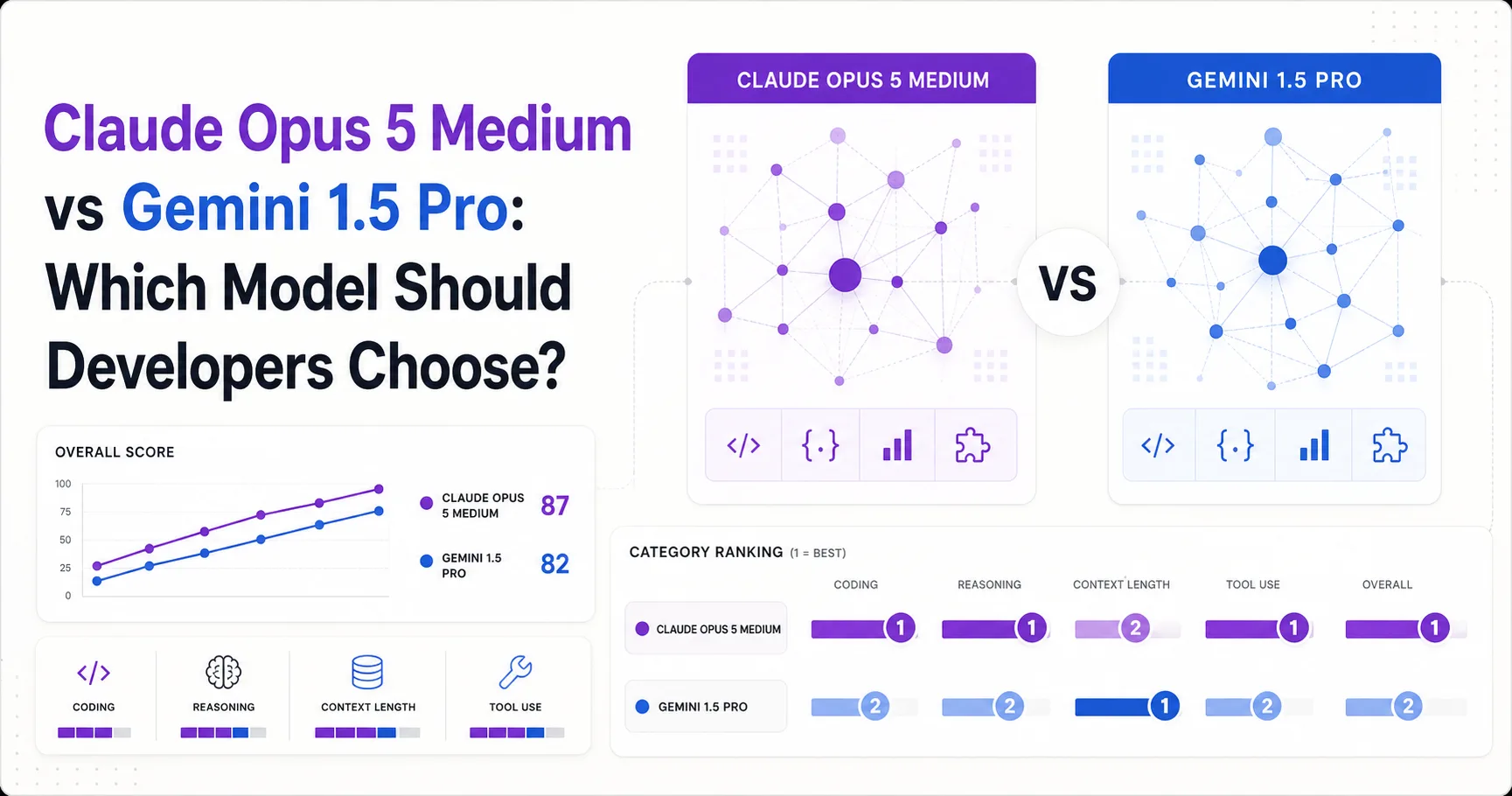
Claude Opus 5 is the safer choice for a new developer project because it is active, documented, and materially stronger on the supplied coding evaluation. Anthropic identifies claude-opus-5 as the API model ID and stable alias, while Medium Effort is configured with effort: "medium", not exposed as a separate API model. The official model overview also documents access through the Claude API, Amazon Bedrock, Google Cloud, and Microsoft Foundry.
Gemini 1.5 Pro (Sep '24) is harder to select responsibly because the current Gemini API model documentation no longer presents an active model card for that specific version. The supplied evidence does not confirm a current endpoint, version-specific output limit, or active commercial path. That difference matters more than historical familiarity: a model that cannot be confidently provisioned is a deployment risk before quality is even tested.
Data provided by Artificial Analysis.
Claude Opus 5 offers the stronger overall selection case because its documented operating model aligns with the evaluation data and with production requirements. Its Artificial Analysis Intelligence Index is 56.3, compared with 10 for Gemini 1.5 Pro, while its Coding Index is 74.3 compared with 23.6. These figures do not prove that every prompt will favor Claude, but they establish a large measured gap for the developer-oriented decision described here.
| Decision area | Claude Opus 5 | Gemini 1.5 Pro |
|---|---|---|
| Current product status | Listed as available in Anthropic's model overview | No active model card found in Google's current model directory |
| API identity | claude-opus-5 with effort: "medium" |
Current stable endpoint not confirmed |
| Context documentation | 1M-token context window | Historical materials described up to 2 million tokens, but the supplied current page does not preserve version-specific parameters |
| Maximum standard output | 128k tokens | Not found for this version |
| Blended price | $10 per 1M tokens | $15 per 1M tokens |
| Median output speed | 54.838 tokens per second | No reported value |
| Latency | 0.3 seconds | 0.3 seconds |
The main unresolved question is not whether Gemini 1.5 Pro once had useful long-context capabilities. It is whether a developer can still call this exact version with documented behavior and a current price. The supplied sources do not answer that question positively. Google's current pricing page does not list an active Gemini 1.5 Pro price, so historical comparisons should not be treated as procurement guidance.
Claude Opus 5 is the better performance bet for repository-scale coding because its measured coding score is 74.3 and its median output speed is 54.838 tokens per second. The chart below provides the numerical comparison, so the practical issue is how those values affect workflow design.
A stronger coding score should matter most when the task requires several dependent actions: inspecting an unfamiliar repository, changing multiple files, running tests, interpreting failures, and revising the implementation. Anthropic explicitly positions Claude Opus 5 for complex agentic coding, long-horizon work, code review, multi-file development, and multi-agent collaboration in its Opus 5 update. Those claims fit the kind of work where a model must preserve constraints across many tool calls.
The speed result needs a narrower interpretation. Gemini 1.5 Pro has no supplied median output-speed value, so the comparison cannot establish that Claude is faster in every interactive setting. Both models show 0.3 seconds for the supplied latency metric, which suggests that first-response responsiveness does not separate them in this snapshot. Streaming speed and end-to-end task completion are different variables. A model that reasons, tests, and revises more effectively may finish a larger task with fewer corrective turns, but the supplied data does not measure that directly.
Claude also has documented output and reasoning interactions that developers must control. Thinking tokens share the max_tokens ceiling, and default reasoning can reduce visible output if the ceiling is not adjusted. The official documentation warns that disabling thinking can occasionally expose tool-call text or internal XML-like tags. These are integration concerns, not proof of poor capability, but they make a small evaluation harness essential.
Gemini's missing current version documentation prevents an equivalent failure-mode analysis. The supplied sources do not provide reproducible Gemini coding tests, current limits, or community evidence for this exact release. A team considering Gemini should therefore treat its performance result as historical or environment-dependent until it can verify an endpoint and run the same tasks.
Claude Opus 5 (Adaptive Reasoning, Medium Effort) leads on 2 of 2 metrics
Claude Opus 5 is cheaper on every supplied price measure, and its documented billing makes the cost decision easier to operationalize. The chart below shows the prices, so the important question is when token price translates into total application cost.
Claude costs $10 per 1M blended tokens, compared with $15 for Gemini 1.5 Pro. Its input price is $5 per 1M tokens and its output price is $25, compared with Gemini's $10 input and $30 output prices. Claude therefore has the lower listed rate for both prompt-heavy and response-heavy workloads. Anthropic also documents prompt caching at $0.50 for cache hits, with separate write prices of $6.25 for five-minute storage and $10 for one-hour storage on the official pricing page. Repeated repository context may benefit from that structure, although actual savings depend on cache eligibility and request patterns.
A lower token rate does not automatically mean a lower monthly bill. If Claude's adaptive reasoning produces longer responses, extra validation, or more delegated subtasks, an application that pays for every token could spend more than a simple blended comparison suggests. Anthropic explicitly warns that default responses and delivery documents may be longer, with more progress narration, self-verification, and delegation. Developers should cap unnecessary output, choose the intended effort level, and measure completed task cost rather than response cost alone.
Gemini 1.5 Pro creates a different budget risk. Google's current pricing documentation does not list a current price for this version, so the $15 benchmark value cannot be assumed to be a live purchasable rate. The supplied evidence also does not confirm whether an old configuration would route successfully, fail, or require migration. For a new product, an undocumented price is not a discount. It is an unpriced dependency that can invalidate a forecast.
Gemini 1.5 Pro (Sep '24) leads on 3 of 3 metrics
Claude Opus 5 should be the default pick for a new coding product, while Gemini 1.5 Pro is reasonable only when an existing system can already verify its endpoint and behavior. The recommendation follows from the combination of active documentation, lower supplied prices, and stronger measured coding and intelligence scores.
Choose Claude Opus 5 for an agent that edits repositories, performs code review, handles multi-file changes, or works through a task over many iterations. Anthropic's release announcement describes the model as aimed at complex agentic coding and enterprise work. The supplied evaluation gives it a Coding Index of 74.3, which supports that positioning more directly than the historical Gemini material supports a current version choice.
Choose Claude with explicit controls. Use the real API ID, claude-opus-5, and set effort to medium when reproducing the compared configuration. Do not invent a separate claude-opus-5-medium endpoint. Decide whether thinking should remain enabled, size max_tokens for both reasoning and visible output, and add tool-call validation. These steps address documented behavior rather than speculative tuning.
Consider Gemini 1.5 Pro only for a constrained migration, a legacy integration, or a validated internal experiment. Its historical long-context reputation may still be relevant to a team with an existing Google deployment, but the supplied model directory does not confirm an active model card or current endpoint for this exact version. The research brief also found no reproducible community coding tests for the release.
The evidence is insufficient to declare a universal winner for multimodal workloads, audio or video-heavy prompts, or tasks that depend primarily on a very large context window. Claude's official materials document text and image input, while historical Gemini materials describe text, image, video, and audio input. The current Gemini source does not preserve enough version-specific detail to make a fair capability comparison. Validate those workloads directly before committing.
Claude Opus 5 is easier to put into production today because its identity, limits, platforms, and pricing are documented in active official materials. The questions below focus on risks that the headline scores cannot resolve.
Claude Opus 5 Medium is not a separate API model in the supplied documentation; developers should call claude-opus-5 and set effort to medium. Anthropic documents Medium Effort as a reasoning-depth setting, while the model overview identifies the stable API model ID. A benchmark label that includes “medium” should therefore be treated as an evaluation configuration, not as an endpoint name. Verify the request payload in your own integration before deployment using the model overview and the Opus 5 update.
Claude Opus 5 is cheaper on the supplied blended comparison, at $10 per 1M tokens versus $15 for Gemini 1.5 Pro. Claude also has the lower supplied input price, $5 versus $10, and the lower supplied output price, $25 versus $30. Those values should guide a first budget model, but teams should still measure total task cost because reasoning, retries, tool calls, and output length can change consumption. Claude's caching options are documented on the official pricing page.
Gemini 1.5 Pro is not a strong default for a new integration unless the team can verify an active endpoint, current billing, and version-specific limits in its own environment. Google's current model documentation does not present an active model card for this exact version, and its pricing page does not list a current price. The supplied research does not identify a clear retirement announcement, so the status is uncertain rather than conclusively retired. That uncertainty is itself a procurement risk, documented in Google's model directory and pricing page.
Claude Opus 5 cannot be declared universally faster because the supplied benchmark reports 54.838 median output tokens per second for Claude and no comparable value for Gemini 1.5 Pro. Both models show 0.3 seconds for the supplied latency metric, so initial responsiveness is tied in this snapshot. Output speed, first-token latency, and complete task duration measure different parts of an application experience. Run representative streaming and tool-use tests before making a user-experience promise.
Claude Opus 5's largest practical risk is excess autonomy and output overhead in integrations that need strict tool discipline, compact responses, or exact adherence to repository instructions. Anthropic documents longer responses, more progress narration, self-verification, and delegation, while community reports describe over-planning, unrequested edits, and occasional instruction drift. Those community observations lack controlled experiments, so their frequency is unknown. The documented mitigation is to constrain effort and output, validate tool calls, and require tests before accepting changes. See the Opus 5 update and the community feedback thread.