
Time to First Token · Claude Opus 5 (Adaptive Reasoning, Medium Effort)
6909ms
Time to First Token · GPT-4
0ms
Deep dive into reasoning, benchmarks, and latency insights.
The current catalog does not contain complete performance evidence for both models, so this page does not declare an overall winner. Use the available fields as comparison signals and validate the models on your own workload.
Key decision metrics at a glance.
| Model | Metric | Value | Unit | Source / snapshot |
|---|---|---|---|---|
| Claude Opus 5 (Adaptive Reasoning, Medium Effort) | Reasoning | 6.0 | benchmark or capability score | Artificial Analysis · current catalog |
| GPT-4 | Reasoning | 6.0 | benchmark or capability score | Artificial Analysis · current catalog |
| Claude Opus 5 (Adaptive Reasoning, Medium Effort) | Coding | 7.0 | benchmark or capability score | Artificial Analysis · current catalog |
| GPT-4 | Coding | 1.0 | benchmark or capability score | Artificial Analysis · current catalog |
| Claude Opus 5 (Adaptive Reasoning, Medium Effort) | Multimodal | 5.0 | benchmark or capability score | Artificial Analysis · current catalog |
| GPT-4 | Multimodal | 1.0 | benchmark or capability score | Artificial Analysis · current catalog |
| Claude Opus 5 (Adaptive Reasoning, Medium Effort) | Long Context | 7.0 | benchmark or capability score | Artificial Analysis · current catalog |
| GPT-4 | Long Context | 1.0 | benchmark or capability score | Artificial Analysis · current catalog |
| Claude Opus 5 (Adaptive Reasoning, Medium Effort) | Blended Price / 1M tokens | $10 | USD per 1M tokens | Artificial Analysis · current catalog |
| GPT-4 | Blended Price / 1M tokens | $37.5 | USD per 1M tokens | Artificial Analysis · current catalog |
| Claude Opus 5 (Adaptive Reasoning, Medium Effort) | P95 Latency | — | milliseconds | Artificial Analysis · current catalog |
| GPT-4 | P95 Latency | — | milliseconds | Artificial Analysis · current catalog |
| Claude Opus 5 (Adaptive Reasoning, Medium Effort) | Tokens per second | 50.537 | tokens per second | Artificial Analysis · current catalog |
| GPT-4 | Tokens per second | 0 | tokens per second | Artificial Analysis · current catalog |
Data provided by Artificial Analysis; live values use the current catalog.
This radar chart visually maps the core capabilities (reasoning, coding, math proxy, multimodal, long context) of `Claude Opus 5 (Adaptive Reasoning, Medium Effort)` vs `GPT-4`.
This grouped bar chart provides a side-by-side comparison for each benchmark metric.
Lower time to first token is better; higher tokens per second is better.
Compare input and output pricing in USD per 1M tokens.
Claude Opus 5 (Adaptive Reasoning, Medium Effort)$11.25
GPT-4$45
Claude Opus 5 (Adaptive Reasoning, Medium Effort) costs $33.75 less per run
This article is a dated snapshot published on 2026-08-07. Live cards above use the current catalog; missing live fields are not inferred.
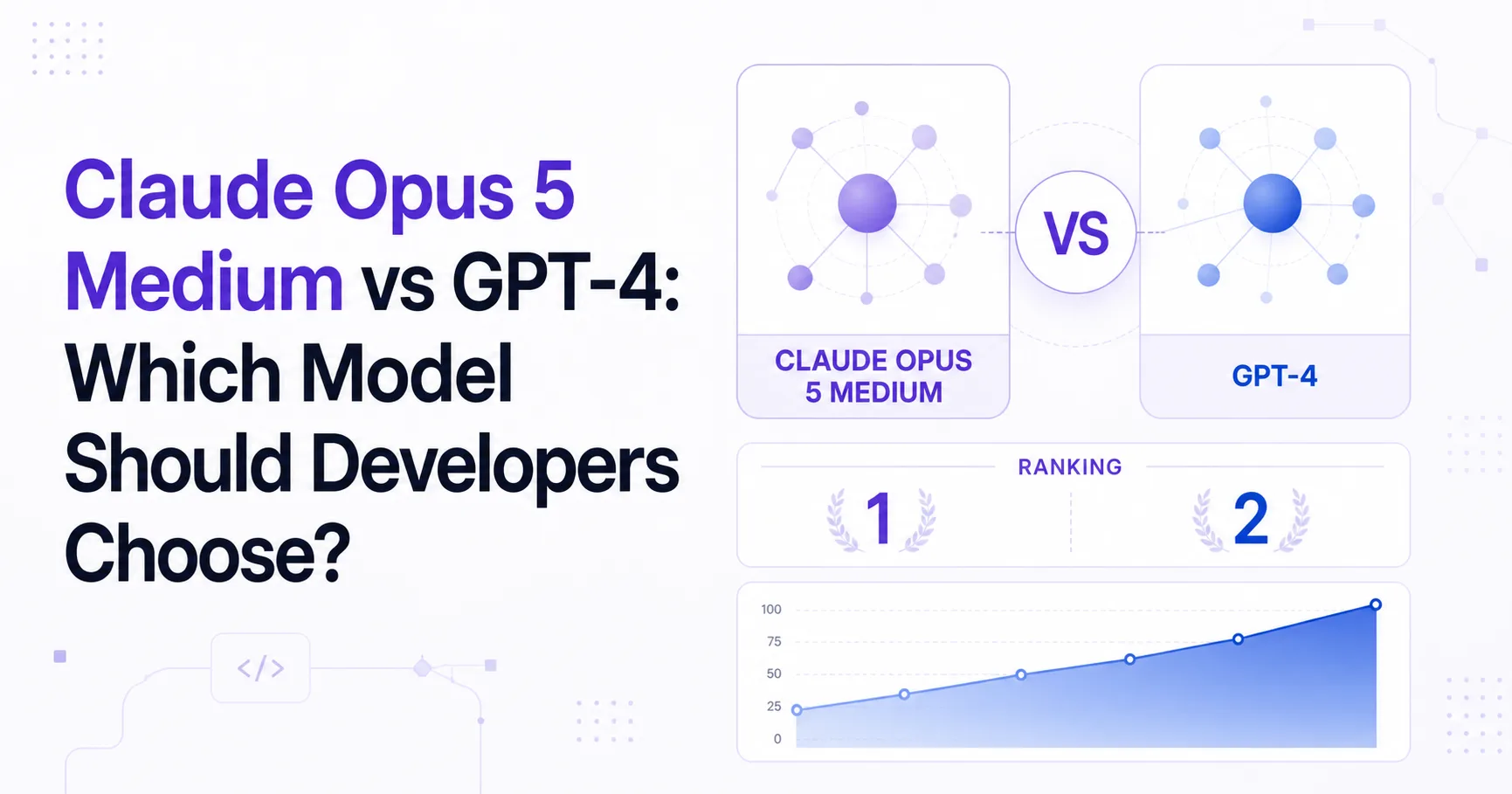
Claude Opus 5 is the stronger documented choice for developers, while GPT-4 carries substantial uncertainty around its current API status and capabilities. The comparison data gives Claude Opus 5 a 74.3 coding index and a 56.3 intelligence index, compared with GPT-4 at 13.1 and 7. Data provided by Artificial Analysis.
Anthropic positions Claude Opus 5 for complex agentic coding and enterprise work, including multi-file development, code review, long-context tasks, visual understanding, and multi-agent collaboration. These claims appear in the official Claude Opus 5 announcement and the Opus 5 model update documentation.
GPT-4 is harder to evaluate as a current product. OpenAI’s current model documentation does not list current GPT-4 capability parameters, and the current pricing documentation does not list GPT-4 as a directly priced model.
Claude Opus 5 offers the clearer production decision because its identity, controls, pricing, and intended workloads are documented, while GPT-4’s current status remains unresolved. Anthropic documents the stable API model ID as claude-opus-5, with medium reasoning selected through effort: "medium", rather than through a separate official API model named claude-opus-5-medium.Model overview and Opus 5 update notes support that distinction.
For coding selection, the gap is substantial in the supplied benchmark snapshot. Claude Opus 5 records 74.3 on the Artificial Analysis coding index, while GPT-4 records 13.1. The intelligence index shows the same direction, at 56.3 versus 7. These scores do not prove that every repository or prompt will produce the same outcome, but they make Claude Opus 5 the stronger default for implementation-heavy work. Artificial Analysis provides the comparison data.
The evidence is weaker for GPT-4 than for Claude Opus 5. OpenAI’s current model page does not provide a confirmed GPT-4 context window, output limit, supported input modality, or current parameter set.OpenAI Models OpenAI’s current pricing page also omits GPT-4, so its present direct API price cannot be confirmed.OpenAI Pricing
The practical conclusion is simple: choose Claude Opus 5 when you need a current, documented model contract. Choose GPT-4 only when an existing system already depends on a verified deployment, endpoint, and effective price that are not represented in the current public documentation.
Claude Opus 5 has the stronger measured coding profile, but developers should treat the benchmark gap as a routing signal rather than a guarantee of autonomous success. The supplied snapshot reports a coding index of 74.3 for Claude Opus 5 and 13.1 for GPT-4, plus an intelligence index of 56.3 versus 7. Artificial Analysis provides these values.
A coding-index lead matters most when the task requires maintaining constraints across several files, reasoning about unfamiliar code, or revising an implementation after tests fail. Anthropic explicitly targets Claude Opus 5 at long-running agentic coding, multi-file development, code review, and multi-agent workflows.Claude Opus 5 announcement The benchmark therefore aligns with the model’s stated product position, although the supplied materials do not establish how the index was constructed or how closely it predicts a particular repository.
Speed is less decisive than the quality results suggest. Both models show 0.3 seconds of reported latency in the snapshot, but only Claude Opus 5 has a reported median output speed, at 54.838 tokens per second. GPT-4’s output-speed value is unavailable. Artificial Analysis Consequently, the data supports a latency tie, not a complete throughput comparison.
Claude Opus 5 also requires careful reasoning-budget design. Anthropic says adaptive thinking is enabled by default, and thinking tokens share the max_tokens ceiling with ordinary output.Opus 5 update notes Long answers, progress narration, extra testing, and delegated work can consume more budget than expected. Community reports describe both strong long-running task execution and complaints about over-planning, missed work, and unnecessary changes.Long-task feedbackOver-planning feedback
Claude Opus 5 (Adaptive Reasoning, Medium Effort) leads on 2 of 2 metrics
Claude Opus 5 is the lower-cost option in every supplied API pricing comparison, but its reasoning and agent behavior can still affect the total cost of a development workflow. The blended price is $10 per 1M tokens for Claude Opus 5 versus $37.5 for GPT-4. Input pricing is $5 versus $30, and output pricing is $25 versus $60. Artificial Analysis provides the comparison values.
The price difference matters most for workloads that repeatedly read repositories, produce patches, run tests, and request follow-up corrections. A cheaper token is not automatically a cheaper task if a model creates unnecessary edits or consumes additional tool calls. Community feedback on Claude Opus 5 is divided: some users report sustained work over several hours, while others report excessive planning, testing, or unrequested changes.Long-task feedbackUnrequested-change feedback
Claude Opus 5 has documented prompt-caching prices, including $0.50 for cache hits and separate write prices of $6.25 for 5-minute storage and $10 for 1-hour storage.Anthropic pricing That makes repeated repository context easier to budget when the integration can reuse stable prompts. The supplied GPT-4 materials do not provide a current, comparable caching price.
The cost conclusion can therefore be stated with confidence only at the listed-token level. Claude Opus 5 is cheaper on the supplied prices. A full cost-per-completed-task comparison remains unproven because GPT-4’s current public price is absent and neither model’s tool-call count, retry rate, or task-success rate is supplied.
Claude Opus 5 (Adaptive Reasoning, Medium Effort) leads on 3 of 3 metrics
Claude Opus 5 should be the default pick for complex coding agents, while GPT-4 should remain a compatibility choice until its current deployment contract is verified. Anthropic documents Claude Opus 5 availability through the Claude API, Amazon Bedrock, Google Cloud, and Microsoft Foundry.Model overview Anthropic also documents a 1M-token context window and a maximum output of 128k tokens, with a beta batch configuration allowing 300k tokens in a specific case.Model overviewOpus 5 update notes
Pick Claude Opus 5 for repository-scale implementation, multi-file refactoring, code review, visual inputs, long-running agent loops, and tasks where the model must recover after intermediate failures. Its 74.3 coding index and documented adaptive reasoning controls support that choice, while the official product positioning targets the same class of work. Artificial AnalysisClaude Opus 5 announcement
Use medium effort explicitly when reproducing the comparison. Anthropic says Claude API and Claude Code default to high effort, while the medium setting must be selected explicitly for a medium-effort evaluation.Opus 5 update notes This setting difference can invalidate otherwise careful comparisons.
Keep GPT-4 only when an existing application has a tested endpoint and a known operational contract. The current OpenAI documentation does not confirm whether the original GPT-4 remains directly callable, which stable alias it maps to, or what context and output limits apply.OpenAI Models The current pricing page also omits GPT-4.OpenAI Pricing That evidence gap is itself a selection risk, not proof that every GPT-4 deployment is unavailable.
Before production rollout, test Claude Opus 5 on representative repositories with explicit edit boundaries, test commands, output limits, and a review checkpoint. Anthropic warns that disabling thinking can expose tool-call text or internal XML tags, and that high reasoning settings constrain how thinking can be disabled.Opus 5 update notes
Claude Opus 5 is easier to validate before adoption because its model identifier, reasoning controls, supported platforms, and pricing are documented. Anthropic’s model overview identifies claude-opus-5 as the API model, while the update notes explain how medium effort works.
GPT-4 is the less certain option because the current official pages do not preserve the parameters a new integration needs. OpenAI’s models page does not confirm GPT-4’s current context or output limits, and its pricing page does not show a direct current price.
Developers should separate two decisions: which model appears stronger in the supplied snapshot, and which model has a verifiable production contract. The first answer is Claude Opus 5. The second answer is also Claude Opus 5, unless an existing GPT-4 deployment can provide evidence unavailable in the current public pages.
No, Claude Opus 5 Medium is not documented as a separate official API model ID; use claude-opus-5 and set effort: "medium" explicitly for the intended evaluation.
Claude Opus 5 is cheaper in the supplied comparison, priced at $10 per 1M blended tokens versus $37.5 for GPT-4, although total task cost can depend on retries and tool usage.
Claude Opus 5 is the stronger documented choice for coding agents, with a 74.3 coding index versus 13.1 for GPT-4 and official positioning around long-running, multi-file development.
The supplied official documentation does not answer that question clearly: the current model page does not list GPT-4’s parameters, and the current pricing page does not list a direct GPT-4 price.
No, the benchmark advantage does not guarantee success on every repository; community reports also describe over-planning, unnecessary changes, and instruction-following problems without controlled frequency measurements.