
Time to First Token · Claude Opus 5 (Adaptive Reasoning, Medium Effort)
6909ms
Time to First Token · GPT-4o (Nov '24)
0ms
Deep dive into reasoning, benchmarks, and latency insights.
The current catalog does not contain complete performance evidence for both models, so this page does not declare an overall winner. Use the available fields as comparison signals and validate the models on your own workload.
Key decision metrics at a glance.
| Model | Metric | Value | Unit | Source / snapshot |
|---|---|---|---|---|
| Claude Opus 5 (Adaptive Reasoning, Medium Effort) | Reasoning | 6.0 | benchmark or capability score | Artificial Analysis · current catalog |
| GPT-4o (Nov '24) | Reasoning | 1.0 | benchmark or capability score | Artificial Analysis · current catalog |
| Claude Opus 5 (Adaptive Reasoning, Medium Effort) | Coding | 7.0 | benchmark or capability score | Artificial Analysis · current catalog |
| GPT-4o (Nov '24) | Coding | 6.0 | benchmark or capability score | Artificial Analysis · current catalog |
| Claude Opus 5 (Adaptive Reasoning, Medium Effort) | Multimodal | 5.0 | benchmark or capability score | Artificial Analysis · current catalog |
| GPT-4o (Nov '24) | Multimodal | 1.0 | benchmark or capability score | Artificial Analysis · current catalog |
| Claude Opus 5 (Adaptive Reasoning, Medium Effort) | Long Context | 7.0 | benchmark or capability score | Artificial Analysis · current catalog |
| GPT-4o (Nov '24) | Long Context | 1.0 | benchmark or capability score | Artificial Analysis · current catalog |
| Claude Opus 5 (Adaptive Reasoning, Medium Effort) | Blended Price / 1M tokens | $10 | USD per 1M tokens | Artificial Analysis · current catalog |
| GPT-4o (Nov '24) | Blended Price / 1M tokens | $4.375 | USD per 1M tokens | Artificial Analysis · current catalog |
| Claude Opus 5 (Adaptive Reasoning, Medium Effort) | P95 Latency | — | milliseconds | Artificial Analysis · current catalog |
| GPT-4o (Nov '24) | P95 Latency | — | milliseconds | Artificial Analysis · current catalog |
| Claude Opus 5 (Adaptive Reasoning, Medium Effort) | Tokens per second | 50.537 | tokens per second | Artificial Analysis · current catalog |
| GPT-4o (Nov '24) | Tokens per second | 0 | tokens per second | Artificial Analysis · current catalog |
Data provided by Artificial Analysis; live values use the current catalog.
This radar chart visually maps the core capabilities (reasoning, coding, math proxy, multimodal, long context) of `Claude Opus 5 (Adaptive Reasoning, Medium Effort)` vs `GPT-4o (Nov '24)`.
This grouped bar chart provides a side-by-side comparison for each benchmark metric.
Lower time to first token is better; higher tokens per second is better.
Compare input and output pricing in USD per 1M tokens.
Claude Opus 5 (Adaptive Reasoning, Medium Effort)$11.25
GPT-4o (Nov '24)$5
GPT-4o (Nov '24) costs $6.25 less per run
This article is a dated snapshot published on 2026-08-07. Live cards above use the current catalog; missing live fields are not inferred.
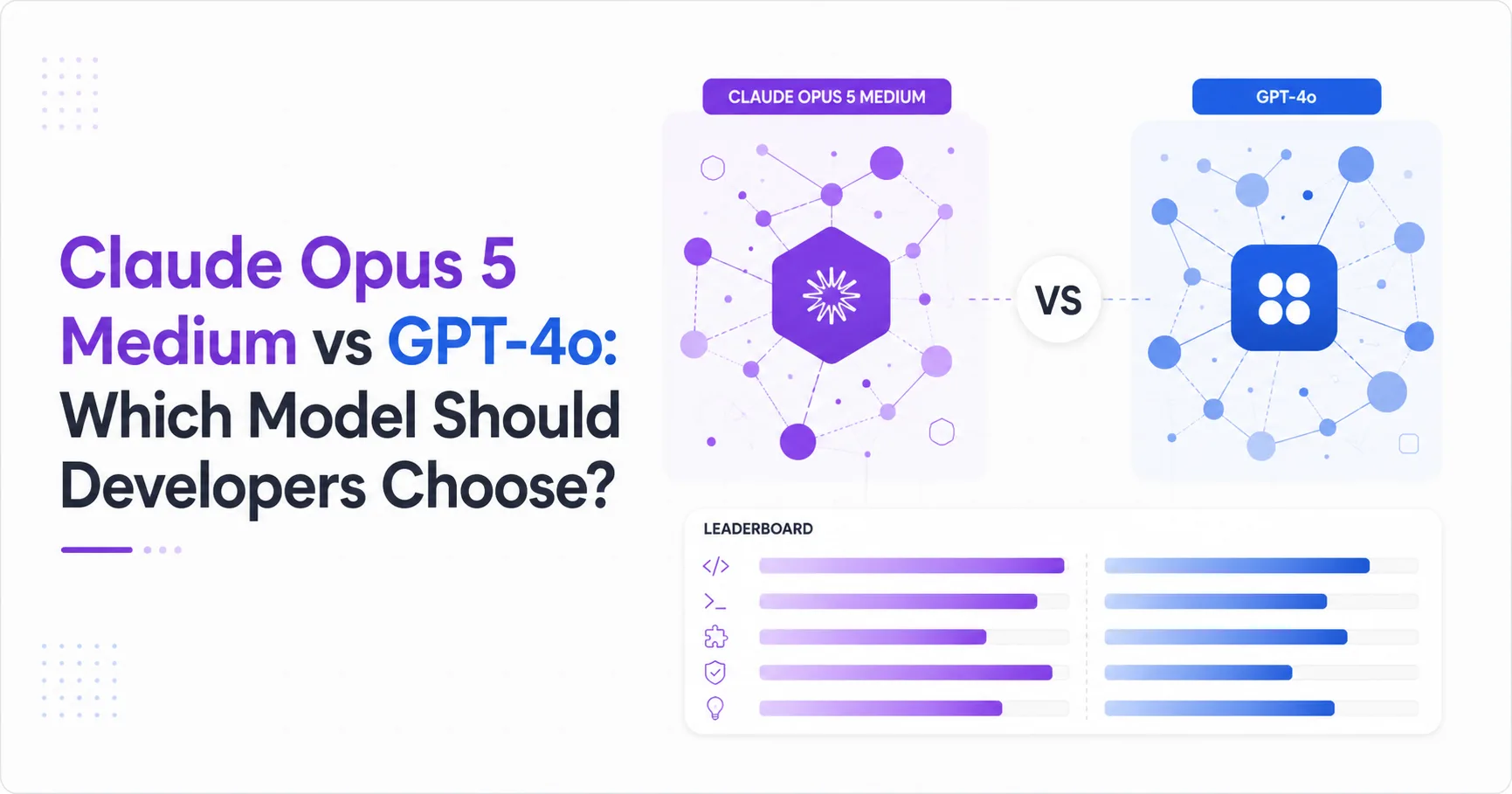
Claude Opus 5 is the stronger documented choice for demanding developer workflows, while GPT-4o is cheaper but difficult to validate as a current production target.
The supplied data gives Claude Opus 5 an Artificial Analysis Intelligence Index of 56.3, compared with 11.2 for GPT-4o. It also records Claude Opus 5 at 54.838 median output tokens per second, while GPT-4o has no supplied output-speed value. Both models show 0.3 seconds of latency in the data brief.
The comparison has an important asymmetry. Anthropic documents Claude Opus 5 as a current model with the stable API identifier claude-opus-5, while the supplied OpenAI model directory does not list gpt-4o or GPT-4o (Nov '24) (Anthropic model overview, OpenAI Models). That does not prove GPT-4o is unavailable. It means the supplied evidence cannot confirm its current lifecycle status, stable alias, or recommended integration path.
For a new application, Claude Opus 5 offers a clearer technical contract. GPT-4o remains attractive when price is the dominant constraint, but its version-specific documentation gap should be treated as an integration risk rather than ignored.
Claude Opus 5 wins on the supplied intelligence evidence and documented agentic positioning, while GPT-4o wins on reported blended-token price.
Claude Opus 5 costs $10 per 1M blended tokens in the data brief, compared with $4.375 for GPT-4o. Its input price is $5 per 1M tokens and its output price is $25 per 1M tokens. GPT-4o is listed at $2.5 for input and $10 for output. The price gap matters most for applications that generate long plans, code patches, test output, or explanations.
Anthropic explicitly positions Claude Opus 5 for complex agentic coding, multi-file development, code review, long-context work, visual understanding, office documents, and multi-agent collaboration (Claude Opus 5 announcement, Opus 5 update notes). The supplied OpenAI material provides only general current-model documentation. It does not provide a GPT-4o-specific capability statement, benchmark result, context window, output limit, release note, or stable alias (OpenAI Models).
The data supports a capability-versus-cost decision, not a universal winner. Claude Opus 5 is the safer selection for complex reasoning and coding workloads. GPT-4o is the economical selection when the task is well-bounded and the deployment team can independently verify access, limits, and behavior.
The coding comparison is incomplete. Claude Opus 5 has a coding index of 74.3, but the data brief provides no comparable GPT-4o coding index. GPT-4o has a math index of 6, but the data brief provides no comparable Claude Opus 5 math index. These missing cells prevent a complete domain-by-domain ranking.
Claude Opus 5 has the stronger measured intelligence result, but the supplied benchmark evidence cannot establish a complete coding or math ranking.
The Intelligence Index is 56.3 for Claude Opus 5 and 11.2 for GPT-4o. That gap suggests a meaningful difference on the measured intelligence workload, especially when a task requires maintaining constraints across several reasoning steps. It does not automatically predict equal gains on every codebase, language, framework, or tool loop.
Claude Opus 5 also has a supplied coding index of 74.3. GPT-4o has no coding index in the data brief, so developers should not describe Claude Opus 5 as a measured coding winner against GPT-4o. The available evidence supports a narrower conclusion: Claude Opus 5 has a strong reported coding result, while the direct comparison is missing.
The two models have the same recorded latency of 0.3 seconds. That tie suggests request-start responsiveness is not the differentiator in this dataset. Claude Opus 5 has a median output speed of 54.838 tokens per second, but GPT-4o has no corresponding supplied value. A full throughput comparison therefore remains unavailable.
Real agent performance also depends on how much work the model chooses to perform. Anthropic says Claude Opus 5 can use adaptive thinking with low, medium, high, xhigh, and max effort settings, and that Claude API and Claude Code default to high (Opus 5 update notes). A medium-effort evaluation must explicitly set effort: "medium"; otherwise, the measured behavior may not match the model label used in this comparison.
Community evidence is mixed rather than conclusive. One user described Claude Opus 5 completing complex tasks over several hours with repeated editing and testing (long-task feedback). Other users reported over-planning, excessive testing, missed work, or unwanted additions (planning feedback, additional planning feedback). These reports lack controlled prompts, project details, and reproducible logs, so they should inform testing rather than replace it.
GPT-4o is cheaper on every supplied token-price measure, but Claude Opus 5 can justify its higher price when it reduces rework or supervision.
The data brief lists GPT-4o at $4.375 per 1M blended tokens, versus $10 for Claude Opus 5. GPT-4o is also cheaper for input at $2.5 versus $5, and for output at $10 versus $25. The price advantage is therefore strongest in workloads with high volume, short prompts, predictable outputs, or limited reasoning requirements.
The chart below the section should be used for the exact price comparison. The operational question is different: how many retries, reviews, tool calls, and human corrections does each model require before a task is accepted? The supplied materials do not provide a controlled cost-per-completed-task study, so no evidence-based break-even point can be stated.
Claude Opus 5 may be economically preferable for repository-wide changes, extended debugging, or code review when one successful run replaces several weaker attempts. Anthropic describes the model as designed for long-horizon agentic coding and multi-file development (Claude Opus 5 announcement). A Reddit user also reported sustained complex task execution, but that account had no reproducible code or quantitative score (long-task feedback).
Claude Opus 5 introduces another cost-control option through prompt caching. Anthropic lists cache-hit pricing at $0.50, with five-minute writes at $6.25 and one-hour writes at $10 (Anthropic pricing). Those prices may improve repeated-context economics, but the supplied evidence does not show cache-hit rates or a workload simulation.
Thinking tokens share the max_tokens total limit with ordinary response tokens (Opus 5 update notes). Teams that fail to budget for reasoning may receive shorter visible answers, create extra follow-up calls, and erase part of the apparent price advantage. GPT-4o could still be the better choice for high-volume automation, but only after its current price and availability are verified independently.
GPT-4o (Nov '24) leads on 3 of 3 metrics
Claude Opus 5 is the default recommendation for complex software agents, while GPT-4o fits cost-sensitive workloads that can tolerate documentation uncertainty.
Choose Claude Opus 5 when the model must inspect several files, maintain a changing plan, run tests, review its own work, or coordinate multiple tool-driven steps. Anthropic documents these scenarios as central use cases, including complex agentic coding, code review, long-context processing, and multi-agent collaboration (Opus 5 update notes). The data brief strengthens that recommendation with an Intelligence Index of 56.3 and a coding index of 74.3.
Choose GPT-4o when request volume and token price dominate the decision, the task has narrow acceptance criteria, and the integration team can verify the exact model endpoint. Its listed blended price is $4.375 per 1M tokens, compared with $10 for Claude Opus 5. GPT-4o may be appropriate for classification, extraction, routine transformation, or bounded assistant interactions, but the supplied research does not contain version-specific evidence for those scenarios.
Use Claude Opus 5 with explicit output and tool-use controls. Anthropic warns that default responses and delivery documents may become longer, with more progress narration, self-verification, and delegation (Opus 5 update notes). Community reports also mention unwanted changes, ignored project instructions, and divergence from architecture documents, although the reports do not establish frequency (instruction feedback, architecture feedback).
Do not select GPT-4o solely because its name is familiar. The supplied OpenAI directory does not list it, and the supplied pricing page does not list its current price (OpenAI Models, OpenAI Pricing). The evidence supports a verification gate before production adoption.
Claude Opus 5 requires more deliberate configuration, while GPT-4o requires more upfront verification because the supplied OpenAI documentation is not version-specific.
Before implementation, confirm the endpoint, model alias, output limits, thinking configuration, tool behavior, and acceptance tests. Claude Opus 5 has documented operational caveats, including visible tool markup when thinking is disabled and a shared token limit for thinking and ordinary output (Opus 5 update notes). GPT-4o has no comparable version-specific limitation evidence in the supplied materials.
Claude Opus 5 is the better-supported coding choice, but the supplied evidence cannot prove a direct coding win because Claude Opus 5 has a coding index of 74.3 and GPT-4o has no comparable coding score. Anthropic positions Claude Opus 5 for complex agentic coding and multi-file development (Opus 5 update notes).
GPT-4o is cheaper on the supplied price measures, at $4.375 per 1M blended tokens versus $10 for Claude Opus 5. Its input price is $2.5 versus $5, and its output price is $10 versus $25. These values come from the data brief, while Anthropic’s current pricing documentation covers Claude Opus 5 (Anthropic pricing).
The supplied evidence cannot confirm that GPT-4o still has a stable production API identity. The current OpenAI model directory does not list gpt-4o, and the research found no dedicated version alias or lifecycle announcement (OpenAI Models).
Claude Opus 5 does not have a guaranteed improvement from higher reasoning effort in every task. Anthropic supports several effort levels, but one supplied community report described contradictory long-context advice even after increasing effort (long-context failure case).
Claude Opus 5’s main documented operational risk is excess reasoning and output management. Anthropic says thinking tokens share the max_tokens limit, and the model may produce longer responses, more progress narration, and more delegated work (Opus 5 update notes).
Developers should run a task-specific evaluation before selecting either model because the supplied comparison has missing GPT-4o coding and speed values, missing Claude Opus 5 math values, and no controlled cost-per-completed-task study. Community reports are also inconsistent and lack reproducible prompts or logs (speed feedback, communication feedback).