
Time to First Token · Claude Opus 5 (Adaptive Reasoning, Medium Effort)
6909ms
Time to First Token · GPT-5 (high)
0ms
Deep dive into reasoning, benchmarks, and latency insights.
The current catalog does not contain complete performance evidence for both models, so this page does not declare an overall winner. Use the available fields as comparison signals and validate the models on your own workload.
Key decision metrics at a glance.
| Model | Metric | Value | Unit | Source / snapshot |
|---|---|---|---|---|
| Claude Opus 5 (Adaptive Reasoning, Medium Effort) | Reasoning | 6.0 | benchmark or capability score | Artificial Analysis · current catalog |
| GPT-5 (high) | Reasoning | 9.0 | benchmark or capability score | Artificial Analysis · current catalog |
| Claude Opus 5 (Adaptive Reasoning, Medium Effort) | Coding | 7.0 | benchmark or capability score | Artificial Analysis · current catalog |
| GPT-5 (high) | Coding | 4.0 | benchmark or capability score | Artificial Analysis · current catalog |
| Claude Opus 5 (Adaptive Reasoning, Medium Effort) | Multimodal | 5.0 | benchmark or capability score | Artificial Analysis · current catalog |
| GPT-5 (high) | Multimodal | 3.0 | benchmark or capability score | Artificial Analysis · current catalog |
| Claude Opus 5 (Adaptive Reasoning, Medium Effort) | Long Context | 7.0 | benchmark or capability score | Artificial Analysis · current catalog |
| GPT-5 (high) | Long Context | 4.0 | benchmark or capability score | Artificial Analysis · current catalog |
| Claude Opus 5 (Adaptive Reasoning, Medium Effort) | Blended Price / 1M tokens | $10 | USD per 1M tokens | Artificial Analysis · current catalog |
| GPT-5 (high) | Blended Price / 1M tokens | $3.438 | USD per 1M tokens | Artificial Analysis · current catalog |
| Claude Opus 5 (Adaptive Reasoning, Medium Effort) | P95 Latency | — | milliseconds | Artificial Analysis · current catalog |
| GPT-5 (high) | P95 Latency | — | milliseconds | Artificial Analysis · current catalog |
| Claude Opus 5 (Adaptive Reasoning, Medium Effort) | Tokens per second | 50.537 | tokens per second | Artificial Analysis · current catalog |
| GPT-5 (high) | Tokens per second | 0 | tokens per second | Artificial Analysis · current catalog |
Data provided by Artificial Analysis; live values use the current catalog.
This radar chart visually maps the core capabilities (reasoning, coding, math proxy, multimodal, long context) of `Claude Opus 5 (Adaptive Reasoning, Medium Effort)` vs `GPT-5 (high)`.
This grouped bar chart provides a side-by-side comparison for each benchmark metric.
Lower time to first token is better; higher tokens per second is better.
Compare input and output pricing in USD per 1M tokens.
Claude Opus 5 (Adaptive Reasoning, Medium Effort)$11.25
GPT-5 (high)$3.75
GPT-5 (high) costs $7.5 less per run
This article is a dated snapshot published on 2026-08-06. Live cards above use the current catalog; missing live fields are not inferred.
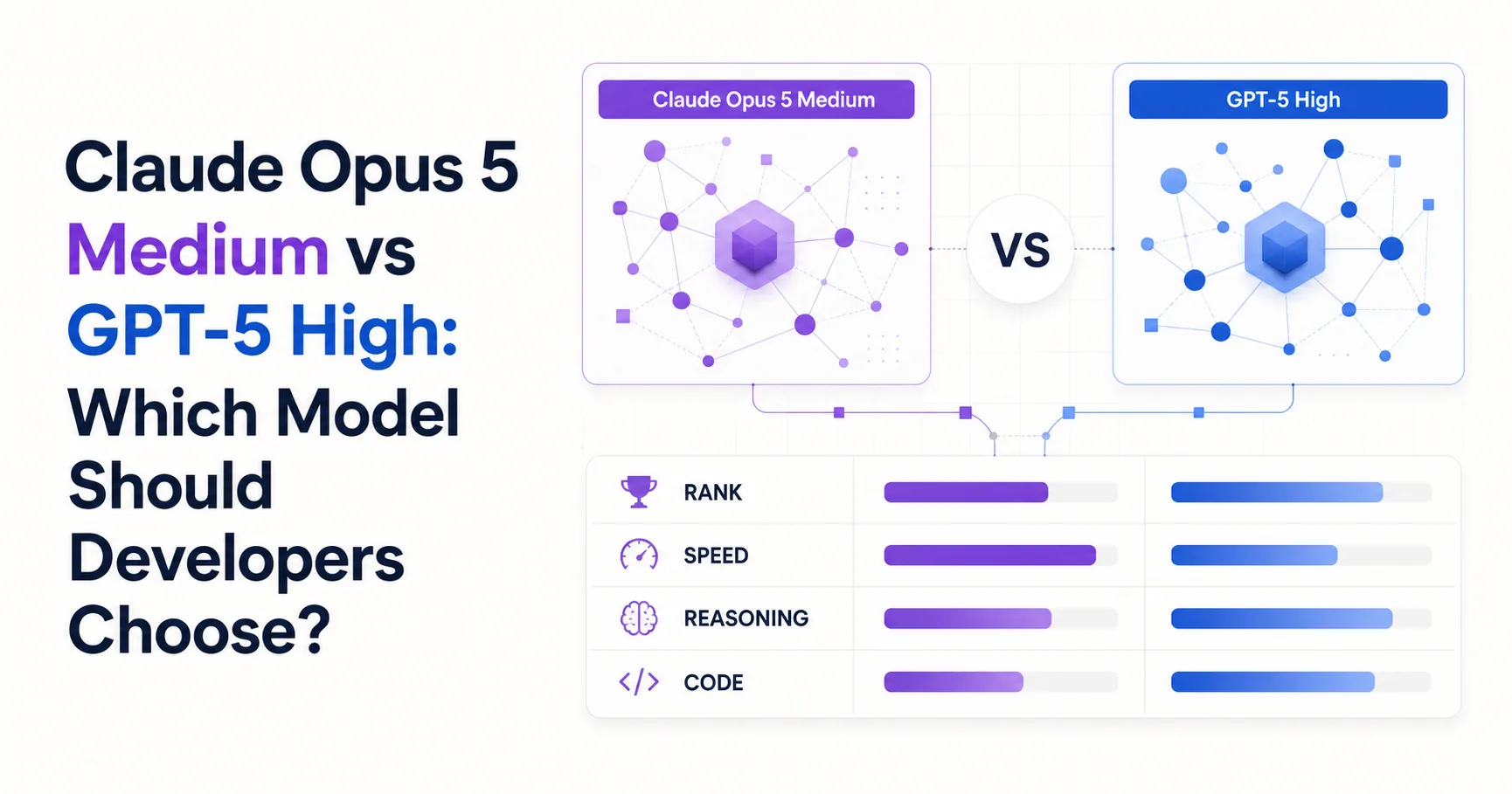
Claude Opus 5 (Adaptive Reasoning, Medium Effort) is the stronger default for complex coding and agentic software work, while GPT-5 (high) is the cheaper specialist when mathematical performance or token economics dominates the decision. The comparison data gives Claude a 74.3 coding index and GPT-5 a 37.8 coding index. GPT-5 leads the available mathematics measurement with a 94.3 math index, but Claude has no corresponding value in the dataset. Data provided by https://artificialanalysis.ai/
The labels also require careful interpretation. claude-opus-5-medium is an evaluation slug, not an official API model identifier. Developers should call claude-opus-5 and set effort to medium, according to Anthropic's model overview and the Claude Opus 5 update notes. Likewise, gpt-5-high is not an independent OpenAI model. Developers should call gpt-5 and set reasoning_effort to high, as described in GPT-5 for developers.
This article treats benchmark values as directional evidence, not as a universal ranking. The sources do not provide a controlled head-to-head test using the same prompts, tool environment, or output constraints. Production selection should therefore combine the reported indexes with a task-specific evaluation.
Claude Opus 5 (Adaptive Reasoning, Medium Effort) offers the clearer coding advantage, while GPT-5 (high) offers the clearer cost and mathematics advantage. The available comparison values show a 36.5-point gap on the coding index and a 21.599999999999994-point gap on the intelligence index in Claude's favor. GPT-5 is the only model with a reported math index, at 94.3.
| Decision factor | Claude Opus 5 (Adaptive Reasoning, Medium Effort) | GPT-5 (high) | Practical reading |
|---|---|---|---|
| Coding index | 74.3 | 37.8 | Claude has the stronger reported coding signal |
| Intelligence index | 56.3 | 34.7 | Claude leads the reported general capability signal |
| Math index | No value reported | 94.3 | GPT-5 has the only available result |
| Blended price | $10 | $3.4375 | GPT-5 costs less under the supplied mix |
| Input price | $5 | $1.25 | GPT-5 is cheaper for input-heavy workloads |
| Output price | $25 | $10 | GPT-5 is cheaper for generated text |
| Median output speed | 54.838 tokens per second | No value reported | The data supports a Claude speed claim only |
| Latency | 0.3 seconds | 0.3 seconds | The supplied latency measurement is tied |
Claude's official positioning emphasizes complex agentic coding, long-running software tasks, code review, visual understanding, long context, and multi-agent workflows in the official release announcement. OpenAI positions GPT-5 around coding, reasoning, and agentic tasks in its developer announcement. Those positions overlap, but the supplied evaluation results favor Claude for coding-oriented selection.
The main unresolved question is reliability across a developer's actual repository. The research brief contains anecdotal reports for both models, but no controlled comparison of instruction following, unwanted edits, tool discipline, or review burden. That evidence gap matters more than a small latency preference when a model can modify production code.
Claude Opus 5 (Adaptive Reasoning, Medium Effort) is the better-supported choice for difficult coding tasks, but the evidence does not prove that every engineering workflow will finish faster or require less review. The comparison reports a 74.3 coding index for Claude and 37.8 for GPT-5, a difference of 36.5 points. That gap suggests a meaningful advantage for repository-level implementation, debugging, and multi-step coding evaluation, provided the benchmark conditions resemble the target workflow.
The real task implication is quality at the point where requirements, files, tests, and tool calls interact. Claude's official material emphasizes long-running agentic coding, multi-file development, code review, and autonomous work. Anthropic's release announcement also states that the model has important limitations in long-cycle autonomous biological research. That qualification is useful for developers: strong coding performance should not be read as general autonomy without supervision.
The supplied speed data is asymmetric. Claude records 54.838 median output tokens per second, while GPT-5 has no reported value. Both models show 0.3 seconds for latency. The dataset therefore supports a Claude output-speed observation, but it does not support a direct speed winner. A faster stream can still produce a slower workflow if the model over-plans, over-tests, or generates unnecessary explanation.
Community feedback points in opposite directions. One Claude user described sustained complex work involving repeated edits, tests, and rework, while other users described excessive planning, additional tests, and missed or unrequested changes. The reports lack complete prompts, repositories, and controlled measurements. See the long-task Claude report and the over-planning report.
GPT-5 has a different practical profile in the available community evidence. A Reddit user found it useful for locating and fixing small bugs, but less complete for full application and interface generation. The same source also mentions hallucinations or incorrect modifications in complex existing codebases. These observations are not controlled tests, so the research does not establish whether GPT-5's lower coding index reflects weaker coding quality, different evaluation settings, or a broader capability tradeoff. The relevant missing evidence is a matched repository task with identical tools, prompts, review criteria, and reasoning settings.
GPT-5 (high) is the clear API price winner, yet Claude Opus 5 (Adaptive Reasoning, Medium Effort) may be economically preferable when higher task completion quality reduces retries and human review. The supplied blended price is $3.4375 for GPT-5 versus $10 for Claude per 1M blended tokens. GPT-5 also costs $1.25 per 1M input tokens and $10 per 1M output tokens, compared with Claude at $5 input and $25 output. These prices make GPT-5 attractive for high-volume workloads, frequent iterations, and applications where each request has limited complexity.
The price comparison does not measure total task cost. A developer pays for more than model tokens when an agent repeats failed edits, produces incomplete code, violates repository instructions, or requires manual correction. A single anecdotal GPT-5 report describes good results for small debugging tasks but weaker completion for full applications and possible incorrect changes in complex codebases. The evidence comes from one non-controlled community evaluation, so it cannot quantify the additional cost.
Claude's higher price becomes easier to justify when the task requires sustained reasoning, multi-file changes, code review, or long-running delegation. It can also become less attractive when the integration does not constrain output length or tool behavior. Anthropic's update notes state that thinking tokens share the max_tokens ceiling with ordinary output. The same notes warn that default responses and delivery documents may be longer, with more progress narration, validation, and delegation. Those behaviors can increase token use even when the final answer is useful.
Prompt caching changes the economics for repeated context, but the supplied prices show that caching is a separate pricing decision rather than a reason to assume Claude is cheaper. Developers should model input reuse, output volume, retry rate, review time, and tool-call count together. The official Claude pricing page provides the relevant caching and token prices. The research brief does not provide equivalent end-to-end cost measurements for either model, so the break-even point remains unknown.
GPT-5 (high) leads on 3 of 3 metrics
Claude Opus 5 (Adaptive Reasoning, Medium Effort) is the recommended first choice for complex coding agents, while GPT-5 (high) is the recommended first choice for cost-sensitive and mathematics-heavy workloads. The choice should reflect the cost of a wrong edit, not only the price of a successful request.
Choose Claude when the system must reason across many files, maintain a long implementation thread, review code, or coordinate multiple subtasks. Claude has the stronger supplied coding index at 74.3, the stronger intelligence index at 56.3, and a reported median output speed of 54.838 tokens per second. Its official documentation also supports text and image input, multilingual use, and access through Claude API, Amazon Bedrock, Google Cloud, and Microsoft Foundry. See the model overview.
Choose GPT-5 when request volume and token price dominate, when mathematical evaluation is central, or when the task is a bounded debugging change. GPT-5 has the only supplied math index, at 94.3, and its $3.4375 blended price is lower than Claude's $10. Its official API supports function calling, structured outputs, streaming, and custom tools with developer-provided grammar constraints, as described in GPT-5 for developers.
Treat release management as a separate decision. Claude Opus 5 remains listed as callable and is not marked deprecated in the supplied research snapshot. OpenAI still lists the gpt-5 alias, but the fixed snapshot gpt-5-2025-08-07 is marked Deprecated and the model page recommends GPT-5.6. That distinction means an application depending on a fixed GPT-5 snapshot carries a migration concern, while an application using the stable alias must still test behavior changes over time. The GPT-5 model documentation is the source for this status.
The safest implementation choice is to run a private evaluation using representative repository tasks, explicit tool constraints, and human review criteria. The research does not provide enough evidence to predict which model will produce fewer unwanted edits, follow project instructions more consistently, or reduce total engineering time. Those are the measurements most likely to reverse a purely benchmark-based recommendation.
Claude Opus 5 (Adaptive Reasoning, Medium Effort) requires explicit effort configuration when an evaluation intends to measure medium reasoning rather than the default high setting. Anthropic's update notes state that medium is an effort setting, not a separate API model. GPT-5 similarly uses reasoning_effort=high, rather than a separate gpt-5-high model identifier, according to OpenAI's developer documentation.
The two systems also differ in operational constraints. Claude's thinking tokens share the ordinary output ceiling, while GPT-5's official model page lists fine-tuning and predicted outputs as unsupported. Claude supports image input and text output, while GPT-5 supports text and image input with text output but does not support audio or video input or output. These differences matter when the model sits inside a larger developer toolchain.
The largest unanswered integration questions concern actual repository behavior. The available community sources describe useful results and failure cases for each model, but they do not offer controlled rates for instruction violations, incorrect edits, excessive tool use, or review time. Teams should treat those properties as test targets rather than assume that the reported coding index resolves them.
No, Claude Opus 5 Medium is an evaluation label for Claude Opus 5 configured with medium effort, so applications should call claude-opus-5 and set effort to medium.
No, GPT-5 High is a configuration label rather than an independent API model, so applications should call gpt-5 and set reasoning_effort to high.
Claude Opus 5 is the better-supported choice for coding agents because its supplied coding index is 74.3 versus 37.8 for GPT-5, although repository-specific testing remains necessary.
GPT-5 is cheaper under the supplied pricing comparison, costing $3.4375 versus $10 per 1M blended tokens, with lower input and output token prices as well.
GPT-5 has the stronger available mathematics evidence because its supplied math index is 94.3, while Claude Opus 5 has no comparable math value in the dataset.
No, the comparison reports Claude at 54.838 median output tokens per second but provides no corresponding GPT-5 value, while latency is tied at 0.3 seconds.
Developers should review migration risk before relying on the fixed snapshot because gpt-5-2025-08-07 is marked Deprecated, even though the gpt-5 alias remains listed.