
Time to First Token · Claude Opus 5 (Adaptive Reasoning, Medium Effort)
6909ms
Time to First Token · o3
7185ms
Deep dive into reasoning, benchmarks, and latency insights.
The current catalog does not contain complete performance evidence for both models, so this page does not declare an overall winner. Use the available fields as comparison signals and validate the models on your own workload.
Key decision metrics at a glance.
| Model | Metric | Value | Unit | Source / snapshot |
|---|---|---|---|---|
| Claude Opus 5 (Adaptive Reasoning, Medium Effort) | Reasoning | 6.0 | benchmark or capability score | Artificial Analysis · current catalog |
| o3 | Reasoning | 9.0 | benchmark or capability score | Artificial Analysis · current catalog |
| Claude Opus 5 (Adaptive Reasoning, Medium Effort) | Coding | 7.0 | benchmark or capability score | Artificial Analysis · current catalog |
| o3 | Coding | 6.0 | benchmark or capability score | Artificial Analysis · current catalog |
| Claude Opus 5 (Adaptive Reasoning, Medium Effort) | Multimodal | 5.0 | benchmark or capability score | Artificial Analysis · current catalog |
| o3 | Multimodal | 3.0 | benchmark or capability score | Artificial Analysis · current catalog |
| Claude Opus 5 (Adaptive Reasoning, Medium Effort) | Long Context | 7.0 | benchmark or capability score | Artificial Analysis · current catalog |
| o3 | Long Context | 4.0 | benchmark or capability score | Artificial Analysis · current catalog |
| Claude Opus 5 (Adaptive Reasoning, Medium Effort) | Blended Price / 1M tokens | $10 | USD per 1M tokens | Artificial Analysis · current catalog |
| o3 | Blended Price / 1M tokens | $3.5 | USD per 1M tokens | Artificial Analysis · current catalog |
| Claude Opus 5 (Adaptive Reasoning, Medium Effort) | P95 Latency | — | milliseconds | Artificial Analysis · current catalog |
| o3 | P95 Latency | — | milliseconds | Artificial Analysis · current catalog |
| Claude Opus 5 (Adaptive Reasoning, Medium Effort) | Tokens per second | 50.537 | tokens per second | Artificial Analysis · current catalog |
| o3 | Tokens per second | 119.185 | tokens per second | Artificial Analysis · current catalog |
Data provided by Artificial Analysis; live values use the current catalog.
This radar chart visually maps the core capabilities (reasoning, coding, math proxy, multimodal, long context) of `Claude Opus 5 (Adaptive Reasoning, Medium Effort)` vs `o3`.
This grouped bar chart provides a side-by-side comparison for each benchmark metric.
Lower time to first token is better; higher tokens per second is better.
Compare input and output pricing in USD per 1M tokens.
Claude Opus 5 (Adaptive Reasoning, Medium Effort)$11.25
o3$4
o3 costs $7.25 less per run
This article is a dated snapshot published on 2026-08-07. Live cards above use the current catalog; missing live fields are not inferred.
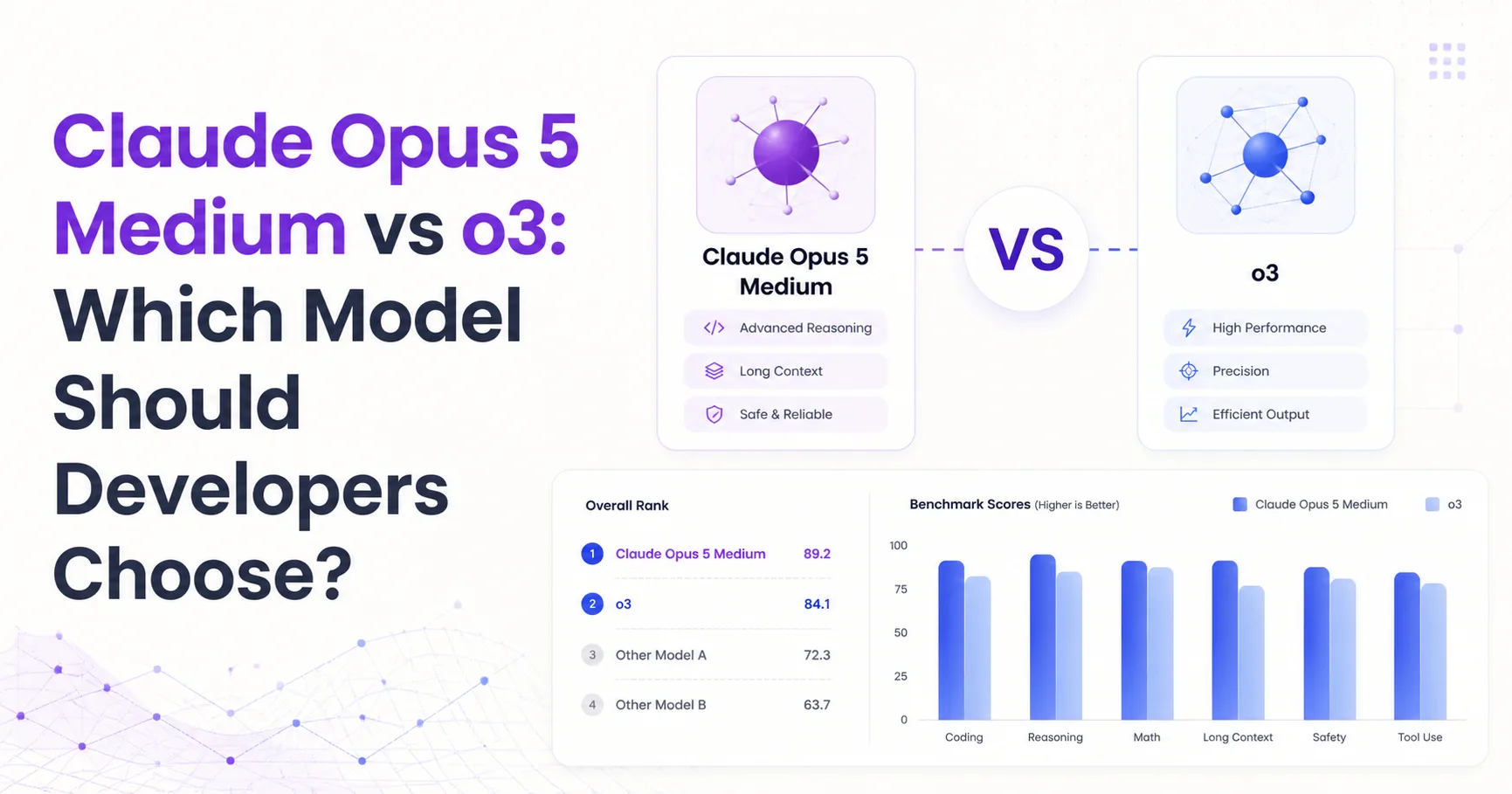
Claude Opus 5 is the stronger documented choice for complex developer work, while o3 is faster and substantially cheaper in the supplied benchmark snapshot.
The evidence is asymmetric. Anthropic documents Claude Opus 5 as a current model for complex agentic coding, enterprise work, long-context processing, and visual understanding. OpenAI’s current model directory does not list o3 in the supplied research material, so its current API status, capabilities, and stable alias remain unverified here.
The practical decision is therefore not simply capability versus price. Claude Opus 5 has a documented production position and a coding index of 74.3 in the data snapshot. o3 has a lower overall intelligence index of 30.4, a higher math index of 88.3, output speed of 128.056 tokens per second, and a blended price of $3.5 per 1M tokens.
Data provided by https://artificialanalysis.ai/.
Claude Opus 5 offers the broader documented fit for software agents, but o3 offers the clearer throughput and price advantage in the supplied data.
| Decision factor | Claude Opus 5 | o3 |
|---|---|---|
| Overall intelligence index | 56.3 | 30.4 |
| Coding index | 74.3 | Not provided |
| Math index | Not provided | 88.3 |
| Median output speed | 54.838 tokens per second | 128.056 tokens per second |
| Blended price | $10 per 1M tokens | $3.5 per 1M tokens |
| Measured latency | 0.3 seconds | 0.3 seconds |
Anthropic’s release announcement positions Claude Opus 5 around deep reasoning, long-running agentic coding, multi-file development, code review, and multi-agent collaboration. The model overview also documents text and image input, multilingual support, and availability across several enterprise platforms.
The o3 material does not provide a comparable coding score, official benchmark result, context limit, output limit, multimodal specification, or reliable community testing. That missing evidence prevents a clean claim that Claude wins every developer workload. It does support a narrower conclusion: Claude has stronger documented general and coding evidence, while o3 has stronger documented math evidence and better measured economics.
The version distinction also matters. Anthropic’s material says claude-opus-5-medium should be treated as an evaluation slug, with requests sent to claude-opus-5 and effort: "medium" configured explicitly. The supplied OpenAI sources do not verify an equivalent o3 alias or endpoint.
o3 produces output faster, while Claude Opus 5 has stronger evidence for tasks where sustained reasoning and code quality dominate wall-clock output.
The data snapshot records o3 at 128.056 median output tokens per second and Claude Opus 5 at 54.838. Measured latency is 0.3 seconds for each model. For interactive products, the equal latency matters because first response availability is not separated in the supplied data. The output-speed gap matters after generation begins, especially for long answers, streaming interfaces, and agent traces.
That speed advantage does not establish that o3 finishes engineering tasks sooner. A coding agent can spend time planning, invoking tools, reviewing patches, rerunning tests, and correcting failures. Anthropic explicitly describes Claude Opus 5 as designed for long-running agentic coding, multi-file development, code review, and delegation. The Opus 5 update notes also warn that the model may narrate progress more often, verify more aggressively, and delegate subtasks more readily.
Community evidence is mixed rather than conclusive. One long-task report describes sustained work involving repeated edits, tests, and rework. Other feedback describes complex tasks as slow, while a separate comment reports faster behavior. These are personal observations without controlled prompts or complete logs.
The evidence is insufficient to compare end-to-end coding completion time, tool-call efficiency, or reliability. Developers should benchmark their own repository workflow instead of treating output speed as a complete productivity measure.
o3 is the clear purchasing choice for high-volume inference, but Claude Opus 5 can be cheaper in practice when its stronger task completion reduces rework.
The supplied blended price is $3.5 per 1M tokens for o3 and $10 for Claude Opus 5. The input prices are $2 and $5, while output prices are $8 and $25 respectively. The price gap is largest on generated output, which matters for verbose agents that produce plans, patches, explanations, tests, and review summaries.
A direct token-price comparison can still mislead engineering teams. A cheaper model becomes more expensive operationally if it requires repeated prompts, additional validation calls, manual debugging, or fallback requests. Conversely, Claude Opus 5’s tendency toward longer responses, extra validation, and delegation can increase spend even when the final patch is better. Anthropic’s update documentation specifically identifies output length and tool-call budgets as integration concerns.
Prompt caching changes the economics for repeated repository instructions or stable context. Anthropic lists cache-hit pricing of $0.50, with separate write prices of $6.25 and $10 depending on cache duration, according to the official pricing page. The supplied o3 research does not provide comparable caching terms.
The cost evidence is incomplete for o3 because OpenAI’s current pricing page does not list o3 in the supplied material. The snapshot provides comparison prices, but the research cannot confirm current Standard, Batch, Flex, or Fast mode availability. Treat the $3.5 figure as the supplied comparison value, then verify procurement terms before production budgeting.
o3 leads on 3 of 3 metrics
Claude Opus 5 is the safer default for complex coding agents, while o3 is the better fit for speed-sensitive, cost-constrained workloads with strong external validation.
Choose Claude Opus 5 when the workload involves multi-file changes, long-running implementation, code review, visual inputs, or enterprise platform deployment. Anthropic documents those use cases directly in the model overview and release announcement. Its supplied intelligence index of 56.3 and coding index of 74.3 provide the stronger documented capability signal in this comparison.
Choose o3 when request volume, streaming speed, or mathematical reasoning matters most. Its 128.056 output tokens per second and $3.5 blended price are materially better in the supplied snapshot. Its math index of 88.3 is also the only supplied math result, so quantitative workloads deserve a focused evaluation rather than an assumption that Claude is superior everywhere.
Use explicit controls with Claude Opus 5. The official update notes say adaptive thinking is enabled by default, and effort: "medium" must be set when evaluating the medium-effort configuration. Thinking tokens share the total max_tokens limit, and disabling thinking can cause tool-call text or internal XML-like tags to appear in visible output.
Do not select o3 solely because it is faster or cheaper. The supplied official OpenAI material does not verify its current availability, API identity, context window, output limit, or failure modes. That evidence gap is itself a deployment risk for teams that need stable procurement and support assumptions.
A sensible evaluation should measure accepted patch rate, test-pass rate, tool-call count, review corrections, and total spend on representative repositories. The supplied research does not contain those end-to-end results.
Claude Opus 5 is the better documented default for developers who need complex agentic coding, while o3 remains attractive for speed, math reasoning, and lower supplied inference cost.
The main uncertainty is not a missing headline score. It is the lack of comparable evidence for o3’s current product status, coding behavior, context limits, and failure patterns. That makes a local task benchmark essential before committing either model to a critical workflow.
Teams should also distinguish the evaluation label from the production API configuration. Anthropic’s documentation identifies claude-opus-5 as the API model and uses effort: "medium" as a setting, rather than a separate verified model identity.
Claude Opus 5 has the stronger supplied coding evidence, with a coding index of 74.3, while no comparable o3 coding result or reliable coding evaluation is provided in the research. Anthropic also documents Claude for multi-file development, code review, and long-running agentic coding, but those claims do not prove superiority on every repository.
o3 is cheaper in the supplied comparison, priced at $3.5 per 1M blended tokens versus $10 for Claude Opus 5. Its input price is $2 versus $5, and its output price is $8 versus $25. Actual total cost can change if one model requires more retries, reviews, or fallback calls.
o3 is faster after generation starts, with a median output speed of 128.056 tokens per second versus 54.838 for Claude Opus 5. The supplied latency value is 0.3 seconds for each model, so the research does not show a first-response latency advantage. End-to-end agent completion time remains unverified.
Developers should call claude-opus-5 and set effort: "medium" explicitly, because the supplied Anthropic documentation does not verify claude-opus-5-medium as an API ID or stable alias. The medium label is best treated as an evaluation configuration, not as a separate production endpoint.
The supplied research cannot confirm that o3 is currently available, retired, replaced, or exposed through a stable alias. OpenAI’s current model directory does not list o3 in the provided material, and its pricing page does not list current o3 plans. Teams should verify access directly before designing a production integration.