
Time to First Token · Claude Opus 5 (Adaptive Reasoning, Max Effort)
36976ms
Time to First Token · Claude Opus 5 (Adaptive Reasoning, Xhigh Effort)
26692ms
Deep dive into reasoning, benchmarks, and latency insights.
The current catalog does not contain complete performance evidence for both models, so this page does not declare an overall winner. Use the available fields as comparison signals and validate the models on your own workload.
Key decision metrics at a glance.
| Model | Metric | Value | Unit | Source / snapshot |
|---|---|---|---|---|
| Claude Opus 5 (Adaptive Reasoning, Max Effort) | Reasoning | 6.0 | benchmark or capability score | Artificial Analysis · current catalog |
| Claude Opus 5 (Adaptive Reasoning, Xhigh Effort) | Reasoning | 6.0 | benchmark or capability score | Artificial Analysis · current catalog |
| Claude Opus 5 (Adaptive Reasoning, Max Effort) | Coding | 8.0 | benchmark or capability score | Artificial Analysis · current catalog |
| Claude Opus 5 (Adaptive Reasoning, Xhigh Effort) | Coding | 8.0 | benchmark or capability score | Artificial Analysis · current catalog |
| Claude Opus 5 (Adaptive Reasoning, Max Effort) | Multimodal | 5.0 | benchmark or capability score | Artificial Analysis · current catalog |
| Claude Opus 5 (Adaptive Reasoning, Xhigh Effort) | Multimodal | 5.0 | benchmark or capability score | Artificial Analysis · current catalog |
| Claude Opus 5 (Adaptive Reasoning, Max Effort) | Long Context | 8.0 | benchmark or capability score | Artificial Analysis · current catalog |
| Claude Opus 5 (Adaptive Reasoning, Xhigh Effort) | Long Context | 8.0 | benchmark or capability score | Artificial Analysis · current catalog |
| Claude Opus 5 (Adaptive Reasoning, Max Effort) | Blended Price / 1M tokens | $10 | USD per 1M tokens | Artificial Analysis · current catalog |
| Claude Opus 5 (Adaptive Reasoning, Xhigh Effort) | Blended Price / 1M tokens | $10 | USD per 1M tokens | Artificial Analysis · current catalog |
| Claude Opus 5 (Adaptive Reasoning, Max Effort) | P95 Latency | — | milliseconds | Artificial Analysis · current catalog |
| Claude Opus 5 (Adaptive Reasoning, Xhigh Effort) | P95 Latency | — | milliseconds | Artificial Analysis · current catalog |
| Claude Opus 5 (Adaptive Reasoning, Max Effort) | Tokens per second | 54.418 | tokens per second | Artificial Analysis · current catalog |
| Claude Opus 5 (Adaptive Reasoning, Xhigh Effort) | Tokens per second | 53.473 | tokens per second | Artificial Analysis · current catalog |
Data provided by Artificial Analysis; live values use the current catalog.
This radar chart visually maps the core capabilities (reasoning, coding, math proxy, multimodal, long context) of `Claude Opus 5 (Adaptive Reasoning, Max Effort)` vs `Claude Opus 5 (Adaptive Reasoning, Xhigh Effort)`.
This grouped bar chart provides a side-by-side comparison for each benchmark metric.
Lower time to first token is better; higher tokens per second is better.
Compare input and output pricing in USD per 1M tokens.
Claude Opus 5 (Adaptive Reasoning, Max Effort)$11.25
Claude Opus 5 (Adaptive Reasoning, Xhigh Effort)$11.25
This article is a dated snapshot published on 2026-08-04. Live cards above use the current catalog; missing live fields are not inferred.
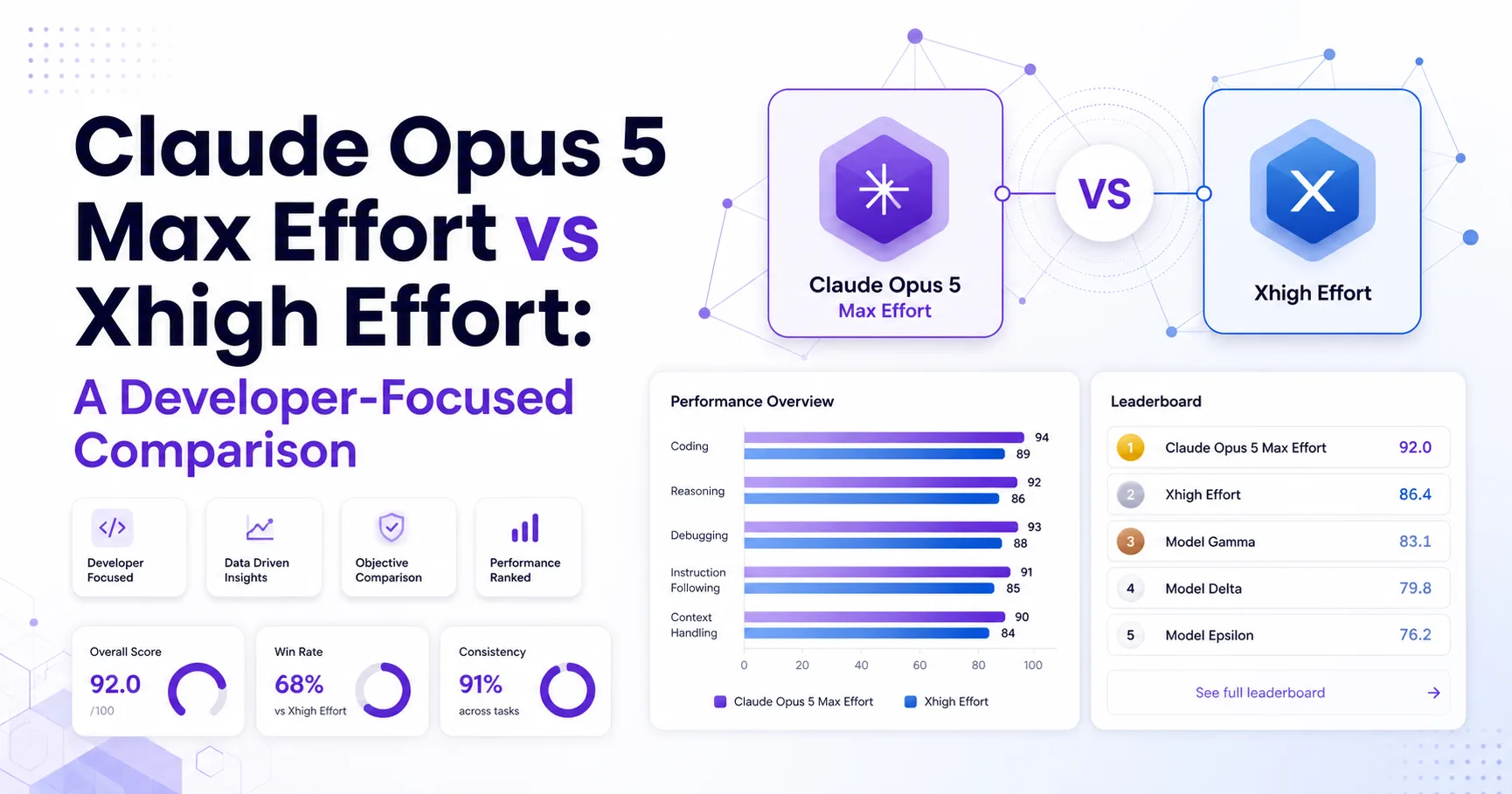
Claude Opus 5 (Adaptive Reasoning, Max Effort) is the practical winner for developers who value measured coding quality and faster output at the same price.
The supplied Artificial Analysis snapshot gives Max Effort a coding index of 78 versus 77 for Xhigh, an intelligence index of 60.7 versus 60.1, and median output speed of 60.088 versus 53.917 tokens per second. Both configurations show a blended price of $10 per 1M tokens, with input at $5 and output at $25.
Data provided by https://artificialanalysis.ai/; the Artificial Analysis snapshot supplies the comparison values. The result should be read as a runtime-choice guide, not proof of a separately released Xhigh model.
Anthropic’s Models overview identifies claude-opus-5 as the stable API model ID and alias. Anthropic’s What's new in Claude Opus 5 describes xhigh as an effort option. Max Effort is therefore the stronger default for this comparison, while Xhigh deserves validation only when a team has a specific reason to change the effort setting.
Claude Opus 5 (Adaptive Reasoning, Max Effort) is the stronger default because it leads the supplied coding and intelligence indexes without a price premium.
| Decision area | Max Effort | Xhigh Effort | Interpretation |
|---|---|---|---|
| Official API identity | claude-opus-5 |
claude-opus-5 with xhigh effort |
Same documented model identity |
| Release date in the supplied data | 2026-07-24 | 2026-07-24 | No release-date separation |
| Coding index | 78 | 77 | Max leads in the supplied index |
| Intelligence index | 60.7 | 60.1 | Max leads in the supplied index |
| Median output speed | 60.088 | 53.917 | Max leads in the supplied metric |
| Latency | 0.3 | 0.3 | Tie |
| Blended price per 1M tokens | $10 | $10 | Tie |
The version story is important for procurement and integration. The data brief presents claude-opus-5-xhigh as a comparison slug, but Anthropic’s Models overview presents claude-opus-5 as the API identity. The same documentation describes adaptive thinking and configurable effort rather than a separate Xhigh model. Anthropic’s model deprecations page also treats the model lifecycle independently from this evaluator label.
The supplied data does not disclose the exact request payload, effort implementation, token budget, task mix, or sampling controls used for either row. That gap prevents a causal claim that Xhigh itself caused the lower score or slower output. The safest interpretation is narrower: under the supplied evaluation conditions, the Max-labelled configuration is ahead, while the official product documentation describes a shared model with different effort settings.
Claude Opus 5 (Adaptive Reasoning, Max Effort) is the measured performance winner, with the higher coding index, higher intelligence index, and faster output.
The coding result is 78 for Max Effort and 77 for Xhigh. That is a narrow separation, so developers should treat it as a default signal rather than a guarantee that every repository, language, or agent harness will improve. The intelligence index also favors Max at 60.7 versus 60.1. The two indexes point in the same direction, but they do not show whether the difference comes from reasoning depth, prompt handling, task selection, or the evaluator’s configuration.
The clearer operational separation appears in output speed. Max Effort reaches 60.088 median output tokens per second, compared with 53.917 for Xhigh. Both configurations report latency of 0.3 seconds. For interactive coding, the output-speed difference can make planning, code review, and visible tool-loop progress feel more responsive. The shared latency figure does not remove that distinction, because startup latency and generation speed affect different parts of an interaction.
The speed result matters less when a workflow spends most of its time waiting for tools, builds, test suites, network calls, or human approvals. The supplied data contains no tool-loop timing, completion-time measurement, retry rate, or accepted-change rate. Developers should therefore avoid turning the generation-speed lead into a claim about total task throughput.
Anthropic’s Introducing Claude Opus 5 positions the model for complex agentic coding, enterprise work, long-context tasks, and several advanced evaluations. The announcement names leading results, but it does not provide a complete, independently reproducible split between Max and Xhigh. Those official claims support the model’s intended use cases, yet they cannot settle the effort-setting question in this comparison.
Behavioral evidence is mixed. Anthropic’s What's new in Claude Opus 5 records longer responses, more progress narration, more active delegation, and repeated validation as behavior changes. A Reddit discussion reports both strong performance on complex work and frustration with verbosity, slow interaction, and overthinking. A Hacker News discussion similarly describes useful autonomous workflows alongside concern that the model may continue down an incorrect path when necessary input is unavailable. These reports explain why a faster Max configuration may feel better in interactive work, but they do not establish a controlled quality difference for Xhigh.
Claude Opus 5 (Adaptive Reasoning, Max Effort) leads on 2 of 2 metrics
Claude Opus 5 (Adaptive Reasoning, Max Effort) and Claude Opus 5 (Adaptive Reasoning, Xhigh Effort) are cost ties, so token price cannot justify choosing Xhigh.
The supplied rate card lists $10 per 1M blended tokens for each configuration. Input pricing is $5 per 1M tokens, and output pricing is $25 per 1M tokens for each row. The economic decision therefore moves away from list price and toward the amount of work required to reach an accepted result.
Nominal rate equality does not guarantee equal spend per completed task. Anthropic’s What's new in Claude Opus 5 explains that max_tokens covers thinking tokens and final response text together. If a higher-effort request consumes more reasoning, produces longer delivery text, or repeats validation, the same token rates can produce a higher bill for the same user outcome. That is a conditional risk, not a measured finding in the supplied data.
Prompt caching can also change the economics of repeated repository context. Anthropic’s Pricing documentation describes separate cache-write and cache-hit pricing. A workflow with stable prompts and repeated context may therefore have different effective input costs from a workflow that rebuilds context on every request. The supplied comparison does not report cache usage, cache hit rates, or prompt composition.
Community feedback makes this distinction practical. The Reddit discussion associates some negative experiences with verbosity and excessive reasoning, while the Hacker News discussion raises concern about continued work on an incorrect path. Those behaviors can create extra review, retries, or tool calls even when the per-token price is unchanged. The Lenny’s Newsletter review also describes a model that can require repeated human prompting in coding-agent situations.
The evidence is insufficient to name a production cost winner. Teams should measure spend per accepted change, successful tool loop, or completed workflow. Until that data exists, Max has the better measured value because it leads the supplied quality and speed metrics at the same listed price.
Claude Opus 5 (Adaptive Reasoning, Max Effort) should be the default pick, while Claude Opus 5 (Adaptive Reasoning, Xhigh Effort) needs task-specific validation.
Choose Max Effort for interactive coding, multi-file implementation, code review, debugging, and agent workflows where visible response speed affects the developer experience. The supplied data gives that configuration a coding index of 78 and median output speed of 60.088 tokens per second. Those results do not prove universal superiority, but they provide the clearest default when the price is $10 per 1M blended tokens for either choice.
Choose Xhigh only when an existing harness already exposes the effort setting or when internal testing shows a meaningful improvement on the team’s hardest tasks. Anthropic’s Models overview and What's new in Claude Opus 5 describe xhigh as an effort level under the claude-opus-5 model identity. The slug claude-opus-5-xhigh should not be treated as evidence of a separate release, compatibility target, or pricing tier.
Keep adaptive thinking enabled for production tool use unless testing proves a clear need to change it. Anthropic warns that disabling thinking can cause tool calls to appear as ordinary text or expose internal XML-like content. The same documentation states that higher effort settings cannot be combined with disabled thinking. Existing integrations should also account for thinking and final text sharing the max_tokens ceiling.
Platform availability is unlikely to decide the model identity question. Anthropic documents access through the Claude API, Amazon Bedrock, Claude Platform on AWS, Google Cloud, and Microsoft Foundry in the model overview. Teams should instead compare operational controls, observability, regional needs, fallback behavior, and harness reliability.
Use additional review for security research and long autonomous scientific work. Anthropic’s release announcement describes safety restrictions for cyber tasks and important limits for autonomous biological research. Those boundaries are product behavior, not evidence that Xhigh solves the underlying reliability problem.
A sensible validation loop records accepted output, rework, tool-call correctness, completion time, and spend across representative tasks. If those measurements do not show a clear Xhigh benefit, the supplied evidence favors Max Effort.
Claude Opus 5 (Adaptive Reasoning, Xhigh Effort) is an effort-labelled evaluation configuration, not a separately documented API model, so developers should interpret the comparison carefully.
The central unknown is causal. The supplied data shows Max Effort ahead on coding, intelligence, and output speed, but it does not disclose enough evaluation detail to prove that the effort setting alone produced the difference. Official documentation explains model identity, adaptive thinking, constraints, and behavior changes through the model overview and What's new in Claude Opus 5.
Community evidence remains directional. Reddit, Hacker News, and the Lenny’s Newsletter review describe conflicting experiences with autonomy, verbosity, speed, and human control. None supplies a standardized comparison of these exact configurations. The FAQ below therefore separates documented facts from decisions that require local testing.
Choose Claude Opus 5 (Adaptive Reasoning, Max Effort) for interactive coding when measured coding quality and response speed matter, because the supplied snapshot reports a coding index of 78 and median output speed of 60.088 tokens per second. See the Artificial Analysis data attribution.
No, Claude Opus 5 Xhigh is not documented as a separate API model; Anthropic presents claude-opus-5 as the model ID and xhigh as an effort setting in its model overview and release documentation.
No price advantage is visible for Xhigh: the supplied data lists $10 per 1M blended tokens for each configuration, while the research provides no task-level token or accepted-work evidence proving that Xhigh creates enough value to justify a different selection.
Keep thinking enabled for production tool use, because Anthropic warns that disabled thinking can produce visible internal markup or ordinary text instead of the expected tool-use structure, especially when integrations depend on reliable tool calls. See What's new in Claude Opus 5.
Treat community reports as directional rather than decisive, because Reddit, Hacker News, and Lenny’s review describe divergent experiences without a standardized, independently reproducible test design.