
Time to First Token · Claude Opus 5 (Adaptive Reasoning, Max Effort)
36976ms
Time to First Token · o3
7185ms
Deep dive into reasoning, benchmarks, and latency insights.
The current catalog does not contain complete performance evidence for both models, so this page does not declare an overall winner. Use the available fields as comparison signals and validate the models on your own workload.
Key decision metrics at a glance.
| Model | Metric | Value | Unit | Source / snapshot |
|---|---|---|---|---|
| Claude Opus 5 (Adaptive Reasoning, Max Effort) | Reasoning | 6.0 | benchmark or capability score | Artificial Analysis · current catalog |
| o3 | Reasoning | 9.0 | benchmark or capability score | Artificial Analysis · current catalog |
| Claude Opus 5 (Adaptive Reasoning, Max Effort) | Coding | 8.0 | benchmark or capability score | Artificial Analysis · current catalog |
| o3 | Coding | 6.0 | benchmark or capability score | Artificial Analysis · current catalog |
| Claude Opus 5 (Adaptive Reasoning, Max Effort) | Multimodal | 5.0 | benchmark or capability score | Artificial Analysis · current catalog |
| o3 | Multimodal | 3.0 | benchmark or capability score | Artificial Analysis · current catalog |
| Claude Opus 5 (Adaptive Reasoning, Max Effort) | Long Context | 8.0 | benchmark or capability score | Artificial Analysis · current catalog |
| o3 | Long Context | 4.0 | benchmark or capability score | Artificial Analysis · current catalog |
| Claude Opus 5 (Adaptive Reasoning, Max Effort) | Blended Price / 1M tokens | $10 | USD per 1M tokens | Artificial Analysis · current catalog |
| o3 | Blended Price / 1M tokens | $3.5 | USD per 1M tokens | Artificial Analysis · current catalog |
| Claude Opus 5 (Adaptive Reasoning, Max Effort) | P95 Latency | — | milliseconds | Artificial Analysis · current catalog |
| o3 | P95 Latency | — | milliseconds | Artificial Analysis · current catalog |
| Claude Opus 5 (Adaptive Reasoning, Max Effort) | Tokens per second | 54.418 | tokens per second | Artificial Analysis · current catalog |
| o3 | Tokens per second | 119.185 | tokens per second | Artificial Analysis · current catalog |
Data provided by Artificial Analysis; live values use the current catalog.
This radar chart visually maps the core capabilities (reasoning, coding, math proxy, multimodal, long context) of `Claude Opus 5 (Adaptive Reasoning, Max Effort)` vs `o3`.
This grouped bar chart provides a side-by-side comparison for each benchmark metric.
Lower time to first token is better; higher tokens per second is better.
Compare input and output pricing in USD per 1M tokens.
Claude Opus 5 (Adaptive Reasoning, Max Effort)$11.25
o3$4
o3 costs $7.25 less per run
This article is a dated snapshot published on 2026-08-06. Live cards above use the current catalog; missing live fields are not inferred.
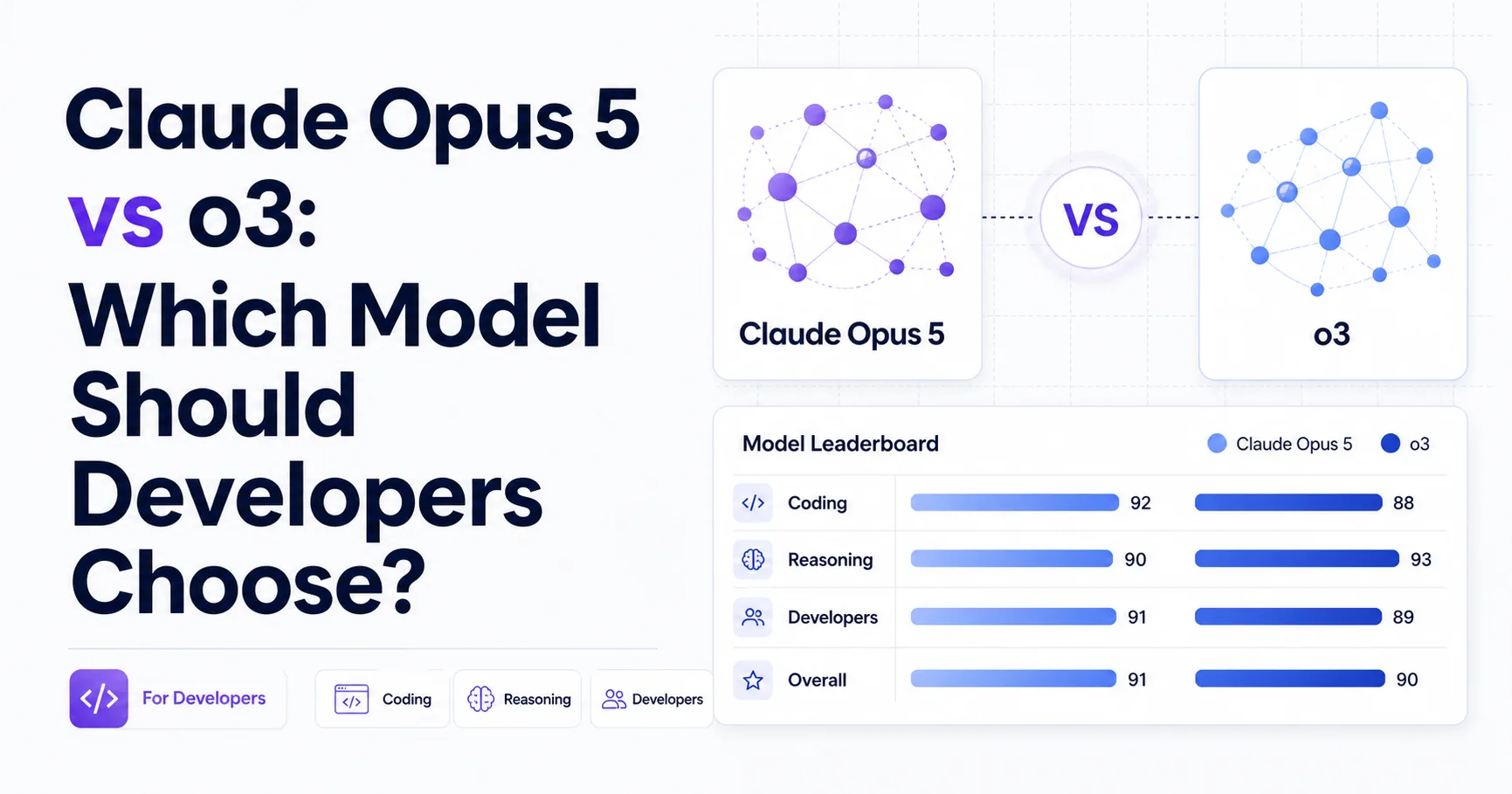
Claude Opus 5 is the stronger default for developers who value broad capability evidence, while o3 is the faster and cheaper option for cost-sensitive workloads. The supplied data reports a 60.7 Artificial Analysis Intelligence Index for Claude Opus 5 and 30.4 for o3. It also reports a 78 Coding Index for Claude Opus 5 and an 88.3 Math Index for o3, but those specialized scores do not form a complete head-to-head benchmark.\n\nClaude Opus 5 has a documented current product path through the Claude API, Amazon Bedrock, Google Cloud, and Microsoft Foundry. Anthropic’s model overview documents its model identity, modalities, context window, and output behavior. By contrast, the supplied OpenAI model directory does not list o3 among its current models. OpenAI’s model directory therefore leaves o3’s current API status and product position unresolved.\n\nData provided by https://artificialanalysis.ai/.
Claude Opus 5 offers the clearer production choice, while o3 offers the clearer efficiency choice. The difference is not simply a matter of one model being better at everything. The evidence is asymmetric, and that asymmetry should affect the decision.\n\n| Decision area | Claude Opus 5 | o3 | What the evidence means | |---|---:|---:|---| | Broad intelligence index | 60.7 | 30.4 | Claude Opus 5 leads on the supplied general index | | Coding index | 78 | Not provided | Claude has direct coding evidence; o3 does not in this snapshot | | Math index | Not provided | 88.3 | o3 has direct math evidence; Claude does not in this snapshot | | Median output speed | 60.088 | 128.056 | o3 is better suited to fast response generation | | Latency | 0.3 seconds | 0.3 seconds | The supplied latency measure is tied | | Blended price per 1M tokens | $10 | $3.5 | o3 costs less on the supplied 3-to-1 blend | \nClaude Opus 5 is also the model with substantially more documented behavior. Anthropic describes it as a model for complex agentic coding and enterprise work in the launch announcement. The same announcement reports leading results on Frontier-Bench v0.1, CursorBench 3.2, ARC-AGI 3, Zapier AutomationBench, and OSWorld 2.0, although those claims are not a direct comparison with o3.\n\no3 has a narrower evidence profile in the supplied material. The official OpenAI page does not provide an o3 context window, output limit, API parameter description, stable alias, or benchmark result. That absence does not prove that o3 lacks those properties. It means a developer cannot verify them from the supplied official source set. The comparison therefore supports a confident capability and cost direction, but not a complete feature parity judgment.
Claude Opus 5 is the better-supported choice for complex coding and multi-step agent workflows, while o3 is the better-supported choice for fast generation and mathematical reasoning. The supplied chart places Claude Opus 5 at 60.7 on the Artificial Analysis Intelligence Index and o3 at 30.4. That gap suggests a meaningful difference in broad task performance, but it does not predict every repository, prompt, or evaluation harness.\n\nFor software teams, Claude’s 78 Coding Index is the most relevant evidence for codebase work. It supports choosing Claude for tasks that require planning across files, making coordinated edits, and completing several verification steps. Anthropic’s official launch material positions the model around complex agentic coding and enterprise work, with benchmark claims covering coding, computer interaction, and automation. The launch announcement also documents the evaluation setup for Frontier-Bench v0.1, including mini-SWE-agent, a GKE backend, 5 runs per task, and fallback behavior after safety-classifier refusals. Those details make the result more interpretable, but they still do not establish parity with an o3 test.\n\nO3’s 88.3 Math Index is a strong reason to test it for symbolic reasoning, quantitative analysis, and workloads where mathematical accuracy dominates broader planning. The evidence does not establish that o3 is weaker at coding. It establishes that the supplied snapshot contains no o3 Coding Index. Similarly, Claude Opus 5’s missing Math Index is an evidence gap, not a demonstrated weakness.\n\nSpeed changes the user experience even when first-token latency is tied at 0.3 seconds. The supplied data reports median output speeds of 60.088 tokens per second for Claude Opus 5 and 128.056 for o3. O3 should feel more responsive during long answers, while Claude may be preferable when the value comes from deeper orchestration rather than rapid text streaming. Anthropic reports that Claude Opus 5 enables adaptive thinking, with effort levels from low through max in its model overview. That control can influence practical latency and output behavior, but the supplied material does not provide a controlled speed comparison by effort level.\n\nThe biggest unresolved performance question is reliability under a developer’s exact workload. Community reports about Claude include complaints about verbosity, slow-feeling responses, overthinking simple tasks, instruction drift, and overly broad edits in a ClaudeCode Reddit discussion and a separate ClaudeAI discussion. Those reports are useful failure hypotheses, not controlled evidence. The supplied research found no comparably verifiable community test material for o3.
o3 is the cheaper model on every supplied token-price measure, but Claude Opus 5 can still be cheaper at the workflow level if it reduces retries, supervision, or corrective edits. The supplied data reports blended prices of $3.5 per 1M tokens for o3 and $10 for Claude Opus 5. It reports input prices of $2 and $5, and output prices of $8 and $25, respectively.\n\nThe displayed price advantage matters most for workloads that are high-volume, short-lived, and easy to validate. Examples include routing, lightweight extraction, simple classification, and mathematical calls where the application already has strong deterministic checks. O3’s 128.056 median output tokens per second can also reduce the time users spend waiting for streamed answers.\n\nThe price advantage becomes less decisive when a model’s first attempt is not the end of the workflow. A coding agent may call the model several times, inspect diffs, rerun tests, and ask for corrections. If a cheaper response creates extra tool calls or human review, the token rate understates the actual cost. The supplied research reports user concerns that Claude Opus 5 can produce longer responses, overthink simple work, or expand changes beyond the requested scope. Anthropic’s documented behavior changes also describe longer default responses, more progress narration, more active delegation, and repeated validation in some multi-agent settings. These behaviors may increase usage, but the supplied material does not quantify that increase.\n\nClaude’s prompt caching can change repeated-context economics. Anthropic’s pricing page lists standard input and output prices, plus separate cache-write and cache-hit prices. The minimum cacheable prompt length is 512 tokens, according to the Opus 5 changes documentation. Caching is relevant for repository instructions, schemas, policies, and other repeated context. It does not automatically make Claude cheaper, because cache writes and cache lifetime choices still matter.\n\nA fair cost decision should therefore measure cost per accepted result, not cost per token. The supplied data supports o3 as the rate-card winner. It does not provide retry counts, tool-call counts, completion quality, or human-review costs, so it cannot determine the cheaper production workflow.
o3 leads on 3 of 3 metrics
Claude Opus 5 is the recommended default for high-value coding agents and enterprise workflows that need broad reasoning evidence and documented operational controls. Anthropic lists Claude Opus 5 as an Active model, with no deprecation date listed and a provisional availability horizon not earlier than 2027-07-24 in the model deprecations page. It is available through multiple cloud and API channels, which reduces the risk of selecting a model with an unclear delivery path.\n\nChoose Claude Opus 5 when the task involves a large repository, coordinated edits, long tool loops, visual input, or an agent that must manage several dependent steps. Its documented 1M-token context window, adaptive thinking, and 78 Coding Index make it the better-supported candidate for that profile. Keep thinking enabled unless a measured integration need requires otherwise. Anthropic documents that disabling thinking can cause tool calls to appear as ordinary text and can expose internal XML tags.\n\nChoose o3 when response speed, token price, or mathematical reasoning is the primary constraint. The supplied data reports 128.056 median output tokens per second, a 0.3-second latency, an 88.3 Math Index, and a $3.5 blended price per 1M tokens. Those values make o3 attractive for high-volume analytical services and interactive workloads with predictable validation.\n\nDo not treat o3 as a safe long-term platform choice without confirming its current access path. The supplied OpenAI model directory does not list o3, and the OpenAI pricing page does not list o3 Standard, Batch, Flex, or Fast mode pricing. The supplied sources also do not identify a successor or formal deprecation date. This is the central evidence gap in the comparison.\n\nThe practical selection path is a two-stage test. Start with Claude Opus 5 for the primary agent workflow and o3 for the math-heavy or cost-sensitive branch. Measure accepted-task rate, correction calls, tool-call validity, output length, review time, and total tokens. The supplied research does not provide those application-level measurements, so a private workload test remains necessary.
Claude Opus 5 is the safer documented platform choice, but o3 can win a narrowly defined workload after application testing. The supplied evidence is strong enough for a directional recommendation, not strong enough to replace a workload-specific evaluation.\n\nThe most important unanswered question is whether o3 remains directly callable in the intended environment. The current OpenAI documentation supplied for this comparison does not answer that question. Developers should verify access, model identifiers, limits, and billing before committing production code.
Claude Opus 5 is the better-supported coding choice because the supplied data reports a 78 Coding Index and Anthropic positions it for complex agentic coding. The comparison does not prove that o3 is weaker at coding, because no o3 Coding Index appears in the supplied snapshot.
o3 is cheaper on the supplied rate card, costing $3.5 per 1M blended tokens versus $10 for Claude Opus 5. Production cost can still reverse if Claude reduces retries, corrective edits, tool calls, or human review.
o3 is faster by the supplied output-speed measure, producing 128.056 median output tokens per second versus Claude Opus 5 at 60.088. The supplied latency value is 0.3 seconds for both models, so the user-visible difference may depend on response length and streaming behavior.
Claude Opus 5 is the stronger documented candidate for long-context agents because Anthropic documents a 1M-token context window, adaptive thinking, and multiple deployment channels. The supplied material does not provide equivalent current context or output-limit documentation for o3.
o3 is not a fully verified long-term dependency from the supplied sources because the current OpenAI model directory does not list it and the pricing page does not provide o3 prices. The data snapshot reports $3.5 blended pricing, but developers should confirm live access and lifecycle terms before deployment.