
Time to First Token · Claude Opus 5 (Adaptive Reasoning, Xhigh Effort)
26692ms
Time to First Token · GPT-4
0ms
Deep dive into reasoning, benchmarks, and latency insights.
The current catalog does not contain complete performance evidence for both models, so this page does not declare an overall winner. Use the available fields as comparison signals and validate the models on your own workload.
Key decision metrics at a glance.
| Model | Metric | Value | Unit | Source / snapshot |
|---|---|---|---|---|
| Claude Opus 5 (Adaptive Reasoning, Xhigh Effort) | Reasoning | 6.0 | benchmark or capability score | Artificial Analysis · current catalog |
| GPT-4 | Reasoning | 6.0 | benchmark or capability score | Artificial Analysis · current catalog |
| Claude Opus 5 (Adaptive Reasoning, Xhigh Effort) | Coding | 8.0 | benchmark or capability score | Artificial Analysis · current catalog |
| GPT-4 | Coding | 1.0 | benchmark or capability score | Artificial Analysis · current catalog |
| Claude Opus 5 (Adaptive Reasoning, Xhigh Effort) | Multimodal | 5.0 | benchmark or capability score | Artificial Analysis · current catalog |
| GPT-4 | Multimodal | 1.0 | benchmark or capability score | Artificial Analysis · current catalog |
| Claude Opus 5 (Adaptive Reasoning, Xhigh Effort) | Long Context | 8.0 | benchmark or capability score | Artificial Analysis · current catalog |
| GPT-4 | Long Context | 1.0 | benchmark or capability score | Artificial Analysis · current catalog |
| Claude Opus 5 (Adaptive Reasoning, Xhigh Effort) | Blended Price / 1M tokens | $10 | USD per 1M tokens | Artificial Analysis · current catalog |
| GPT-4 | Blended Price / 1M tokens | $37.5 | USD per 1M tokens | Artificial Analysis · current catalog |
| Claude Opus 5 (Adaptive Reasoning, Xhigh Effort) | P95 Latency | — | milliseconds | Artificial Analysis · current catalog |
| GPT-4 | P95 Latency | — | milliseconds | Artificial Analysis · current catalog |
| Claude Opus 5 (Adaptive Reasoning, Xhigh Effort) | Tokens per second | 53.473 | tokens per second | Artificial Analysis · current catalog |
| GPT-4 | Tokens per second | 0 | tokens per second | Artificial Analysis · current catalog |
Data provided by Artificial Analysis; live values use the current catalog.
This radar chart visually maps the core capabilities (reasoning, coding, math proxy, multimodal, long context) of `Claude Opus 5 (Adaptive Reasoning, Xhigh Effort)` vs `GPT-4`.
This grouped bar chart provides a side-by-side comparison for each benchmark metric.
Lower time to first token is better; higher tokens per second is better.
Compare input and output pricing in USD per 1M tokens.
Claude Opus 5 (Adaptive Reasoning, Xhigh Effort)$11.25
GPT-4$45
Claude Opus 5 (Adaptive Reasoning, Xhigh Effort) costs $33.75 less per run
This article is a dated snapshot published on 2026-08-07. Live cards above use the current catalog; missing live fields are not inferred.
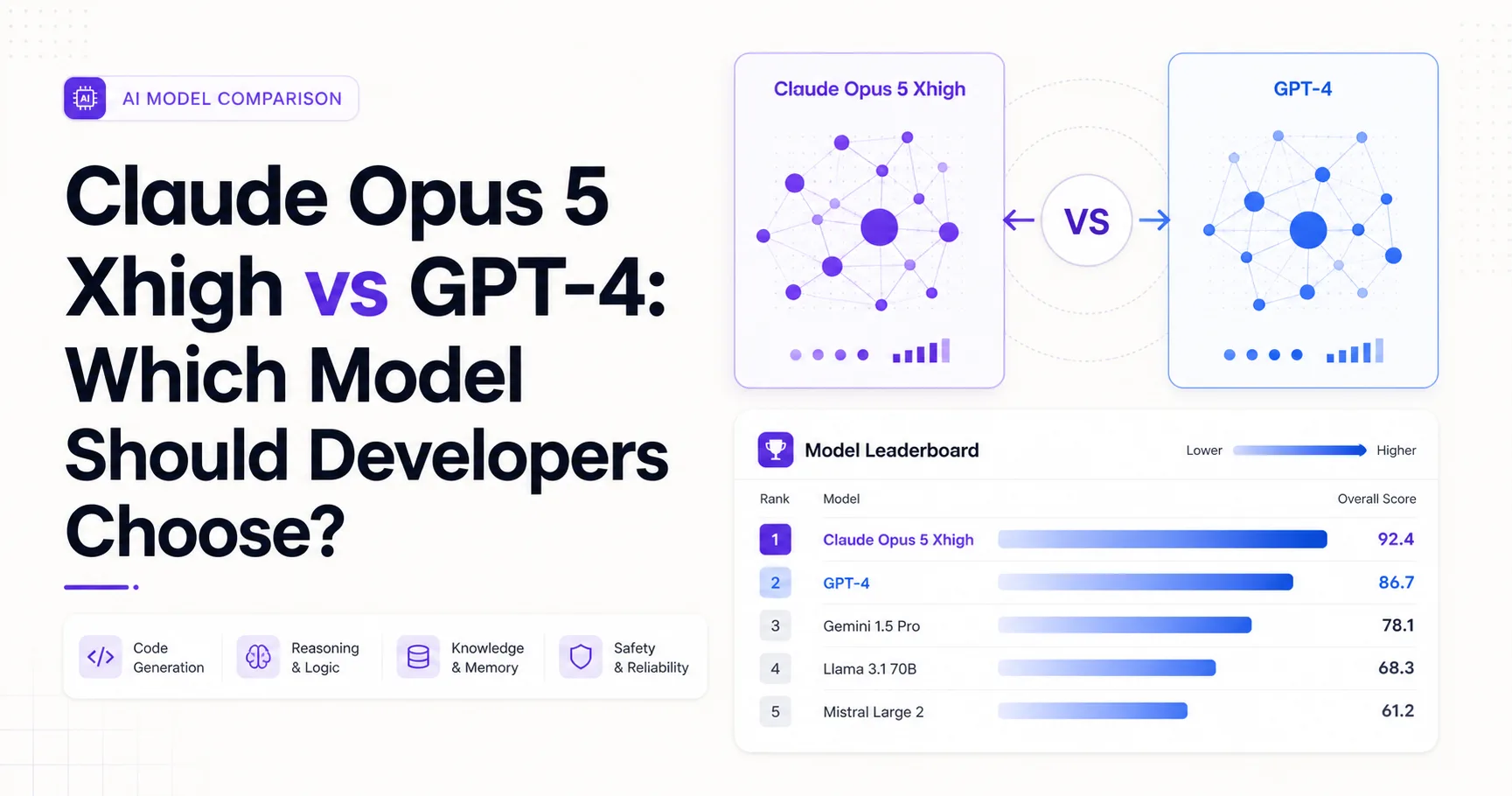
Claude Opus 5 is the clear choice for new developer workloads when the comparison is based on the supplied capability and cost data. The Artificial Analysis dataset gives Claude Opus 5 a coding index of 77, compared with 13.1 for GPT-4, and an intelligence index of 60.1, compared with 7 for GPT-4. Claude Opus 5 also has a blended price of $10 per 1M tokens, while GPT-4 is listed at $37.5. Data provided by https://artificialanalysis.ai/, with the comparison dataset available from Artificial Analysis.\n\nThe evidence is less complete than the score gap suggests. The data brief reports no context-window value for either model, and it reports no GPT-4 output-speed value. OpenAI's current model documentation does not provide current GPT-4 parameters, while the current pricing documentation does not list GPT-4. Developers should therefore treat this as a practical selection between a documented current Claude offering and a less clearly documented GPT-4 reference point, rather than a complete specification audit.
Claude Opus 5 offers stronger supplied benchmark evidence, lower listed prices, and a clearer current product position than GPT-4. The coding-index gap is 63.9 points, and the intelligence-index gap is 53.1 points. Those differences matter most for work that requires planning, code changes across files, debugging, tool use, or sustained reasoning. They matter less for short prompts where integration fit, existing prompts, or application-specific evaluation dominates.\n\nClaude Opus 5's official model overview identifies it as a current model with an official API ID and alias of claude-opus-5. The official Opus 5 release update describes adaptive thinking, configurable effort, agentic coding, code review, visual understanding, long-context work, and multi-agent workflows. These claims establish intended capability and API behavior, but they do not replace an evaluation on your own repository.\n\nGPT-4 has a different selection risk. The cited OpenAI pages do not confirm its current API status, stable alias, context window, output limit, or current pricing. No reliable community material in the brief provides a reproducible modern GPT-4 comparison. That absence does not prove GPT-4 fails at a task. It means a team cannot infer current operational behavior from the supplied official evidence alone.
Claude Opus 5 has the stronger measured capability profile, but its high-effort advantage can create a slower and more expensive workflow than a simple score comparison implies. The supplied data gives Claude Opus 5 a coding index of 77 and GPT-4 a coding index of 13.1. For repository-level engineering, that gap suggests a greater chance of handling planning, implementation, and debugging as one connected task. The exact effect on your codebase remains unproven because the brief does not provide task-level pass rates or a reproducible test protocol for this comparison.\n\nClaude Opus 5 reports a median output speed of 53.917 tokens per second. GPT-4 has no corresponding reported value, so no speed winner can be established from the dataset. Both models show latency of 0.3 seconds in the supplied snapshot, but identical initial latency does not establish identical time to a useful answer. Adaptive thinking, tool calls, retries, repository inspection, and response length can dominate an agent's end-to-end duration.\n\nThe official Opus 5 update says adaptive thinking is enabled by default and that high effort can produce longer responses and more progress reporting. Community reports are divided. A Reddit discussion describes verbosity, overthinking, and instruction drift, while a Hacker News discussion praises autonomy but warns that the model may continue building workflows when it should request missing input. These reports lack standardized methods, so they are workflow risks, not quantitative performance results.
Claude Opus 5 (Adaptive Reasoning, Xhigh Effort) leads on 2 of 2 metrics
Claude Opus 5 is the lower-cost option in the supplied pricing snapshot, but prompt design and agent behavior determine whether that advantage survives production. Its blended price is $10 per 1M tokens, compared with $37.5 for GPT-4. Its input price is $5 per 1M tokens, compared with $30, and its output price is $25, compared with $60. These differences make Claude Opus 5 the stronger default for workloads with substantial input context or generated output.\n\nA cheaper token is not automatically a cheaper completed task. Claude Opus 5's official pricing page lists separate cache-write and cache-hit prices, while the Opus 5 update describes adaptive thinking and higher-effort modes. A workflow that repeatedly explores unnecessary paths, produces long status reports, or spends more thinking tokens can reduce the practical savings. The same update warns that max_tokens covers thinking tokens and final response text, so existing budgets may need adjustment.\n\nGPT-4 could still be cheaper in a particular legacy deployment if an existing provider contract, cache policy, or tuned prompt reduces its actual spend. The supplied evidence cannot test that scenario. OpenAI's current pricing page does not list GPT-4, so the comparison uses the data snapshot's GPT-4 price while acknowledging that current public billing cannot be independently confirmed from the cited page.
Claude Opus 5 (Adaptive Reasoning, Xhigh Effort) leads on 3 of 3 metrics
Claude Opus 5 should be the default pick for new, difficult developer workflows that can tolerate deliberate reasoning and require strong coding performance. Anthropic's release announcement positions the model for complex agentic coding, long-horizon tasks, and advanced technical work. The supplied coding index of 77 supports that positioning relative to GPT-4's 13.1, although the benchmark brief does not reveal enough methodology to predict every repository outcome.\n\nChoose Claude Opus 5 for multi-file feature development, code review, difficult bug investigation, tool-using agents, and tasks where a model must maintain a plan over many actions. Keep effort configurable. The official documentation says xhigh is an effort setting, not a separate API model ID, and warns that disabling thinking with xhigh or max returns a 400 error. Integrations should also reserve enough max_tokens for both reasoning and the final response.\n\nConsider GPT-4 only when a validated existing integration, prompt suite, or organizational dependency makes migration costly. The current OpenAI models page does not document GPT-4's present limits or capability parameters, and the brief supplies no reproducible community test. Before selecting it for a new system, verify the exact endpoint, model availability, billing, context behavior, and task success rate in your account.\n\nClaude Opus 5 still needs guardrails. Anthropic documents important limitations for long-running scientific work and safety constraints in biology and cybersecurity. A Lenny's Newsletter review reports a cautious agent that may request human judgment, while another Hacker News report discusses long runs, recovery needs, and service interruptions. Those observations support harness-level timeouts, checkpoints, approval gates, and recovery logic. They do not establish a universal defect in the model.
GPT-4's current production status remains the largest unresolved question in this comparison. The cited OpenAI pages establish what is currently documented, but they do not provide enough GPT-4-specific detail to validate a modern deployment decision.\n\nClaude Opus 5's stronger evidence also has boundaries. The official sources describe features, intended use cases, parameters, and limitations, while the supplied dataset reports comparative scores, prices, latency, and output speed. Neither source set provides a complete application-specific success rate. Developers should combine this article with a small evaluation built from representative tasks, tool permissions, failure recovery, and acceptable output length.
Claude Opus 5 is the stronger coding choice in the supplied evidence, with a coding index of 77 versus 13.1 for GPT-4, although repository-specific testing is still required.
Claude Opus 5 is cheaper in the supplied snapshot, costing $10 versus $37.5 per 1M blended tokens, but agent verbosity can change completed-task spending.
Claude Opus 5 has a reported median output speed of 53.917 tokens per second, while GPT-4 has no reported speed value, so a complete comparison is unavailable.
Developers should use claude-opus-5 as the official model ID and treat Xhigh as an effort configuration, according to Anthropic's model documentation.
The biggest risk is unclear current support and pricing, because the cited OpenAI documentation does not confirm GPT-4's availability, limits, or present API price.