
Time to First Token · Claude Opus 5 (Adaptive Reasoning, Xhigh Effort)
26692ms
Time to First Token · GPT-4o mini
0ms
Deep dive into reasoning, benchmarks, and latency insights.
The current catalog does not contain complete performance evidence for both models, so this page does not declare an overall winner. Use the available fields as comparison signals and validate the models on your own workload.
Key decision metrics at a glance.
| Model | Metric | Value | Unit | Source / snapshot |
|---|---|---|---|---|
| Claude Opus 5 (Adaptive Reasoning, Xhigh Effort) | Reasoning | 6.0 | benchmark or capability score | Artificial Analysis · current catalog |
| GPT-4o mini | Reasoning | 1.0 | benchmark or capability score | Artificial Analysis · current catalog |
| Claude Opus 5 (Adaptive Reasoning, Xhigh Effort) | Coding | 8.0 | benchmark or capability score | Artificial Analysis · current catalog |
| GPT-4o mini | Coding | 1.0 | benchmark or capability score | Artificial Analysis · current catalog |
| Claude Opus 5 (Adaptive Reasoning, Xhigh Effort) | Multimodal | 5.0 | benchmark or capability score | Artificial Analysis · current catalog |
| GPT-4o mini | Multimodal | 1.0 | benchmark or capability score | Artificial Analysis · current catalog |
| Claude Opus 5 (Adaptive Reasoning, Xhigh Effort) | Long Context | 8.0 | benchmark or capability score | Artificial Analysis · current catalog |
| GPT-4o mini | Long Context | 1.0 | benchmark or capability score | Artificial Analysis · current catalog |
| Claude Opus 5 (Adaptive Reasoning, Xhigh Effort) | Blended Price / 1M tokens | $10 | USD per 1M tokens | Artificial Analysis · current catalog |
| GPT-4o mini | Blended Price / 1M tokens | $0.262 | USD per 1M tokens | Artificial Analysis · current catalog |
| Claude Opus 5 (Adaptive Reasoning, Xhigh Effort) | P95 Latency | — | milliseconds | Artificial Analysis · current catalog |
| GPT-4o mini | P95 Latency | — | milliseconds | Artificial Analysis · current catalog |
| Claude Opus 5 (Adaptive Reasoning, Xhigh Effort) | Tokens per second | 53.473 | tokens per second | Artificial Analysis · current catalog |
| GPT-4o mini | Tokens per second | 0 | tokens per second | Artificial Analysis · current catalog |
Data provided by Artificial Analysis; live values use the current catalog.
This radar chart visually maps the core capabilities (reasoning, coding, math proxy, multimodal, long context) of `Claude Opus 5 (Adaptive Reasoning, Xhigh Effort)` vs `GPT-4o mini`.
This grouped bar chart provides a side-by-side comparison for each benchmark metric.
Lower time to first token is better; higher tokens per second is better.
Compare input and output pricing in USD per 1M tokens.
Claude Opus 5 (Adaptive Reasoning, Xhigh Effort)$11.25
GPT-4o mini$0.3
GPT-4o mini costs $10.95 less per run
This article is a dated snapshot published on 2026-08-07. Live cards above use the current catalog; missing live fields are not inferred.
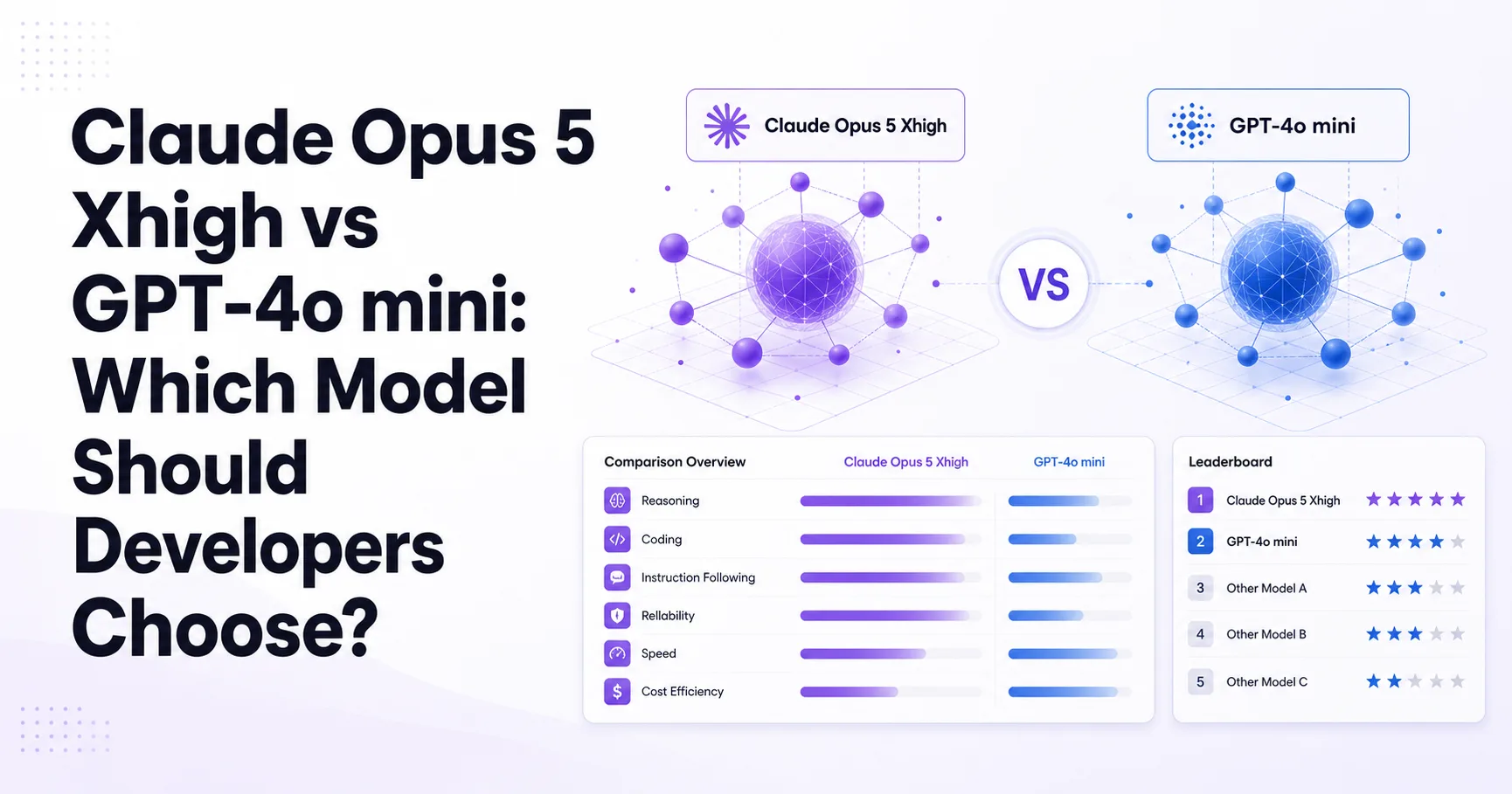
Claude Opus 5 is the stronger choice for complex development work, while GPT-4o mini remains the practical option for cost-sensitive, high-volume automation.
The supplied evaluation data puts Claude Opus 5 at 77 on the Artificial Analysis coding index and 60.1 on its intelligence index. GPT-4o mini reaches 11.4 and 6.9 on those same measures. The gap is large enough to change the type of work each model can safely handle, not merely the quality of a final answer. Data provided by https://artificialanalysis.ai/
Claude Opus 5 launched on 2026-07-24, while GPT-4o mini launched on 2024-07-18. That release gap matters because the models occupy different product positions. Anthropic presents Opus 5 as a model for complex agentic coding, long-running work, code review, debugging, and multi-agent workflows. Introducing Claude Opus 5 OpenAI originally positioned GPT-4o mini as a small model for high-frequency, cost-efficient tasks. GPT-4o mini release announcement
The comparison therefore has a clear shape: Opus 5 buys substantially more task capability at a much higher token price, while GPT-4o mini buys low operating cost with a narrower evidence-backed ceiling.
Claude Opus 5 wins capability-sensitive development workloads, but GPT-4o mini wins predictable low-cost workloads by a wide margin.
| Decision area | Claude Opus 5 | GPT-4o mini | What it means |
|---|---|---|---|
| Coding index | 77 | 11.4 | Opus 5 is the safer candidate for repository-level engineering tasks |
| Intelligence index | 60.1 | 6.9 | Opus 5 has a substantial advantage on the supplied general capability measure |
| Blended price per 1M tokens | $10 | $0.2625 | GPT-4o mini is better suited to high-volume requests |
| Input price per 1M tokens | $5 | $0.15 | Large prompts are materially cheaper with GPT-4o mini |
| Output price per 1M tokens | $25 | $0.6 | Verbose or reasoning-heavy output is especially expensive with Opus 5 |
| Reported latency | 0.3 seconds | 0.3 seconds | The supplied latency measure is a tie |
| Median output speed | 53.917 tokens per second | Not reported | Throughput comparison is incomplete |
Claude Opus 5 is officially identified by the stable API model ID and alias claude-opus-5; xhigh describes an effort setting rather than a separate API model. Models overview GPT-4o mini uses the public alias gpt-4o-mini, with gpt-4o-mini-2024-07-18 as its fixed snapshot. GPT-4o mini model documentation
The most important unanswered question is current GPT-4o mini availability. The supplied OpenAI model directory emphasizes the GPT-5 family, while the current pricing page does not list GPT-4o mini. The materials do not establish whether the model remains directly callable, region-limited, or formally replaced. OpenAI model directory OpenAI pricing Developers should verify access before designing a new dependency around it.
Claude Opus 5 is better suited to autonomous software work because its coding advantage can reduce the amount of human decomposition and correction required.
The chart shows a 77 coding index for Claude Opus 5 versus 11.4 for GPT-4o mini. That difference should not be read as a guaranteed success rate for every repository. It does indicate a major separation in the supplied evaluation signal. Opus 5 is the more credible candidate for multi-file changes, difficult debugging, code review, and tasks where the model must maintain a plan across several steps. Anthropic explicitly describes those use cases in its release material. What's new in Claude Opus 5
GPT-4o mini is better matched to bounded operations: classification, extraction, lightweight transformations, short code assistance, and request paths where a human or deterministic program already controls the workflow. Its published release benchmarks include MMLU at 82.0%, MGSM at 87.0%, HumanEval at 87.2%, and MMMU at 59.4%, but those results come from the launch announcement and do not guarantee broad repository-level performance. GPT-4o mini release announcement
The speed evidence is incomplete. Claude Opus 5 has a reported median output speed of 53.917 tokens per second, while GPT-4o mini has no corresponding value in the supplied data. Both models show 0.3 seconds for the supplied latency measure, but equal latency does not prove equal completion time. A model that needs fewer corrective turns can still finish a real task sooner, even if its first response is more expensive or more deliberate.
Claude Opus 5 also brings integration-specific risks. Adaptive thinking is enabled by default, and Anthropic warns that thinking tokens and final response tokens share the max_tokens budget. What's new in Claude Opus 5 GPT-4o mini has a less demanding documented operating profile, but the supplied material does not provide equivalent modern agentic-workflow testing.
GPT-4o mini is dramatically cheaper per token, but Claude Opus 5 can justify its price when human correction and orchestration dominate the project cost.
The chart places GPT-4o mini at $0.2625 per 1M blended tokens, compared with $10 for Claude Opus 5. Input pricing is $0.15 versus $5, and output pricing is $0.6 versus $25. The difference is large enough to make GPT-4o mini the default economic choice for frequent requests, large-scale enrichment, and simple product interactions. GPT-4o mini release announcement
Claude Opus 5 becomes easier to justify when one successful run replaces substantial developer supervision. A weak model may require extra prompts, manual review, retries, test interpretation, and repair passes. Those costs are not represented in a token table. The supplied coding index gap, 77 versus 11.4, is the clearest evidence that capability may affect the total workflow rather than only the API bill. Data provided by https://artificialanalysis.ai/
The cost conclusion can also reverse under output-heavy usage. Claude Opus 5 charges $25 per 1M output tokens, so verbose agent reports, repeated planning, and high-effort reasoning can expand spend quickly. Anthropic acknowledges that Opus 5 tends to produce longer responses and more frequent progress updates in agentic sessions. What's new in Claude Opus 5
GPT-4o mini's apparent price advantage has an availability caveat. The current OpenAI pricing page does not list the model, so the supplied materials cannot confirm that the launch price remains valid for new calls. OpenAI pricing Treat $0.2625 as the comparison snapshot supplied by the dataset, not as a current billing guarantee.
For production planning, estimate cost per completed task, not cost per token alone. The materials do not provide comparable retry counts, human-review rates, or task-level completion costs, so the break-even point remains unproven.
GPT-4o mini leads on 3 of 3 metrics
Claude Opus 5 should be the primary choice for difficult coding agents, while GPT-4o mini should serve controlled workloads where unit cost and scale dominate.
Choose Claude Opus 5 when the model must inspect a substantial codebase, edit several files, diagnose a failure, write or revise tests, or continue through a long task with limited intervention. Anthropic explicitly targets complex agentic coding, multi-file feature work, debugging, code review, and multi-agent collaboration. Introducing Claude Opus 5 The supplied coding index of 77 supports that positioning relative to GPT-4o mini's 11.4.
Choose GPT-4o mini when the task is narrow, repetitive, and easy to validate. Good candidates include structured extraction, tagging, routing, short transformations, simple user-facing assistance, and large request volumes. Its $0.2625 blended price makes experimentation and broad deployment much easier, provided the model is still available through the intended account and region. OpenAI model directory OpenAI pricing
Use a two-tier design when the product contains both request types. Route routine traffic to GPT-4o mini, then escalate ambiguous or high-impact cases to Claude Opus 5. The escalation policy should be based on validation failures, task complexity, or user impact rather than on model branding.
Claude Opus 5's operational behavior deserves explicit guardrails. Anthropic documents effort levels including xhigh, and xhigh or max cannot be combined with disabled thinking because the request returns a 400 error. What's new in Claude Opus 5 Community reports also disagree about autonomy. Some developers praise independent task execution, while others report verbosity, overthinking, and instruction drift. Reddit: Is Opus 5 actually that bad, or is it just Reddit hype? Hacker News users similarly describe useful self-directed workflows alongside concern about continued token consumption when required inputs are missing. Hacker News: Claude Opus 5
The evidence does not settle which model delivers better end-to-end developer productivity. Community tests lack a shared protocol, and the supplied dataset does not include comparable GPT-4o mini output speed or task completion cost. Lenny's review also describes a model that can be cautious and dependent on human confirmation, which may conflict with teams seeking aggressive autonomous execution. Claude Opus 5 review Pilot both models on representative repositories before committing to a single-agent architecture.
Claude Opus 5 is the safer default for complex engineering, but the supplied evidence still leaves important production questions unanswered.
The FAQ below separates observed differences from assumptions that require a local pilot. Developers should validate availability, task completion cost, and failure recovery in their own environment.
Claude Opus 5 is the stronger coding candidate because its supplied coding index is 77 versus 11.4 for GPT-4o mini, although those scores do not guarantee identical repository-level outcomes.
GPT-4o mini is cheaper in the supplied comparison at $0.2625 per 1M blended tokens versus $10 for Claude Opus 5, but current OpenAI pricing does not list it.
Claude Opus 5 has a reported median output speed of 53.917 tokens per second, while GPT-4o mini has no supplied value, so the 0.3-second latency tie cannot answer throughput.
Developers should treat xhigh as an effort configuration, not a separate API model ID, because the official Claude model identifier and alias are both claude-opus-5.
GPT-4o mini can replace Claude Opus 5 for bounded and easily validated steps, but the supplied coding-index gap and missing agentic evaluation evidence make full replacement unproven.
Claude Opus 5 can consume more tokens and require stronger orchestration because adaptive thinking, high effort, verbose progress updates, and autonomous behavior may increase cost or delay.