
Time to First Token · Claude Opus 5 (Adaptive Reasoning, Xhigh Effort)
26692ms
Time to First Token · GPT-5.5 (xhigh)
0ms
Deep dive into reasoning, benchmarks, and latency insights.
The current catalog does not contain complete performance evidence for both models, so this page does not declare an overall winner. Use the available fields as comparison signals and validate the models on your own workload.
Key decision metrics at a glance.
| Model | Metric | Value | Unit | Source / snapshot |
|---|---|---|---|---|
| Claude Opus 5 (Adaptive Reasoning, Xhigh Effort) | Reasoning | 6.0 | benchmark or capability score | Artificial Analysis · current catalog |
| GPT-5.5 (xhigh) | Reasoning | 6.0 | benchmark or capability score | Artificial Analysis · current catalog |
| Claude Opus 5 (Adaptive Reasoning, Xhigh Effort) | Coding | 8.0 | benchmark or capability score | Artificial Analysis · current catalog |
| GPT-5.5 (xhigh) | Coding | 7.0 | benchmark or capability score | Artificial Analysis · current catalog |
| Claude Opus 5 (Adaptive Reasoning, Xhigh Effort) | Multimodal | 5.0 | benchmark or capability score | Artificial Analysis · current catalog |
| GPT-5.5 (xhigh) | Multimodal | 5.0 | benchmark or capability score | Artificial Analysis · current catalog |
| Claude Opus 5 (Adaptive Reasoning, Xhigh Effort) | Long Context | 8.0 | benchmark or capability score | Artificial Analysis · current catalog |
| GPT-5.5 (xhigh) | Long Context | 7.0 | benchmark or capability score | Artificial Analysis · current catalog |
| Claude Opus 5 (Adaptive Reasoning, Xhigh Effort) | Blended Price / 1M tokens | $10 | USD per 1M tokens | Artificial Analysis · current catalog |
| GPT-5.5 (xhigh) | Blended Price / 1M tokens | $11.25 | USD per 1M tokens | Artificial Analysis · current catalog |
| Claude Opus 5 (Adaptive Reasoning, Xhigh Effort) | P95 Latency | — | milliseconds | Artificial Analysis · current catalog |
| GPT-5.5 (xhigh) | P95 Latency | — | milliseconds | Artificial Analysis · current catalog |
| Claude Opus 5 (Adaptive Reasoning, Xhigh Effort) | Tokens per second | 53.473 | tokens per second | Artificial Analysis · current catalog |
| GPT-5.5 (xhigh) | Tokens per second | 0 | tokens per second | Artificial Analysis · current catalog |
Data provided by Artificial Analysis; live values use the current catalog.
This radar chart visually maps the core capabilities (reasoning, coding, math proxy, multimodal, long context) of `Claude Opus 5 (Adaptive Reasoning, Xhigh Effort)` vs `GPT-5.5 (xhigh)`.
This grouped bar chart provides a side-by-side comparison for each benchmark metric.
Lower time to first token is better; higher tokens per second is better.
Compare input and output pricing in USD per 1M tokens.
Claude Opus 5 (Adaptive Reasoning, Xhigh Effort)$11.25
GPT-5.5 (xhigh)$12.5
Claude Opus 5 (Adaptive Reasoning, Xhigh Effort) costs $1.25 less per run
This article is a dated snapshot published on 2026-08-05. Live cards above use the current catalog; missing live fields are not inferred.
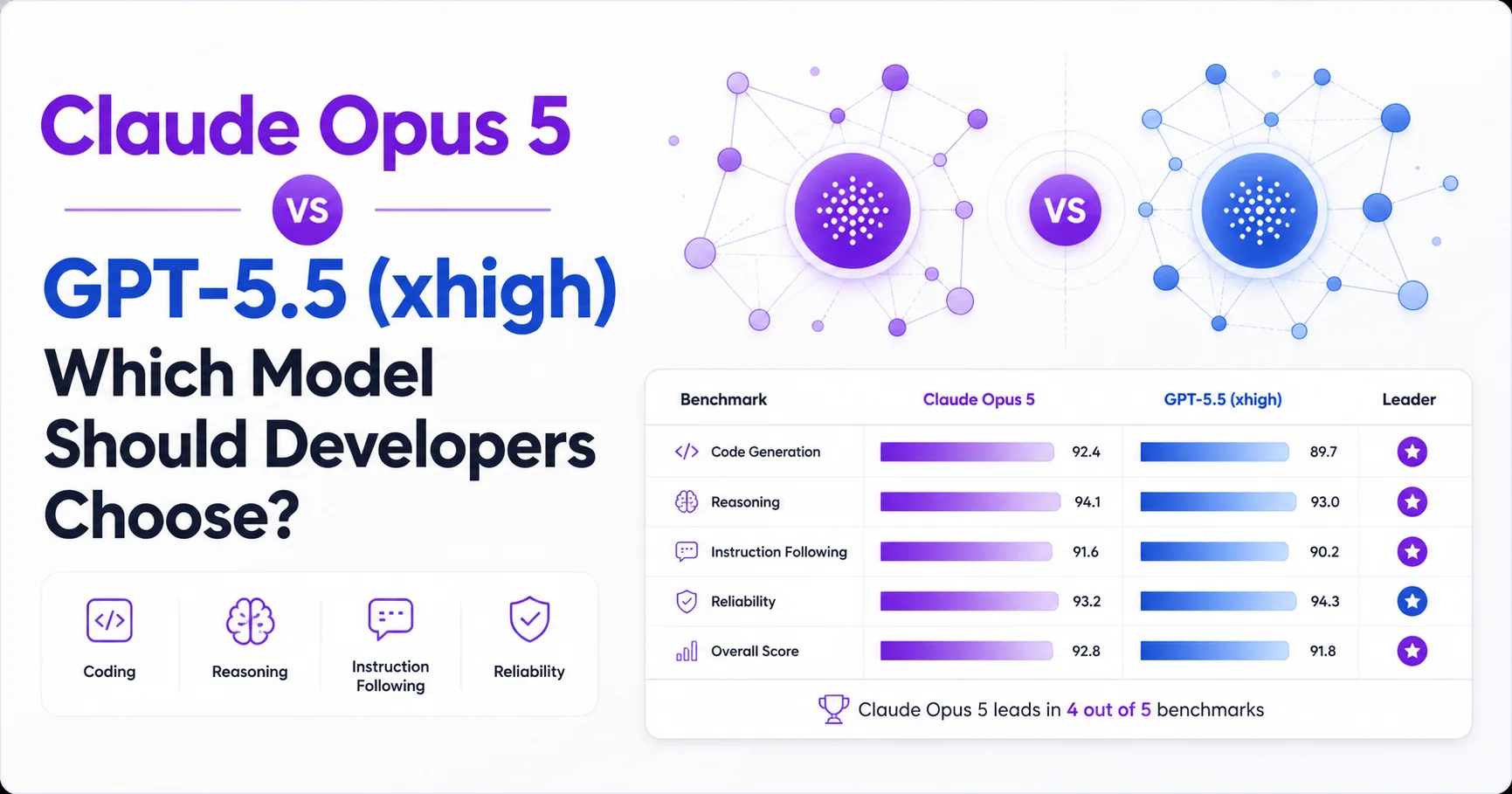
Claude Opus 5 is the stronger overall default for developers who value measured capability, lower blended cost, and a visible throughput signal.
Claude Opus 5 scores 77 on the Artificial Analysis coding index and 60.1 on its intelligence index, compared with GPT-5.5 at 74.9 and 54.8. Its supplied blended price is $10 per 1M tokens versus $11.25 for GPT-5.5. Claude Opus 5 also has a reported median output rate of 53.917 tokens per second, while GPT-5.5 has no comparable value in the snapshot. Data provided by https://artificialanalysis.ai/.
This result does not make Claude universal. GPT-5.5 presents a broad documented tool surface, including structured outputs, hosted shell, computer use, and MCP, and OpenAI frames it for tool-heavy professional workflows (GPT-5.5 model documentation; Using GPT-5.5). Claude Opus 5 is framed around complex agentic coding, long-running work, and multi-agent workflows (Introducing Claude Opus 5).
Release timing also matters. Claude Opus 5 released on 2026-07-24, while GPT-5.5 released on 2026-04-23. Claude's current overview lists it as available, and its deprecation page does not list it as deprecated or retired (Models overview; Model deprecations). GPT-5.5 remains callable with a dedicated model page and pricing entry, although OpenAI's current catalog points users toward the GPT-5.6 family (GPT-5.5 model; Models; Pricing). Treat that as a lifecycle signal to monitor, not evidence that GPT-5.5 is unavailable.
Claude Opus 5 wins the supplied decision signals, while GPT-5.5 remains a credible choice for tool-dense systems with explicit orchestration.
Data provided by https://artificialanalysis.ai/.
| Decision signal | Claude Opus 5 | GPT-5.5 | Practical reading |
|---|---|---|---|
| Artificial Analysis intelligence index | 60.1 | 54.8 | Claude has the stronger supplied general capability signal |
| Artificial Analysis coding index | 77 | 74.9 | Claude has the stronger supplied coding signal |
| Blended price per 1M tokens | $10 | $11.25 | Claude is cheaper in the supplied blend |
| Input price per 1M tokens | $5 | $5 | The input price is tied |
| Output price per 1M tokens | $25 | $30 | Claude is cheaper for generated output |
| Median output tokens per second | 53.917 | No supplied value | The speed comparison is incomplete |
| Latency | 0.3 seconds | 0.3 seconds | The supplied latency result is tied |
The labels also create a configuration trap. Anthropic documents claude-opus-5 as the model ID and describes xhigh as an effort value. OpenAI documents gpt-5.5 as the model ID and xhigh as a reasoning.effort setting (What's new in Claude Opus 5; GPT-5.5 model documentation). Production code should select the stable model ID, then configure effort separately.
The supplied snapshot leaves context_window null for both models. That means this comparison cannot award a context-window winner. Official documentation describes large context support for each model, but the provided data does not establish comparable effective limits. The snapshot also does not show whether either model is better at your repository, language, toolchain, or review standard.
The safest interpretation is directional. Claude has the stronger measured signal and lower listed cost. GPT-5.5 has a strong platform and tool story. Your final choice should depend on whether model capability or integration control dominates the workflow.
Claude Opus 5 has the stronger measured capability signal, while GPT-5.5 lacks a comparable output-speed observation in the supplied snapshot.
The coding index reports 77 for Claude Opus 5 and 74.9 for GPT-5.5. The intelligence index reports 60.1 for Claude and 54.8 for GPT-5.5. Those results support Claude as the better first candidate for difficult coding, planning, and reasoning workloads. They do not prove that Claude will produce better patches in every repository.
A benchmark index is most useful as a screening signal. It can justify putting Claude first in an evaluation queue. It cannot replace tests for framework conventions, dependency boundaries, migration safety, error handling, or code review quality. The Artificial Analysis snapshot is the clearest supplied head-to-head signal, but it does not reveal the task mix behind each index. Data provided by https://artificialanalysis.ai/.
The official evidence is also asymmetric. Anthropic's announcement lists several evaluation names but does not provide a complete reproducible results table (Introducing Claude Opus 5). OpenAI publishes many GPT-5.5 benchmark results, but the published suites and reporting context do not create a direct, independently controlled comparison with Anthropic's release evidence (Introducing GPT-5.5). Developers should not merge those official numbers into a single ranking.
Throughput evidence is incomplete. Claude Opus 5 has a supplied median output rate of 53.917 tokens per second. GPT-5.5 has no comparable value in the snapshot. The latency value is 0.3 seconds for each model, but latency does not describe sustained generation speed, thinking time, tool-loop duration, or recovery behavior.
That distinction matches the qualitative evidence. Anthropic says Opus 5 uses adaptive thinking by default and can produce longer responses or more progress updates (What's new in Claude Opus 5). Community reports split between strong autonomous execution and complaints about slow, verbose, or overextended sessions (Reddit discussion; Hacker News discussion). GPT-5.5 users report useful architecture and debugging help, but also warn that vague constraints can produce brittle or overly abstract code (GPT-5.5 community discussion).
For interactive development, measure time to accepted patch rather than token speed alone. For autonomous work, measure completion quality, retries, tool errors, and human intervention. The supplied data favors Claude, but the missing GPT-5.5 speed value prevents a complete responsiveness verdict.
Claude Opus 5 (Adaptive Reasoning, Xhigh Effort) leads on 2 of 2 metrics
Claude Opus 5 is cheaper on the supplied blended and output prices, but workflow behavior can reverse the practical winner.
The supplied blended price is $10 for Claude Opus 5 and $11.25 for GPT-5.5 per 1M tokens. Input pricing is tied at $5. Output pricing favors Claude at $25 versus $30 for GPT-5.5. These figures make Claude the clear starting point for output-heavy coding agents and generated documentation. Data provided by https://artificialanalysis.ai/.
Input-heavy workflows need a more careful reading. Retrieval prompts, repository context, and repeated instructions can dominate a bill while the input price remains tied. A lower output price helps less if the selected model produces longer explanations, repeats tool calls, or keeps exploring after the useful answer is already available.
The models also expose different cost controls. Anthropic documents adaptive thinking, effort settings, prompt caching, and cache pricing for Claude Opus 5 (Anthropic pricing; What's new in Claude Opus 5). OpenAI documents Standard, Batch, Flex, Fast mode, cached input pricing, and long-context pricing for GPT-5.5 (OpenAI API pricing). The supplied comparison does not provide enough workload detail to convert those options into a single production cost forecast.
Reasoning configuration is another cost variable. Claude's thinking tokens count toward the request budget, and Anthropic warns that higher effort can require a larger token allowance. OpenAI warns that xhigh can increase delay and cost without guaranteeing better quality (Using GPT-5.5). Developers should therefore compare complete task cost, including failed calls, retries, tool execution, and human review.
GPT-5.5 could still be cheaper at the system level if its tool integrations reduce orchestration work or prevent retries. The supplied snapshot cannot prove that outcome because it has no comparable GPT-5.5 output-speed value and no workflow-level cost data. Claude wins the listed price comparison. Your harness determines the invoice.
Claude Opus 5 (Adaptive Reasoning, Xhigh Effort) leads on 2 of 3 metrics
Claude Opus 5 is the default pick for complex coding agents, while GPT-5.5 fits teams that can enforce explicit orchestration and acceptance rules.
| Developer situation | Recommended model | Why |
|---|---|---|
| Complex repository changes and long-running coding | Claude Opus 5 | Stronger supplied coding signal and official agentic coding positioning |
| Output-heavy generation | Claude Opus 5 | Lower supplied output price and lower blended price |
| Tool-rich API workflows | GPT-5.5 | Broad documented support for structured outputs, tools, hosted shell, computer use, and MCP |
| Customer-facing concise responses | GPT-5.5 with an explicit style prompt | Official guidance describes a concise, direct default style |
| Autonomous scientific or security-sensitive work | Validate both | Anthropic documents important limits, while OpenAI warns about open-ended tool use |
| Context-window selection | No winner from this snapshot | Both context_window fields are null in the supplied data |
Choose Claude Opus 5 when the main risk is incomplete reasoning across a large change. Anthropic positions it for multi-file development, code review, bug diagnosis, visual understanding, and long-running agentic work (Introducing Claude Opus 5). That strength comes with a harness responsibility. Define stop conditions, limit unnecessary delegation, and inspect whether tool calls match the requested task. Community reviews describe both strong autonomy and a tendency to continue working when a clarification would be better (Claude review; Hacker News discussion).
Choose GPT-5.5 when your product already depends on OpenAI's tool ecosystem or needs structured orchestration around the model. OpenAI recommends explicit reuse rules, testing expectations, acceptance criteria, and instructions for when the agent should stop or ask for help (Using GPT-5.5). That guidance is especially relevant for large refactors, where community users report better results after adding strict project rules and clear exclusions (GPT-5.5 community discussion).
Provider availability may override the score. Claude Opus 5 is documented across Claude API, Amazon Bedrock, Google Cloud, and Microsoft Foundry. GPT-5.5 is documented across OpenAI APIs and a wider set of hosted tools (Models overview; GPT-5.5 model documentation). The practical winner is the model your team can observe, constrain, and recover reliably.
Do not treat xhigh as a permanent quality setting. Anthropic prohibits disabling thinking with xhigh or max, while OpenAI warns that xhigh may cause overthinking or quality regression under conflicting instructions and open tool access (What's new in Claude Opus 5; Using GPT-5.5). Test effort settings against accepted outcomes, not impressive transcripts.
GPT-5.5 and Claude Opus 5 both need a workload-specific harness, so community enthusiasm cannot settle this choice.
Opus feedback is sharply divided. Some users value its ability to plan and continue independently. Others report slow responses, excessive explanation, overthinking, and poor interactive control (Reddit discussion). A public review describes a more cautious agent that often asks for human judgment, while Hacker News users describe useful self-built workflows alongside concerns about token consumption (Claude review; Hacker News discussion).
GPT-5.5 feedback is also conditional. Developers praise architecture work, debugging direction, and long project sessions. Other users report overly brief explanations, fragile abstractions, weak domain mapping, or monolithic refactors when constraints are vague (GPT-5.5 workflow discussion; GPT-5.5 community discussion). None of these discussions provides a standardized test set or reproducible sample.
Before production, evaluate representative repositories, tool permissions, stopping rules, code review requirements, and recovery behavior. Record accepted output, retries, tool failures, human corrections, output tokens, latency, and total spend. Keep model ID and effort configuration separate. The supplied data leaves context values null and GPT-5.5 output speed unreported, so those questions require direct measurement.
Claude Opus 5 is the better default in the supplied data because its coding index is 77 versus GPT-5.5 at 74.9, but repository-specific evaluations should decide production use.
Claude Opus 5 is cheaper on the supplied blended price, at $10 versus GPT-5.5 at $11.25 per 1M blended tokens, and its output price is $25 versus $30. Actual spend still depends on workflow behavior.
Claude Opus 5 and GPT-5.5 use xhigh as a reasoning or effort setting, not as a separate API model ID. Use the documented IDs when configuring production requests, as described in Anthropic's model guidance and OpenAI's model documentation.
GPT-5.5 is a strong candidate for structured tool workflows because its official documentation lists function calling, structured outputs, MCP, hosted shell, and related tools, but the model still needs explicit stop and test rules.
Neither model can be awarded a context-window win from this comparison because the supplied snapshot leaves both context_window fields null. Official documentation describes large context support, so developers should validate effective limits in their own deployment.