
Time to First Token · Claude Opus 5 (Adaptive Reasoning, Xhigh Effort)
26692ms
Time to First Token · GPT-5.6 Sol (xhigh)
31324ms
Deep dive into reasoning, benchmarks, and latency insights.
The current catalog does not contain complete performance evidence for both models, so this page does not declare an overall winner. Use the available fields as comparison signals and validate the models on your own workload.
Key decision metrics at a glance.
| Model | Metric | Value | Unit | Source / snapshot |
|---|---|---|---|---|
| Claude Opus 5 (Adaptive Reasoning, Xhigh Effort) | Reasoning | 6.0 | benchmark or capability score | Artificial Analysis · current catalog |
| GPT-5.6 Sol (xhigh) | Reasoning | 6.0 | benchmark or capability score | Artificial Analysis · current catalog |
| Claude Opus 5 (Adaptive Reasoning, Xhigh Effort) | Coding | 8.0 | benchmark or capability score | Artificial Analysis · current catalog |
| GPT-5.6 Sol (xhigh) | Coding | 8.0 | benchmark or capability score | Artificial Analysis · current catalog |
| Claude Opus 5 (Adaptive Reasoning, Xhigh Effort) | Multimodal | 5.0 | benchmark or capability score | Artificial Analysis · current catalog |
| GPT-5.6 Sol (xhigh) | Multimodal | 5.0 | benchmark or capability score | Artificial Analysis · current catalog |
| Claude Opus 5 (Adaptive Reasoning, Xhigh Effort) | Long Context | 8.0 | benchmark or capability score | Artificial Analysis · current catalog |
| GPT-5.6 Sol (xhigh) | Long Context | 7.0 | benchmark or capability score | Artificial Analysis · current catalog |
| Claude Opus 5 (Adaptive Reasoning, Xhigh Effort) | Blended Price / 1M tokens | $10 | USD per 1M tokens | Artificial Analysis · current catalog |
| GPT-5.6 Sol (xhigh) | Blended Price / 1M tokens | $11.25 | USD per 1M tokens | Artificial Analysis · current catalog |
| Claude Opus 5 (Adaptive Reasoning, Xhigh Effort) | P95 Latency | — | milliseconds | Artificial Analysis · current catalog |
| GPT-5.6 Sol (xhigh) | P95 Latency | — | milliseconds | Artificial Analysis · current catalog |
| Claude Opus 5 (Adaptive Reasoning, Xhigh Effort) | Tokens per second | 53.473 | tokens per second | Artificial Analysis · current catalog |
| GPT-5.6 Sol (xhigh) | Tokens per second | 64.533 | tokens per second | Artificial Analysis · current catalog |
Data provided by Artificial Analysis; live values use the current catalog.
This radar chart visually maps the core capabilities (reasoning, coding, math proxy, multimodal, long context) of `Claude Opus 5 (Adaptive Reasoning, Xhigh Effort)` vs `GPT-5.6 Sol (xhigh)`.
This grouped bar chart provides a side-by-side comparison for each benchmark metric.
Lower time to first token is better; higher tokens per second is better.
Compare input and output pricing in USD per 1M tokens.
Claude Opus 5 (Adaptive Reasoning, Xhigh Effort)$11.25
GPT-5.6 Sol (xhigh)$12.5
Claude Opus 5 (Adaptive Reasoning, Xhigh Effort) costs $1.25 less per run
This article is a dated snapshot published on 2026-08-05. Live cards above use the current catalog; missing live fields are not inferred.
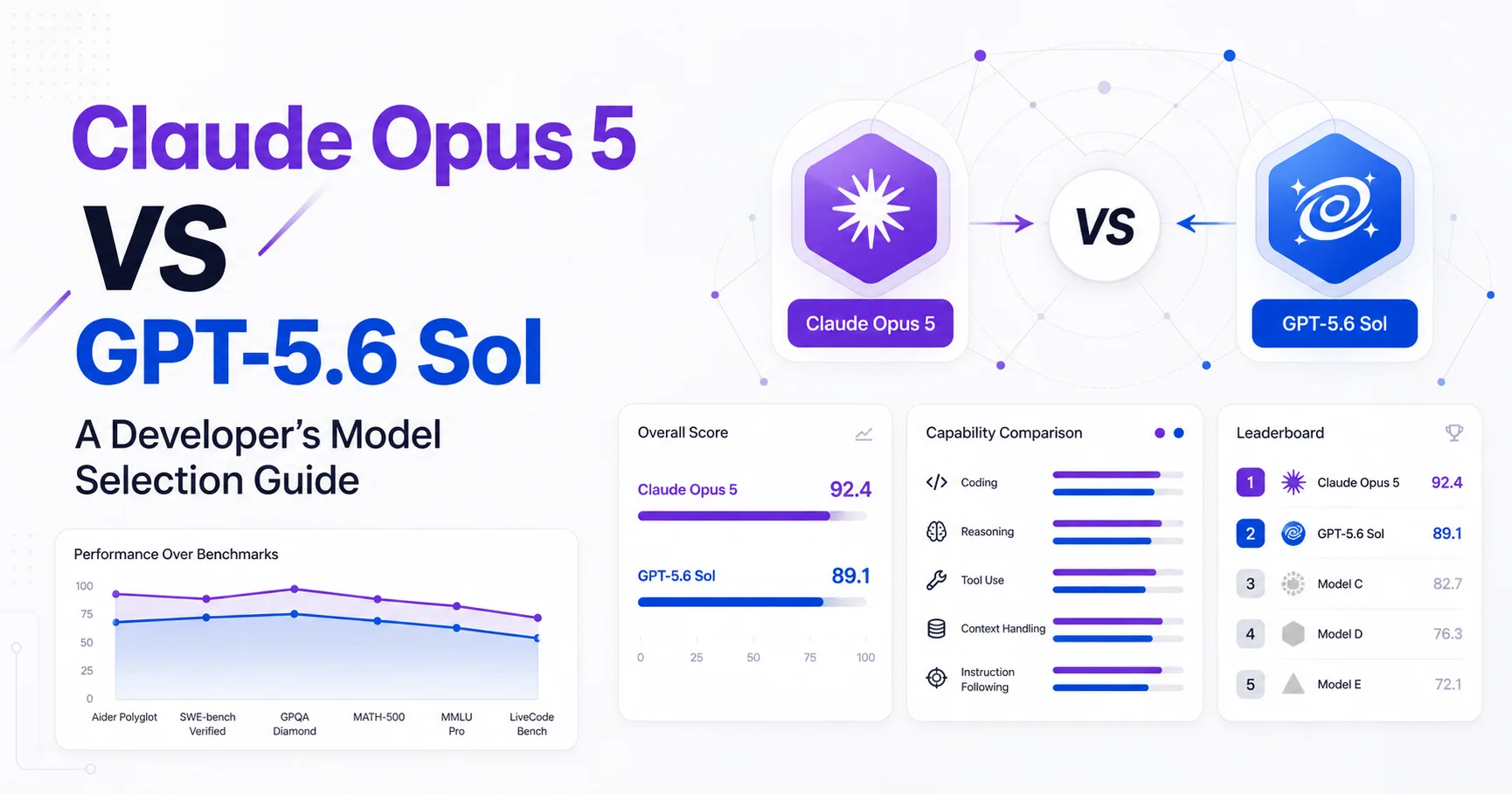
GPT-5.6 Sol (xhigh) is the default pick for coding-first developers, while Claude Opus 5 earns the edge for broader intelligence and lower blended cost. The supplied snapshot gives GPT-5.6 Sol a Coding Index of 78.3 versus Claude Opus 5 at 77, plus median output speed of 73.479 versus 53.917 tokens per second. Claude Opus 5 leads the Intelligence Index at 60.1 versus 57.7 and costs $10 versus $11.25 per 1M blended tokens.
The practical choice is therefore workload-dependent. GPT-5.6 Sol fits interactive coding loops where visible throughput and tool execution shape the user experience. Claude Opus 5 fits deliberate analysis, long-running agentic work, and workloads where generated-token cost matters. Anthropic positions Claude Opus 5 for complex agentic coding and enterprise work in its official model documentation, while OpenAI positions GPT-5.6 Sol for complex reasoning, programming, and professional work in its release announcement.
Data provided by https://artificialanalysis.ai/ supplies the comparative measurements. The snapshot does not disclose a shared task design, confidence interval, or independent reproduction method. The ranking should guide a developer test plan, not replace one.
GPT-5.6 Sol (xhigh) wins the coding-and-speed tradeoff, while Claude Opus 5 wins the intelligence-and-price tradeoff. The comparison is best read as a workload map rather than a universal capability ranking.
| Decision area | Claude Opus 5 | GPT-5.6 Sol | Practical reading |
|---|---|---|---|
| Artificial Analysis Intelligence Index | 60.1 | 57.7 | Claude has the stronger broad reasoning signal in this snapshot |
| Artificial Analysis Coding Index | 77 | 78.3 | GPT has the stronger coding signal, but the gap is narrow |
| Median output tokens per second | 53.917 | 73.479 | GPT should feel more responsive during streamed generation |
| Latency | 0.3 | 0.3 | The snapshot gives neither model a latency advantage |
| Price per 1M blended tokens | $10 | $11.25 | Claude is cheaper under the supplied blended assumption |
The benchmark labels append xhigh, but neither label is a separate official model identity. Anthropic documents claude-opus-5 as the stable API model ID and explains that xhigh is an effort setting in Models overview and What’s new in Claude Opus 5. OpenAI documents gpt-5.6-sol as the fixed model ID, gpt-5.6 as the stable alias, and xhigh as a reasoning setting in the GPT-5.6 Sol model page and Reasoning models guide.
Claude Opus 5 was released on 2026-07-24, after GPT-5.6 Sol on 2026-07-09. Anthropic’s current model overview and deprecation page do not mark Claude Opus 5 as deprecated or retired. OpenAI’s model directory and GPT-5.6 model page likewise present GPT-5.6 Sol as callable. The version-status evidence therefore supports evaluating both as current options, not treating either as a legacy fallback.
GPT-5.6 Sol (xhigh) is the faster coding choice, but Claude Opus 5 may be the stronger general problem solver. The output-speed difference, 73.479 versus 53.917 tokens per second, is large enough to affect streamed coding sessions, review cycles, and perceived agent momentum. Latency is 0.3 for both models in the supplied snapshot, so the advantage appears after generation begins rather than at request startup.
The Coding Index favors GPT-5.6 Sol at 78.3 versus Claude Opus 5 at 77. That lead supports GPT for code generation and tool-heavy implementation, but it is too narrow to justify assuming better repository-level outcomes everywhere. A small index difference can disappear under a different repository, harness, prompt style, tool policy, or stopping rule. The brief does not provide task-level variance or a shared head-to-head protocol.
Claude’s adaptive thinking changes the meaning of speed. Anthropic says Claude Opus 5 defaults to adaptive thinking and supports several effort levels, which lets teams trade depth for response time through configuration in What’s new in Claude Opus 5. OpenAI similarly warns that xhigh increases reasoning time and token consumption in its Reasoning models guide. A lower effort setting may change the operational winner, but the supplied data does not measure those alternatives.
Community evidence reinforces the need for workload testing. Reddit reports describe Claude as capable of sustained autonomous execution but also slow, verbose, or prone to overthinking in this Claude discussion. Hacker News users praise Claude’s self-directed workflows while warning about unnecessary token consumption in this discussion. A separate Hacker News report describes long runs, recovery needs, and service errors, which indicate integration risk rather than a measured model defect. GPT reports are also split: one coding report describes a usable feature completed from a large instruction, while another longer test reports over-engineering and bugs. These accounts lack controlled reproduction.
Claude Opus 5 is the cheaper default for mixed workloads, while GPT-5.6 Sol can justify its premium when latency has visible product value. The supplied blended comparison places Claude at $10 versus GPT at $11.25 per 1M blended tokens. Input pricing is tied at $5, so the main cost difference comes from generated output and the reasoning behavior behind it.
That distinction matters for agents. A model that produces more intermediate reasoning, longer explanations, extra tool calls, or repeated recovery attempts can exceed a simple blended estimate. Claude’s official pricing documentation lists separate input, output, and cache pricing in its pricing guide. OpenAI documents separate Standard, Batch, Flex, and Fast pricing paths in its API pricing page. The page-level prices therefore depend on service tier, cache behavior, context size, and workload timing.
Claude is more attractive for output-heavy automation if its results require comparable review effort. GPT may be economically preferable for interactive products if faster streaming reduces user waiting, agent wall time, or the number of conversational turns. That is a business-level tradeoff, not a conclusion available from the price chart alone.
Reasoning settings can reverse expectations. OpenAI states that reasoning tokens consume output capacity and can contribute to incomplete responses when limits are too low in the Reasoning models guide. Anthropic states that thinking and final text share the configured token budget, and recommends keeping thinking enabled while controlling effort in What’s new in Claude Opus 5. Teams should therefore measure total spend per accepted task, including retries, tool calls, human corrections, and failed runs.
The briefs do not reveal cost distributions by task, cache hit rates, or spend per successful change. Those missing measurements prevent a universal claim that Claude is always cheaper in production.
Claude Opus 5 (Adaptive Reasoning, Xhigh Effort) leads on 2 of 3 metrics
GPT-5.6 Sol (xhigh) should be the default for interactive coding agents, while Claude Opus 5 fits deliberate, context-heavy work. The recommendation follows the combined evidence, including the coding and speed snapshot, official tool support, reasoning controls, price structure, and conflicting community reports.
| Developer need | Recommended model | Why |
|---|---|---|
| Interactive coding agent | GPT-5.6 Sol | Higher coding signal and faster output support rapid implementation loops |
| Broad reasoning and complex analysis | Claude Opus 5 | Higher Intelligence Index and an official focus on deep reasoning |
| Tool-rich orchestration | GPT-5.6 Sol | The official model page lists structured outputs, web search, file search, code execution, hosted shell, computer use, MCP, patch application, and skills support in the model documentation |
| Long-running autonomous coding | Claude Opus 5, with controls | Anthropic explicitly targets long-horizon agentic coding, but community reports indicate verbosity and overthinking risks in its review coverage |
| Output-heavy budget-sensitive work | Claude Opus 5 | The supplied blended price is lower, subject to actual reasoning and retry behavior |
| Audio or video input | Neither GPT-5.6 Sol by itself | OpenAI explicitly excludes audio and video input from GPT-5.6 Sol in the model page |
Implementation should start with the official IDs, not the evaluation slugs. Use claude-opus-5 or gpt-5.6-sol, then treat xhigh as a configurable reasoning or effort level. Claude integrations should keep thinking enabled unless testing proves a lower effort path is safer, because Anthropic documents malformed tool-call behavior when thinking is disabled. GPT integrations should reserve output capacity for hidden reasoning and handle incomplete responses explicitly, as described in the Reasoning models guide.
Both models need operational boundaries. Require explicit stop conditions before an agent invents substitute workflows. Cap tool permissions, log retries, and score accepted repository changes rather than raw response quality. Hacker News discussions about Claude’s autonomous behavior and service recovery show why harness design matters, while GPT community reports show that over-engineering can survive until review.
The strongest unanswered question is which model produces the lowest total cost per accepted change in a real codebase. Neither brief provides that evidence. Developers should run the same tasks through both models and record completion, intervention, rework, tool calls, latency, and spend before committing to a default.
Claude Opus 5 and GPT-5.6 Sol require different safeguards, so the right choice depends on control, modality, and workload shape. The official materials clarify model identity, reasoning configuration, tool support, pricing paths, and documented limitations. They do not establish a universal winner for every repository, agent harness, or production budget.
The comparison also contains a version-status question that developers should resolve before implementation. Both models are presented as current callable options in their official catalogs, but the evaluation names include configuration labels that should not be copied blindly into API requests. The evidence is similarly incomplete on community claims: reports describe useful workflows and serious frustrations, yet they do not provide controlled failure rates.
A sensible evaluation should compare accepted task outcomes, human intervention, total generated tokens, retries, tool reliability, and user-visible waiting time. Those measurements can reveal whether GPT’s speed advantage or Claude’s intelligence and price advantages matter for the actual product.
Choose GPT-5.6 Sol (xhigh) for an interactive coding agent if fast output and coding throughput matter most, while validating its tendency toward over-engineering in your own harness. The supplied Coding Index is 78.3 versus 77, but community evidence remains anecdotal and task-dependent.
Claude Opus 5 is the stronger choice on the supplied general intelligence signal, but that evidence does not establish superior performance on every reasoning workload. Its Intelligence Index is 60.1 versus GPT-5.6 Sol at 57.7, while methodology and task-level variance remain undisclosed.
Claude Opus 5 and GPT-5.6 Sol use xhigh as an effort setting, not as separate API model identities. Anthropic documents claude-opus-5 as its stable model ID, while OpenAI documents gpt-5.6-sol and gpt-5.6 as the model ID and alias.
GPT-5.6 Sol does not accept audio or video input, so teams needing those modalities should route that work through another model or preprocessing service. Its official support covers text and image input with text output, making it unsuitable as a direct audio-video interface.
Community reviews can reveal workflow risks, but they cannot establish a stable winner because the reports use personal tasks, different harnesses, and limited reproducibility. The Claude and GPT discussions contain both positive and negative experiences, so developers should treat them as hypothesis generators.