
Time to First Token · Claude Opus 5 (Adaptive Reasoning, Xhigh Effort)
26692ms
Time to First Token · GPT-5.6 Terra (max)
109872ms
Deep dive into reasoning, benchmarks, and latency insights.
The current catalog does not contain complete performance evidence for both models, so this page does not declare an overall winner. Use the available fields as comparison signals and validate the models on your own workload.
Key decision metrics at a glance.
| Model | Metric | Value | Unit | Source / snapshot |
|---|---|---|---|---|
| Claude Opus 5 (Adaptive Reasoning, Xhigh Effort) | Reasoning | 6.0 | benchmark or capability score | Artificial Analysis · current catalog |
| GPT-5.6 Terra (max) | Reasoning | 6.0 | benchmark or capability score | Artificial Analysis · current catalog |
| Claude Opus 5 (Adaptive Reasoning, Xhigh Effort) | Coding | 8.0 | benchmark or capability score | Artificial Analysis · current catalog |
| GPT-5.6 Terra (max) | Coding | 8.0 | benchmark or capability score | Artificial Analysis · current catalog |
| Claude Opus 5 (Adaptive Reasoning, Xhigh Effort) | Multimodal | 5.0 | benchmark or capability score | Artificial Analysis · current catalog |
| GPT-5.6 Terra (max) | Multimodal | 5.0 | benchmark or capability score | Artificial Analysis · current catalog |
| Claude Opus 5 (Adaptive Reasoning, Xhigh Effort) | Long Context | 8.0 | benchmark or capability score | Artificial Analysis · current catalog |
| GPT-5.6 Terra (max) | Long Context | 7.0 | benchmark or capability score | Artificial Analysis · current catalog |
| Claude Opus 5 (Adaptive Reasoning, Xhigh Effort) | Blended Price / 1M tokens | $10 | USD per 1M tokens | Artificial Analysis · current catalog |
| GPT-5.6 Terra (max) | Blended Price / 1M tokens | $4.5 | USD per 1M tokens | Artificial Analysis · current catalog |
| Claude Opus 5 (Adaptive Reasoning, Xhigh Effort) | P95 Latency | — | milliseconds | Artificial Analysis · current catalog |
| GPT-5.6 Terra (max) | P95 Latency | — | milliseconds | Artificial Analysis · current catalog |
| Claude Opus 5 (Adaptive Reasoning, Xhigh Effort) | Tokens per second | 53.473 | tokens per second | Artificial Analysis · current catalog |
| GPT-5.6 Terra (max) | Tokens per second | 117.141 | tokens per second | Artificial Analysis · current catalog |
Data provided by Artificial Analysis; live values use the current catalog.
This radar chart visually maps the core capabilities (reasoning, coding, math proxy, multimodal, long context) of `Claude Opus 5 (Adaptive Reasoning, Xhigh Effort)` vs `GPT-5.6 Terra (max)`.
This grouped bar chart provides a side-by-side comparison for each benchmark metric.
Lower time to first token is better; higher tokens per second is better.
Compare input and output pricing in USD per 1M tokens.
Claude Opus 5 (Adaptive Reasoning, Xhigh Effort)$11.25
GPT-5.6 Terra (max)$5
GPT-5.6 Terra (max) costs $6.25 less per run
This article is a dated snapshot published on 2026-08-05. Live cards above use the current catalog; missing live fields are not inferred.
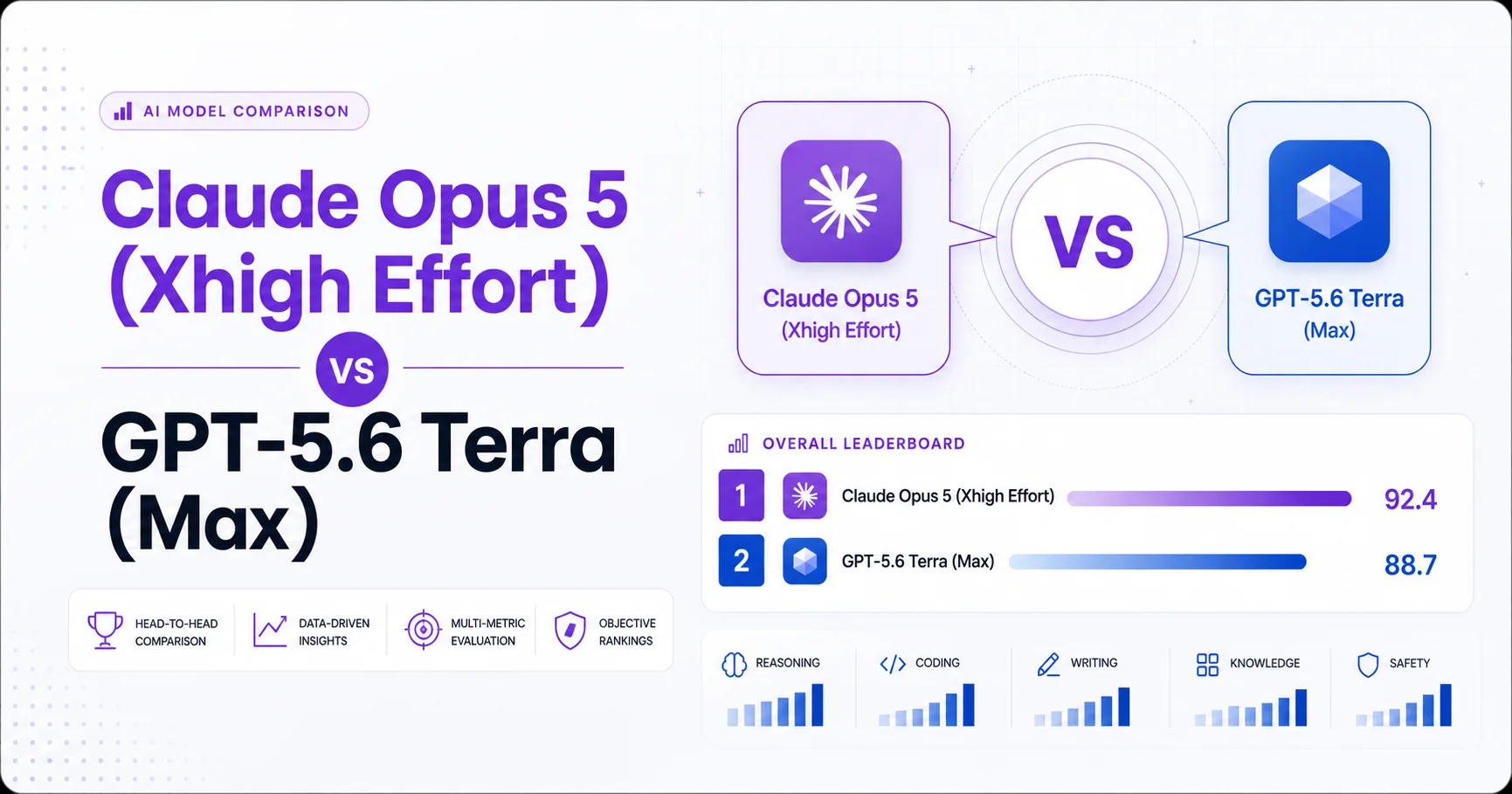
Claude Opus 5 is the stronger overall choice for demanding coding agents, while GPT-5.6 Terra is the faster and cheaper default. Data provided by https://artificialanalysis.ai/
The supplied snapshot gives Claude Opus 5 an intelligence index of 60.1 versus GPT-5.6 Terra's 55, and a coding index of 77 versus 76.7. GPT-5.6 Terra produces output at 144.252 median tokens per second, while both models show 0.3 seconds of latency. Data provided by https://artificialanalysis.ai/
That creates a practical split. Claude Opus 5 is better suited to difficult, open-ended work where planning quality and autonomous execution matter. GPT-5.6 Terra is better suited to products that serve many requests, stream long answers, or operate under strict cost limits.
Anthropic positions Claude Opus 5 for complex agentic coding, multi-file feature development, visual understanding, long-context work, and multi-agent collaboration. What's new in Claude Opus 5 OpenAI positions GPT-5.6 Terra as a general reasoning model that balances intelligence and cost, with structured outputs, function calling, file search, web search, and other tools. GPT-5.6 Terra Model
One naming detail matters before implementation: claude-opus-5-xhigh is an evaluation or effort label, not a separate official API model ID. Anthropic documents claude-opus-5 as the stable model ID and alias. Models overview
Claude Opus 5 wins the supplied quality indices, while GPT-5.6 Terra wins cost and output speed. Data provided by https://artificialanalysis.ai/
| Decision axis | Claude Opus 5 | GPT-5.6 Terra |
|---|---|---|
| Intelligence index | 60.1 | 55 |
| Coding index | 77 | 76.7 |
| Blended price per 1M tokens | $10 | $4.500000000000001 |
| Median output tokens per second | 53.917 | 144.252 |
| Latency seconds | 0.3 | 0.3 |
The coding result is close enough that it should not be treated as a universal quality verdict. The larger separation is on the broader intelligence index, where Claude Opus 5 has a clearer lead in the supplied data. The practical question is whether that lead reduces supervision, retries, or design review in the target workflow.
The official lifecycle evidence is reassuring for both models. Anthropic's current model overview does not mark Claude Opus 5 as deprecated or retired, and OpenAI's deprecation documentation does not list GPT-5.6 Terra. Model deprecations Deprecations Neither source proves how long either model will remain the preferred choice.
The evidence quality differs sharply. Anthropic publishes named evaluations and detailed behavioral guidance, but its release announcement does not provide a complete reproducible results table. Introducing Claude Opus 5 OpenAI's Terra documentation does not provide a Terra-specific public benchmark or reliability study. GPT-5.6 Terra Model
Community evidence is also asymmetric. Reddit reports describe Claude Opus 5 as slow, verbose, or prone to overthinking, while other users value its autonomous planning. Reddit: Is Opus 5 actually that bad, or is it just Reddit hype? Hacker News users praise its ability to construct supporting workflows, but warn that it may continue spending tokens without enough input. Hacker News: Claude Opus 5 A public review likewise describes cautious behavior and repeated requests for human judgment. Claude Opus 5 review The supplied evidence contains no reliable public community record for the exact Terra model, so community sentiment cannot settle this comparison.
GPT-5.6 Terra is the better interactive-performance choice, while Claude Opus 5 retains a narrow coding-score lead. Data provided by https://artificialanalysis.ai/
The equal latency result of 0.3 seconds changes how the speed gap should be interpreted. Neither model has an advantage in the supplied time-to-first-response measurement. The meaningful difference appears during generation, where GPT-5.6 Terra reaches 144.252 median output tokens per second and Claude Opus 5 reaches 53.917. Data provided by https://artificialanalysis.ai/ For an IDE assistant, that affects how quickly a developer can inspect a patch, answer a follow-up, or continue a tool loop.
The coding index is 77 for Claude Opus 5 and 76.7 for GPT-5.6 Terra. Data provided by https://artificialanalysis.ai/ That narrow result does not support a claim that Claude Opus 5 will produce better code in every repository. It supports a more limited conclusion: the supplied coding evaluation gives Claude Opus 5 a small lead, while the broader intelligence index separates the models more clearly.
Claude Opus 5's default adaptive thinking can favor difficult planning and multi-step work, but it can also increase response length and deliberation. Anthropic acknowledges that the model may produce longer responses, report progress more often, and delegate more actively in multi-agent settings. What's new in Claude Opus 5 Community reports describe the same behavior as useful for autonomous work and frustrating for tightly controlled interactive sessions. Reddit: Is Opus 5 actually that bad, or is it just Reddit hype?
Integration details can also change perceived performance. Anthropic warns that disabling thinking may occasionally cause tool calls to appear as ordinary text, and OpenAI warns that reasoning tokens consume the output budget and can produce incomplete responses when the limit is too low. What's new in Claude Opus 5 Reasoning models The supplied data does not measure tool-call correctness, recovery behavior, or completion rate, so those production differences remain unproven.
Claude Opus 5 (Adaptive Reasoning, Xhigh Effort) leads on 2 of 2 metrics
GPT-5.6 Terra is the clear price winner, but Claude Opus 5 can justify its premium only through better task completion. Data provided by https://artificialanalysis.ai/
The supplied blended price is $4.500000000000001 for GPT-5.6 Terra versus $10 for Claude Opus 5 per 1M tokens. Terra also lists lower input and output prices, at $2 and $12 compared with Opus at $5 and $25. Data provided by https://artificialanalysis.ai/ The difference matters most in output-heavy agent loops, code reviews, long explanations, and workflows that repeatedly send generated artifacts back to the model.
The chart does not show the cost of failure. A cheaper model can become more expensive if it requires extra retries, more human supervision, or more tool calls before completing the same task. A costlier model can become cheaper in practice if it finishes complex work with fewer corrections. The supplied comparison does not include task-success rates, retry counts, token consumption per completed task, or total cost per successful outcome. Those are major evidence gaps.
Claude Opus 5's official pricing page includes caching options and different service modes, while OpenAI documents separate pricing behavior for standard, cached, batch, flex, and fast processing. Pricing Pricing The right budget model therefore depends on request shape, cache reuse, output length, and whether the workload is interactive or asynchronous.
GPT-5.6 Terra is the rational starting point for a cost-controlled product because its price advantage is large and its coding index is close to Opus in the supplied snapshot. Claude Opus 5 becomes economically defensible for high-value engineering tasks where planning quality reduces rework. That claim remains a hypothesis until a team measures completed tasks on its own repositories.
GPT-5.6 Terra (max) leads on 3 of 3 metrics
GPT-5.6 Terra is the default pick for cost-sensitive products, while Claude Opus 5 fits quality-first autonomous engineering. Data provided by https://artificialanalysis.ai/
| Workflow priority | Recommended model | Reason |
|---|---|---|
| High request volume and controlled spend | GPT-5.6 Terra | Lower blended price and faster generation |
| Autonomous multi-file engineering | Claude Opus 5 | Stronger intelligence index and official agentic-coding positioning |
| Fast interactive edits | GPT-5.6 Terra | Higher median output speed at the same measured latency |
| Complex planning with visual or document inputs | Claude Opus 5 | Official support for vision, long-context work, and complex document tasks |
| Safety-critical or research-heavy autonomy | Pilot either model | The supplied evidence does not establish reliable completion or recovery rates |
Choose GPT-5.6 Terra if the product needs quick streaming responses, predictable unit economics, and broad tool integration. OpenAI lists structured outputs, function calling, file search, web search, hosted tools, and MCP support for the model. GPT-5.6 Terra Model Its lack of public Terra-specific benchmark results still makes a workload pilot necessary.
Choose Claude Opus 5 if the central problem is difficult coding work that benefits from independent planning, multi-file changes, code review, visual understanding, or longer autonomous sessions. Anthropic explicitly targets these workflows. Introducing Claude Opus 5 Set clear stop conditions and confirmation points because community reports disagree about whether its autonomy feels productive or excessive. Hacker News: Claude Opus 5
Implementation should use the official IDs, not comparison-site slugs. Claude's xhigh setting is an effort level, and high effort cannot be combined with disabled thinking. Models overview OpenAI's reasoning guide likewise requires enough output budget for hidden reasoning and visible text. Reasoning models
The final choice should come from a pilot that measures successful task completion, human interventions, tool-call correctness, response speed, and cost per completed task. The current evidence identifies a strong default, not a universal winner.
Claude Opus 5 needs a workload-specific case, while GPT-5.6 Terra needs a validation pilot because public quality evidence is limited.
The strongest evidence is directional rather than complete. Artificial Analysis shows Claude Opus 5 ahead on the supplied intelligence and coding indices, while GPT-5.6 Terra leads on price and output speed. Data provided by https://artificialanalysis.ai/ Official documentation explains integration behavior and positioning, but it does not establish real-world success rates for either model.
The main unresolved question is economic, not technical: whether Claude Opus 5's quality lead reduces enough rework to offset its higher price. The second unresolved question is operational: whether GPT-5.6 Terra's speed translates into equal tool reliability and task completion. Developers should treat both as testable hypotheses rather than assume that benchmark position predicts every production workflow.
No, claude-opus-5-xhigh is an evaluation or effort label, while Anthropic lists claude-opus-5 as the stable API model ID and alias. Developers should map the comparison slug to the documented model ID before deploying requests. Models overview
GPT-5.6 Terra is the better default for interactive coding assistants because the supplied snapshot shows much higher output speed at the same measured latency. Claude Opus 5 becomes more attractive when the assistant must plan across files or operate with less supervision, but community reports make that trade-off uncertain. Data provided by https://artificialanalysis.ai/ What's new in Claude Opus 5
No, Claude Opus 5 has a narrow coding-index lead, not proof of better results on every repository or tool workflow. Anthropic's public announcement names several evaluations but does not provide a complete reproducible results table, so teams should validate their own tasks. Data provided by https://artificialanalysis.ai/ Introducing Claude Opus 5
GPT-5.6 Terra can become more expensive overall if a lower task-success rate causes extra retries, supervision, or longer workflows. The supplied comparison reports price, speed, and index values, but not retry counts, token consumption, or total cost per completed task, so this reversal remains a scenario rather than a measured finding. Data provided by https://artificialanalysis.ai/ Reasoning models
Developers should test task completion, tool correctness, recovery behavior, output limits, and cost on their own workload before committing. The need is especially strong for Terra because official documentation provides no Terra-specific benchmark, while Opus has documented thinking and effort constraints that affect integration. GPT-5.6 Terra Model What's new in Claude Opus 5