
Time to First Token · Claude Opus 5 (Adaptive Reasoning, Xhigh Effort)
26692ms
Time to First Token · Kimi K3 (max)
2585ms
Deep dive into reasoning, benchmarks, and latency insights.
The current catalog does not contain complete performance evidence for both models, so this page does not declare an overall winner. Use the available fields as comparison signals and validate the models on your own workload.
Key decision metrics at a glance.
| Model | Metric | Value | Unit | Source / snapshot |
|---|---|---|---|---|
| Claude Opus 5 (Adaptive Reasoning, Xhigh Effort) | Reasoning | 6.0 | benchmark or capability score | Artificial Analysis · current catalog |
| Kimi K3 (max) | Reasoning | 6.0 | benchmark or capability score | Artificial Analysis · current catalog |
| Claude Opus 5 (Adaptive Reasoning, Xhigh Effort) | Coding | 8.0 | benchmark or capability score | Artificial Analysis · current catalog |
| Kimi K3 (max) | Coding | 8.0 | benchmark or capability score | Artificial Analysis · current catalog |
| Claude Opus 5 (Adaptive Reasoning, Xhigh Effort) | Multimodal | 5.0 | benchmark or capability score | Artificial Analysis · current catalog |
| Kimi K3 (max) | Multimodal | 5.0 | benchmark or capability score | Artificial Analysis · current catalog |
| Claude Opus 5 (Adaptive Reasoning, Xhigh Effort) | Long Context | 8.0 | benchmark or capability score | Artificial Analysis · current catalog |
| Kimi K3 (max) | Long Context | 7.0 | benchmark or capability score | Artificial Analysis · current catalog |
| Claude Opus 5 (Adaptive Reasoning, Xhigh Effort) | Blended Price / 1M tokens | $10 | USD per 1M tokens | Artificial Analysis · current catalog |
| Kimi K3 (max) | Blended Price / 1M tokens | $6 | USD per 1M tokens | Artificial Analysis · current catalog |
| Claude Opus 5 (Adaptive Reasoning, Xhigh Effort) | P95 Latency | — | milliseconds | Artificial Analysis · current catalog |
| Kimi K3 (max) | P95 Latency | — | milliseconds | Artificial Analysis · current catalog |
| Claude Opus 5 (Adaptive Reasoning, Xhigh Effort) | Tokens per second | 53.473 | tokens per second | Artificial Analysis · current catalog |
| Kimi K3 (max) | Tokens per second | 38.637 | tokens per second | Artificial Analysis · current catalog |
Data provided by Artificial Analysis; live values use the current catalog.
This radar chart visually maps the core capabilities (reasoning, coding, math proxy, multimodal, long context) of `Claude Opus 5 (Adaptive Reasoning, Xhigh Effort)` vs `Kimi K3 (max)`.
This grouped bar chart provides a side-by-side comparison for each benchmark metric.
Lower time to first token is better; higher tokens per second is better.
Compare input and output pricing in USD per 1M tokens.
Claude Opus 5 (Adaptive Reasoning, Xhigh Effort)$11.25
Kimi K3 (max)$6.75
Kimi K3 (max) costs $4.5 less per run
This article is a dated snapshot published on 2026-08-05. Live cards above use the current catalog; missing live fields are not inferred.
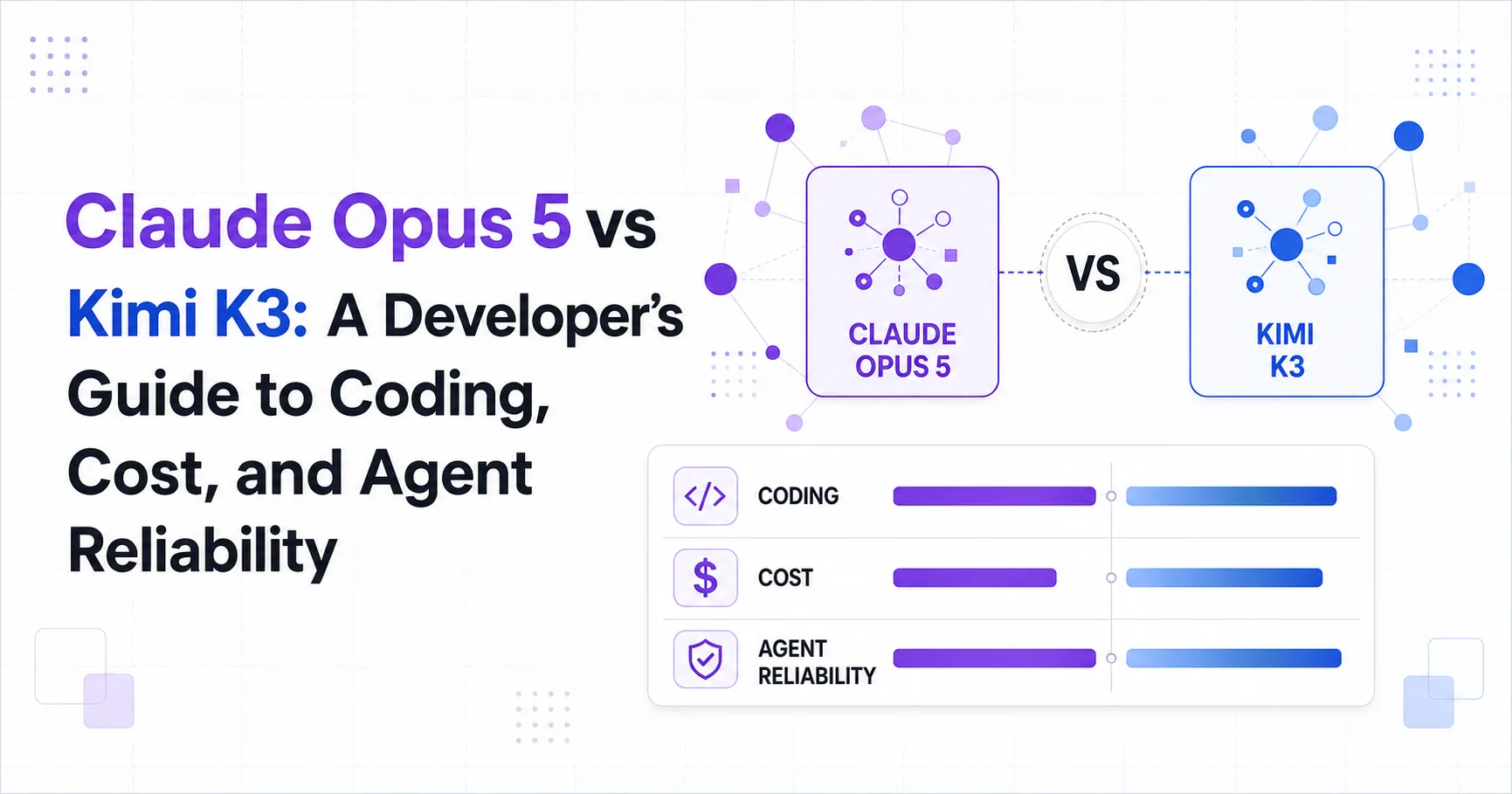
Claude Opus 5 (Adaptive Reasoning, Xhigh Effort) is the stronger default for difficult coding agents, while Kimi K3 (max) is the sharper budget choice.
The supplied Artificial Analysis snapshot gives Claude Opus 5 the lead on the coding index, intelligence index, and median output speed. Kimi K3 wins the blended price comparison by a clear margin. The practical choice therefore depends on whether your application values autonomous task quality or lower metered spend. Data provided by https://artificialanalysis.ai/.
Developers should also separate model names from reasoning settings. Anthropic documents claude-opus-5 as the stable API model ID and alias. The xhigh label represents an effort configuration, not a separate API model, according to the Models overview and What's new in Claude Opus 5. Moonshot documents kimi-k3 as the API model name, while max is the highest reasoning setting in the Kimi K3 Quickstart.
This comparison favors Claude Opus 5 for complex repository work, code review, and long agent sessions. Kimi K3 remains compelling for cost-sensitive products that can enforce clear tool boundaries and validate long-running work.
Claude Opus 5 wins the default selection because it combines the higher intelligence and coding scores with faster output, while Kimi K3 reduces API spend.
| Decision axis | Claude Opus 5 | Kimi K3 | Selection meaning |
|---|---|---|---|
| Coding index | 77 | 76.2 | Claude leads, but the coding result supports a close contest rather than a universal knockout |
| Intelligence index | 60.1 | 57.1 | Claude has the clearer advantage on the broader supplied measure |
| Blended price | $10 | $6 | Kimi is the cheaper default for token-heavy traffic |
| Median output tokens per second | 53.917 | 34.453 | Claude should feel better during long streamed responses |
| Latency | 0.3 | 0.3 | The supplied latency measure does not separate the models |
The scores do not answer every production question. Anthropic’s release announcement lists many evaluations, but it does not provide a complete reproducible results table. Kimi’s technical blog reports selected benchmark results with different agent harnesses. The Introducing Claude Opus 5 announcement and Kimi K3 official technical blog therefore support capability claims, but they do not create a perfectly matched independent test.
The lifecycle evidence is reassuring for both models. Anthropic’s Models overview lists Claude Opus 5 as available, while the Model deprecations page does not identify it as deprecated or retired. Kimi K3 remains listed in the official model list, and no supplied official source says that a later model has replaced it.
The best summary is simple: Claude Opus 5 is the quality and speed default, while Kimi K3 is the price and tooling alternative. The final decision should come from task-completion tests using the same harness, prompts, permissions, and recovery rules.
Claude Opus 5 is the faster model in the supplied measurement, and that advantage should matter most in long agent loops and interactive review.
The output-speed gap affects how quickly a developer sees a plan, patch, explanation, or tool-oriented response. Claude Opus 5 records 53.917 median output tokens per second, while Kimi K3 records 34.453. That metric describes generation speed, not complete task duration. A coding agent can still spend time on reasoning, tool execution, repository inspection, retries, and user confirmation.
The reported latency is 0.3 for both models. That tie matters because faster streaming does not automatically mean a faster first response. If a product sends many short requests, initial latency and tool overhead may dominate. If a session produces long plans or large code changes, output speed becomes more visible. The supplied data does not provide a complete time-to-completion measure, so developers should not treat output speed as a proxy for end-to-end productivity.
Anthropic enables adaptive thinking by default and exposes low, medium, high, xhigh, and max effort settings. Anthropic also warns that thinking tokens and final response tokens share the max_tokens budget. These behaviors are documented in What's new in Claude Opus 5. Kimi K3 always uses thinking mode and defaults to max reasoning effort. Its Kimi K3 Quickstart describes structured outputs, tool calls, dynamic tool loading, partial mode, and automatic context caching.
Community reports complicate the clean benchmark story. Some Reddit discussion describes Claude Opus 5 as slow, verbose, and prone to overthinking simple tasks. Hacker News discussion praises its autonomy but raises concerns about unnecessary token consumption. A Lenny’s review describes a more cautious agent that can ask for human judgment. For Kimi K3, no supplied community source establishes stable real-world speed or average first-token latency. That evidence gap makes a same-harness trial essential.
Claude Opus 5 (Adaptive Reasoning, Xhigh Effort) leads on 2 of 2 metrics
Kimi K3 is the cost winner for token-heavy workloads, but Claude Opus 5 can become cheaper operationally when retries, supervision, or unfinished tasks dominate.
Kimi K3 costs $6 versus $10 per 1M blended tokens in the supplied comparison. Its listed input price is $3 per 1M tokens and its output price is $15 per 1M tokens. Claude Opus 5 lists $5 per 1M input tokens and $25 per 1M output tokens. The Claude pricing documentation and Kimi pricing page support the published price positions.
The blended figure is useful for a first screening, but it is not a completed-task cost. Agent workloads often produce output, invoke tools, inspect files, recover from errors, and repeat steps. A lower unit price helps only when the cheaper model reaches an acceptable result with similar operational effort. A model that needs more continuation, more human review, or more recovery can erase its apparent saving.
The supplied behavior evidence makes this qualification important. Anthropic says Claude Opus 5 produces longer responses, reports progress more frequently, and can delegate more actively in multi-agent frameworks. The same release notes explain that higher effort can require a larger token budget. These details appear in What's new in Claude Opus 5. A Kimi K3 community report describes a long coding task that reached its token limit before completion.
Caching and harness behavior can further change effective spend. Claude supports prompt caching features, while Kimi documents automatic context caching. The supplied materials do not provide a comparable cache-hit trace, retry count, or cost per successful task. Therefore, Kimi K3 is the safer price choice on the meter, but not automatically the cheaper choice for every finished feature.
Kimi K3 (max) leads on 3 of 3 metrics
Claude Opus 5 is the safer first choice for autonomous repository work, while Kimi K3 is the better controlled experiment for cost-sensitive, multimodal workflows.
Choose Claude Opus 5 when the model must handle multi-file changes, difficult bug localization, code review, or long agentic coding sessions with limited supervision. Anthropic explicitly positions the model for these tasks, along with complex documents, tables, visual understanding, and multi-agent work in Introducing Claude Opus 5. Its stronger supplied intelligence index and faster output make it the more defensible default when developer time matters more than token price.
Choose Kimi K3 when API cost is the primary constraint and your application can enforce strict boundaries. Kimi supports native visual input, video files, tool calls, JSON Mode, JSON Schema output, partial mode, constrained tool choice, and dynamic tool loading. Those capabilities are documented in the Kimi K3 Quickstart. Kimi’s lower listed price is especially attractive for products with predictable prompts, repeatable tool paths, and strong validation after each step.
Developer priority ├── Autonomous coding, broader reasoning, and faster streaming → Claude Opus 5 ├── Lower token spend, visual inputs, and structured tool output → Kimi K3 └── Uncertain production fit or high recovery cost → Test both with the same harness
Integration details can decide the result. Use claude-opus-5 as the Claude API model ID and configure xhigh as effort. Do not disable thinking while using xhigh or max, because Anthropic documents that combination as invalid. For Kimi K3, preserve the full reasoning history, avoid switching models mid-session, and define explicit behavior boundaries in the system prompt or AGENTS.md, as recommended by the Kimi K3 official technical blog. Kimi’s web search should not enter a production workflow until its documented update is complete.
The recommendation is therefore conditional but actionable: start with Claude Opus 5 for high-value coding autonomy, start with Kimi K3 for controlled cost reduction, and keep the other model as a targeted fallback after task-level validation.
Kimi K3 needs stricter integration guardrails, while Claude Opus 5 needs careful token budgeting around adaptive thinking.
The questions below address the selection issues that the benchmark chart cannot settle by itself. They also separate documented API behavior from community observations, because the latter are useful signals but not standardized measurements.
Use claude-opus-5 for Claude Opus 5, and treat xhigh as an effort setting rather than a separate API model. Anthropic documents this distinction in the Models overview.
Choose Kimi K3 for the lower listed token price, unless extra retries, longer autonomous runs, or additional review erase the metered saving. The data brief reports $6 versus $10 per 1M blended tokens.
Claude Opus 5 streams output faster in the supplied comparison, while the reported latency is tied, so interactive feel still depends on thinking, tool execution, and recovery behavior. The reported speeds are 53.917 and 34.453.
Do not put Kimi K3 web search into a production workflow until its documented update is complete. The Kimi K3 Quickstart explicitly advises against relying on that feature for production work.
The evidence is insufficient to select either model solely by context window because the supplied comparison snapshot leaves both context_window fields null. Developers should verify effective limits and behavior inside their chosen API and harness.