
Time to First Token · Claude Sonnet 4.6 (Adaptive Reasoning, Max Effort)
0ms
Time to First Token · GPT-5 mini (high)
0ms
Deep dive into reasoning, benchmarks, and latency insights.
The current catalog does not contain complete performance evidence for both models, so this page does not declare an overall winner. Use the available fields as comparison signals and validate the models on your own workload.
Key decision metrics at a glance.
| Model | Metric | Value | Unit | Source / snapshot |
|---|---|---|---|---|
| Claude Sonnet 4.6 (Adaptive Reasoning, Max Effort) | Reasoning | 6.0 | benchmark or capability score | Artificial Analysis · current catalog |
| GPT-5 mini (high) | Reasoning | 9.0 | benchmark or capability score | Artificial Analysis · current catalog |
| Claude Sonnet 4.6 (Adaptive Reasoning, Max Effort) | Coding | 6.0 | benchmark or capability score | Artificial Analysis · current catalog |
| GPT-5 mini (high) | Coding | 2.0 | benchmark or capability score | Artificial Analysis · current catalog |
| Claude Sonnet 4.6 (Adaptive Reasoning, Max Effort) | Multimodal | 4.0 | benchmark or capability score | Artificial Analysis · current catalog |
| GPT-5 mini (high) | Multimodal | 2.0 | benchmark or capability score | Artificial Analysis · current catalog |
| Claude Sonnet 4.6 (Adaptive Reasoning, Max Effort) | Long Context | 6.0 | benchmark or capability score | Artificial Analysis · current catalog |
| GPT-5 mini (high) | Long Context | 3.0 | benchmark or capability score | Artificial Analysis · current catalog |
| Claude Sonnet 4.6 (Adaptive Reasoning, Max Effort) | Blended Price / 1M tokens | $6 | USD per 1M tokens | Artificial Analysis · current catalog |
| GPT-5 mini (high) | Blended Price / 1M tokens | $0.688 | USD per 1M tokens | Artificial Analysis · current catalog |
| Claude Sonnet 4.6 (Adaptive Reasoning, Max Effort) | P95 Latency | — | milliseconds | Artificial Analysis · current catalog |
| GPT-5 mini (high) | P95 Latency | — | milliseconds | Artificial Analysis · current catalog |
| Claude Sonnet 4.6 (Adaptive Reasoning, Max Effort) | Tokens per second | 0 | tokens per second | Artificial Analysis · current catalog |
| GPT-5 mini (high) | Tokens per second | 0 | tokens per second | Artificial Analysis · current catalog |
Data provided by Artificial Analysis; live values use the current catalog.
This radar chart visually maps the core capabilities (reasoning, coding, math proxy, multimodal, long context) of `Claude Sonnet 4.6 (Adaptive Reasoning, Max Effort)` vs `GPT-5 mini (high)`.
This grouped bar chart provides a side-by-side comparison for each benchmark metric.
Lower time to first token is better; higher tokens per second is better.
Compare input and output pricing in USD per 1M tokens.
Claude Sonnet 4.6 (Adaptive Reasoning, Max Effort)$6.75
GPT-5 mini (high)$0.75
GPT-5 mini (high) costs $6 less per run
This article is a dated snapshot published on 2026-08-07. Live cards above use the current catalog; missing live fields are not inferred.
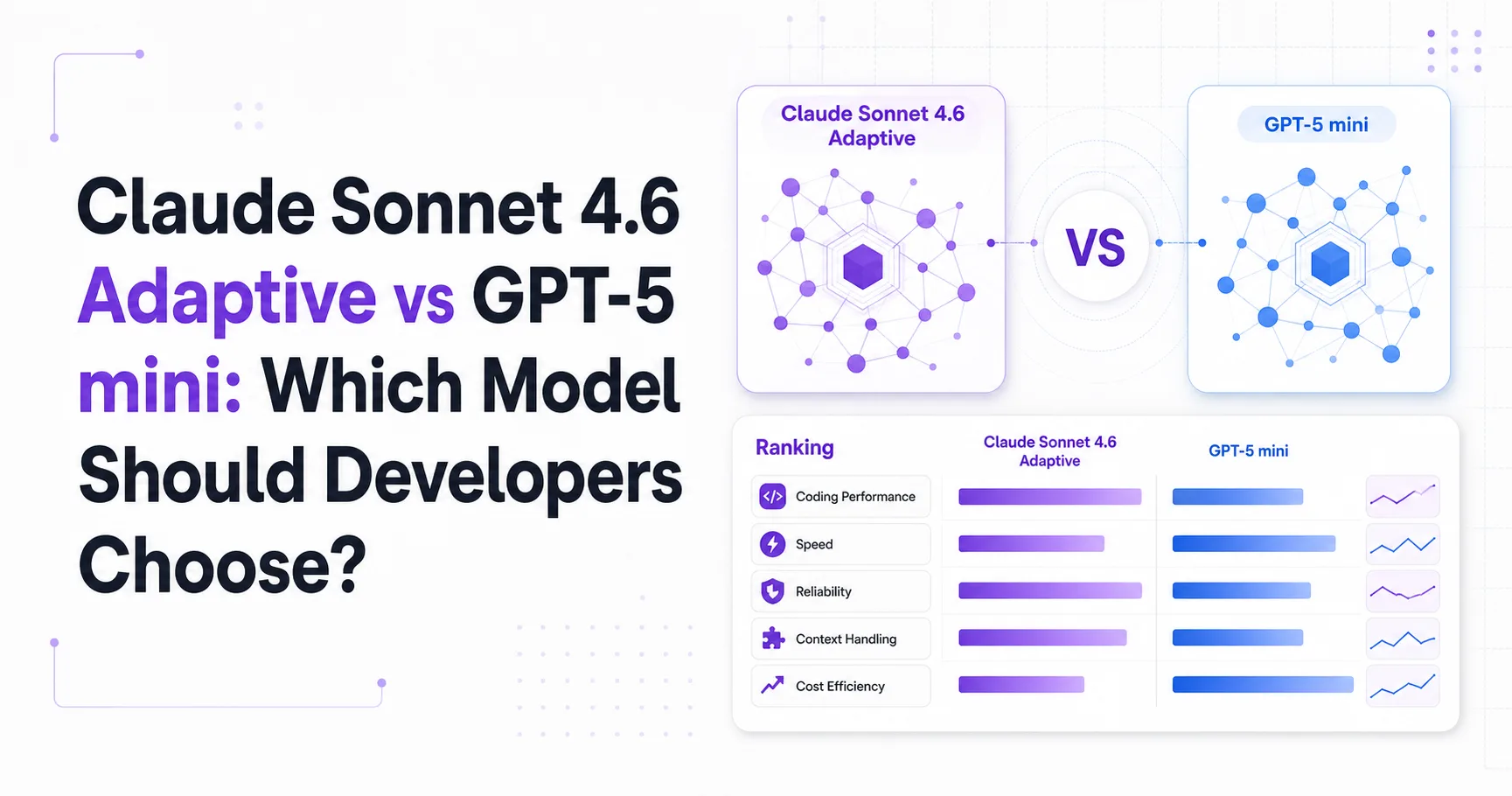
Claude Sonnet 4.6 (Adaptive Reasoning, Max Effort) is the stronger documented choice for general software development, while GPT-5 mini (high) is the lower-cost specialist candidate with a reported Math Index of 90.7. The comparison is based on the supplied evaluation snapshot from Artificial Analysis, plus current vendor documentation.
Claude Sonnet 4.6 leads the reported Artificial Analysis Coding Index at 63, compared with 15.6 for GPT-5 mini (high). Claude also leads the Artificial Analysis Intelligence Index at 47.2, compared with 25.3. GPT-5 mini (high) has the only reported mathematics result, at 90.7, so the evidence does not establish a complete winner for mathematical workloads.
The availability evidence is uneven. Anthropic’s Models overview and Pricing page explicitly document Claude Sonnet 4.6. The current OpenAI Models directory and OpenAI Pricing page do not list gpt-5-mini in the supplied research. Developers should therefore treat GPT-5 mini’s current API status as unverified.
Claude Sonnet 4.6 (Adaptive Reasoning, Max Effort) offers the better evidence-backed default for coding and broad reasoning, while GPT-5 mini (high) offers the stronger reported value proposition.
| Decision factor | Claude Sonnet 4.6 | GPT-5 mini (high) | Selection meaning |
|---|---|---|---|
| Coding Index | 63 | 15.6 | Claude has the stronger reported coding result |
| Intelligence Index | 47.2 | 25.3 | Claude has the stronger reported general result |
| Math Index | Not reported | 90.7 | GPT-5 mini has a documented advantage in the available math evidence |
| Median latency | 0.3 seconds | 0.3 seconds | The supplied snapshot shows a tie |
| Blended price per 1M tokens | $6 | $0.6875 | GPT-5 mini is the lower-cost option |
These values come from the supplied Artificial Analysis data snapshot. The price comparison describes the snapshot’s blended pricing metric, not every production billing pattern.
Claude’s official documentation confirms standard input pricing of $3 per MTok and output pricing of $15 per MTok on its Pricing page. The same page documents separate prompt-cache pricing. OpenAI’s current official pricing page does not provide a matching gpt-5-mini entry in the supplied research, so the GPT price should be validated before deployment.
The main conclusion is conditional. Choose Claude for code generation, code review, repository changes, and mixed technical reasoning. Choose GPT-5 mini only after confirming access, model identity, and billing, especially if mathematical evaluation is the main acceptance criterion.
Claude Sonnet 4.6 (Adaptive Reasoning, Max Effort) is the safer performance choice for software tasks because its reported coding result is materially stronger than GPT-5 mini’s available coding result.
The supplied Artificial Analysis snapshot places Claude at 63 on the Coding Index and GPT-5 mini at 15.6. That difference matters most when the model must preserve requirements across several files, understand unfamiliar code, modify existing interfaces, or explain tradeoffs in a review. A benchmark gap does not guarantee success on every repository, but it supports choosing Claude when coding quality is the primary risk.
Claude also leads the available Intelligence Index, at 47.2 versus 25.3. That result supports Claude for mixed tasks where implementation, explanation, debugging, and planning appear in one request. The evidence remains limited because the supplied research does not provide vendor-published benchmark details for either named configuration. Anthropic’s Models overview does not provide an independent specification table for Claude Sonnet 4.6 Adaptive Reasoning, Max Effort. The current OpenAI Models directory does not provide an independent entry for GPT-5 mini high.
GPT-5 mini has the only reported Math Index, at 90.7. That makes it a serious candidate for mathematical workloads, structured calculation, and math-heavy evaluation. It does not prove that GPT-5 mini is better for coding, because Claude has no corresponding reported Math Index in the supplied snapshot. The correct conclusion is an evidence boundary, not a universal ranking.
The latency evidence does not separate the models. Both are reported at 0.3 seconds median latency, while median output tokens per second are unavailable for both. Developers should therefore test streaming behavior and sustained throughput directly, because the supplied figures cannot answer whether long responses feel faster.
GPT-5 mini (high) is the cheaper reported option, but Claude Sonnet 4.6 (Adaptive Reasoning, Max Effort) can be economically preferable when it prevents rework or repeated attempts.
The supplied Artificial Analysis snapshot reports $0.6875 per 1M blended tokens for GPT-5 mini and $6 for Claude. It also reports input prices of $0.25 and $3, plus output prices of $2 and $15, respectively. The page comparison already makes the price gap clear. The selection question is whether the lower token price survives the full workflow.
A lower-cost model may become more expensive if developers need additional prompts, validation passes, repair calls, or human review. This is especially relevant for repository edits, migration scripts, and production code where a weak first answer creates downstream work. Claude’s reported Coding Index of 63 versus GPT-5 mini’s 15.6 provides evidence for considering output quality as part of total cost, although the supplied data does not quantify rework.
Claude’s official Pricing page confirms $3 per MTok for input and $15 per MTok for output. It also lists 5-minute cache writes at $3.75 per MTok, 1-hour cache writes at $6 per MTok, and cache hits and refreshes at $0.30 per MTok. Those billing modes mean a simple blended estimate can misstate cost when prompts are cached or output-heavy.
The same Anthropic page states that the US data region uses a 1.1x price multiplier for Claude 4.6 and later models, while global is the default standard price. GPT-5 mini’s official price and regional rules remain unverified in the supplied OpenAI Pricing documentation. Confirm the production bill before committing to a cost-sensitive architecture.
GPT-5 mini (high) leads on 3 of 3 metrics
Claude Sonnet 4.6 (Adaptive Reasoning, Max Effort) should be the default shortlist choice for developers who value coding reliability and broad technical reasoning.
Choose Claude when the model must work inside an existing codebase. The reported Coding Index of 63 supports its use for implementation, refactoring, debugging, code review, and multi-file changes. The reported Intelligence Index of 47.2 further supports workloads that combine technical analysis with written explanation. These are comparative signals from Artificial Analysis, not guarantees for a specific repository.
Choose GPT-5 mini (high) when token cost is the dominant constraint, mathematics is central, and the reported Math Index of 90.7 matches the task’s acceptance tests. Its reported blended price is $0.6875 per 1M tokens, which makes it attractive for high-volume experimentation, lightweight classification, or narrowly scoped transformations. That recommendation depends on confirming that the exact model configuration is callable.
Do not choose either model solely from an assumed context window, output ceiling, or community reputation. The supplied research does not verify context windows for either model. Anthropic documents a Batch API path that can output up to 300,000 tokens with the output-300k-2026-03-24 beta header, but its Models overview says this does not represent the synchronous Messages API limit. No equivalent verified GPT-5 mini limit appears in the supplied OpenAI Models documentation.
Before production adoption, run the same repository tasks, math tests, retry policy, and billing mix against the exact API identifiers. The research found no reliable Reddit, Hacker News, or X posts for either named configuration, so community preference cannot resolve the remaining uncertainty.
GPT-5 mini (high) requires more verification before adoption because the supplied official OpenAI pages do not currently confirm its model entry, stable identifier, or price.
Anthropic’s documentation is more explicit for Claude Sonnet 4.6. Its Models overview explains that Claude 4.6 and later models use undated model IDs that refer to fixed snapshots rather than aliases that continuously follow a latest version. The documentation also confirms that Claude Sonnet 4.6 remains listed on the current Pricing page and is not marked retired in the supplied research.
The OpenAI evidence is narrower. The current OpenAI Models directory does not list gpt-5-mini in the supplied material, and the OpenAI Pricing page does not list its standard, Batch, Flex, or Fast mode price. This creates a version-status and procurement risk that benchmark data alone cannot answer.
The research also found no reliable community posts or disclosed independent tests for either exact configuration. Developers should treat undocumented behavior, throughput, failure modes, and provider availability as open questions.
Claude Sonnet 4.6 is the stronger evidence-backed coding choice because the supplied Artificial Analysis snapshot reports a Coding Index of 63, compared with 15.6 for GPT-5 mini, although repository-specific testing remains necessary.
GPT-5 mini is cheaper in the supplied comparison, at $0.6875 per 1M blended tokens versus $6 for Claude Sonnet 4.6, but developers must first verify its current API access and billing.
GPT-5 mini is the stronger mathematical candidate in the available evidence because it has a reported Math Index of 90.7, while Claude Sonnet 4.6 has no corresponding Math Index in the supplied snapshot.
The supplied data does not show a latency difference because both Claude Sonnet 4.6 and GPT-5 mini are reported at 0.3 seconds median latency, while output-speed measurements are unavailable.
Developers cannot rely on a verified context window for either model because the supplied research leaves both context windows unconfirmed, while Claude’s 300,000-token figure applies only to a Batch API beta path.
Developers should not use community opinion as a deciding factor here because the research found no reliably verifiable Reddit, Hacker News, or X posts for either exact model configuration.