
Time to First Token · Claude Sonnet 4.6 (Non-reasoning, High Effort)
0ms
Time to First Token · o3
7185ms
Deep dive into reasoning, benchmarks, and latency insights.
The current catalog does not contain complete performance evidence for both models, so this page does not declare an overall winner. Use the available fields as comparison signals and validate the models on your own workload.
Key decision metrics at a glance.
| Model | Metric | Value | Unit | Source / snapshot |
|---|---|---|---|---|
| Claude Sonnet 4.6 (Non-reasoning, High Effort) | Reasoning | 6.0 | benchmark or capability score | Artificial Analysis · current catalog |
| o3 | Reasoning | 9.0 | benchmark or capability score | Artificial Analysis · current catalog |
| Claude Sonnet 4.6 (Non-reasoning, High Effort) | Coding | 6.0 | benchmark or capability score | Artificial Analysis · current catalog |
| o3 | Coding | 6.0 | benchmark or capability score | Artificial Analysis · current catalog |
| Claude Sonnet 4.6 (Non-reasoning, High Effort) | Multimodal | 3.0 | benchmark or capability score | Artificial Analysis · current catalog |
| o3 | Multimodal | 3.0 | benchmark or capability score | Artificial Analysis · current catalog |
| Claude Sonnet 4.6 (Non-reasoning, High Effort) | Long Context | 5.0 | benchmark or capability score | Artificial Analysis · current catalog |
| o3 | Long Context | 4.0 | benchmark or capability score | Artificial Analysis · current catalog |
| Claude Sonnet 4.6 (Non-reasoning, High Effort) | Blended Price / 1M tokens | $6 | USD per 1M tokens | Artificial Analysis · current catalog |
| o3 | Blended Price / 1M tokens | $3.5 | USD per 1M tokens | Artificial Analysis · current catalog |
| Claude Sonnet 4.6 (Non-reasoning, High Effort) | P95 Latency | — | milliseconds | Artificial Analysis · current catalog |
| o3 | P95 Latency | — | milliseconds | Artificial Analysis · current catalog |
| Claude Sonnet 4.6 (Non-reasoning, High Effort) | Tokens per second | 0 | tokens per second | Artificial Analysis · current catalog |
| o3 | Tokens per second | 119.185 | tokens per second | Artificial Analysis · current catalog |
Data provided by Artificial Analysis; live values use the current catalog.
This radar chart visually maps the core capabilities (reasoning, coding, math proxy, multimodal, long context) of `Claude Sonnet 4.6 (Non-reasoning, High Effort)` vs `o3`.
This grouped bar chart provides a side-by-side comparison for each benchmark metric.
Lower time to first token is better; higher tokens per second is better.
Compare input and output pricing in USD per 1M tokens.
Claude Sonnet 4.6 (Non-reasoning, High Effort)$6.75
o3$4
o3 costs $2.75 less per run
This article is a dated snapshot published on 2026-08-07. Live cards above use the current catalog; missing live fields are not inferred.
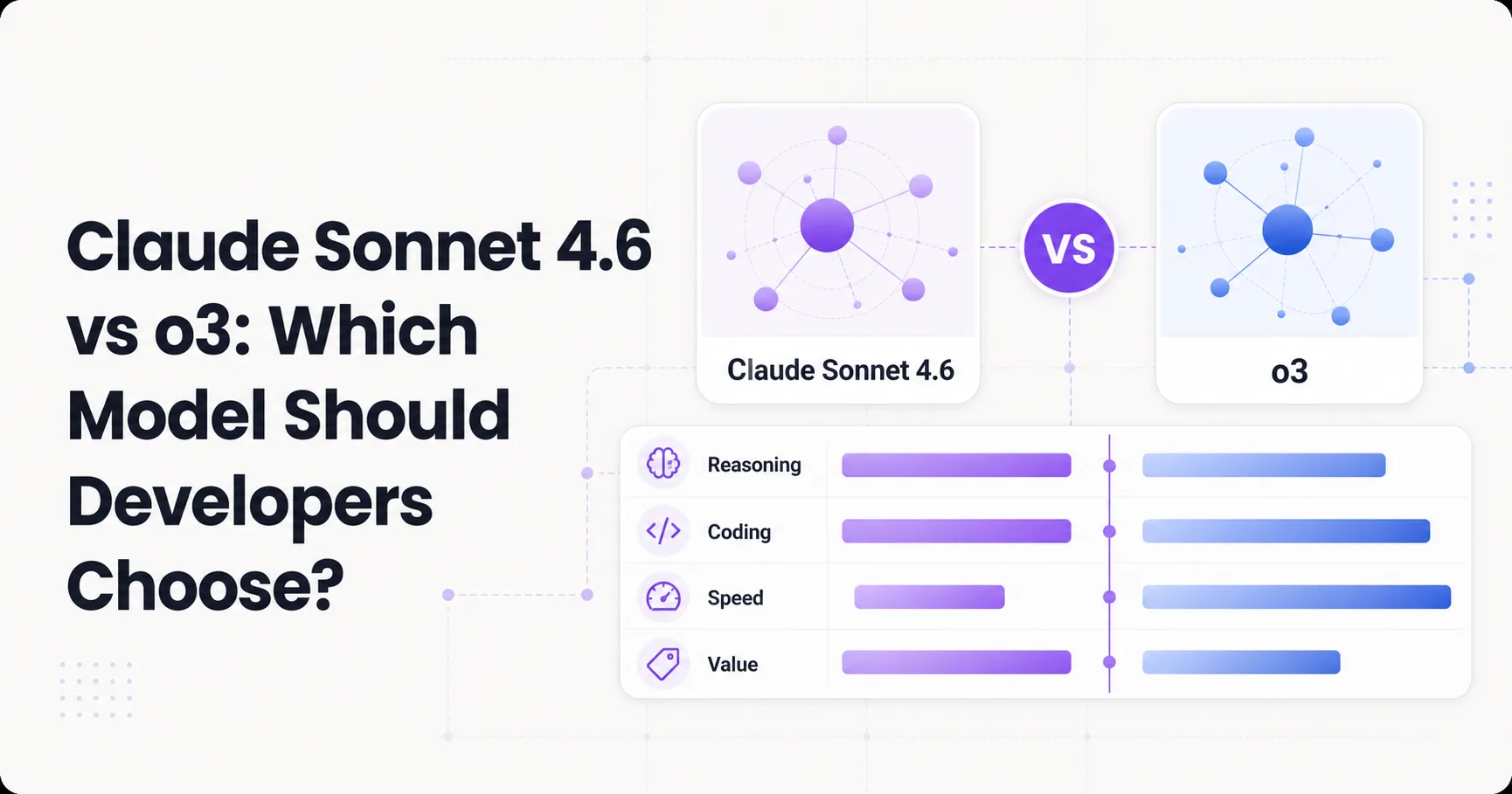
Claude Sonnet 4.6 is the safer default for new development, while o3 is the cheaper specialist option with stronger evidence in mathematics.
The data brief gives Claude Sonnet 4.6 an Artificial Analysis Intelligence Index score of 35.9, compared with 30.4 for o3. That gap supports a general-purpose quality advantage for Claude Sonnet 4.6, although it does not prove superiority on every production workload. The same dataset gives o3 a Math Index score of 88.3, while no corresponding Claude Sonnet 4.6 value is available. The result is a split decision: Claude leads on the available broad intelligence measure, while o3 has the only reported mathematics result.
The operational evidence is also asymmetric. Anthropic documents Claude Sonnet 4.6 with the API ID claude-sonnet-4-6, lists it as active on its pricing page, and describes access through the Claude API, Amazon Bedrock, Google Cloud, and Microsoft Foundry. These claims are supported by Anthropic’s models overview and Anthropic’s pricing documentation. OpenAI’s supplied current model directory does not list o3, and the supplied pricing page does not list its current price.
The comparison therefore measures more than model behavior. It measures how much uncertainty a developer must accept before committing to an integration. Data provided by https://artificialanalysis.ai/ supplies the numerical comparison, but the official documentation leaves important o3 lifecycle questions unresolved.
Claude Sonnet 4.6 offers the stronger broad-quality signal, while o3 offers lower measured cost and the only reported mathematics score.
| Decision factor | Claude Sonnet 4.6 | o3 | Selection meaning |
|---|---|---|---|
| Artificial Analysis Intelligence Index | 35.9 | 30.4 | Claude has the higher available general score |
| Artificial Analysis Math Index | Not provided | 88.3 | o3 has a documented mathematics result |
| Blended price per 1M tokens | $6 | $3.5 | o3 is cheaper in the supplied data |
| Input price per 1M tokens | $3 | $2 | o3 reduces input-heavy spend |
| Output price per 1M tokens | $15 | $8 | o3 reduces generation-heavy spend |
| Latency | 0.3 seconds | 0.3 seconds | The supplied measurement is a tie |
| Median output speed | Not provided | 128.056 tokens per second | Only o3 has a reported speed value |
The table does not establish a universal winner because the evidence is incomplete in different directions. Claude Sonnet 4.6 has a broad intelligence score but no supplied mathematics score or output-speed value. o3 has a mathematics score and output-speed value, but the supplied OpenAI documentation does not confirm its current listing, API endpoint, stable alias, or official price.
Claude Sonnet 4.6 also has a clearer documented product status. Anthropic’s overview identifies the fixed snapshot API ID claude-sonnet-4-6, and its pricing page still includes the model without a retired label. Anthropic documents the model ID and availability context here. That does not guarantee long-term support, but it gives a new integration a visible contract.
o3 may still be the better choice for a controlled workload if mathematics quality is the decisive test and the deployment path is already validated. Developers should not treat the lack of current OpenAI catalog evidence as proof that o3 is unavailable. The supplied sources simply do not resolve that question.
Claude Sonnet 4.6 has the stronger broad intelligence result, while o3 has the stronger documented case for mathematics-focused evaluation.
The Artificial Analysis Intelligence Index places Claude Sonnet 4.6 at 35.9 and o3 at 30.4. For a developer building an assistant, coding tool, research workflow, or mixed task router, that result makes Claude the more defensible starting hypothesis. It suggests better aggregate performance across the benchmark’s covered capabilities, but it does not identify which individual task types create the gap. Developers still need workload-specific tests for code editing, tool calls, structured output, retrieval, and long-context behavior.
o3’s Math Index score of 88.3 changes the decision for numerical workloads. A model can lose on a broad index and still be preferable for symbolic reasoning, quantitative verification, or mathematics-heavy pipelines. The supplied data does not provide a matching Claude Sonnet 4.6 Math Index value, so no numerical head-to-head mathematics conclusion is justified. Claude’s missing value is evidence of an information gap, not evidence of a lower mathematics capability.
The speed evidence is similarly incomplete. Both models have a supplied latency value of 0.3 seconds, so the measured latency comparison is a tie. Only o3 has a median output speed value, at 128.056 tokens per second. That may matter for streaming interfaces and long generated answers, but the missing Claude value prevents a complete speed ranking. Output speed also cannot replace end-to-end testing because queueing, network time, prompt size, tool execution, and client buffering affect user-visible response time.
Anthropic’s documentation states that Claude Sonnet 4.6 belongs to a model family supporting text and image inputs, text outputs, multilingual capability, and vision. The official overview describes those family-level capabilities. The supplied OpenAI model page does not provide equivalent o3 details. Therefore, Claude has the better documented capability surface, while o3 has a stronger measured case only in the reported mathematics and output-speed fields.
o3 is the clear price winner in the supplied snapshot, but Claude Sonnet 4.6 can remain economical when caching and token counts dominate the workload.
The blended comparison lists o3 at $3.5 per 1M tokens and Claude Sonnet 4.6 at $6. That difference makes o3 attractive for high-volume applications, especially when requests are short, routing is simple, and the lower model price does not require extra retries or verification passes. The input comparison also favors o3 at $2 versus Claude at $3, while the output comparison favors o3 at $8 versus Claude at $15.
Those prices do not automatically determine total application cost. A cheaper model becomes more expensive when it needs additional calls, longer prompts, external validators, or human review to reach the same accepted-result rate. The supplied brief contains no reliable failure-rate comparison, coding-error study, or production retry data. Developers therefore cannot convert the price difference into a guaranteed cost-per-successful-task result.
Claude Sonnet 4.6 has a documented prompt-caching structure. Anthropic lists five-minute cache writes at $3.75 per MTok, one-hour cache writes at $6 per MTok, and cache hits and refreshes at $0.30 per MTok. The pricing page documents these cache charges. For applications with repeated system instructions, repository context, or stable policy text, cache behavior could narrow the practical gap. The supplied materials do not include cache-hit rates, so the size of that effect is unknown.
Tokenizer choice is another cost variable that the chart cannot show. Anthropic states that Claude Sonnet 4.6 uses the previous-generation tokenizer, while Claude 4.7 and later models use a newer tokenizer that usually produces about 30% more tokens for the same text. Anthropic explains the tokenizer distinction in its pricing documentation. Developers comparing future models should measure actual tokenization rather than reuse estimates from another model family.
o3 leads on 3 of 3 metrics
Claude Sonnet 4.6 is the recommended default for a new general-purpose integration, while o3 is the targeted choice for validated mathematics workloads and aggressive cost control.
Pick Claude Sonnet 4.6 when the application needs a documented model ID, visible active pricing status, and multiple listed hosting channels. Anthropic identifies claude-sonnet-4-6 as a fixed snapshot-style ID rather than an alias that automatically points to a future version. The model overview explains this versioning approach. That behavior can simplify reproducibility because the application is tied to a named snapshot. It also means developers must plan an explicit upgrade process instead of assuming silent improvements.
Pick o3 when mathematics is central, the workload has passed a representative evaluation, and the team has already confirmed a working OpenAI integration. The supplied data gives o3 the only Math Index result, at 88.3, and the only median output-speed result, at 128.056 tokens per second. Its lower prices also make it attractive for large workloads. However, the supplied OpenAI materials do not establish whether o3 is currently directly callable, which endpoint supports it, whether it has a stable alias, or what its current official price is. The current OpenAI model directory does not list o3, and the current OpenAI pricing page does not list o3 pricing.
Do not select Claude solely because its broad score is higher. Do not select o3 solely because its charted price is lower. The decisive production test should measure accepted task completion, correction effort, tool-call reliability, latency under realistic prompts, and total spend. The brief does not provide those measurements, so the final choice remains evidence-limited.
A sensible evaluation sequence is to start with the model that matches the dominant workload, then test the other model on the same fixed task set. Keep prompts, output constraints, validation rules, and retry policy constant. Record successful outcomes and operational friction separately. This approach can reveal whether o3’s price advantage survives verification overhead or whether Claude’s broader score translates into fewer corrective calls.
Claude Sonnet 4.6 gives developers the stronger documented starting point, but o3 remains a credible alternative when mathematics and price dominate the decision.
Claude Sonnet 4.6 is better supported as the overall default because its Artificial Analysis Intelligence Index is 35.9 versus 30.4 for o3, while o3 leads the available mathematics evidence.
o3 is cheaper in the supplied data, costing $3.5 per 1M blended tokens versus $6 for Claude Sonnet 4.6, with lower input and output prices as well.
o3 has the only reported median output speed, at 128.056 tokens per second, while both models have a supplied latency value of 0.3 seconds.
Developers should test o3 first for mathematics-heavy applications because its supplied Math Index is 88.3, but the brief does not provide a matching Claude Sonnet 4.6 result.
The supplied OpenAI documentation does not confirm o3’s current direct API availability, stable alias, endpoint, or lifecycle status, so developers must verify access in their account before committing.
Claude Sonnet 4.6 can reach 300k-token output in the Message Batches API with the output-300k-2026-03-24 beta header, but that limit must not be applied to synchronous Messages API calls.