
Time to First Token · DeepSeek V4 Flash (Reasoning, Max Effort)
0ms
Time to First Token · GPT-5 mini (high)
0ms
Deep dive into reasoning, benchmarks, and latency insights.
The current catalog does not contain complete performance evidence for both models, so this page does not declare an overall winner. Use the available fields as comparison signals and validate the models on your own workload.
Key decision metrics at a glance.
| Model | Metric | Value | Unit | Source / snapshot |
|---|---|---|---|---|
| DeepSeek V4 Flash (Reasoning, Max Effort) | Reasoning | 6.0 | benchmark or capability score | Artificial Analysis · current catalog |
| GPT-5 mini (high) | Reasoning | 9.0 | benchmark or capability score | Artificial Analysis · current catalog |
| DeepSeek V4 Flash (Reasoning, Max Effort) | Coding | 6.0 | benchmark or capability score | Artificial Analysis · current catalog |
| GPT-5 mini (high) | Coding | 2.0 | benchmark or capability score | Artificial Analysis · current catalog |
| DeepSeek V4 Flash (Reasoning, Max Effort) | Multimodal | 4.0 | benchmark or capability score | Artificial Analysis · current catalog |
| GPT-5 mini (high) | Multimodal | 2.0 | benchmark or capability score | Artificial Analysis · current catalog |
| DeepSeek V4 Flash (Reasoning, Max Effort) | Long Context | 5.0 | benchmark or capability score | Artificial Analysis · current catalog |
| GPT-5 mini (high) | Long Context | 3.0 | benchmark or capability score | Artificial Analysis · current catalog |
| DeepSeek V4 Flash (Reasoning, Max Effort) | Blended Price / 1M tokens | $0.168 | USD per 1M tokens | Artificial Analysis · current catalog |
| GPT-5 mini (high) | Blended Price / 1M tokens | $0.688 | USD per 1M tokens | Artificial Analysis · current catalog |
| DeepSeek V4 Flash (Reasoning, Max Effort) | P95 Latency | — | milliseconds | Artificial Analysis · current catalog |
| GPT-5 mini (high) | P95 Latency | — | milliseconds | Artificial Analysis · current catalog |
| DeepSeek V4 Flash (Reasoning, Max Effort) | Tokens per second | 0 | tokens per second | Artificial Analysis · current catalog |
| GPT-5 mini (high) | Tokens per second | 0 | tokens per second | Artificial Analysis · current catalog |
Data provided by Artificial Analysis; live values use the current catalog.
This radar chart visually maps the core capabilities (reasoning, coding, math proxy, multimodal, long context) of `DeepSeek V4 Flash (Reasoning, Max Effort)` vs `GPT-5 mini (high)`.
This grouped bar chart provides a side-by-side comparison for each benchmark metric.
Lower time to first token is better; higher tokens per second is better.
Compare input and output pricing in USD per 1M tokens.
DeepSeek V4 Flash (Reasoning, Max Effort)$0.2
GPT-5 mini (high)$0.75
DeepSeek V4 Flash (Reasoning, Max Effort) costs $0.55 less per run
This article is a dated snapshot published on 2026-08-07. Live cards above use the current catalog; missing live fields are not inferred.
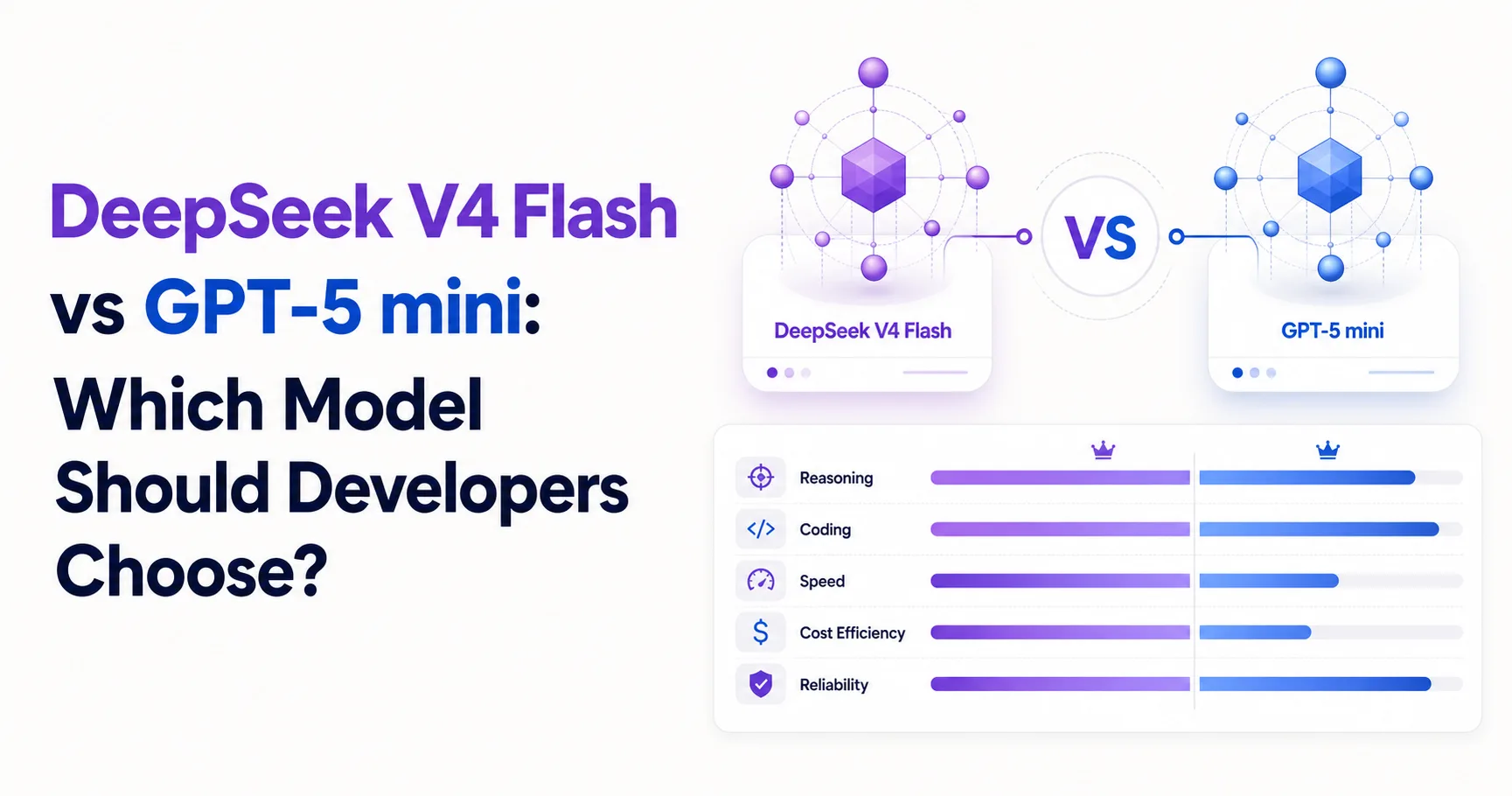
DeepSeek V4 Flash (Reasoning, Max Effort) is the stronger default for cost-sensitive developer workloads, but its target version label does not match the current official alias. The data snapshot gives DeepSeek a coding index of 56.2 and an intelligence index of 40.3, compared with 15.6 and 25.3 for GPT-5 mini (high). DeepSeek also has the lower blended price at $0.17125 per 1M tokens, compared with $0.6875 for GPT-5 mini. Latency is tied at 0.3 seconds.\n\nThe central selection issue is identity, not just capability. DeepSeek's official pricing page lists deepseek-v4-flash as the stable API alias and associates it with DeepSeek-V4-Flash-0731, while the compared data slug is deepseek-v4-flash-0420. The page does not explicitly say that one version replaced the other. OpenAI's model directory does not list gpt-5-mini as an independent current entry.\n\nTherefore, DeepSeek is the practical recommendation for a new developer integration only if the team confirms that the live alias produces the behavior represented by the data snapshot. GPT-5 mini may still be attractive for a narrowly defined math workload, but the supplied official sources do not establish a current API path, stable alias, or model-specific contract for the compared label.
DeepSeek V4 Flash (Reasoning, Max Effort) offers the better documented developer surface and the stronger measured coding profile, while GPT-5 mini (high) has one clear advantage in the available math evaluation.\n\n| Decision factor | DeepSeek V4 Flash (Reasoning, Max Effort) | GPT-5 mini (high) | What it means for developers |\n| --- | --- | --- | --- |\n| Coding index | 56.2 | 15.6 | DeepSeek is the safer benchmark-led choice for code generation and software tasks |\n| Intelligence index | 40.3 | 25.3 | DeepSeek leads on the supplied general capability measure |\n| Math index | No supplied result | 90.7 | GPT-5 mini deserves a focused math evaluation before exclusion |\n| Blended price | $0.17125 per 1M tokens | $0.6875 per 1M tokens | DeepSeek has more room for high-volume use |\n| Latency | 0.3 seconds | 0.3 seconds | Neither model has a measured latency advantage in this snapshot |\n| API evidence | Stable alias and documented interfaces | No dedicated current directory entry | DeepSeek is easier to validate operationally |\n\nThe benchmark evidence is asymmetric. DeepSeek has the higher coding and intelligence scores, but GPT-5 mini is the only model with a supplied math score. That does not prove GPT-5 mini is better at math overall, because DeepSeek has no corresponding result. It does show that a general recommendation should not be presented as a universal capability ranking.\n\nThe official evidence is also asymmetric. DeepSeek's documentation describes JSON output, tool calling, Responses API access, Anthropic API compatibility, and a Chat Prefix Completion beta. OpenAI's current models page provides broad platform-level capability language, but does not confirm those details for gpt-5-mini or the high label.
DeepSeek V4 Flash (Reasoning, Max Effort) has the clearer performance case for coding, while GPT-5 mini (high) remains viable only where its measured math result matches the workload.\n\nA coding index of 56.2 versus 15.6 is a meaningful directional signal for developers choosing a model for repository changes, code completion, debugging, and implementation planning. The result does not establish equal reliability across languages, frameworks, repository sizes, or tool-use patterns. It also does not reveal whether the compared DeepSeek data represents the current deepseek-v4-flash alias or an earlier snapshot.\n\nThe intelligence index favors DeepSeek at 40.3 versus 25.3. That supports a broader default preference, but it should not be read as proof that DeepSeek wins every reasoning task. GPT-5 mini has a supplied math index of 90.7, and DeepSeek has no supplied math result. A team building symbolic, quantitative, or verification-heavy workflows should therefore run a task-specific evaluation instead of extrapolating from the coding result.\n\nThe latency chart shows a tie at 0.3 seconds. That removes latency as a deciding factor in the supplied comparison, but it does not answer important production questions such as output streaming behavior, sustained throughput, queueing, rate-limit response, or long-context latency. The official DeepSeek page documents a concurrency limit of 2500, while the supplied OpenAI sources do not provide a comparable model-specific limit for GPT-5 mini.\n\nNo reliable community evidence was supplied for either target label. The research brief therefore cannot support claims about coding feel, recurring reasoning errors, tool-call failure patterns, or stable user preferences.
DeepSeek V4 Flash (Reasoning, Max Effort) is materially cheaper in the supplied price snapshot, especially for generated output, but its documented repricing warning creates planning risk.\n\nThe blended price is $0.17125 per 1M tokens for DeepSeek and $0.6875 for GPT-5 mini. DeepSeek's input price is $0.135 compared with $0.25, while its output price is $0.28 compared with $2. The output difference matters for coding agents, because generated patches, explanations, test plans, and tool-call arguments can make output consumption a large part of total spend.\n\nThe cheaper model can still become more expensive in practice if it requires retries, longer prompts, manual review, or routing to another model for tasks it handles poorly. The supplied data does not include failure rates, retry rates, token distributions, or quality-adjusted cost. It is therefore evidence for lower nominal spend, not proof of lower total engineering cost.\n\nDeepSeek's official pricing page also warns that API prices may increase substantially in the future. The official pricing documentation does not provide a fixed future schedule in the supplied material. GPT-5 mini has an even larger availability problem: OpenAI's pricing page does not list a standard, Batch, Flex, or Fast mode price for gpt-5-mini.\n\nFor budgeting, DeepSeek is the only model with a directly documented current price in the research material and a lower artificial analysis blended price. Procurement should still treat that price as changeable and verify the live account-level rate before committing to volume.
DeepSeek V4 Flash (Reasoning, Max Effort) leads on 3 of 3 metrics
DeepSeek V4 Flash (Reasoning, Max Effort) is the recommended first candidate for developer-facing workloads, subject to an alias and regression check against the compared snapshot.\n\nChoose DeepSeek when the product needs code generation, repository assistance, tool calling, JSON output, or high-volume inference with predictable nominal cost. Its official documentation gives developers a concrete stable alias, compatible API formats, and a documented concurrency limit of 2500. Its coding index of 56.2 also provides the strongest supplied evidence for software development use.\n\nChoose GPT-5 mini (high) only after confirming that the label maps to a callable production model and after testing math-heavy tasks. The available math index is 90.7, which is a strong reason to keep GPT-5 mini in a specialist evaluation track. That result is not enough to justify a broad production choice because the official model and pricing pages do not confirm the compared model label.\n\nA sensible rollout has three gates:\n\n1. Confirm the exact API identifier and current version for DeepSeek, then compare representative coding tasks with the data snapshot's target.\n2. Confirm whether gpt-5-mini and high are valid current API identifiers, and obtain current price and limit information from OpenAI documentation or the account environment.\n3. Measure quality-adjusted cost using real prompts, retries, tool calls, review effort, and latency under expected concurrency.\n\nThe supplied evidence does not answer whether either model is better for multimodal development, long-context repository work, agentic tool reliability, or sustained production throughput. Those are open evaluation items, not conclusions that can be inferred from the current sources.
DeepSeek V4 Flash (Reasoning, Max Effort) should be treated as the easier model to validate, but developers still need to resolve the version mismatch before shipping.
DeepSeek V4 Flash (Reasoning, Max Effort) has the stronger supplied coding result, with a coding index of 56.2 versus 15.6 for GPT-5 mini (high), but the benchmark does not establish performance for every language or repository.
DeepSeek V4 Flash (Reasoning, Max Effort) is cheaper in the supplied snapshot at $0.17125 per 1M blended tokens versus $0.6875 for GPT-5 mini, although future pricing changes remain a documented risk.
GPT-5 mini (high) has the only supplied math result, with a math index of 90.7, so it deserves a focused math evaluation; DeepSeek has no corresponding math score in the provided data.
Neither model is faster in the supplied comparison because DeepSeek V4 Flash (Reasoning, Max Effort) and GPT-5 mini (high) both have a measured latency of 0.3 seconds, while output speed is unavailable.
Developers should verify the identifier before integration because the data compares deepseek-v4-flash-0420, while the official page currently documents deepseek-v4-flash with the version shown as DeepSeek-V4-Flash-0731.
The supplied official evidence cannot confirm current availability because OpenAI's model directory and pricing page do not list gpt-5-mini as a dedicated current model entry or provide its model-specific price.