
Time to First Token · DeepSeek V4 Flash 0731 (Reasoning, Max Effort)
910ms
Time to First Token · GPT-5 mini (high)
0ms
Deep dive into reasoning, benchmarks, and latency insights.
The current catalog does not contain complete performance evidence for both models, so this page does not declare an overall winner. Use the available fields as comparison signals and validate the models on your own workload.
Key decision metrics at a glance.
| Model | Metric | Value | Unit | Source / snapshot |
|---|---|---|---|---|
| DeepSeek V4 Flash 0731 (Reasoning, Max Effort) | Reasoning | 6.0 | benchmark or capability score | Artificial Analysis · current catalog |
| GPT-5 mini (high) | Reasoning | 9.0 | benchmark or capability score | Artificial Analysis · current catalog |
| DeepSeek V4 Flash 0731 (Reasoning, Max Effort) | Coding | 7.0 | benchmark or capability score | Artificial Analysis · current catalog |
| GPT-5 mini (high) | Coding | 2.0 | benchmark or capability score | Artificial Analysis · current catalog |
| DeepSeek V4 Flash 0731 (Reasoning, Max Effort) | Multimodal | 4.0 | benchmark or capability score | Artificial Analysis · current catalog |
| GPT-5 mini (high) | Multimodal | 2.0 | benchmark or capability score | Artificial Analysis · current catalog |
| DeepSeek V4 Flash 0731 (Reasoning, Max Effort) | Long Context | 6.0 | benchmark or capability score | Artificial Analysis · current catalog |
| GPT-5 mini (high) | Long Context | 3.0 | benchmark or capability score | Artificial Analysis · current catalog |
| DeepSeek V4 Flash 0731 (Reasoning, Max Effort) | Blended Price / 1M tokens | $0.66 | USD per 1M tokens | Artificial Analysis · current catalog |
| GPT-5 mini (high) | Blended Price / 1M tokens | $0.688 | USD per 1M tokens | Artificial Analysis · current catalog |
| DeepSeek V4 Flash 0731 (Reasoning, Max Effort) | P95 Latency | — | milliseconds | Artificial Analysis · current catalog |
| GPT-5 mini (high) | P95 Latency | — | milliseconds | Artificial Analysis · current catalog |
| DeepSeek V4 Flash 0731 (Reasoning, Max Effort) | Tokens per second | 114.602 | tokens per second | Artificial Analysis · current catalog |
| GPT-5 mini (high) | Tokens per second | 0 | tokens per second | Artificial Analysis · current catalog |
Data provided by Artificial Analysis; live values use the current catalog.
This radar chart visually maps the core capabilities (reasoning, coding, math proxy, multimodal, long context) of `DeepSeek V4 Flash 0731 (Reasoning, Max Effort)` vs `GPT-5 mini (high)`.
This grouped bar chart provides a side-by-side comparison for each benchmark metric.
Lower time to first token is better; higher tokens per second is better.
Compare input and output pricing in USD per 1M tokens.
DeepSeek V4 Flash 0731 (Reasoning, Max Effort)$0.77
GPT-5 mini (high)$0.75
GPT-5 mini (high) costs $0.02 less per run
This article is a dated snapshot published on 2026-08-07. Live cards above use the current catalog; missing live fields are not inferred.
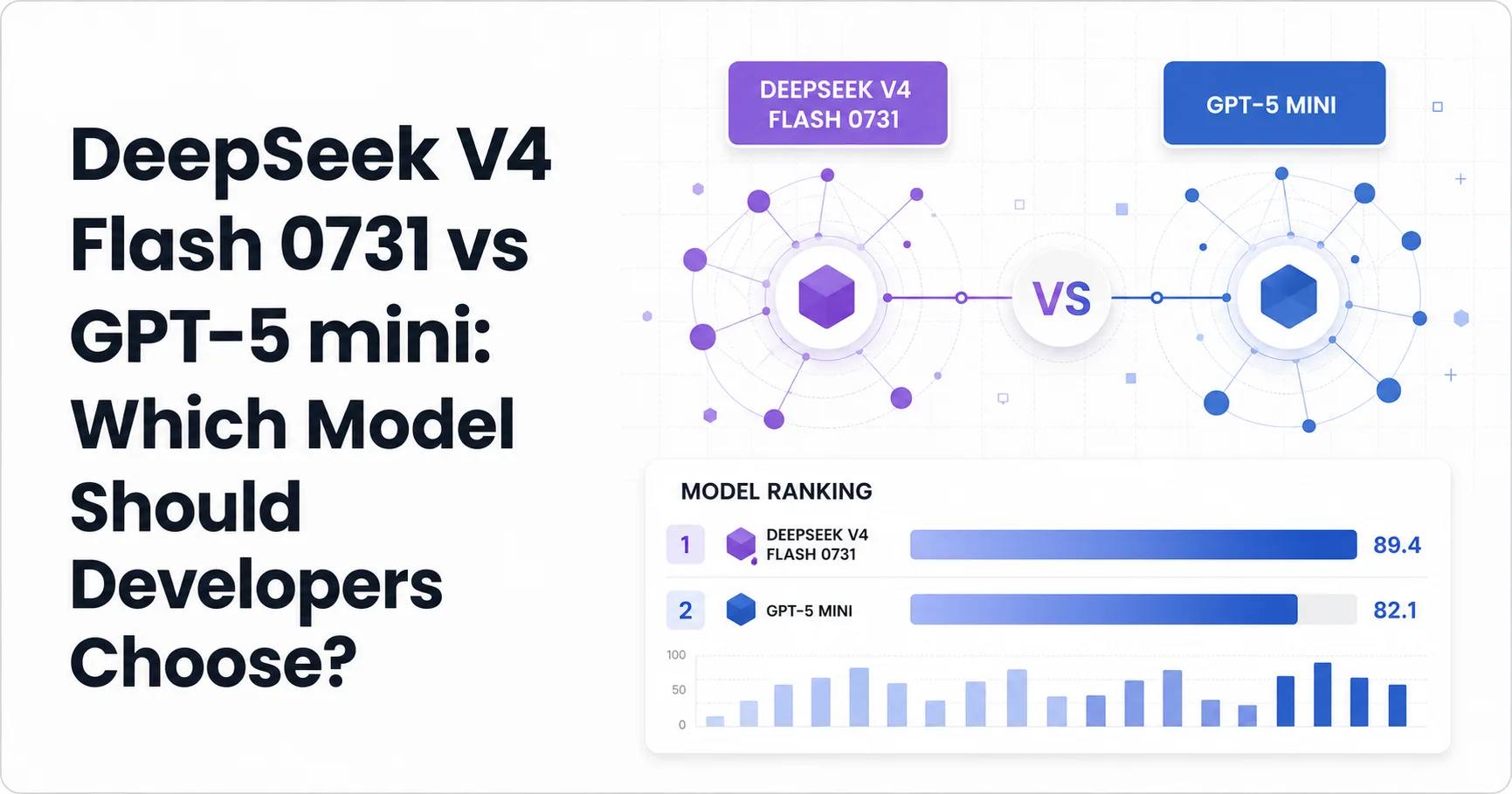
DeepSeek V4 Flash 0731 is the safer default for developers who need verified API access, coding performance, speed, and lower recorded cost. The comparison data gives DeepSeek V4 Flash 0731 a 69.1 coding index, a 49.9 intelligence index, and a 102.212 median output speed. GPT-5 mini (high) records a 15.6 coding index, a 25.3 intelligence index, and a 90.7 math index, but its current API identity and pricing are not confirmed in the supplied OpenAI documentation. Data provided by https://artificialanalysis.ai/
DeepSeek V4 Flash 0731 is the stronger general developer choice because its measured coding and intelligence scores lead while its official API status and pricing are documented. The Artificial Analysis data reports a 69.1 coding index for DeepSeek V4 Flash 0731 and 15.6 for GPT-5 mini (high). It also reports a 49.9 intelligence index for DeepSeek V4 Flash 0731 and 25.3 for GPT-5 mini (high). Those results favor DeepSeek for code generation, debugging, repository work, and general engineering assistance.
GPT-5 mini (high) remains relevant when mathematical reasoning is the primary acceptance criterion. The supplied data reports a 90.7 math index for GPT-5 mini, while no DeepSeek math value is provided. That is a meaningful capability boundary, but it does not establish that GPT-5 mini is the better complete software-development assistant.
The largest selection risk is not a benchmark score. The supplied OpenAI model directory does not list gpt-5-mini or GPT-5 mini (high) as an independent current model entry. The supplied OpenAI pricing page also does not list its standard, Batch, Flex, or Fast mode prices. Therefore, GPT-5 mini may be useful in the evaluated environment, but its production continuity cannot be verified from these sources.
DeepSeek has a clearer operational contract. Its official models and pricing page identifies DeepSeek-V4-Flash-0731, the stable alias deepseek-v4-flash, a 1M-token context window, and a maximum output of 384K tokens. Its documented interface supports JSON Output and Tool Calls. GPT-5 mini has no equivalent verified details in the supplied material.
DeepSeek V4 Flash 0731 is the better-supported performance choice for coding workflows, while GPT-5 mini is only clearly preferable on the reported mathematics evaluation. The coding index gap is visible in the chart, but its practical meaning depends on the task. A higher coding result should matter most for multi-file changes, bug localization, test generation, and agent loops where the model must preserve constraints across several edits. It is less decisive for a narrow completion task with strong tests and a small prompt.
DeepSeek also has a reported 102.212 median output tokens per second. GPT-5 mini has no reported output-speed value in the supplied data, so developers cannot make a verified throughput comparison. DeepSeek and GPT-5 mini both show 0.3 seconds of reported latency, which makes first-response timing look tied in this snapshot. That tie does not prove equal user experience because output streaming, queueing, tool-call pauses, and retry behavior are not described.
Community evidence supports a cautious interpretation. One Reddit report describes sustained debugging on an unfinished website and includes personal observations of about 74 tokens per second during some server-side use. The same discussion mentions slower periods, so it does not define a stable service-level expectation. A separate local deployment report records 12.5 tokens per second on an RTX 3090 setup with quantization and system-memory placement. Local speed therefore depends heavily on hardware and expert placement.
The evidence gap is larger for GPT-5 mini. No reliable supplied community test describes its coding behavior, speed, or failure patterns. Developers should treat the reported 90.7 math index as a reason to run a targeted validation set, not as proof of broader software-engineering superiority.
DeepSeek V4 Flash 0731 has the lower recorded token price, but workload shape and operational uncertainty determine the real bill. The data reports $0.17500000000000002 per 1M blended tokens for DeepSeek V4 Flash 0731 and $0.6875 for GPT-5 mini (high). DeepSeek's recorded input and output prices are $0.14 and $0.28 per 1M tokens. GPT-5 mini records $0.25 input and $2 output per 1M tokens.
The output price is the important practical distinction for agentic development. A workflow that repeatedly asks for long plans, patches, explanations, or tool-call follow-ups can make output tokens dominate the bill. Under that pattern, GPT-5 mini's recorded output price creates more exposure even when prompts are short. A prompt-heavy workflow with limited completions reduces that difference, but the blended comparison still favors DeepSeek in the supplied snapshot.
DeepSeek's official page separately lists cached-input pricing at $0.0028 and uncached-input pricing at $0.14 per 1M tokens. That means cache design can materially change the economics of repeated repository context, although the supplied data does not provide an equivalent verified GPT-5 mini cache price. DeepSeek also states that peak and off-peak pricing will be introduced, with peak pricing potentially reaching twice the regular price, but the effective date depends on an official announcement. See DeepSeek Models & Pricing for the current qualification.
A cheaper token can become more expensive if the model needs more retries, human corrections, or longer context to reach an accepted patch. The supplied materials do not provide standardized task-success rates, retry counts, or total-cost-per-success measurements for either model. Developers should therefore compare accepted outcomes, not token price alone.
DeepSeek V4 Flash 0731 (Reasoning, Max Effort) leads on 2 of 3 metrics
DeepSeek V4 Flash 0731 should be the default shortlist candidate for production coding agents and general engineering assistants. Its official thinking-mode documentation confirms low, high, and max reasoning effort values, with max corresponding to the evaluated Max Effort setting for deepseek-v4-flash. The same documentation confirms tool use in thinking mode, but it requires the complete reasoning_content to be returned in later requests. That requirement belongs in the SDK adapter and request-history tests.
Choose DeepSeek when the application needs repository debugging, code transformation, structured output, tool calls, or a documented OpenAI-compatible integration. The Responses API guide states that the Responses API currently supports deepseek-v4-flash and describes the compatible request path. The Hacker News discussion also contains a low-cost daily coding-agent report, but it lacks a standardized test protocol. Treat it as supporting context, not validation.
Choose GPT-5 mini (high) only when mathematics is central, when the evaluated runtime has already confirmed that exact model, or when an internal benchmark shows better accepted outcomes for your workload. The 90.7 math index is the strongest evidence in its favor. The supplied official OpenAI model documentation does not verify the model's current standalone listing, while OpenAI pricing documentation does not verify its price. Confirm the model ID, availability, context behavior, tool support, rate limits, and billing before making it a production dependency.
Before committing, run the same repository tasks against both systems. Include a bug fix, a multi-file change, a tool-calling loop, a long-context task, and a math-heavy task. Record accepted patches, retries, latency, output volume, and human correction time. The supplied sources do not answer which model wins that end-to-end metric, so a local evaluation remains necessary.
DeepSeek V4 Flash 0731 is easier to verify from the supplied sources because its model alias, API surfaces, pricing, reasoning controls, and rate-limit behavior are documented. GPT-5 mini (high) requires additional environment verification before production selection. The official DeepSeek rate-limit documentation states that account concurrency is capped at 2,500 and that excess requests return HTTP 429. It also states that a request may remain connected before reasoning begins and can be closed if reasoning has not started within 10 minutes. These constraints should be tested under the intended agent workload.
DeepSeek V4 Flash 0731 is the better default for coding agents because the supplied data reports a 69.1 coding index, documented tool support, verified API availability, and lower recorded blended pricing than GPT-5 mini (high).
A developer should choose GPT-5 mini (high) when mathematics is the primary requirement or when a controlled evaluation confirms better accepted outcomes, because its supplied math index is 90.7 and DeepSeek has no reported math value here.
DeepSeek V4 Flash 0731 has a reported median output speed of 102.212 tokens per second, while GPT-5 mini has no supplied speed value, so DeepSeek is the only verified throughput choice rather than a fully proven speed winner.
The biggest production risk is integration discipline around thinking-mode tool calls, because later requests must preserve the complete reasoning_content, while concurrency above 2,500 can return HTTP 429 according to the supplied official documentation.
The biggest production risk is unresolved model identity and availability, because the supplied OpenAI model directory and pricing page do not independently list gpt-5-mini or confirm the meaning of the high setting.