
Time to First Token · DeepSeek V4 Flash 0731 (Reasoning, Max Effort)
910ms
Time to First Token · GPT-5 nano (high)
0ms
Deep dive into reasoning, benchmarks, and latency insights.
The current catalog does not contain complete performance evidence for both models, so this page does not declare an overall winner. Use the available fields as comparison signals and validate the models on your own workload.
Key decision metrics at a glance.
| Model | Metric | Value | Unit | Source / snapshot |
|---|---|---|---|---|
| DeepSeek V4 Flash 0731 (Reasoning, Max Effort) | Reasoning | 6.0 | benchmark or capability score | Artificial Analysis · current catalog |
| GPT-5 nano (high) | Reasoning | 8.0 | benchmark or capability score | Artificial Analysis · current catalog |
| DeepSeek V4 Flash 0731 (Reasoning, Max Effort) | Coding | 7.0 | benchmark or capability score | Artificial Analysis · current catalog |
| GPT-5 nano (high) | Coding | 6.0 | benchmark or capability score | Artificial Analysis · current catalog |
| DeepSeek V4 Flash 0731 (Reasoning, Max Effort) | Multimodal | 4.0 | benchmark or capability score | Artificial Analysis · current catalog |
| GPT-5 nano (high) | Multimodal | 2.0 | benchmark or capability score | Artificial Analysis · current catalog |
| DeepSeek V4 Flash 0731 (Reasoning, Max Effort) | Long Context | 6.0 | benchmark or capability score | Artificial Analysis · current catalog |
| GPT-5 nano (high) | Long Context | 3.0 | benchmark or capability score | Artificial Analysis · current catalog |
| DeepSeek V4 Flash 0731 (Reasoning, Max Effort) | Blended Price / 1M tokens | $0.66 | USD per 1M tokens | Artificial Analysis · current catalog |
| GPT-5 nano (high) | Blended Price / 1M tokens | $0.138 | USD per 1M tokens | Artificial Analysis · current catalog |
| DeepSeek V4 Flash 0731 (Reasoning, Max Effort) | P95 Latency | — | milliseconds | Artificial Analysis · current catalog |
| GPT-5 nano (high) | P95 Latency | — | milliseconds | Artificial Analysis · current catalog |
| DeepSeek V4 Flash 0731 (Reasoning, Max Effort) | Tokens per second | 114.602 | tokens per second | Artificial Analysis · current catalog |
| GPT-5 nano (high) | Tokens per second | 0 | tokens per second | Artificial Analysis · current catalog |
Data provided by Artificial Analysis; live values use the current catalog.
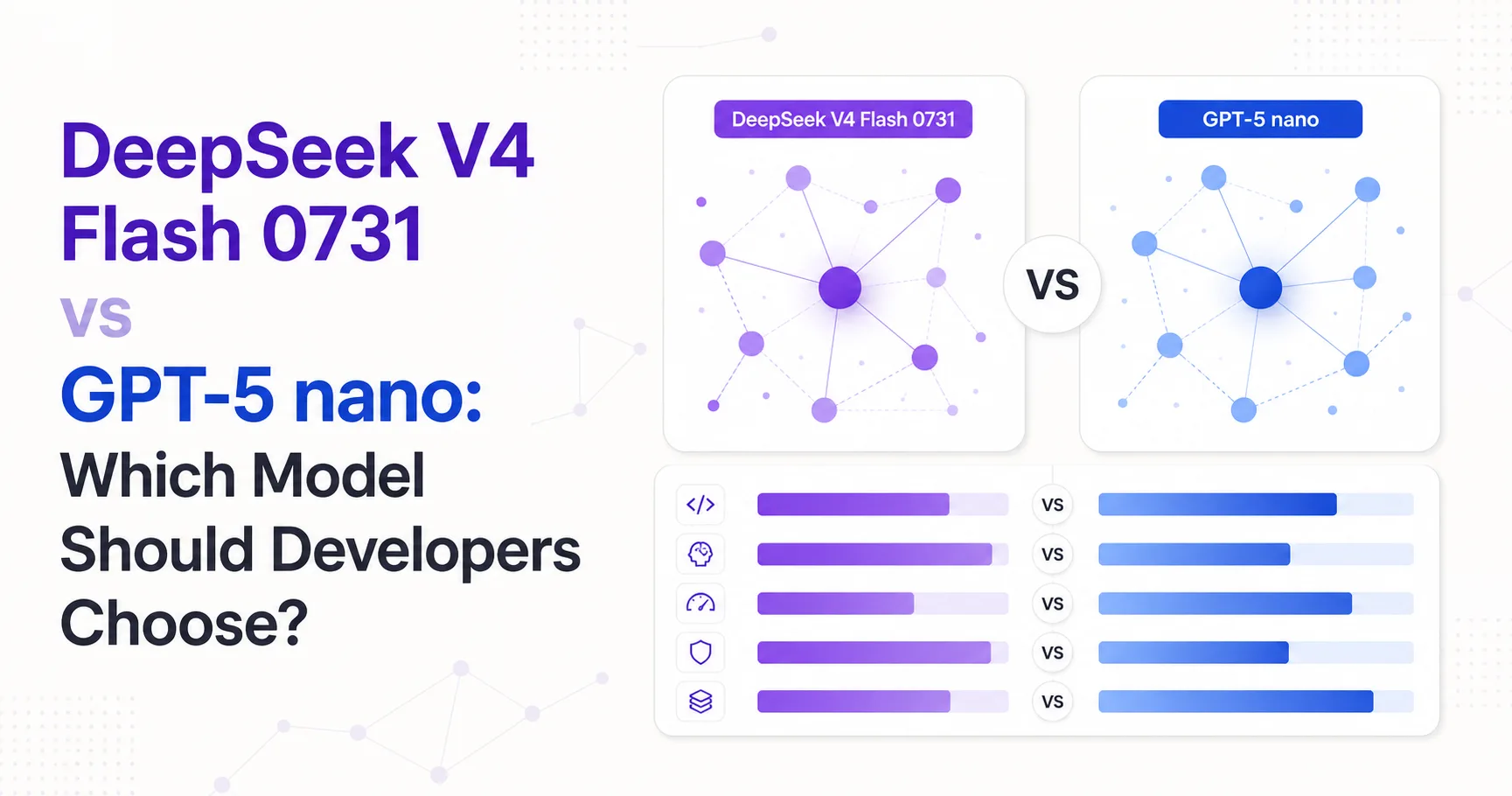
This radar chart visually maps the core capabilities (reasoning, coding, math proxy, multimodal, long context) of `DeepSeek V4 Flash 0731 (Reasoning, Max Effort)` vs `GPT-5 nano (high)`.
This grouped bar chart provides a side-by-side comparison for each benchmark metric.
Lower time to first token is better; higher tokens per second is better.
Compare input and output pricing in USD per 1M tokens.
DeepSeek V4 Flash 0731 (Reasoning, Max Effort)$0.77
GPT-5 nano (high)$0.15
GPT-5 nano (high) costs $0.62 less per run
This article is a dated snapshot published on 2026-08-07. Live cards above use the current catalog; missing live fields are not inferred.
DeepSeek V4 Flash 0731 is the safer developer choice because its current API, capabilities, and production status are documented, while GPT-5 nano has important evidence gaps. The data snapshot gives DeepSeek V4 Flash 0731 an Artificial Analysis Intelligence Index of 49.9, compared with 19.9 for GPT-5 nano. DeepSeek also records 102.212 median output tokens per second, while GPT-5 nano has no reported value. GPT-5 nano is cheaper on the blended price, at $0.1375 versus $0.17500000000000002 per 1M blended tokens. That advantage matters most for input-heavy workloads. It does not remove the uncertainty around whether the named GPT-5 nano model remains directly callable. DeepSeek’s current model and pricing documentation lists deepseek-v4-flash as a stable alias and identifies the version as DeepSeek-V4-Flash-0731 (DeepSeek Models & Pricing). OpenAI’s current model directory does not list GPT-5 nano (OpenAI Models).
DeepSeek V4 Flash 0731 offers the stronger documented default for general development, while GPT-5 nano remains a potentially attractive specialist option with incomplete current evidence. The clearest measured separation is the Artificial Analysis Intelligence Index, where DeepSeek scores 49.9 and GPT-5 nano scores 19.9. The comparison does not establish a coding winner because the data snapshot reports DeepSeek’s Artificial Analysis Coding Index at 69.1 but provides no GPT-5 nano coding score. It also does not establish a general reasoning winner from official vendor benchmarks because neither research brief supplied a complete, directly comparable official evaluation table. GPT-5 nano leads the reported Math Index with 83.7, but DeepSeek has no corresponding value. That makes GPT-5 nano relevant for math-heavy tasks, though the result should not be generalized to coding or broad agent behavior.
DeepSeek has a documented stable API alias, a documented OpenAI-compatible endpoint, tool calls, JSON output, Responses API support, and configurable reasoning effort (Using the Responses API, Thinking Mode). GPT-5 nano’s current model-specific alias, context window, output limit, parameter support, and failure modes were not found in the current OpenAI documentation (OpenAI Models). Developers should therefore compare verified task performance against integration certainty, not just the lower blended price.
DeepSeek V4 Flash 0731 is the better-supported performance choice for coding and general agent work, but the available evidence cannot prove superiority on every task. The Artificial Analysis data reports DeepSeek’s Coding Index at 69.1, yet supplies no GPT-5 nano coding score. That missing comparator prevents a valid coding margin. DeepSeek also has a reported median output speed of 102.212 tokens per second, while GPT-5 nano has no reported speed value. Both models show 0.3 seconds of latency in the snapshot, so the documented difference is likely to appear during generation rather than initial response time.
The practical implication is straightforward. DeepSeek is easier to evaluate for streaming coding assistants, repository repair, and tool-driven workflows because developers have at least one coding score and one output-speed measure. A Reddit report describes DeepSeek V4 Flash 0731 completing missing functionality while debugging an unfinished website, but the post does not disclose a reproducible protocol (Deepseek v4 flash 0731 real experience). Another community report observed 12.5 tokens per second on a quantified local setup using an RTX 3090, system memory, and a specific quantization, showing that local speed can diverge sharply from hosted speed (DeepSeek-V4-Flash-0731 UD-IQ3_S 12.5 tok/s). GPT-5 nano’s Math Index of 83.7 is a meaningful signal for mathematical workloads, but the brief contains no evidence connecting that score to production coding-agent reliability.
GPT-5 nano has the lower blended price, but DeepSeek V4 Flash 0731 can be cheaper for output-heavy workflows because its output price is lower. The data snapshot lists GPT-5 nano at $0.1375 per 1M blended tokens and DeepSeek at $0.17500000000000002. That makes GPT-5 nano the nominal cost winner under the stated blended mix. The input comparison points in the same direction: GPT-5 nano costs $0.05 per 1M input tokens, while DeepSeek costs $0.14. Output reverses the result: DeepSeek costs $0.28 per 1M output tokens, compared with $0.4 for GPT-5 nano.
The billing shape matters for developers building agents. A retrieval-heavy classifier that reads large prompts and emits short answers may favor GPT-5 nano. A coding agent that produces long patches, explanations, test plans, or iterative tool decisions may find DeepSeek’s lower output rate more important than the blended figure. DeepSeek’s official page also documents cached-input pricing at $0.0028 per 1M tokens and uncached input at $0.14, while warning that peak-period pricing may change (DeepSeek Models & Pricing). The current OpenAI pricing page does not list gpt-5-nano; it lists gpt-5.4-nano, whose prices must not be substituted for the compared model (OpenAI API Pricing). GPT-5 nano is therefore cheaper in the supplied snapshot, but its current billable identity is not independently confirmed.
GPT-5 nano (high) leads on 3 of 3 metrics
DeepSeek V4 Flash 0731 is the recommended default for production coding assistants, while GPT-5 nano deserves a controlled trial for math-heavy and input-heavy workloads. Choose DeepSeek when the application needs a documented stable alias, OpenAI-compatible access, tool calls, JSON output, or explicit reasoning controls. Its reasoning mode supports low, high, and max, and the evaluated Max Effort configuration maps to max in the official documentation (Thinking Mode). DeepSeek also supports the Responses API through the documented endpoint (Using the Responses API).
Choose GPT-5 nano only after confirming that the exact model identifier remains available in the target account and region. The supplied research found no current official listing for the model, no model-specific context or output limits, and no verified community reports. Its Math Index of 83.7 and lower blended price justify a benchmark, not an automatic deployment decision. The comparison also leaves a direct coding test unresolved because GPT-5 nano has no supplied Coding Index. Developers should run representative repository tasks, tool-call loops, structured-output checks, and cost traces before switching.
DeepSeek has documented operational constraints. Tool calls in reasoning mode require the complete reasoning_content to be returned in later requests, or the API can return HTTP 400 (Thinking Mode). The account concurrency limit is 2,500, and excess requests can receive HTTP 429 (Rate Limit & Isolation). These are manageable engineering requirements, but they should be included in the integration plan.
DeepSeek V4 Flash 0731 has clearer migration evidence than GPT-5 nano, but developers still need workload-specific validation before committing. Community discussion describes low-cost daily coding use without standardized task records (Hacker News discussion). That evidence supports interest, not a universal quality claim. The research also found no official confirmation of image or audio input for DeepSeek, and no verified GPT-5 nano-specific multimodal contract. Treat multimodal support as unconfirmed for this comparison.
The largest unresolved issue is not a missing decimal in the price chart. It is whether GPT-5 nano is still the exact production model represented by the snapshot. The current OpenAI catalog and pricing pages do not list it, and the brief warns against transferring gpt-5.4-nano information to GPT-5 nano. A migration decision should therefore record the exact model ID, endpoint behavior, context limits, output limits, and billing response before launch.
Choose DeepSeek V4 Flash 0731 for the default coding-assistant deployment because it has a reported Coding Index of 69.1, documented tool calling, documented reasoning controls, and a stable API alias, while GPT-5 nano has no supplied coding comparator.
GPT-5 nano is cheaper on the supplied blended measure at $0.1375 per 1M blended tokens versus $0.17500000000000002, but DeepSeek costs less for output, so long generated responses can change the practical result.
DeepSeek V4 Flash 0731 has the only reported output-speed value at 102.212 median output tokens per second, while both models show 0.3 seconds of latency and GPT-5 nano lacks a comparable generation-speed measurement.
GPT-5 nano has the stronger reported Math Index at 83.7, so it merits testing for mathematical workloads, but the evidence does not show whether that advantage transfers to coding, tool use, or general agent tasks.
DeepSeek’s main production risks are integration-specific: reasoning tool calls require complete reasoning content on follow-up requests, concurrency above 2,500 can return HTTP 429, and local performance depends heavily on hardware configuration.
No, GPT-5.4-nano should not substitute for GPT-5 nano in this comparison because the research explicitly treats them as different model identifiers with different evidence and does not provide equivalent pricing or capability data.