
Time to First Token · DeepSeek V4 Pro (Reasoning, High Effort)
1166ms
Time to First Token · Grok 4.6 (high)
39819ms
Deep dive into reasoning, benchmarks, and latency insights.
The current catalog does not contain complete performance evidence for both models, so this page does not declare an overall winner. Use the available fields as comparison signals and validate the models on your own workload.
Key decision metrics at a glance.
| Model | Metric | Value | Unit | Source / snapshot |
|---|---|---|---|---|
| DeepSeek V4 Pro (Reasoning, High Effort) | Reasoning | 6.0 | benchmark or capability score | Artificial Analysis · current catalog |
| Grok 4.6 (high) | Reasoning | 6.0 | benchmark or capability score | Artificial Analysis · current catalog |
| DeepSeek V4 Pro (Reasoning, High Effort) | Coding | 6.0 | benchmark or capability score | Artificial Analysis · current catalog |
| Grok 4.6 (high) | Coding | 8.0 | benchmark or capability score | Artificial Analysis · current catalog |
| DeepSeek V4 Pro (Reasoning, High Effort) | Multimodal | 4.0 | benchmark or capability score | Artificial Analysis · current catalog |
| Grok 4.6 (high) | Multimodal | 5.0 | benchmark or capability score | Artificial Analysis · current catalog |
| DeepSeek V4 Pro (Reasoning, High Effort) | Long Context | 5.0 | benchmark or capability score | Artificial Analysis · current catalog |
| Grok 4.6 (high) | Long Context | 8.0 | benchmark or capability score | Artificial Analysis · current catalog |
| DeepSeek V4 Pro (Reasoning, High Effort) | Blended Price / 1M tokens | $0.544 | USD per 1M tokens | Artificial Analysis · current catalog |
| Grok 4.6 (high) | Blended Price / 1M tokens | $3 | USD per 1M tokens | Artificial Analysis · current catalog |
| DeepSeek V4 Pro (Reasoning, High Effort) | P95 Latency | — | milliseconds | Artificial Analysis · current catalog |
| Grok 4.6 (high) | P95 Latency | — | milliseconds | Artificial Analysis · current catalog |
| DeepSeek V4 Pro (Reasoning, High Effort) | Tokens per second | 74.13 | tokens per second | Artificial Analysis · current catalog |
| Grok 4.6 (high) | Tokens per second | 65.976 | tokens per second | Artificial Analysis · current catalog |
Data provided by Artificial Analysis; live values use the current catalog.
This radar chart visually maps the core capabilities (reasoning, coding, math proxy, multimodal, long context) of `DeepSeek V4 Pro (Reasoning, High Effort)` vs `Grok 4.6 (high)`.
This grouped bar chart provides a side-by-side comparison for each benchmark metric.
Lower time to first token is better; higher tokens per second is better.
Compare input and output pricing in USD per 1M tokens.
DeepSeek V4 Pro (Reasoning, High Effort)$0.652
Grok 4.6 (high)$3.5
DeepSeek V4 Pro (Reasoning, High Effort) costs $2.848 less per run
This article is a dated snapshot published on 2026-08-13. Live cards above use the current catalog; missing live fields are not inferred.
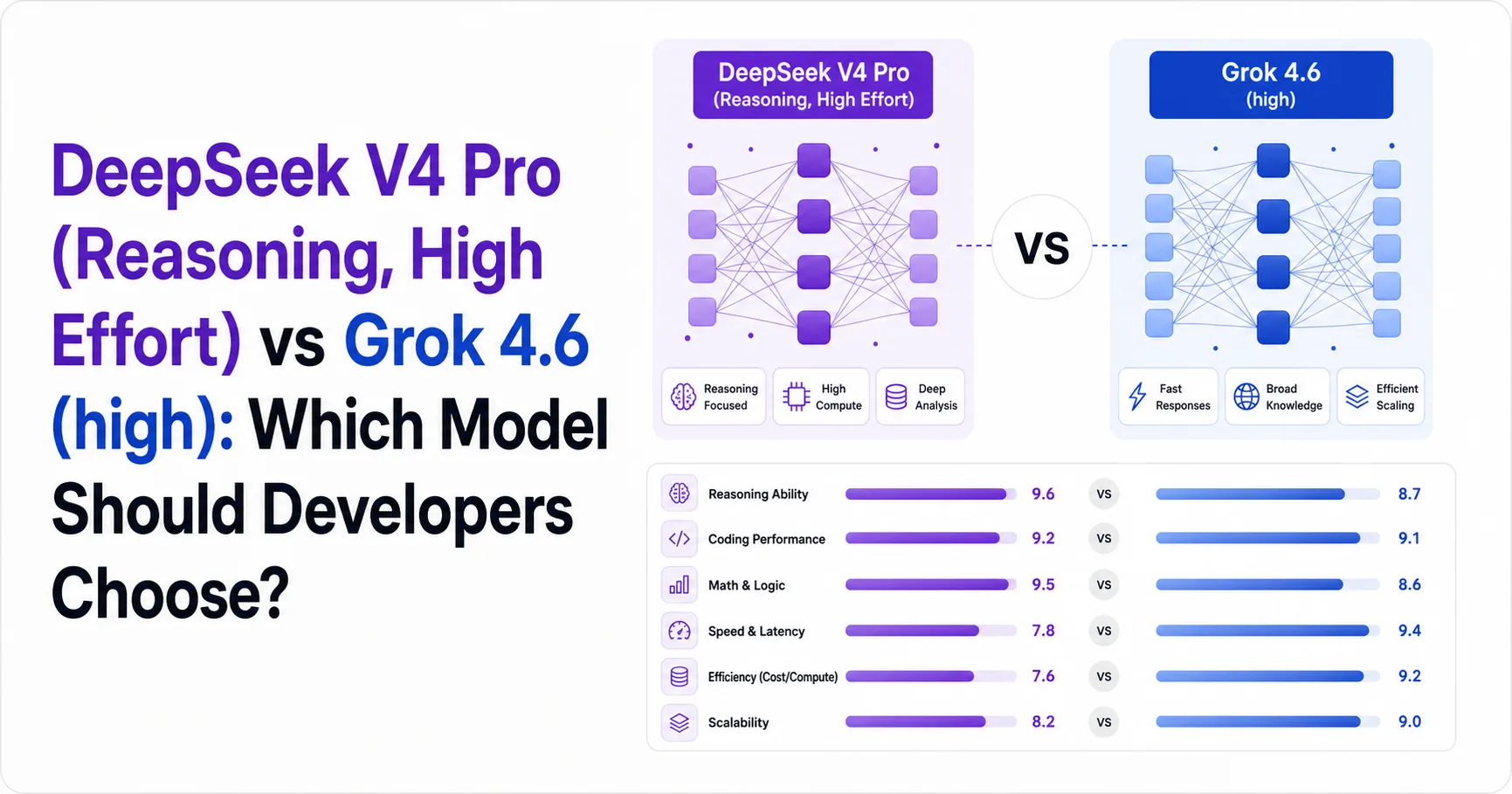
Grok 4.6 (high) is the better default when code quality and complex task completion matter more than token spend. Its measured coding index is 76.8, compared with 58.7 for DeepSeek V4 Pro (Reasoning, High Effort). Its broader intelligence index is also 60.9, compared with 43.7. Those results make Grok the safer starting point for changes where a weak answer can create review work, production defects, or repeated agent runs.
DeepSeek V4 Pro (Reasoning, High Effort) remains compelling when work is high-volume and the task has clear guardrails. Its blended price is $0.544 per 1M tokens, while Grok's is $3. That difference can matter for routine transformations, controlled extraction, test drafting, and internal tools where humans or automated checks review every result.
The important uncertainty is version confidence. The supplied research found no official page for the exact deepseek-v4-pro-0424-high target. DeepSeek's current official pricing page documents deepseek-v4-pro as DeepSeek-V4-Pro-0813, not the evaluated historical version. DeepSeek's official documentation therefore cannot confirm the evaluated version's context window, maximum output, High Effort behavior, or feature set.
Grok has a clearer current product position. xAI's model documentation recommends Grok 4.6 for code and other general tasks, and presents grok-4.6 as its model alias. This is vendor positioning rather than an independent benchmark claim, but it reduces ambiguity about which current API family developers are selecting.
Grok 4.6 (high) wins the capability-led choice, while DeepSeek V4 Pro (Reasoning, High Effort) wins the budget-led choice. The comparison is not simply about finding the largest score or the smallest token bill. A model choice also determines how much validation, retry logic, feature testing, and provider-change monitoring a team must own.
| Decision factor | DeepSeek V4 Pro (Reasoning, High Effort) | Grok 4.6 (high) |
|---|---|---|
| Best fit | Cost-sensitive, reviewed workflows | Difficult coding and general tasks |
| Measured coding index | 58.7 | 76.8 |
| Blended price per 1M tokens | $0.544 | $3 |
| Latency | 33.973 seconds | 49.322 seconds |
| Official version evidence | Exact evaluated version is unverified | Current model family is officially documented |
DeepSeek has the clearer economic advantage in the supplied data. It also has lower latency, which can improve the feel of single-turn interactions. Yet that advantage should not be treated as a guarantee of lower total cost. A cheaper response becomes expensive if it needs more retries, more developer review, or a stronger fallback model for difficult tickets.
Grok has the stronger measured results across the shared capability evaluations. It also has an explicit knowledge boundary: xAI's model documentation says Grok 4.6 has a knowledge cutoff of 2026-02-01 and requires Web Search or X Search for newer information. This limitation is useful because it is stated plainly. The supplied materials do not provide an equivalent verified knowledge-cutoff statement for the exact DeepSeek version.
Data provided by https://artificialanalysis.ai/. The data does not establish context-window size for either evaluated model, and neither supplied source provides verified community reports. Teams that depend on long repositories, large documents, image inputs, or token probabilities should test those needs before committing.
Grok 4.6 (high) is the better fit for difficult implementation tasks because it leads DeepSeek V4 Pro (Reasoning, High Effort) on every shared capability result shown here. The automatic comparison chart below carries the full score detail, so the practical question is what those leads change in day-to-day development.
For an agent that must inspect unfamiliar code, choose an approach, edit files, and explain tradeoffs, a stronger coding result usually means fewer fragile patches. Grok's 76.8 coding index is not a promise that every change will be correct. It does support using Grok first when the task has many interacting requirements, ambiguous failures, or a costly review cycle. The higher shared results on scientific coding, long-context retrieval, and terminal work point in the same direction.
DeepSeek can still be the right performance choice for bounded work. Its latency is 33.973 seconds, compared with 49.322 seconds for Grok. For interactive internal assistants, short drafting tasks, or workflows that make many independent requests, earlier first completion may matter more than a higher benchmark profile. Its 61.151 median output tokens per second is also close enough that end-to-end wait time should be measured inside the actual application.
Neither dataset settles several selection questions. Context-window values are absent for both models. The research also found no verified community evidence about coding reliability, perceived speed, or failure patterns for either target. xAI's documentation describes configurable reasoning and agent tool calling for Grok 4.6, but does not provide the evaluated benchmark scores or detailed parameter behavior. DeepSeek's documentation lists tools and JSON-related features for a later Pro version, but does not prove they apply to the evaluated DeepSeek version.
Use a small production-like evaluation before deciding. Include your repository conventions, tool schemas, tests, expected output format, and review process. The chart identifies the stronger measured candidate. Your evaluation should establish whether that advantage survives your tools, prompts, and acceptance checks.
Grok 4.6 (high) leads on 2 of 2 metrics
DeepSeek V4 Pro (Reasoning, High Effort) is the lower-priced model in every listed token category. The automatic price chart below shows the complete comparison. The cost decision should focus on request shape and correction cost rather than treating the blended price as a universal bill.
DeepSeek is especially attractive for workloads with stable prompts and predictable outputs. Examples include classification with strict labels, extraction into a pre-validated schema, controlled rewriting, and first-pass test generation. Its $0.435 input price and $0.87 output price can make large volumes easier to budget. A review queue or automated validator can then catch the cases where the lower-cost model is not sufficient.
Grok becomes economically rational when one stronger answer avoids repeat work. The supplied data shows a $3 blended price, so it is not the obvious default for bulk tasks. It may still cost less at the workflow level for difficult changes if a cheaper first attempt causes multiple retries, lengthy debugging, or escalation to another model. The briefs do not provide retry rates, tool-call success rates, output lengths in production, or human review time. That missing evidence means neither model can be declared cheaper for an entire engineering workflow.
Price stability is also unevenly documented. DeepSeek's official pricing page lists pricing for DeepSeek-V4-Pro-0813, warns that prices may change, and signals a possible increase. It does not verify that those prices belong to deepseek-v4-pro-0424-high. xAI's model documentation documents Grok 4.6 capabilities and aliases, but the supplied page contains no official price listing.
Treat the data snapshot as a selection input, not a procurement commitment. Confirm live provider pricing, account limits, model identifiers, and the billing treatment of tool use before a launch. Those checks matter because the official material does not close the historical-version gap for DeepSeek or the official-price gap for Grok.
DeepSeek V4 Pro (Reasoning, High Effort) leads on 3 of 3 metrics
Grok 4.6 (high) should be the primary model for complex coding tasks that carry meaningful failure or review cost. Its 76.8 coding index and 60.9 intelligence index give it the strongest measured case in this comparison. Use it for repository-wide changes, hard debugging, agentic terminal tasks, design decisions, and requests where an incomplete answer creates extra engineering work.
DeepSeek V4 Pro (Reasoning, High Effort) should be the economical model for narrow tasks with strong checks. Its $0.544 blended token price and 33.973-second latency make it a credible choice for tasks that are easy to verify. Good examples include structured extraction, routine text generation, constrained refactors, and workload bursts where a validator, test suite, or human review can reject weak outputs.
A practical routing policy can be simple:
Grok needs a freshness rule. xAI's documentation says the model needs Web Search or X Search for information after 2026-02-01. Enable an approved search tool for requests about current releases, current prices, news, or changing APIs. Do not assume general intelligence removes that boundary.
DeepSeek needs a version rule. DeepSeek's documentation supports current Pro API information, but the supplied research could not verify the exact evaluated target as a callable or supported official version. Pin and test the actual model identifier before routing production traffic. If the platform exposes only a newer Pro alias, rerun the evaluation because current documentation cannot establish that it behaves like the evaluated historical version.
This recommendation is intentionally conditional. The evidence strongly supports Grok for measured capability and DeepSeek for listed token economics. It does not establish exact feature parity, long-context behavior, multimodal support, production reliability, or community preference.
DeepSeek V4 Pro (Reasoning, High Effort) and Grok 4.6 (high) both require a production-like trial before a final commitment. The comparison has enough evidence to choose an initial route, but it does not answer several operational questions that can reverse a real deployment decision.
First, verify availability and version naming. The research could not find official evidence that deepseek-v4-pro-0424-high remains directly callable or identify its official replacement. DeepSeek's official page instead documents deepseek-v4-pro and DeepSeek-V4-Pro-0813. Grok has a documented grok-4.6 alias in xAI's model documentation, but the supplied materials do not provide a fixed dated version name.
Second, test the API features that your product actually needs. Grok's official documentation describes agent tool calling and configurable reasoning. It also says that later model families may silently ignore logprobs settings, while the supplied research could not verify Grok 4.6's own status. DeepSeek's current page lists JSON output, tool calling, Responses API, Anthropic compatibility, and FIM completion. Its FIM note says that feature is limited to non-thinking mode, but the research cannot confirm that restriction for the evaluated DeepSeek version.
Third, test retrieval size and media behavior. The data brief has no context-window value for either model. xAI's page provides general image-input limits, but does not explicitly assign them to Grok 4.6. The DeepSeek research does not verify multimodal behavior for the evaluated version. These are not minor documentation gaps if your product reads repositories, contracts, screenshots, or long support threads.
The right pre-launch test is therefore a representative workflow, not a generic chat prompt. Measure acceptance rate, retries, validation failures, tool failures, human review time, and effective token use. The supplied benchmark data identifies a capability leader and a price leader. Your own task data must decide whether either lead turns into a business advantage.
Grok 4.6 (high) is the stronger first choice for a coding agent because its measured coding index is 76.8, while DeepSeek V4 Pro (Reasoning, High Effort) scores 58.7. Test both against your repository and tool workflow before committing.
DeepSeek V4 Pro (Reasoning, High Effort) is cheaper per listed token price, with a $0.544 blended price versus $3 for Grok 4.6 (high). It may not be cheaper overall if retries, validation failures, or human review consume more engineering time.
Grok 4.6 (high) needs Web Search or X Search for information after its 2026-02-01 knowledge cutoff. Without a search tool, developers should provide current source material instead of assuming the model knows current releases, prices, or events.
DeepSeek V4 Pro (Reasoning, High Effort) should not be assumed callable from this comparison alone because the supplied research found no official documentation for deepseek-v4-pro-0424-high. Verify the live identifier, supported features, pricing, and behavior before sending production traffic.