
Time to First Token · DeepSeek V4 Pro (Reasoning, High Effort)
1166ms
Time to First Token · Muse Spark 1.2 (xhigh)
0ms
Deep dive into reasoning, benchmarks, and latency insights.
The current catalog does not contain complete performance evidence for both models, so this page does not declare an overall winner. Use the available fields as comparison signals and validate the models on your own workload.
Key decision metrics at a glance.
| Model | Metric | Value | Unit | Source / snapshot |
|---|---|---|---|---|
| DeepSeek V4 Pro (Reasoning, High Effort) | Reasoning | 6.0 | benchmark or capability score | Artificial Analysis · current catalog |
| Muse Spark 1.2 (xhigh) | Reasoning | 6.0 | benchmark or capability score | Artificial Analysis · current catalog |
| DeepSeek V4 Pro (Reasoning, High Effort) | Coding | 6.0 | benchmark or capability score | Artificial Analysis · current catalog |
| Muse Spark 1.2 (xhigh) | Coding | 7.0 | benchmark or capability score | Artificial Analysis · current catalog |
| DeepSeek V4 Pro (Reasoning, High Effort) | Multimodal | 4.0 | benchmark or capability score | Artificial Analysis · current catalog |
| Muse Spark 1.2 (xhigh) | Multimodal | 5.0 | benchmark or capability score | Artificial Analysis · current catalog |
| DeepSeek V4 Pro (Reasoning, High Effort) | Long Context | 5.0 | benchmark or capability score | Artificial Analysis · current catalog |
| Muse Spark 1.2 (xhigh) | Long Context | 7.0 | benchmark or capability score | Artificial Analysis · current catalog |
| DeepSeek V4 Pro (Reasoning, High Effort) | Blended Price / 1M tokens | $0.544 | USD per 1M tokens | Artificial Analysis · current catalog |
| Muse Spark 1.2 (xhigh) | Blended Price / 1M tokens | $2 | USD per 1M tokens | Artificial Analysis · current catalog |
| DeepSeek V4 Pro (Reasoning, High Effort) | P95 Latency | — | milliseconds | Artificial Analysis · current catalog |
| Muse Spark 1.2 (xhigh) | P95 Latency | — | milliseconds | Artificial Analysis · current catalog |
| DeepSeek V4 Pro (Reasoning, High Effort) | Tokens per second | 74.13 | tokens per second | Artificial Analysis · current catalog |
| Muse Spark 1.2 (xhigh) | Tokens per second | 0 | tokens per second | Artificial Analysis · current catalog |
Data provided by Artificial Analysis; live values use the current catalog.
This radar chart visually maps the core capabilities (reasoning, coding, math proxy, multimodal, long context) of `DeepSeek V4 Pro (Reasoning, High Effort)` vs `Muse Spark 1.2 (xhigh)`.
This grouped bar chart provides a side-by-side comparison for each benchmark metric.
Lower time to first token is better; higher tokens per second is better.
Compare input and output pricing in USD per 1M tokens.
DeepSeek V4 Pro (Reasoning, High Effort)$0.652
Muse Spark 1.2 (xhigh)$2.313
DeepSeek V4 Pro (Reasoning, High Effort) costs $1.66 less per run
This article is a dated snapshot published on 2026-08-13. Live cards above use the current catalog; missing live fields are not inferred.
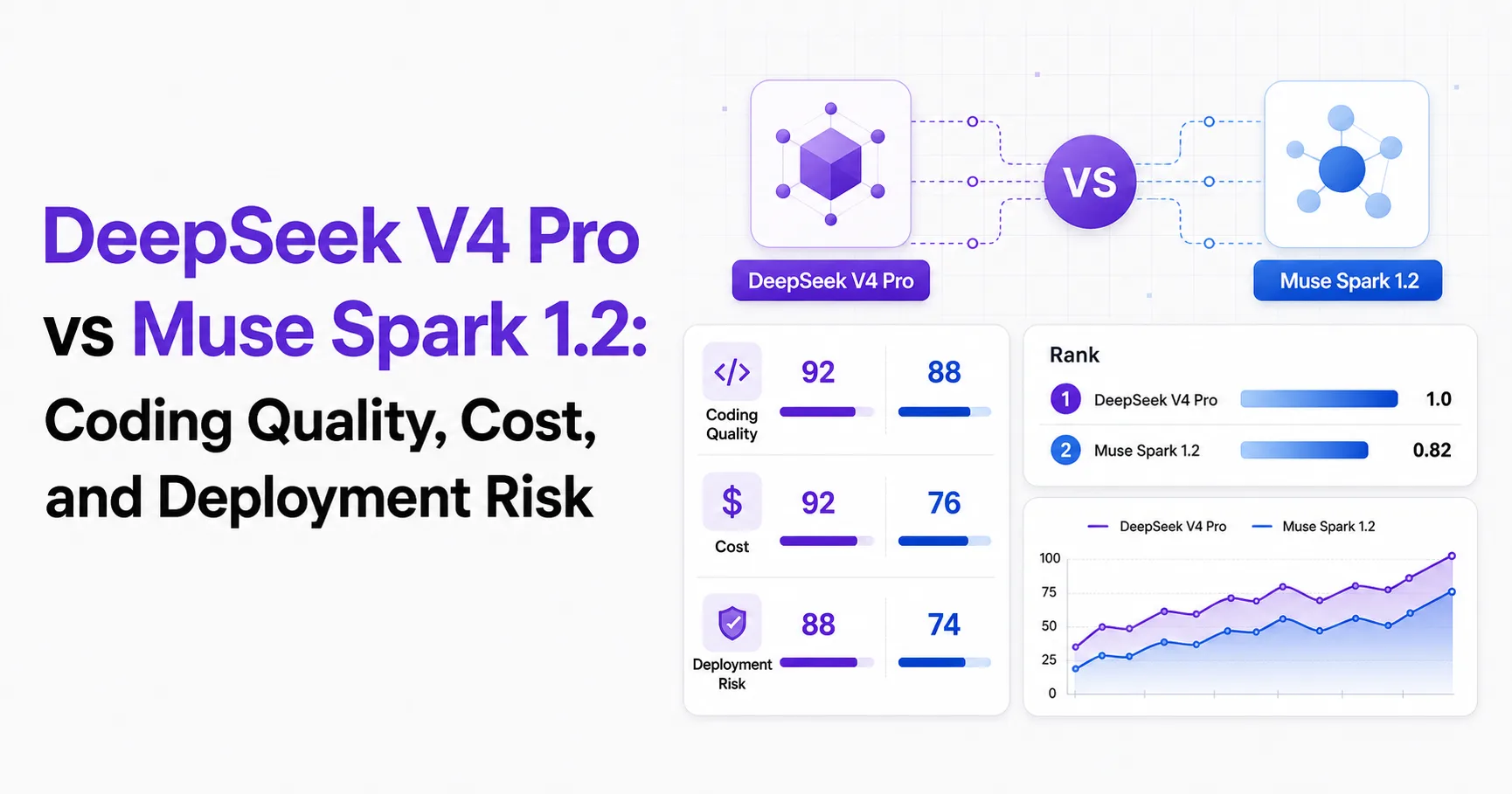
Muse Spark 1.2 (xhigh) is the stronger benchmark-first choice, while DeepSeek V4 Pro (Reasoning, High Effort) is the lower-cost choice with usable speed evidence. Muse records a 72.2 Artificial Analysis Coding Index, compared with 58.7 for DeepSeek. That is the clearest signal in this comparison for developers choosing a model to solve difficult repository tasks, generate code changes, or work through multi-step technical problems.
DeepSeek changes the decision when request volume, output volume, or interactive response speed matters. Its blended price is $0.544 per 1M tokens, while Muse is priced at $2. DeepSeek also reports 61.151 median output tokens per second. Muse shows 0 for both output speed and latency in this snapshot. That does not prove Muse is slow. It means the supplied data does not provide a usable measured speed result for Muse.
The largest risk is not model quality. It is product certainty. The supplied DeepSeek research cannot verify official documentation for the exact deepseek-v4-pro-0424-high version. The available DeepSeek page documents a newer DeepSeek-V4-Pro-0813 version instead, including its current API information and limits. DeepSeek's pricing documentation therefore helps evaluate the current product line, but cannot confirm the historical tested variant.
Muse has a similar but sharper documentation problem. Meta's AI documentation overview lists Llama-family models, not Muse Spark 1.2. For a production buyer, benchmark leadership is meaningful, but it is not a substitute for a documented API contract, model card, support path, or version lifecycle policy.
Muse Spark 1.2 (xhigh) is the better default for quality-sensitive coding work, but DeepSeek V4 Pro (Reasoning, High Effort) is easier to justify for cost-sensitive experimentation. Muse leads on the broad intelligence measure at 56.8 versus 43.7. It also leads on coding, HLE, SciCode, LCR, Terminal-Bench v2.1, and Tau-Bench banking in the supplied snapshot. Those results point toward stronger performance when a task requires sustained technical reasoning rather than a short, predictable completion.
DeepSeek has one notable result that argues against treating the comparison as one-sided. Its GPQA score is 0.905, slightly above Muse at 0.904. The difference is too narrow to support a major product decision by itself. It does show that the models do not separate cleanly on every evaluation.
| Decision factor | Better evidence | What it means for a developer |
|---|---|---|
| Complex coding work | Muse Spark 1.2, 72.2 coding index | Start here if failed code changes are expensive to review or repair. |
| Token budget | DeepSeek V4 Pro, $0.544 blended price | Start here when the application can tolerate more evaluation and routing work. |
| Measured generation rate | DeepSeek V4 Pro, 61.151 tokens per second | Prefer it for interfaces that need documented output-speed evidence. |
| Official version confidence | Neither model | Require a direct provider confirmation before committing either tested slug to production. |
The practical conclusion is simple. Use Muse when the model's first-pass problem-solving quality is the expensive variable. Use DeepSeek when token spend and visible generation speed are the expensive variables. Do not treat this article as confirmation that either exact benchmarked name is currently purchasable. The research found no official entry for Muse Spark 1.2, and it found only a newer DeepSeek Pro version on the official DeepSeek page. Meta's documentation overview and DeepSeek's pricing documentation establish that gap.
Muse Spark 1.2 (xhigh) has the stronger measured quality profile, especially for coding and tool-oriented technical tasks. Its 72.2 coding index exceeds DeepSeek's 58.7, and its 56.8 intelligence index exceeds DeepSeek's 43.7. For a developer, those gaps matter most when the model must understand an unfamiliar codebase, choose among several implementation paths, or recover from a partially failed approach.
The charts below should be read as a decision aid, not as a promise of identical results in your stack. Benchmark tasks are controlled. Your application may depend on private APIs, narrow domain vocabulary, tool reliability, prompt structure, retrieval quality, or a reviewer loop. None of those conditions is described in the supplied research for either exact model version.
Muse also leads on Terminal-Bench v2.1, with 0.801498127340824 against DeepSeek's 0.647940074906367. That is relevant for agent-style work where a model must act across a terminal-like environment. Still, the data does not establish what tools were available in a real provider API, whether the exact product names remain callable, or whether tool calling behaves consistently under production load.
DeepSeek is the only model here with a nonzero measured output-speed result, 61.151 median output tokens per second. Its latency is 33.973 seconds. Muse has 0 for both supplied runtime fields, so the correct conclusion is evidence absence, not runtime superiority or inferiority. A team building a chat product should run its own representative latency test before selecting Muse.
The documentation gap makes that test mandatory. DeepSeek's pricing documentation describes current capabilities such as JSON output, tool calling, Responses API support, and compatibility endpoints for a newer Pro version. It explicitly does not prove those capabilities for deepseek-v4-pro-0424-high. Meta's documentation overview does not document Muse Spark 1.2 at all.
Muse Spark 1.2 (xhigh) leads on 2 of 2 metrics
DeepSeek V4 Pro (Reasoning, High Effort) is the cheaper option across every supplied token-price measure. Its blended 3-to-1 price is $0.544 per 1M tokens, compared with $2 for Muse Spark 1.2. Its input price is $0.435 versus $1.25, while its output price is $0.87 versus $4.25. For high-volume extraction, classification, drafting, or internal assistant workloads, that price difference can dominate the selection.
The charts below show the price gap. They cannot show the total cost of getting a correct outcome. A cheaper model becomes more expensive when it causes repeated retries, longer prompts, additional tool calls, or more human review. The benchmark data gives Muse a stronger coding score, so a coding agent that succeeds more often on a difficult task may be worth its higher token price. The supplied material does not provide task completion rates, retry counts, or human review time. That is the key missing evidence for a true cost-per-success comparison.
DeepSeek's current official page adds a second pricing caveat. Its listed Pro prices belong to DeepSeek-V4-Pro-0813, not the tested deepseek-v4-pro-0424-high slug. The page also says prices may change and notes a possible upcoming increase. DeepSeek's pricing documentation should therefore be used to validate a live quote, not to assume future billing for the benchmarked historical variant.
Muse presents a different buying risk. The supplied research found no official Meta price, API alias, or replacement relationship for muse-spark-1-2. The $2 blended figure in this comparison is useful benchmark data, but it is not proof of a publicly available provider price. Meta's documentation overview only states that Llama models can be obtained from Meta or partners. It does not identify Muse Spark 1.2.
DeepSeek V4 Pro (Reasoning, High Effort) leads on 3 of 3 metrics
Muse Spark 1.2 (xhigh) is the recommended quality-first pick if your team can verify access, pricing, and operational support before launch. The evidence supports this recommendation because Muse leads the supplied coding and intelligence measures, while also leading several evaluations relevant to technical and agentic work. Its advantage is most valuable where one poor implementation can create a costly review cycle, a broken release candidate, or an incorrect infrastructure change.
DeepSeek V4 Pro (Reasoning, High Effort) is the recommended budget-first pick for workloads that need lower per-token cost and available speed evidence. Its $0.544 blended price and 61.151 median output tokens per second make it the more concrete choice for a controlled prototype, batch workload, or product surface where token economics are visible. The quality tradeoff is real, because its coding index is 58.7 versus Muse's 72.2.
Before selecting either model, make provider verification a release gate. Ask the provider or platform for the exact callable model ID, supported regions, context limit, output limit, rate limit, tool behavior, version-retirement policy, and current pricing. This is not administrative overhead. It decides whether a benchmark result can become an application dependency.
DeepSeek has partial current documentation, but it is for DeepSeek-V4-Pro-0813. DeepSeek's pricing documentation lists a 1M context window, a 384K maximum output, and a concurrency limit of 500 for that current version. Those details must not be projected onto the tested April version. Muse has no corresponding official documentation in the supplied sources. Meta's documentation overview does not list the Muse name.
The safest implementation pattern is to preserve a model switch in your application, evaluate both models on your own tasks, and promote a provider only after the exact production version is confirmed. The benchmark winner and the deployment winner may be different models.
DeepSeek V4 Pro (Reasoning, High Effort) and Muse Spark 1.2 (xhigh) require provider verification before either can be treated as a stable production dependency. The data snapshot offers meaningful quality, price, and runtime signals. It does not establish a complete deployment contract for either exact tested identifier.
The most important unanswered questions are practical. Can your account call the exact model? What happens when the provider retires or changes that model? Does tool calling work with the requested reasoning mode? What context and output limits apply? How much does a successful completed task cost after retries and review? The supplied research cannot answer those questions directly.
For DeepSeek, the current official product documentation is informative but version-specific. DeepSeek's pricing documentation lists current Pro endpoints and features, including JSON output and tool calling. It also states that FIM Completion is limited to non-thinking mode. The research cannot confirm that this restriction or any listed feature applies to deepseek-v4-pro-0424-high.
For Muse, the documentation shortfall is broader. Meta's documentation overview covers Llama models and partner access, but does not mention Muse Spark 1.2. That leaves its model limits, supported modes, price source, and operational availability unverified by an official source.
Use the benchmark result to decide what to test first. Use direct provider confirmation and a representative integration test to decide what to ship.
Muse Spark 1.2 (xhigh) is the better first model to evaluate for coding agents because its Artificial Analysis Coding Index is 72.2, versus 58.7 for DeepSeek V4 Pro. Verify that the exact model is callable and supports your required tool workflow before shipping.
DeepSeek V4 Pro (Reasoning, High Effort) is cheaper in the supplied snapshot at $0.544 per 1M blended tokens, versus $2 for Muse Spark 1.2. Measure retries, prompt length, and human review because token price alone cannot show total cost per successful task.
DeepSeek V4 Pro has the only usable measured output-speed value, 61.151 median output tokens per second. Muse Spark 1.2 shows 0 for supplied speed and latency fields, which indicates missing usable runtime evidence here rather than proof that Muse is slower.
Neither exact tested name has sufficient official documentation in the supplied research. DeepSeek documentation covers a newer DeepSeek-V4-Pro-0813 version, while Meta's supplied documentation does not mention Muse Spark 1.2. Confirm the exact version, limits, price, and lifecycle directly with the provider.