
Time to First Token · DeepSeek V4 Pro (Non-reasoning)
1342ms
Time to First Token · GPT-5.5 (xhigh)
0ms
Deep dive into reasoning, benchmarks, and latency insights.
The current catalog does not contain complete performance evidence for both models, so this page does not declare an overall winner. Use the available fields as comparison signals and validate the models on your own workload.
Key decision metrics at a glance.
| Model | Metric | Value | Unit | Source / snapshot |
|---|---|---|---|---|
| DeepSeek V4 Pro (Non-reasoning) | Reasoning | 6.0 | benchmark or capability score | Artificial Analysis · current catalog |
| GPT-5.5 (xhigh) | Reasoning | 6.0 | benchmark or capability score | Artificial Analysis · current catalog |
| DeepSeek V4 Pro (Non-reasoning) | Coding | 6.0 | benchmark or capability score | Artificial Analysis · current catalog |
| GPT-5.5 (xhigh) | Coding | 7.0 | benchmark or capability score | Artificial Analysis · current catalog |
| DeepSeek V4 Pro (Non-reasoning) | Multimodal | 3.0 | benchmark or capability score | Artificial Analysis · current catalog |
| GPT-5.5 (xhigh) | Multimodal | 5.0 | benchmark or capability score | Artificial Analysis · current catalog |
| DeepSeek V4 Pro (Non-reasoning) | Long Context | 4.0 | benchmark or capability score | Artificial Analysis · current catalog |
| GPT-5.5 (xhigh) | Long Context | 7.0 | benchmark or capability score | Artificial Analysis · current catalog |
| DeepSeek V4 Pro (Non-reasoning) | Blended Price / 1M tokens | $0.544 | USD per 1M tokens | Artificial Analysis · current catalog |
| GPT-5.5 (xhigh) | Blended Price / 1M tokens | $11.25 | USD per 1M tokens | Artificial Analysis · current catalog |
| DeepSeek V4 Pro (Non-reasoning) | P95 Latency | — | milliseconds | Artificial Analysis · current catalog |
| GPT-5.5 (xhigh) | P95 Latency | — | milliseconds | Artificial Analysis · current catalog |
| DeepSeek V4 Pro (Non-reasoning) | Tokens per second | 75.998 | tokens per second | Artificial Analysis · current catalog |
| GPT-5.5 (xhigh) | Tokens per second | 0 | tokens per second | Artificial Analysis · current catalog |
Data provided by Artificial Analysis; live values use the current catalog.
This radar chart visually maps the core capabilities (reasoning, coding, math proxy, multimodal, long context) of `DeepSeek V4 Pro (Non-reasoning)` vs `GPT-5.5 (xhigh)`.
This grouped bar chart provides a side-by-side comparison for each benchmark metric.
Lower time to first token is better; higher tokens per second is better.
Compare input and output pricing in USD per 1M tokens.
DeepSeek V4 Pro (Non-reasoning)$0.652
GPT-5.5 (xhigh)$12.5
DeepSeek V4 Pro (Non-reasoning) costs $11.848 less per run
This article is a dated snapshot published on 2026-08-13. Live cards above use the current catalog; missing live fields are not inferred.
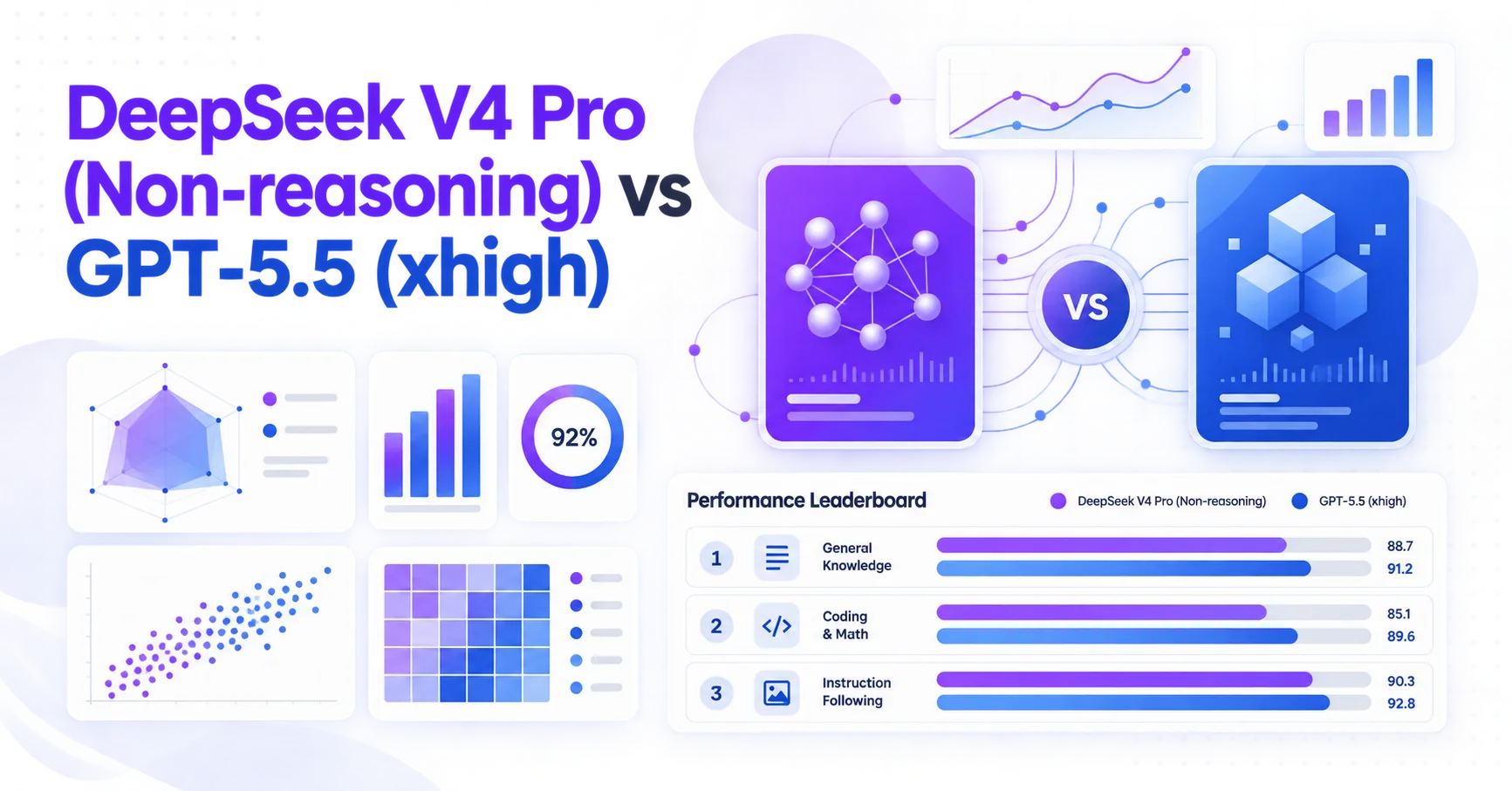
GPT-5.5 (xhigh) is the safer overall choice when correctness, tool use, and difficult coding work matter more than token cost. Its measured intelligence index is 56.3, compared with 31.9 for DeepSeek V4 Pro (Non-reasoning). The available evaluation data also favors GPT-5.5 across GPQA, HLE, SciCode, instruction following, long-context retrieval, terminal tasks, and agent tasks. Data provided by https://artificialanalysis.ai/
That conclusion has an important limit. GPT-5.5 (xhigh) is a reasoning setting for the gpt-5.5 model, not a separate model ID, and OpenAI says higher reasoning effort does not always improve results. Poor stopping rules, conflicting instructions, or overly broad tool access can cause extra searching, higher latency, and lower-quality output. Using GPT-5.5
DeepSeek V4 Pro (Non-reasoning) is attractive when low unit cost and fast output are primary constraints. However, its exact model identifier has a major procurement risk: no dedicated official capability, API, modality, benchmark, or availability documentation was found for deepseek-v4-pro-0424-non-reasoning. DeepSeek's current stable alias points to a later model, DeepSeek-V4-Pro-0813, so an integration using the alias is not a reproducible deployment of the compared version. Models & Pricing
For most teams, the practical decision is therefore simple. Use GPT-5.5 (xhigh) for fewer, more consequential runs that must inspect code, follow constraints, and operate tools. Use DeepSeek only after confirming that the exact version remains callable and passes your own production test set.
GPT-5.5 (xhigh) offers clearer product boundaries, while DeepSeek V4 Pro (Non-reasoning) offers a much lower measured token price. OpenAI documents the model ID, current snapshot, APIs, input types, output limits, structured outputs, function calling, image input, web search, file search, and hosted tools. GPT-5.5 model documentation
DeepSeek's evidence is less stable for this exact comparison target. Current documentation describes the stable deepseek-v4-pro alias rather than the dated non-reasoning version. It lists JSON output, tool calling, Responses API, Anthropic API compatibility, Chat Prefix Completion, and FIM Completion for the current alias. Yet these capabilities cannot be safely projected backward onto the 0424 version. Models & Pricing
| Decision factor | Better choice | Why it matters |
|---|---|---|
| Complex task quality | GPT-5.5 (xhigh) | The available cross-model evaluations consistently favor it. |
| Token economics | DeepSeek V4 Pro (Non-reasoning) | Its blended price is $0.544, versus $11.25. |
| Version reproducibility | GPT-5.5 (xhigh) | Its stable model ID and current snapshot are documented. |
| Fast streamed drafting | DeepSeek V4 Pro (Non-reasoning) | The snapshot reports 62.894 median output tokens per second. |
| Multimodal and hosted tools | GPT-5.5 (xhigh) | Official documentation explicitly covers image input and hosted tools. |
The unanswered question is whether DeepSeek's low price survives real operational costs. The supplied material does not establish its exact API availability, multimodal support, or failure rate for the 0424 non-reasoning version. A cheap model becomes expensive if engineers must repeatedly retry tasks, add manual review, or build compatibility fallbacks. The brief does not provide retry-rate evidence, so that risk must be tested rather than assumed.
GPT-5.5 (xhigh) is the stronger choice for tasks where a failed run costs more than a slow or expensive run. Its 56.3 intelligence index leads DeepSeek's 31.9, and it also leads on the available GPQA, HLE, SciCode, instruction-following, long-context retrieval, terminal, and agent evaluations. Data provided by https://artificialanalysis.ai/
The chart below shows the scores, but the decision value lies in their pattern. GPT-5.5 does not win only one narrow category. It leads on knowledge-heavy reasoning, technical scientific work, following complex instructions, retrieving from long contexts, and operating in terminal-style environments. That pattern supports using it where one task combines repository context, a plan, tools, and acceptance checks.
OpenAI's own positioning aligns with that use case. It describes GPT-5.5 for complex professional work, coding, tool-intensive agents, long-context retrieval, and transforming product specifications into plans. Using GPT-5.5 OpenAI also publishes results for benchmarks including Terminal-Bench 2.0 and SWE-Bench Pro, although some listed evaluations are internal. Introducing GPT-5.5
DeepSeek V4 Pro (Non-reasoning) has a reported output speed of 62.894 median tokens per second and latency of 1.24 seconds. GPT-5.5's supplied speed and latency values are both 0, which should not be read as real zero latency or zero generation speed. They are insufficient measurement data for a speed comparison. Data provided by https://artificialanalysis.ai/
Choose DeepSeek for throughput-sensitive, reviewable tasks only after testing. The evidence does not show whether its fast token stream produces accepted work at the same rate. It also does not show how its non-reasoning mode behaves on multi-step coding tasks.
DeepSeek V4 Pro (Non-reasoning) is the clear per-token cost winner at $0.544 per 1M blended tokens, compared with $11.25 for GPT-5.5 (xhigh). Its input price is $0.435 and output price is $0.87, while GPT-5.5's corresponding supplied prices are $5 and $30. Data provided by https://artificialanalysis.ai/
The chart below captures the direct price gap. It does not capture the cost of a task that must be rerun, manually repaired, or escalated to a stronger model. That missing evidence matters most for coding agents. A model that creates a plausible but fragile change can consume engineering review time and create downstream maintenance work. Community reports about GPT-5.5 itself also warn that insufficient constraints can lead to brittle code or an overly monolithic structure. These reports are personal experiences, not controlled benchmarks. What types of users are getting good results from GPT 5.5?
GPT-5.5 pricing also depends on context length and service mode. OpenAI lists different short-context and long-context prices, plus Batch, Flex, and Fast mode prices. For inputs beyond 272K tokens, Standard, Batch, and Flex apply higher full-session prices. OpenAI API pricing GPT-5.5 model documentation
DeepSeek's current public pricing introduces another uncertainty. Its documented stable alias has announced peak and off-peak pricing, but that is not a version-specific price for deepseek-v4-pro-0424-non-reasoning. Models & Pricing
Budget owners should therefore buy DeepSeek for high-volume, bounded work with easy verification. They should buy GPT-5.5 for tasks where a correct first result prevents expensive rework. No supplied source measures accepted-task cost, so run a representative internal evaluation before setting a routing rule.
DeepSeek V4 Pro (Non-reasoning) leads on 3 of 3 metrics
GPT-5.5 (xhigh) should be the primary model for complex coding agents, architecture review, difficult debugging, and long-context work. Its documented 1,050,000-token context window, 128,000-token maximum output, text-and-image input, structured outputs, function calling, and hosted tools make it the more specified platform for those workflows. GPT-5.5 model documentation
Use xhigh selectively rather than universally. OpenAI recommends using the highest reasoning effort only when evaluation proves that its quality gain justifies added delay and cost. For open-ended agents, define tool permissions, stopping conditions, validation rules, and escalation behavior. Using GPT-5.5
DeepSeek V4 Pro (Non-reasoning) should be considered for large volumes of constrained work, such as drafts, transformations, classification-like routing, or clearly testable code edits. Its supplied price and output-speed figures create a strong economic case for such queues. Do not treat that as a universal recommendation. The materials do not confirm whether the dated model can still be called directly, nor do they establish its context window, modality support, official benchmark results, or tool behavior.
A useful routing policy is:
Community discussion offers supporting but limited context. One developer described GPT-5.5 as useful for architecture, debugging direction, code review, planning, and long project sessions. The post provides no reproducible benchmark or sample size. Codex GPT-5.5 + cheap coding models is honestly the best workflow I’ve used so far
This recommendation favors predictable delivery over the lowest invoice. DeepSeek may become the better default if an internal test proves comparable acceptance rates on your specific workload, but the supplied evidence cannot establish that outcome.
GPT-5.5 (xhigh) and DeepSeek V4 Pro (Non-reasoning) require different validation plans because their evidence quality is not equivalent. GPT-5.5 has detailed official product documentation, while the exact dated DeepSeek version has substantial documentation gaps. GPT-5.5 model documentation Models & Pricing
Before a production commitment, confirm four things: whether deepseek-v4-pro-0424-non-reasoning is directly callable, whether its required APIs and tools work, whether it passes your representative acceptance tests, and whether retries erase its token-price advantage. These are not minor operational details. They decide whether a model can be deployed predictably.
GPT-5.5 also needs a real evaluation, despite its stronger evidence. Its current model ID remains available, but OpenAI's visible model-selection guidance has moved toward the GPT-5.6 family. No supplied official source says GPT-5.5 has been deprecated or removed. Models GPT-5.5 model documentation
The evidence is particularly thin on direct head-to-head user experience. No verified community discussion was found for the specific DeepSeek 0424 non-reasoning version. GPT-5.5 discussions are mixed and anecdotal. That means neither model's real-world coding acceptance rate, latency under your load, or maintenance impact can be inferred from community sentiment alone.
GPT-5.5 (xhigh) is the better starting choice for a production coding agent because the available evaluation evidence and official tool documentation are stronger. Use xhigh only after testing its quality gain against added cost and delay. Using GPT-5.5
DeepSeek V4 Pro (Non-reasoning) should not be assumed to be available through the stable alias because the documented alias currently points to DeepSeek-V4-Pro-0813. Confirm the exact dated identifier, required API behavior, and pricing before deployment. Models & Pricing
GPT-5.5 xhigh does not always produce better answers because OpenAI warns that higher reasoning effort can overthink, search unnecessarily, increase latency, and reduce quality under conflicting instructions or weak stopping conditions. Using GPT-5.5
DeepSeek V4 Pro (Non-reasoning) can cost more per accepted outcome if low-cost generations require retries, manual repairs, extra review, or escalation to another model. The supplied sources provide no accepted-task-cost benchmark, so measure this on representative internal tasks.
DeepSeek V4 Pro (Non-reasoning) has usable supplied speed data, but GPT-5.5 xhigh does not have usable supplied latency or output-speed data in this snapshot. Treat the zero values as missing comparison evidence, then benchmark your own workload. Data provided by https://artificialanalysis.ai/