
Time to First Token · DeepSeek V4 Pro (Non-reasoning)
1342ms
Time to First Token · GPT-5.6 Sol (max)
75247ms
Deep dive into reasoning, benchmarks, and latency insights.
The current catalog does not contain complete performance evidence for both models, so this page does not declare an overall winner. Use the available fields as comparison signals and validate the models on your own workload.
Key decision metrics at a glance.
| Model | Metric | Value | Unit | Source / snapshot |
|---|---|---|---|---|
| DeepSeek V4 Pro (Non-reasoning) | Reasoning | 6.0 | benchmark or capability score | Artificial Analysis · current catalog |
| GPT-5.6 Sol (max) | Reasoning | 6.0 | benchmark or capability score | Artificial Analysis · current catalog |
| DeepSeek V4 Pro (Non-reasoning) | Coding | 6.0 | benchmark or capability score | Artificial Analysis · current catalog |
| GPT-5.6 Sol (max) | Coding | 8.0 | benchmark or capability score | Artificial Analysis · current catalog |
| DeepSeek V4 Pro (Non-reasoning) | Multimodal | 3.0 | benchmark or capability score | Artificial Analysis · current catalog |
| GPT-5.6 Sol (max) | Multimodal | 5.0 | benchmark or capability score | Artificial Analysis · current catalog |
| DeepSeek V4 Pro (Non-reasoning) | Long Context | 4.0 | benchmark or capability score | Artificial Analysis · current catalog |
| GPT-5.6 Sol (max) | Long Context | 8.0 | benchmark or capability score | Artificial Analysis · current catalog |
| DeepSeek V4 Pro (Non-reasoning) | Blended Price / 1M tokens | $0.544 | USD per 1M tokens | Artificial Analysis · current catalog |
| GPT-5.6 Sol (max) | Blended Price / 1M tokens | $11.25 | USD per 1M tokens | Artificial Analysis · current catalog |
| DeepSeek V4 Pro (Non-reasoning) | P95 Latency | — | milliseconds | Artificial Analysis · current catalog |
| GPT-5.6 Sol (max) | P95 Latency | — | milliseconds | Artificial Analysis · current catalog |
| DeepSeek V4 Pro (Non-reasoning) | Tokens per second | 75.998 | tokens per second | Artificial Analysis · current catalog |
| GPT-5.6 Sol (max) | Tokens per second | 68.734 | tokens per second | Artificial Analysis · current catalog |
Data provided by Artificial Analysis; live values use the current catalog.
This radar chart visually maps the core capabilities (reasoning, coding, math proxy, multimodal, long context) of `DeepSeek V4 Pro (Non-reasoning)` vs `GPT-5.6 Sol (max)`.
This grouped bar chart provides a side-by-side comparison for each benchmark metric.
Lower time to first token is better; higher tokens per second is better.
Compare input and output pricing in USD per 1M tokens.
DeepSeek V4 Pro (Non-reasoning)$0.652
GPT-5.6 Sol (max)$12.5
DeepSeek V4 Pro (Non-reasoning) costs $11.848 less per run
This article is a dated snapshot published on 2026-08-13. Live cards above use the current catalog; missing live fields are not inferred.
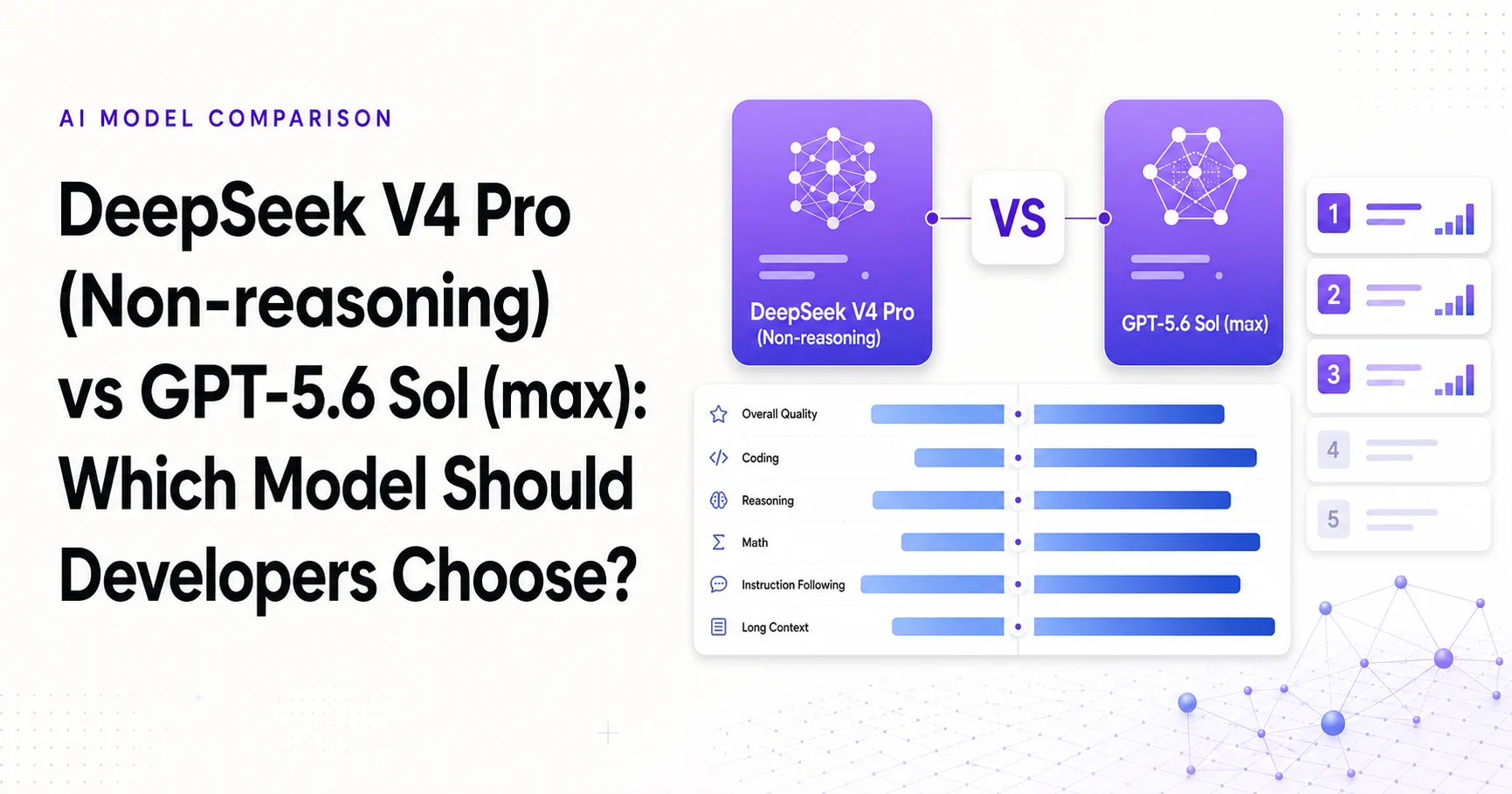
GPT-5.6 Sol (max) is the stronger default for high-stakes developer work because its measured capability is higher across most shared evaluations. The trade-off is material: DeepSeek V4 Pro (Non-reasoning) costs $0.544 per 1M blended tokens, while GPT-5.6 Sol (max) costs $11.25 in the supplied snapshot. DeepSeek also records 1.24 seconds latency, compared with 113.767 seconds for Sol Max.
That creates two very different product choices. GPT-5.6 Sol (max) fits work where a harder answer can prevent engineering rework: complex code changes, long investigations, agent tasks, and reviews that need structured tool use. OpenAI positions Sol as its flagship for complex reasoning, programming, and professional work, and documents max as the setting for the most difficult tasks in its reasoning guide.
DeepSeek V4 Pro (Non-reasoning) fits throughput-sensitive work where fast first responses and low unit cost matter more than maximum reasoning depth. However, this comparison has an unusual procurement risk. The benchmark snapshot names the April model, but DeepSeek's current stable alias points to a later version. Its official documentation does not establish whether the exact April non-reasoning model remains directly callable on the current pricing page.
Data provided by https://artificialanalysis.ai/. The numbers show a clear economic and latency divide, but they do not answer every operational question. Teams should confirm the exact DeepSeek model ID, availability, and API behavior before making it a production dependency.
DeepSeek V4 Pro (Non-reasoning) is the better value choice for high-volume tasks that can tolerate weaker general reasoning evidence. Its $0.544 blended price makes it suitable for classification, extraction, routine drafting, simple transformations, and interactive features where 1.24 seconds latency affects user experience. GPT-5.6 Sol (max) is the better fit when the task itself is expensive to get wrong.
| Decision factor | Better choice | Why it matters |
|---|---|---|
| Difficult coding and terminal work | GPT-5.6 Sol (max) | It leads the shared intelligence, science-code, instruction-following, long-context, and terminal evaluations. |
| High-volume request handling | DeepSeek V4 Pro (Non-reasoning) | Its $0.544 blended price supports far more economical repeated calls. |
| Fast interactive response | DeepSeek V4 Pro (Non-reasoning) | Its measured latency is 1.24 seconds. |
| Built-in agent tooling and image input | GPT-5.6 Sol (max) | OpenAI documents image input, structured outputs, function calling, and hosted tools for Sol. |
| Version stability and documentation | GPT-5.6 Sol (max) | Its model ID and stable alias are currently documented, while the DeepSeek comparison version lacks equivalent current documentation. |
The most important missing evidence is not a benchmark score. Neither brief provides a controlled, task-for-task comparison of production completion quality, retry rate, tool-call reliability, or code review acceptance. That gap matters because a cheaper model becomes more expensive if it requires more human correction or repeated calls.
GPT-5.6 Sol (max) also should not be treated as automatically better for every coding prompt. Community reports describe over-design, expanded scope, and excessive defensive code in some real projects, but the reports lack reproducible test setups on Reddit and on Hacker News. Use those reports as a prompt-design warning, not as a measured failure rate.
GPT-5.6 Sol (max) leads DeepSeek V4 Pro (Non-reasoning) on the shared evaluations that best represent difficult reasoning and developer-agent work. The chart below carries the full score detail. Its practical meaning is that Sol Max is the safer first candidate when one request must navigate ambiguity, follow multi-part constraints, use tools, or complete difficult terminal tasks.
The lead is not universal. DeepSeek performs better on TAU2 in this snapshot, so the data does not support a claim that Sol Max dominates every agent-style workflow. It also does not supply a DeepSeek coding-index score, so developers should not infer a precise coding-quality gap from the available comparison. Missing values are evidence gaps, not poor scores.
Speed needs careful interpretation. The measured output rates are close, at 62.894 and 63.925 output tokens per second. The far larger difference is time before useful work begins: 1.24 seconds for DeepSeek versus 113.767 seconds for Sol Max. For chat interfaces, autocomplete-like flows, or many short requests, that waiting time can outweigh Sol's capability advantage.
Sol Max latency is partly a feature choice rather than a fixed model trait. OpenAI says higher reasoning effort raises token use, latency, and cost, and recommends using higher settings only when testing shows enough benefit in its reasoning documentation. The supplied data describes max, not lower effort settings. A team that chooses Sol should benchmark low, medium, and max against its own tasks instead of assuming every request needs maximum deliberation.
DeepSeek's fast result also needs validation before rollout. The official material found for DeepSeek documents the current stable alias rather than the exact April non-reasoning version. There is no version-specific official evidence here for its tool behavior, multimodal support, or known failure modes on DeepSeek's pricing page.
DeepSeek V4 Pro (Non-reasoning) is dramatically cheaper in the supplied token-price snapshot, making it the rational baseline for volume-led workloads. The chart below already shows the full price comparison. The meaningful business implication is that DeepSeek gives teams more room for retries, larger evaluation sets, and frequent user-facing calls within a fixed model budget.
Price alone is not the same as cost per successful outcome. DeepSeek becomes less attractive if a task needs several corrections, a second model pass, or human review before it is usable. The research brief does not provide task completion rates, retry counts, or human-editing time for the exact DeepSeek version. It therefore cannot prove whether its lower token price stays lower after quality-control work.
GPT-5.6 Sol (max) has a different cost risk. Its maximum reasoning setting can create invisible reasoning tokens that consume context and are billed as output tokens. OpenAI states that those tokens can range from hundreds to tens of thousands on complex work in the reasoning guide. Developers should measure complete request cost, including reasoning and retries, rather than estimate from visible output alone.
Long prompts deserve separate budgeting. OpenAI says requests above 272K input tokens are charged at higher input and output rates on the Sol model page. A repository-wide investigation, large specification, or extensive retrieved context may therefore cost more than a short-context estimate suggests. Caching strategy also matters because OpenAI publishes separate input, cached-input, and cache-write prices on its pricing page.
DeepSeek's official listed prices should not be substituted for the snapshot's April-version numbers. The current alias maps to a later model, and DeepSeek has announced peak and off-peak price changes on its pricing page. Confirm current billing before forecasting production spend.
DeepSeek V4 Pro (Non-reasoning) leads on 3 of 3 metrics
GPT-5.6 Sol (max) should be selected for hard developer tasks where stronger measured capability can save more time than its $11.25 blended price costs. Start with codebase investigations, multi-step implementation plans, difficult terminal tasks, complex reviews, and agent flows that need first-party tool support. Sol supports text and image input, plus Responses API tools such as web search, file search, code interpreter, hosted shell, computer use, MCP, and tool search on its model page.
DeepSeek V4 Pro (Non-reasoning) should be tested first for predictable, repeatable, high-frequency work where latency and token price drive the product economics. Use it for structured extraction, routing, concise generation, low-risk transformations, and queues where a 1.24-second response is more valuable than extended deliberation. Do not make the exact April ID a hidden infrastructure assumption until its direct availability is verified.
A practical routing policy is simple. Send low-risk, high-volume requests to DeepSeek after task-specific quality tests. Escalate ambiguous, high-impact, or tool-heavy tasks to Sol. For Sol, begin below max where acceptable, then increase reasoning effort only after evaluation shows a meaningful improvement. OpenAI explicitly advises measuring whether higher effort offsets its extra latency and token cost in its reasoning guide.
Avoid a full replacement decision based solely on this article's benchmark chart. The briefs provide no matched production corpus, no side-by-side tool-use reliability result, no exact DeepSeek API compatibility record for the April version, and no controlled evidence about Sol's reported over-building behavior. The right rollout is a gated evaluation with your prompts, repositories, schemas, latency target, and human review standard.
For teams that need one initial answer, choose Sol Max for difficult work with a high failure cost. Choose DeepSeek for scale-sensitive work only after confirming that the exact version can be invoked and meets your acceptance threshold.
DeepSeek V4 Pro (Non-reasoning) requires an availability check before production use because its exact comparison version is not documented as the current stable target. DeepSeek's current stable alias points to DeepSeek-V4-Pro-0813, not the April non-reasoning version in this benchmark snapshot on the official pricing page. Ask the provider whether the full versioned ID is callable, what lifecycle guarantees apply, and whether its pricing remains aligned with your procurement assumptions.
GPT-5.6 Sol (max) requires a task-level reasoning policy before production use because max can trade responsiveness for deeper work. The model remains listed in OpenAI's model documentation, and its stable alias routes to GPT-5.6 Sol in the model catalog. Yet its 113.767-second measured latency means it should rarely be the unexamined default for a user waiting in a live interface.
The missing comparison evidence is especially important for developers. There is no shared code benchmark result for both models in the supplied data. There is no controlled study of JSON validity, tool-call recovery, repository modification success, or post-review defect rate. There is also no reliable community evidence specific to DeepSeek V4 Pro (Non-reasoning).
The decision is therefore not "which model is best?" It is "which model has the lowest cost for an accepted result in this workflow?" Use the benchmark data to form a hypothesis. Then test a representative set of real tasks, record success, retries, elapsed time, and total billed tokens. That evidence will resolve the questions the public materials cannot answer.
GPT-5.6 Sol (max) is the stronger starting choice for difficult coding tasks because it leads the supplied shared capability measures and has an Artificial Analysis Coding Index result of 77.4. Still, DeepSeek lacks a matching coding-index result here, so teams should test their own repositories before making a final decision.
DeepSeek V4 Pro (Non-reasoning) is cheaper in the supplied snapshot at $0.544 per 1M blended tokens, compared with $11.25 for GPT-5.6 Sol (max). That advantage matters most for repeated, low-risk requests, but it can disappear if lower first-pass quality causes retries, review work, or escalation.
GPT-5.6 Sol (max) is slower mainly because its measured latency is 113.767 seconds and maximum reasoning can spend extra time generating internal reasoning tokens. Its output speed is 63.925 tokens per second, close to DeepSeek's 62.894, so output generation is not the central difference.
DeepSeek V4 Pro (Non-reasoning) should not be assumed safe to depend on until developers confirm its exact model ID and lifecycle status. The current official stable alias maps to a later version, while the brief found no official confirmation that the April non-reasoning version remains directly available.
GPT-5.6 Sol should not always run at max reasoning effort because OpenAI says higher effort increases latency and token use. Start with a lower setting for routine tasks, then use max only where measured task success improves enough to justify the additional wait and cost.