
Time to First Token · DeepSeek V4 Pro (Non-reasoning)
1342ms
Time to First Token · Grok 4.6 (high)
39819ms
Deep dive into reasoning, benchmarks, and latency insights.
The current catalog does not contain complete performance evidence for both models, so this page does not declare an overall winner. Use the available fields as comparison signals and validate the models on your own workload.
Key decision metrics at a glance.
| Model | Metric | Value | Unit | Source / snapshot |
|---|---|---|---|---|
| DeepSeek V4 Pro (Non-reasoning) | Reasoning | 6.0 | benchmark or capability score | Artificial Analysis · current catalog |
| Grok 4.6 (high) | Reasoning | 6.0 | benchmark or capability score | Artificial Analysis · current catalog |
| DeepSeek V4 Pro (Non-reasoning) | Coding | 6.0 | benchmark or capability score | Artificial Analysis · current catalog |
| Grok 4.6 (high) | Coding | 8.0 | benchmark or capability score | Artificial Analysis · current catalog |
| DeepSeek V4 Pro (Non-reasoning) | Multimodal | 3.0 | benchmark or capability score | Artificial Analysis · current catalog |
| Grok 4.6 (high) | Multimodal | 5.0 | benchmark or capability score | Artificial Analysis · current catalog |
| DeepSeek V4 Pro (Non-reasoning) | Long Context | 4.0 | benchmark or capability score | Artificial Analysis · current catalog |
| Grok 4.6 (high) | Long Context | 8.0 | benchmark or capability score | Artificial Analysis · current catalog |
| DeepSeek V4 Pro (Non-reasoning) | Blended Price / 1M tokens | $0.544 | USD per 1M tokens | Artificial Analysis · current catalog |
| Grok 4.6 (high) | Blended Price / 1M tokens | $3 | USD per 1M tokens | Artificial Analysis · current catalog |
| DeepSeek V4 Pro (Non-reasoning) | P95 Latency | — | milliseconds | Artificial Analysis · current catalog |
| Grok 4.6 (high) | P95 Latency | — | milliseconds | Artificial Analysis · current catalog |
| DeepSeek V4 Pro (Non-reasoning) | Tokens per second | 75.998 | tokens per second | Artificial Analysis · current catalog |
| Grok 4.6 (high) | Tokens per second | 65.976 | tokens per second | Artificial Analysis · current catalog |
Data provided by Artificial Analysis; live values use the current catalog.
This radar chart visually maps the core capabilities (reasoning, coding, math proxy, multimodal, long context) of `DeepSeek V4 Pro (Non-reasoning)` vs `Grok 4.6 (high)`.
This grouped bar chart provides a side-by-side comparison for each benchmark metric.
Lower time to first token is better; higher tokens per second is better.
Compare input and output pricing in USD per 1M tokens.
DeepSeek V4 Pro (Non-reasoning)$0.652
Grok 4.6 (high)$3.5
DeepSeek V4 Pro (Non-reasoning) costs $2.848 less per run
This article is a dated snapshot published on 2026-08-13. Live cards above use the current catalog; missing live fields are not inferred.
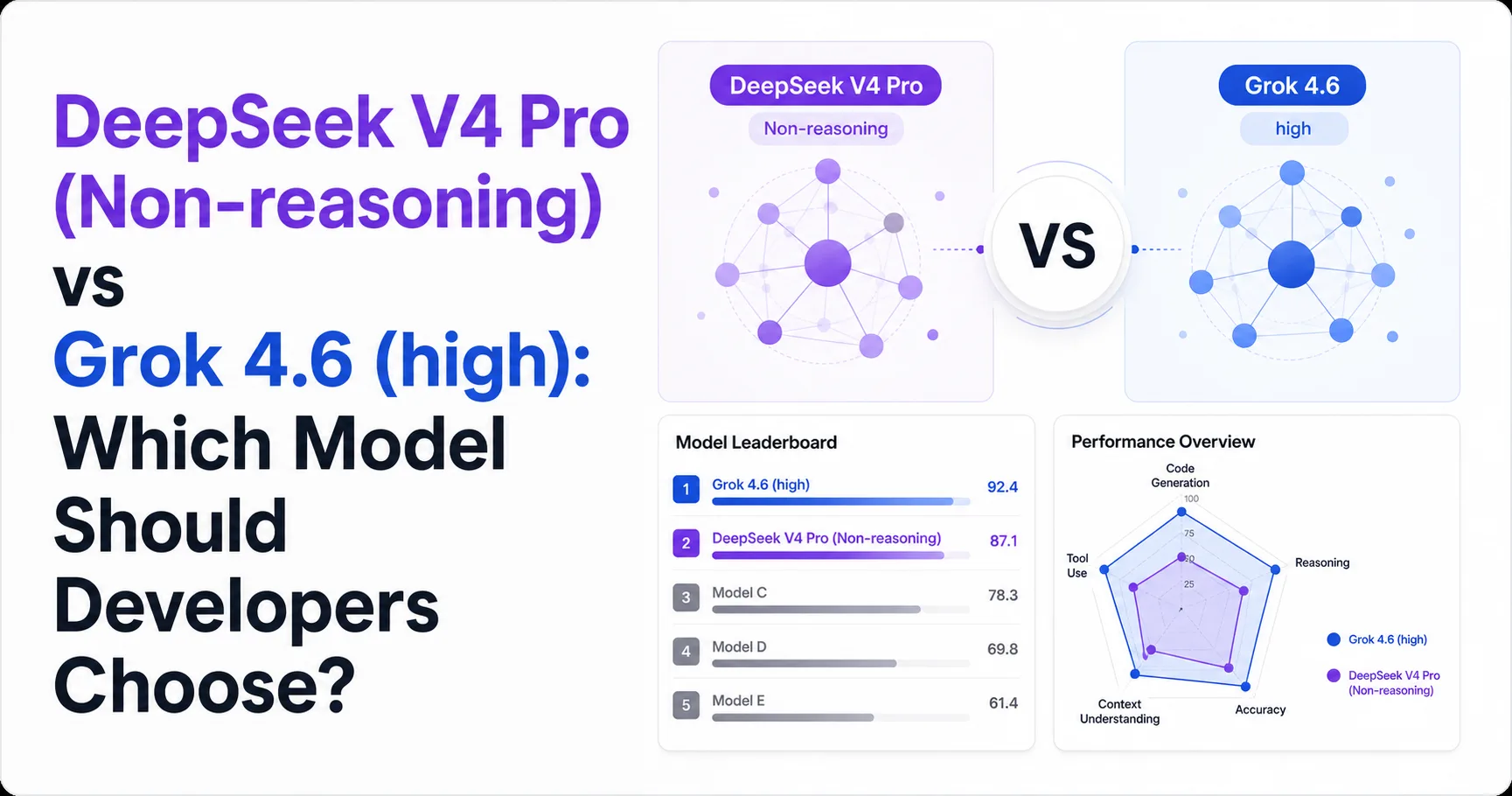
Grok 4.6 (high) is the stronger default for difficult coding and general reasoning, while DeepSeek V4 Pro (Non-reasoning) is the practical choice for latency-sensitive budgets.
The benchmark snapshot gives Grok 4.6 (high) a 60.9 Artificial Analysis Intelligence Index, compared with 31.9 for DeepSeek V4 Pro (Non-reasoning). DeepSeek changes the operational equation with $0.544 blended pricing per 1M tokens and 1.24 seconds latency. Grok costs $3 per 1M blended tokens and reports 49.322 seconds latency.
That contrast should shape the decision. Choose Grok when a harder task is expensive to get wrong, such as an engineering agent that must plan, inspect, and revise. Choose DeepSeek when the product needs quick, frequent responses and can use narrower prompts, deterministic checks, or human review.
The evidence has an important gap. This comparison evaluates a dated DeepSeek version, deepseek-v4-pro-0424-non-reasoning, but current DeepSeek documentation maps the stable deepseek-v4-pro alias to a later 0813 release. DeepSeek's pricing documentation does not confirm whether the exact 0424 identifier remains callable. xAI's model documentation still recommends Grok 4.6 for code and general tasks. Performance and price data are provided by Artificial Analysis.
Grok 4.6 (high) buys more measured capability and a clearer current product position, while DeepSeek V4 Pro (Non-reasoning) buys responsiveness and lower unit cost.
The raw benchmark lead is meaningful, but it is not a blanket promise that Grok will win every production request. Grok leads on the available shared measures, including GPQA, HLE, LCR, and SciCode. It is also the only model here with a reported Artificial Analysis Coding Index, 76.8. That makes Grok the safer starting point for workloads where code quality, multi-step judgment, and recovery from ambiguous instructions matter.
DeepSeek has a different appeal. Its observed latency is 1.24 seconds, which suits autocomplete-like experiences, inline assistance, routing, extraction, and high-frequency application interactions. Its non-reasoning label also matters. A non-reasoning model may fit jobs where the desired result is short, bounded, and easy to validate outside the model.
| Decision factor | Better starting choice | Why it matters |
|---|---|---|
| Difficult coding or broad reasoning | Grok 4.6 (high) | It has the stronger available capability evidence. |
| Interactive latency | DeepSeek V4 Pro (Non-reasoning) | Its 1.24-second latency is far lower in this snapshot. |
| Large-scale token spend | DeepSeek V4 Pro (Non-reasoning) | Its $0.544 blended price is lower than $3. |
| Current documented positioning | Grok 4.6 (high) | xAI currently recommends it for code and general tasks. |
| Exact-version reproducibility | Neither, based on available evidence | Neither brief confirms a dated, pinned production identifier for both sides. |
Version handling is the hidden selection risk. DeepSeek's pricing documentation says the current stable DeepSeek alias points to DeepSeek-V4-Pro-0813, not the 0424 model in this comparison. xAI's model documentation describes grok-4.6 as a stable alias and grok-4.6-latest as a moving series alias, but does not provide a date-stamped Grok 4.6 identifier. If output stability is a product requirement, test the exact API names before committing either model to a critical workflow.
Grok 4.6 (high) is the capability leader in this dataset, but DeepSeek V4 Pro (Non-reasoning) is the model that can make an interface feel immediate.
Grok's 60.9 Intelligence Index versus DeepSeek's 31.9 points toward better results on broad, difficult tasks. Its higher results on the shared knowledge, reasoning, long-context retrieval, and scientific-code measures support the same direction. For an agent that must interpret an unfamiliar repository, choose tools, and produce a correct patch, that pattern matters more than one fast first response.
The performance chart should not be read as a guarantee of end-to-end user wait time. The reported output speeds are close, at 67.375 output tokens per second for Grok and 62.894 for DeepSeek. The much larger difference is latency: 49.322 seconds for Grok versus 1.24 seconds for DeepSeek. A short answer or a UI action may therefore feel much faster with DeepSeek even if generation speed is similar.
This can reverse the apparent winner by task shape. A long, complex request may justify Grok's delay if it avoids repeated corrections, retries, or engineer review. A product that sends many brief requests may find Grok's latency unacceptable even when its final answer is stronger. Conversely, DeepSeek can become slower at the workflow level if lower first-pass quality creates more repair loops.
Evidence is incomplete for a full coding comparison. DeepSeek has no reported Coding Index in the data brief, while Grok has no reported IFBench, Tau2, or TerminalBench Hard result. Do not infer a precise coding margin from non-overlapping tests. Run a representative evaluation using your own repositories, acceptance tests, tool permissions, and response-length limits. The benchmark data are provided by Artificial Analysis, while xAI's model documentation positions Grok 4.6 for coding without publishing official benchmark scores.
DeepSeek V4 Pro (Non-reasoning) is the clear token-cost winner, with $0.544 blended pricing per 1M tokens against $3 for Grok 4.6 (high).
That price gap makes DeepSeek compelling for chat features, classification, summarization, structured extraction, and other workflows where volume is known and correctness can be checked cheaply. Its input and output prices are also lower in the supplied snapshot. For teams that need to serve a large number of short requests, the lower price and lower latency reinforce each other.
The cheaper model is not automatically the lower-cost system. If a difficult task needs several retries, larger prompts, manual review, or a second model to repair mistakes, token savings can disappear. Grok can be economically rational for a narrow set of expensive decisions where a stronger first attempt saves developer time or avoids a failed downstream action.
There is also a pricing-version warning. The supplied DeepSeek prices belong to the compared 0424 snapshot. DeepSeek's pricing documentation lists prices for the current stable alias, which maps to a later 0813 version, and announces different peak and off-peak rates beginning on 2026-08-16. The brief provides Grok prices from the benchmark dataset, but xAI's model documentation does not list a current price. Treat the comparison as a planning signal, then confirm live billing before launch.
The cost chart is useful for token economics, not total ownership cost. Include evaluation time, observability, fallback traffic, cache behavior, tool calls, and human handling when estimating the real budget.
DeepSeek V4 Pro (Non-reasoning) leads on 3 of 3 metrics
Grok 4.6 (high) should be the primary model for high-stakes reasoning work, while DeepSeek V4 Pro (Non-reasoning) should be the primary candidate for fast, cost-sensitive product flows.
Choose Grok first for an internal coding assistant, an agent that makes multi-step decisions, or a workflow where one wrong answer creates costly follow-up work. Its available benchmark advantage is broad, and xAI's model documentation explicitly recommends Grok 4.6 for code and other general tasks. Build a latency expectation into the product, because 49.322 seconds is a poor fit for interactions that users expect to complete instantly.
Choose DeepSeek first for a customer-facing assistant that needs quick acknowledgments, a high-volume extraction pipeline, or a feature with strict token budgets. The 1.24-second latency and $0.544 blended price make a strong operational case. Keep the tasks bounded. Use schemas, validators, retrieval, and business-rule checks instead of asking the model to make unsupported high-impact judgments.
A two-model route can work, but only if complexity justifies its added maintenance. Send straightforward, low-risk tasks to DeepSeek. Escalate only ambiguous, complex, or failed cases to Grok. Measure whether escalation improves accepted outcomes enough to cover the added routing, testing, and monitoring burden.
Do not make either model choice based on assumed context capacity, multimodal support, or token-probability support. The research brief could not verify the exact 0424 DeepSeek context window, output limit, multimodal capability, or API parameters. It also could not verify Grok 4.6's context window, maximum output, specific reasoning controls, or its logprobs status. DeepSeek's pricing documentation documents capabilities for the later stable alias, not necessarily the compared version. xAI's model documentation says Grok needs Web Search or X Search for information after its 2026-02-01 knowledge cutoff. Test these product requirements directly before architecture decisions.
Grok 4.6 (high) and DeepSeek V4 Pro (Non-reasoning) both require a production trial before a final model commitment.
The central uncertainty is not the benchmark direction. Grok has stronger available capability evidence, while DeepSeek has stronger cost and latency evidence. The uncertainty is whether the exact API behavior, version availability, prompt compatibility, and failure patterns match your product.
Before rollout, test fixed prompts against real acceptance criteria. Record pass rate, response time, output length, retries, tool failures, and reviewer edits. Include current facts in the test set if your product depends on them. xAI's model documentation states that Grok 4.6 needs a search tool for facts after 2026-02-01. Also verify whether the exact DeepSeek 0424 identifier is available, because DeepSeek's pricing documentation only confirms the current stable alias points elsewhere.
Grok 4.6 (high) is the better overall choice for difficult coding and general reasoning in this dataset. It leads the available shared capability measures and has a 60.9 Intelligence Index, versus 31.9 for DeepSeek V4 Pro (Non-reasoning).
DeepSeek V4 Pro (Non-reasoning) is cheaper on listed token prices, at $0.544 per 1M blended tokens versus $3 for Grok 4.6 (high). Real application cost can still favor Grok if stronger first-pass results reduce retries, review, and repair work.
DeepSeek V4 Pro (Non-reasoning) is the better starting option for fast interactions because its reported latency is 1.24 seconds, compared with 49.322 seconds for Grok 4.6 (high). Test your own prompts because end-to-end latency also includes networking, tools, and output length.
No, you should not assume current DeepSeek alias documentation applies to the compared 0424 non-reasoning version. The official page documents a stable alias that currently maps to DeepSeek-V4-Pro-0813, so direct API availability and feature compatibility require verification.
No, Grok 4.6 does not know events after its 2026-02-01 knowledge cutoff unless Web Search or X Search is enabled. Applications handling current prices, news, version status, or changing policies should enable search or supply trusted source material.