
Time to First Token · DeepSeek V4 Pro (Non-reasoning)
—
Time to First Token · GPT-5 (high)
—
Deep dive into reasoning, benchmarks, and latency insights.
The current catalog does not contain complete performance evidence for both models, so this page does not declare an overall winner. Use the available fields as comparison signals and validate the models on your own workload.
Key decision metrics at a glance.
| Model | Metric | Value | Unit | Source / snapshot |
|---|---|---|---|---|
| DeepSeek V4 Pro (Non-reasoning) | Reasoning | 6.0 | benchmark or capability score | Artificial Analysis · current catalog |
| GPT-5 (high) | Reasoning | 9.0 | benchmark or capability score | Artificial Analysis · current catalog |
| DeepSeek V4 Pro (Non-reasoning) | Coding | 6.0 | benchmark or capability score | Artificial Analysis · current catalog |
| GPT-5 (high) | Coding | 4.0 | benchmark or capability score | Artificial Analysis · current catalog |
| DeepSeek V4 Pro (Non-reasoning) | Multimodal | 3.0 | benchmark or capability score | Artificial Analysis · current catalog |
| GPT-5 (high) | Multimodal | 3.0 | benchmark or capability score | Artificial Analysis · current catalog |
| DeepSeek V4 Pro (Non-reasoning) | Long Context | 4.0 | benchmark or capability score | Artificial Analysis · current catalog |
| GPT-5 (high) | Long Context | 4.0 | benchmark or capability score | Artificial Analysis · current catalog |
| DeepSeek V4 Pro (Non-reasoning) | Blended Price / 1M tokens | $0.544 | USD per 1M tokens | Artificial Analysis · current catalog |
| GPT-5 (high) | Blended Price / 1M tokens | $3.438 | USD per 1M tokens | Artificial Analysis · current catalog |
| DeepSeek V4 Pro (Non-reasoning) | P95 Latency | — | milliseconds | Artificial Analysis · current catalog |
| GPT-5 (high) | P95 Latency | — | milliseconds | Artificial Analysis · current catalog |
| DeepSeek V4 Pro (Non-reasoning) | Tokens per second | 65.267 | tokens per second | Artificial Analysis · current catalog |
| GPT-5 (high) | Tokens per second | — | tokens per second | Artificial Analysis · current catalog |
Data provided by Artificial Analysis; live values use the current catalog.
This radar chart visually maps the core capabilities (reasoning, coding, math proxy, multimodal, long context) of `DeepSeek V4 Pro (Non-reasoning)` vs `GPT-5 (high)`.
This grouped bar chart provides a side-by-side comparison for each benchmark metric.
Lower time to first token is better; higher tokens per second is better.
Compare input and output pricing in USD per 1M tokens.
DeepSeek V4 Pro (Non-reasoning)$0.652
GPT-5 (high)$3.75
DeepSeek V4 Pro (Non-reasoning) costs $3.098 less per run
This article is a dated snapshot published on 2026-08-07. Live cards above use the current catalog; missing live fields are not inferred.
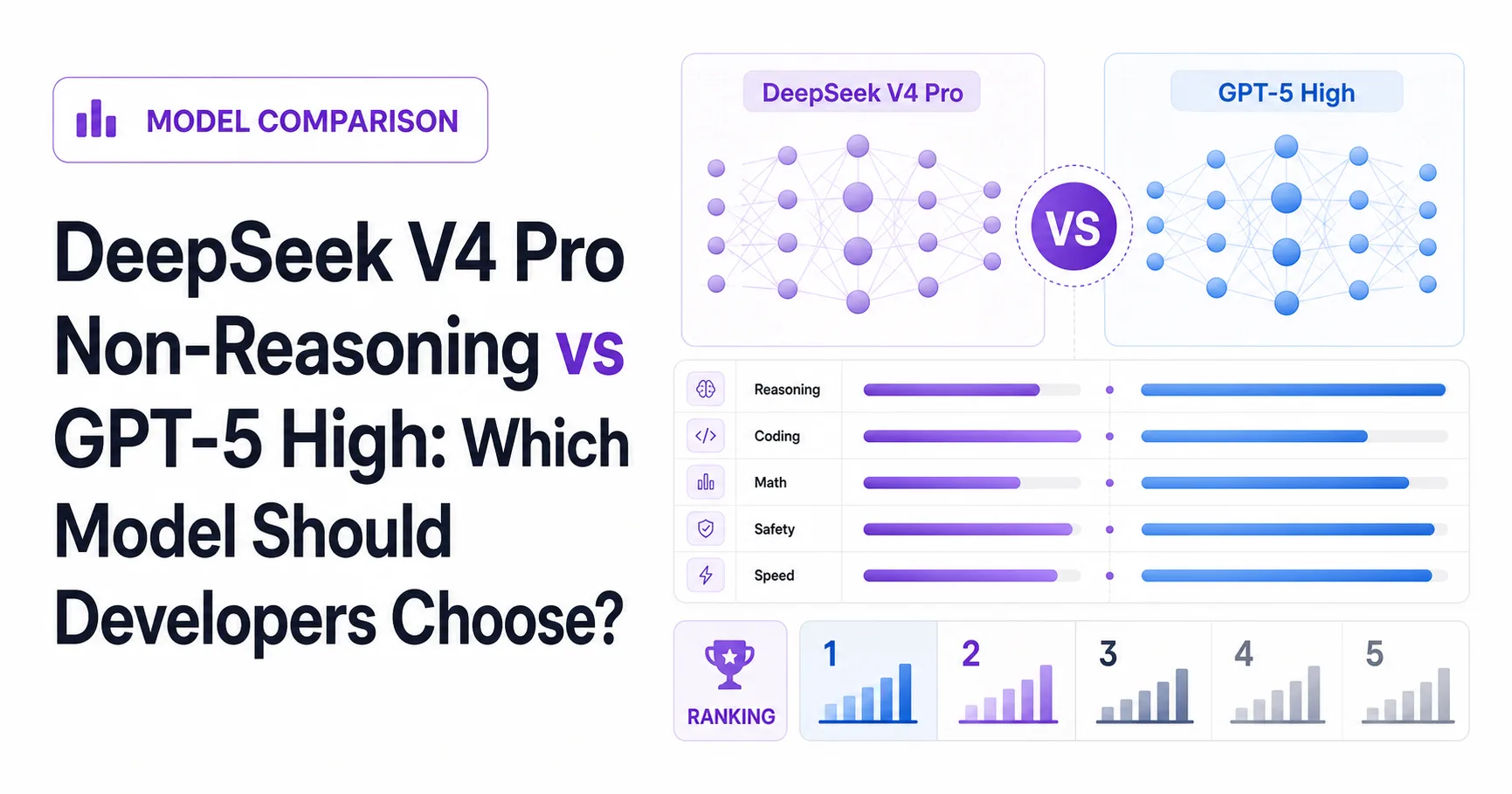
GPT-5 (high) is the safer capability choice, while DeepSeek V4 Pro (Non-reasoning) is the stronger cost and throughput choice. The available data gives GPT-5 (high) an Artificial Analysis Intelligence Index of 34.7, compared with 31.2 for DeepSeek V4 Pro (Non-reasoning), while DeepSeek costs $0.54375 per 1M blended tokens against $3.4375 for GPT-5 (high). Data provided by https://artificialanalysis.ai/
The comparison needs careful interpretation because the models are not represented symmetrically. The data brief reports coding and math scores for GPT-5 (high), but not for DeepSeek V4 Pro (Non-reasoning). It reports output speed for DeepSeek, but not for GPT-5. Therefore, the evidence supports a practical selection decision, not a complete ranking across every developer workload.
DeepSeek’s official API model is deepseek-v4-pro; the non-reasoning label describes its operating mode rather than a separate official model ID. DeepSeek’s model and pricing documentation identifies the supported model and API capabilities. GPT-5 high similarly describes reasoning_effort=high, not a separate gpt-5-high API model. OpenAI’s developer documentation explains that parameter choice.
GPT-5 (high) offers the stronger documented capability profile, while DeepSeek V4 Pro (Non-reasoning) offers the more economical production profile.
GPT-5 (high) leads the shared Artificial Analysis Intelligence Index at 34.7 versus 31.2. The same data brief lists GPT-5 at 37.8 on the Artificial Analysis Coding Index and 94.3 on the Artificial Analysis Math Index. DeepSeek has no corresponding coding or math values in the supplied data, so those dimensions cannot establish a direct head-to-head winner. Data provided by https://artificialanalysis.ai/
The price difference is substantial. DeepSeek’s blended price is $0.54375 per 1M tokens, compared with $3.4375 for GPT-5 (high). DeepSeek also costs less on input and output pricing. That advantage matters most for applications with large request volume, long prompts, repeated retrieval context, or substantial generated text.
API fit may decide the result before benchmark scores do. DeepSeek documents JSON output, tool calls, Anthropic API compatibility, and Chat Prefix Completion Beta. Its FIM Completion Beta is limited to non-reasoning mode. GPT-5 documents structured outputs, function calling, streaming, custom tools, and Responses API support. DeepSeek’s model and pricing documentation and OpenAI’s GPT-5 model documentation describe those interfaces.
The evidence does not establish a reliable community consensus on speed, hallucination patterns, or coding quality for DeepSeek. GPT-5 has anecdotal reports of fast small-bug fixes and weaker completeness in some full-application tasks, but those reports are not controlled tests. The Reddit discussion should inform testing priorities, not replace testing.
GPT-5 (high) has the stronger documented evaluation coverage, but DeepSeek V4 Pro (Non-reasoning) has the only reported output-speed measurement.
The shared intelligence score favors GPT-5 (high), at 34.7 versus 31.2. That lead is useful as a broad signal, but it does not answer whether GPT-5 will produce better patches, tool calls, or repository changes for a particular application. GPT-5 also has reported coding and math scores, while DeepSeek has no supplied values for those indexes. The missing DeepSeek scores create evidence asymmetry, not proof that DeepSeek performs poorly.
DeepSeek’s reported median output speed is 65.267 tokens per second. GPT-5 has no reported value in the data brief, so a speed ranking is unavailable. Latency is tied at 0.3 seconds. In an interactive coding assistant, the missing output-speed value matters because perceived responsiveness depends on token streaming after request latency. In a batch workflow, total completion quality and retry frequency may matter more than first-token experience.
The official positioning also differs. OpenAI presents GPT-5 as a reasoning model for coding, reasoning, and agentic tasks. OpenAI’s developer announcement supports that positioning and documents configurable reasoning effort. DeepSeek exposes reasoning and non-reasoning modes through its model offering, but the supplied official pricing page does not fully explain the switching parameters. DeepSeek’s model and pricing documentation leaves that implementation detail unresolved.
A developer should therefore test representative repository tasks, structured tool calls, long-context edits, and failure recovery. The supplied material does not reveal which model is more reliable on those tasks. GPT-5 community reports mention useful small-scope debugging alongside possible hallucinations or incorrect edits in complex existing codebases, but the Reddit source provides no reproducible measurement.
DeepSeek V4 Pro (Non-reasoning) is materially cheaper, but GPT-5 (high) can still be economically preferable when better first-pass outcomes reduce retries and review work.
DeepSeek’s blended price is $0.54375 per 1M tokens, compared with $3.4375 for GPT-5 (high). DeepSeek also has lower input pricing at $0.435 per 1M tokens versus $1.25, and lower output pricing at $0.87 versus $10. The largest practical difference appears on generated output, especially for agents that produce long patches, explanations, or tool-directed plans.
Price alone does not equal total cost. A lower-priced model becomes less attractive if it requires more retries, larger verification prompts, more human review, or additional routing logic. The supplied materials do not provide retry rates, task success rates, or production error costs for either model. No defensible break-even point can therefore be calculated from the brief.
DeepSeek’s pricing page also warns that API prices may increase substantially in the future. DeepSeek’s model and pricing documentation makes that warning part of the current purchasing risk. GPT-5’s fixed snapshot is marked Deprecated, while the gpt-5 alias remains documented as callable. OpenAI’s model documentation makes version planning a separate cost concern, because migration work can affect engineering budgets even when token prices are known.
Caching can change the economics of repeated prompts, but the data brief supplies only the blended, input, and output prices used for this comparison. Developers should measure prompt reuse, generated-token volume, retries, and human review in a pilot. DeepSeek is the clear token-price choice. GPT-5 may be the lower total-cost choice for high-value tasks where correctness and completion quality dominate raw token spend.
DeepSeek V4 Pro (Non-reasoning) leads on 3 of 3 metrics
DeepSeek V4 Pro (Non-reasoning) is the default pick for cost-sensitive throughput, while GPT-5 (high) is the default pick for capability-sensitive development workflows.
Choose DeepSeek when the application generates large volumes of text, needs fast streamed output, or must keep output spending predictable at scale. Its reported 65.267 median output tokens per second and $0.87 output price per 1M tokens support that use case. DeepSeek also documents JSON output, tool calls, and Anthropic API compatibility. DeepSeek’s model and pricing documentation supports the API fit, although the supplied material does not confirm how well its tool calls perform in production.
Choose GPT-5 when coding quality, mathematical reasoning, agentic behavior, or mature endpoint coverage matters more than token price. GPT-5 has the higher shared intelligence score, reported coding and math scores, configurable reasoning effort, structured outputs, function calling, streaming, custom tools, and Responses API support. OpenAI’s developer documentation and GPT-5’s model documentation provide the relevant official evidence.
Do not select either model solely from the label in the comparison. DeepSeek V4 Pro Non-reasoning maps to the official deepseek-v4-pro model, while GPT-5 high maps to a reasoning parameter on gpt-5. The official DeepSeek page previously described Responses API support as pending, and the supplied research does not verify whether that rollout is complete. GPT-5’s fixed snapshot is Deprecated, even though the alias remains listed. Those version conditions should be tested in the exact endpoint and SDK combination you plan to ship.
A sensible deployment strategy is workload routing. Use DeepSeek for high-volume routine generation and GPT-5 for difficult coding, math, or agent steps, provided your evaluation shows the routing overhead is justified. The evidence is insufficient to claim that this split will outperform a single-model design without task-level measurements.
DeepSeek V4 Pro (Non-reasoning) deserves a pilot when price and output throughput are central selection criteria.
The supplied evidence does not answer every production question. It lacks a direct DeepSeek coding score, a GPT-5 output-speed value, controlled hallucination testing, and reliable community consensus for DeepSeek. Treat the following answers as decision guidance tied to the available evidence, not as substitutes for an application-specific evaluation.
GPT-5 (high) is the better-supported coding choice because the data brief reports an Artificial Analysis Coding Index of 37.8, while no comparable DeepSeek coding value is supplied. That missing value prevents a complete direct ranking.
DeepSeek V4 Pro (Non-reasoning) is cheaper at $0.54375 per 1M blended tokens versus $3.4375 for GPT-5 (high). Total cost can still change if DeepSeek requires more retries, review, or corrective calls.
DeepSeek V4 Pro (Non-reasoning) has the only reported output-speed value, at 65.267 median output tokens per second. Latency is tied at 0.3 seconds, so the available evidence cannot establish a complete speed winner.
GPT-5 high is not a separate documented API model ID; it describes gpt-5 used with reasoning_effort=high. OpenAI’s developer documentation and model documentation support that interpretation.
Developers should verify version status before depending on a fixed snapshot. OpenAI marks gpt-5-2025-08-07 as Deprecated, while DeepSeek’s supplied material warns that pricing may change and leaves some rollout status unresolved.