
Time to First Token · DeepSeek V4 Pro 0813 (Reasoning, Max Effort)
1043ms
Time to First Token · GPT-5.6 Terra (max)
109872ms
Deep dive into reasoning, benchmarks, and latency insights.
The current catalog does not contain complete performance evidence for both models, so this page does not declare an overall winner. Use the available fields as comparison signals and validate the models on your own workload.
Key decision metrics at a glance.
| Model | Metric | Value | Unit | Source / snapshot |
|---|---|---|---|---|
| DeepSeek V4 Pro 0813 (Reasoning, Max Effort) | Reasoning | 6.0 | benchmark or capability score | Artificial Analysis · current catalog |
| GPT-5.6 Terra (max) | Reasoning | 6.0 | benchmark or capability score | Artificial Analysis · current catalog |
| DeepSeek V4 Pro 0813 (Reasoning, Max Effort) | Coding | 7.0 | benchmark or capability score | Artificial Analysis · current catalog |
| GPT-5.6 Terra (max) | Coding | 8.0 | benchmark or capability score | Artificial Analysis · current catalog |
| DeepSeek V4 Pro 0813 (Reasoning, Max Effort) | Multimodal | 4.0 | benchmark or capability score | Artificial Analysis · current catalog |
| GPT-5.6 Terra (max) | Multimodal | 5.0 | benchmark or capability score | Artificial Analysis · current catalog |
| DeepSeek V4 Pro 0813 (Reasoning, Max Effort) | Long Context | 7.0 | benchmark or capability score | Artificial Analysis · current catalog |
| GPT-5.6 Terra (max) | Long Context | 7.0 | benchmark or capability score | Artificial Analysis · current catalog |
| DeepSeek V4 Pro 0813 (Reasoning, Max Effort) | Blended Price / 1M tokens | $1.98 | USD per 1M tokens | Artificial Analysis · current catalog |
| GPT-5.6 Terra (max) | Blended Price / 1M tokens | $4.5 | USD per 1M tokens | Artificial Analysis · current catalog |
| DeepSeek V4 Pro 0813 (Reasoning, Max Effort) | P95 Latency | — | milliseconds | Artificial Analysis · current catalog |
| GPT-5.6 Terra (max) | P95 Latency | — | milliseconds | Artificial Analysis · current catalog |
| DeepSeek V4 Pro 0813 (Reasoning, Max Effort) | Tokens per second | 75.255 | tokens per second | Artificial Analysis · current catalog |
| GPT-5.6 Terra (max) | Tokens per second | 117.141 | tokens per second | Artificial Analysis · current catalog |
Data provided by Artificial Analysis; live values use the current catalog.
This radar chart visually maps the core capabilities (reasoning, coding, math proxy, multimodal, long context) of `DeepSeek V4 Pro 0813 (Reasoning, Max Effort)` vs `GPT-5.6 Terra (max)`.
This grouped bar chart provides a side-by-side comparison for each benchmark metric.
Lower time to first token is better; higher tokens per second is better.
Compare input and output pricing in USD per 1M tokens.
DeepSeek V4 Pro 0813 (Reasoning, Max Effort)$2.31
GPT-5.6 Terra (max)$5
DeepSeek V4 Pro 0813 (Reasoning, Max Effort) costs $2.69 less per run
This article is a dated snapshot published on 2026-08-13. Live cards above use the current catalog; missing live fields are not inferred.
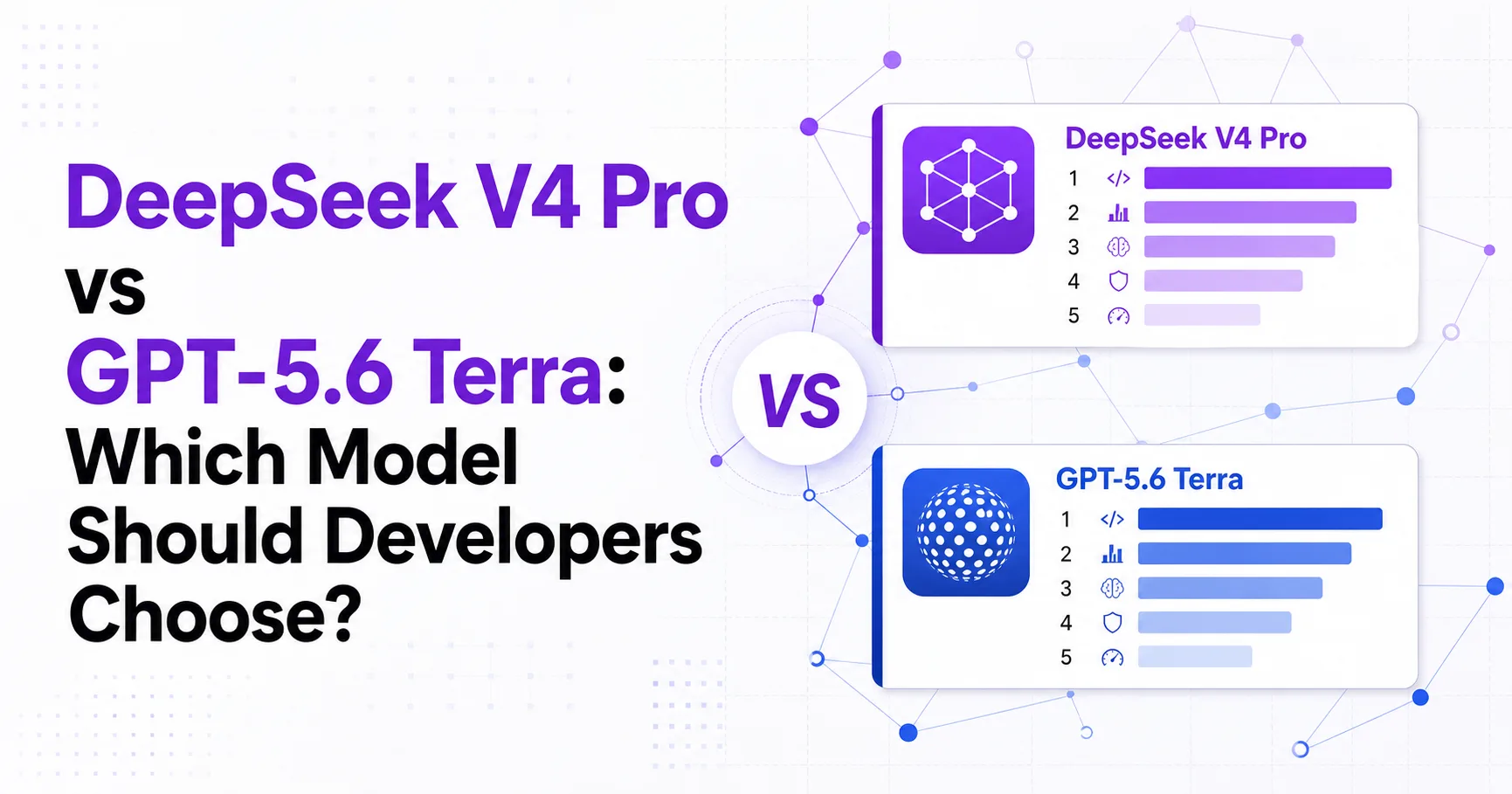
GPT-5.6 Terra is the stronger default for developers who value coding reliability, tool access, and faster token generation, while DeepSeek V4 Pro is the clear cost choice. The independent comparison from Artificial Analysis gives GPT-5.6 Terra a 76.7 coding index and 56.6 intelligence index, compared with 68.8 and 53 for DeepSeek V4 Pro. DeepSeek still matters because its blended price is $0.544 per 1M tokens, versus $4.5 for Terra. That price gap changes the answer for batch workloads, high-volume classification, and applications where a small quality difference is acceptable. The evidence has an important limit: neither vendor publishes a dedicated benchmark report for these exact configurations, and public developer discussions for either precise model identifier were not reliably found. Treat the scores as directional evidence, then validate the workflows that matter to your product.
GPT-5.6 Terra wins the quality-and-capability decision, while DeepSeek V4 Pro wins the economics decision. Artificial Analysis reports Terra ahead on coding, intelligence, HLE, LCR, SciCode, TerminalBench v2.1, and tau banking. DeepSeek leads narrowly on GPQA at 0.928 versus 0.925, so the comparison is not a universal sweep. Terra also produces output at 108.749 median tokens per second, while DeepSeek reaches 67.102. DeepSeek has much lower measured latency at 30.851 seconds, compared with 196.311 seconds for Terra, which may matter more than generation speed in interactive systems. Official documentation adds a second layer of difference. DeepSeek pricing documentation lists JSON output, tool calling, Responses API support, Anthropic API support, and a beta chat-prefix completion mode. GPT-5.6 Terra model documentation lists text and image input, structured output, function calling, file search, web search, prompt caching, and a wider hosted-tool ecosystem. Developers should therefore choose by workload shape, not by one headline score.
GPT-5.6 Terra delivers the stronger coding profile, but DeepSeek V4 Pro can feel more responsive because its measured latency is far lower. Terra's coding index is 76.7 versus DeepSeek's 68.8, a gap large enough to justify preference for repository changes, multi-file debugging, and tasks where fewer correction cycles matter. Terra also leads on the intelligence index, 56.6 versus 53, and on SciCode, 0.539 versus 0.492. Those results suggest a broader advantage on structured technical reasoning, although they do not prove success on your own codebase. Artificial Analysis also shows Terra at 0.880149812734082 on TerminalBench v2.1, ahead of DeepSeek at 0.786516853932584. That difference is especially relevant for agents operating terminals, because tool-use mistakes can cost more than a single failed answer. DeepSeek's 0.928 GPQA score edges Terra's 0.925, showing that narrower knowledge-intensive questions may not favor the more expensive model. Terra's 108.749 median output tokens per second is higher, yet its 196.311-second latency is much longer than DeepSeek's 30.851 seconds. A streaming interface may benefit from Terra's generation rate, while a synchronous API endpoint may favor DeepSeek's shorter wait. Officially, DeepSeek documentation does not provide model-specific benchmark results, and OpenAI's Terra documentation does not publish a Terra-only benchmark report or latency guarantee. Evidence is therefore strong enough for directional routing, but insufficient for a universal performance claim.
GPT-5.6 Terra (max) leads on 2 of 2 metrics
DeepSeek V4 Pro is dramatically cheaper per token, so Terra needs to save enough engineering or review time to justify its price. The blended comparison price is $0.544 for DeepSeek and $4.5 for Terra per 1M tokens, while output pricing is $0.87 versus $12. A high-volume product that generates short answers, runs offline evaluations, or processes repetitive records will usually feel this difference immediately. The cheaper model can become expensive in practice when weaker coding performance creates retries, manual review, or extra orchestration calls. Terra's higher coding index may reduce those hidden costs for production agents that edit files, run tests, and recover from tool errors. The reverse is also possible. If your workload is latency-sensitive and DeepSeek completes requests in 30.851 seconds instead of Terra's 196.311, paying for Terra's faster token generation may not improve user-perceived completion time. DeepSeek pricing documentation also warns that future API prices may rise substantially, so its current price should not be treated as a permanent contract. OpenAI pricing documentation describes multiple processing modes and context-based rates for Terra, which makes budgeting more involved than the single blended figure suggests. The data brief does not provide a request mix, retry rate, cache hit rate, or human-review cost, so no total-cost winner can be proven for a specific application.
DeepSeek V4 Pro 0813 (Reasoning, Max Effort) leads on 3 of 3 metrics
GPT-5.6 Terra is the safer primary model for tool-using coding agents, while DeepSeek V4 Pro is the better economic default for high-volume, lower-risk automation. Choose Terra when the model must inspect files, call tools, use web or file search, accept image inputs, or perform multi-step repository work. GPT-5.6 Terra documentation documents those interfaces and tools directly. Choose DeepSeek when token spend dominates the business case, requests can tolerate fallback handling, and your team can enforce queues around its official concurrency limit of 500. DeepSeek pricing documentation documents that limit and notes that FIM completion works only outside thinking mode. A practical routing policy is to send routine extraction, summarization, and first-pass code suggestions to DeepSeek, then escalate uncertain or tool-heavy cases to Terra. That policy should be tested against your own acceptance criteria because public evidence does not establish either model's real-world failure rate, response consistency, or developer preference. Pin the exact model IDs, log retries and review edits, and recheck pricing before committing to a long-lived architecture.
DeepSeek V4 Pro offers simpler price economics, while GPT-5.6 Terra offers a broader documented integration surface. DeepSeek pricing documentation lists OpenAI-format and Anthropic-format API entry points, JSON output, tool calling, and a beta chat-prefix completion feature. The same page states that FIM completion is unavailable in thinking mode, which creates a direct constraint for editor-style completion pipelines. GPT-5.6 Terra documentation describes Responses, Chat Completions, and Batch APIs, plus structured outputs, function calling, file search, web search, image input, and hosted tools. OpenAI reasoning guidance explains that reasoning tokens consume the output budget and that an overly low max-output setting can produce incomplete responses before visible text appears. Terra's official model ID is gpt-5.6-terra, and the OpenAI changelog identifies its release in the GPT-5.6 family. OpenAI deprecations does not list Terra as deprecated. These are documented product facts, not proof that one SDK will require less maintenance in your environment.
DeepSeek V4 Pro is the lower-risk financial experiment, while GPT-5.6 Terra is the broader capability experiment. Start by defining which failure costs more: extra tokens, a delayed response, a wrong code change, or missing tool access. Then run the same prompt set through both models with fixed acceptance tests. The comparison data can identify likely strengths, but it cannot supply your application's retry behavior, cache pattern, or review burden. Keep those measurements separate from vendor claims, because DeepSeek documentation and OpenAI reasoning guidance describe different operational constraints.
GPT-5.6 Terra is the better starting point for an autonomous coding agent because it has the higher 76.7 coding index, stronger TerminalBench v2.1 result, and broader documented tool support. DeepSeek V4 Pro remains attractive when budget limits dominate, but its lower coding score and official concurrency limit of 500 make additional testing and queueing important before production.
DeepSeek V4 Pro is cheaper on listed token prices, at $0.544 blended tokens and $0.87 output tokens per 1M, but production cost also includes retries, review work, and orchestration. The data brief does not provide those rates, so it cannot prove DeepSeek remains cheaper for your complete workflow.
GPT-5.6 Terra generates tokens faster at 108.749 median output tokens per second, while DeepSeek V4 Pro has lower measured latency at 30.851 seconds. Generation speed describes output flow after processing begins, whereas latency captures waiting time, so interactive systems may experience the two metrics differently.
GPT-5.6 Terra is the safer documented choice when long-context requests need predictable reasoning controls, but neither model has a directly comparable context value in the data brief. Terra also applies higher pricing after 272K input tokens, while DeepSeek documents a large context and 384K maximum output without fully explaining every account-level limit.
No, public community evidence is insufficient for either exact model identifier. The research brief found no reliably verifiable Reddit, Hacker News, or X discussions that establish coding experience, response speed, or recurring model quirks, so developer testing should carry more weight than informal reputation.